
RobustRLlib: A Unified Library and Benchmark for Robust Reinforcement Learning Algorithms
Xi Chen, Fengqi Hu, Zeyu Shen, Jiaying Xu, Shangding Gu, Pan Xu, Anqi Liu, Laixi Shi · N/A · 2026
Framework
N/A
License
N/A
Stars
N/A
Summary
Robust reinforcement learning (RL) is critical for reliable real-world deployment, where policies may fail under diverse shifts and disruptions.
Abstract Summary
Key Points
- Robust reinforcement learning (RL) is critical for reliable real-world deployment, where policies may fail under diverse shifts and disruptions.
- Existing robust RL algorithms offer a rich set of mechanisms and principles, yet two major barriers limit their broader potential: limited algorithm reusability and an unclear empirical capability boundary.
- We introduce RobustRLlib, an algorithm-centric library and benchmark that addresses both challenges
- It integrates 17 representative robust online, offline, and safe RL algorithms under a unified interface for substantially improved reusability, together with an enhanced evaluation platform spanning diverse real-world shifts and advanced humanoid and vision-language-action tasks.
- Systematic evaluation over 273 perturbation configurations provides an up-to-date capability map of current robust RL algorithms, revealing where they remain effective and where substantial robustness gaps persist.
RobustRLlib : An Algorithm-Centric Robust RL Benchmark
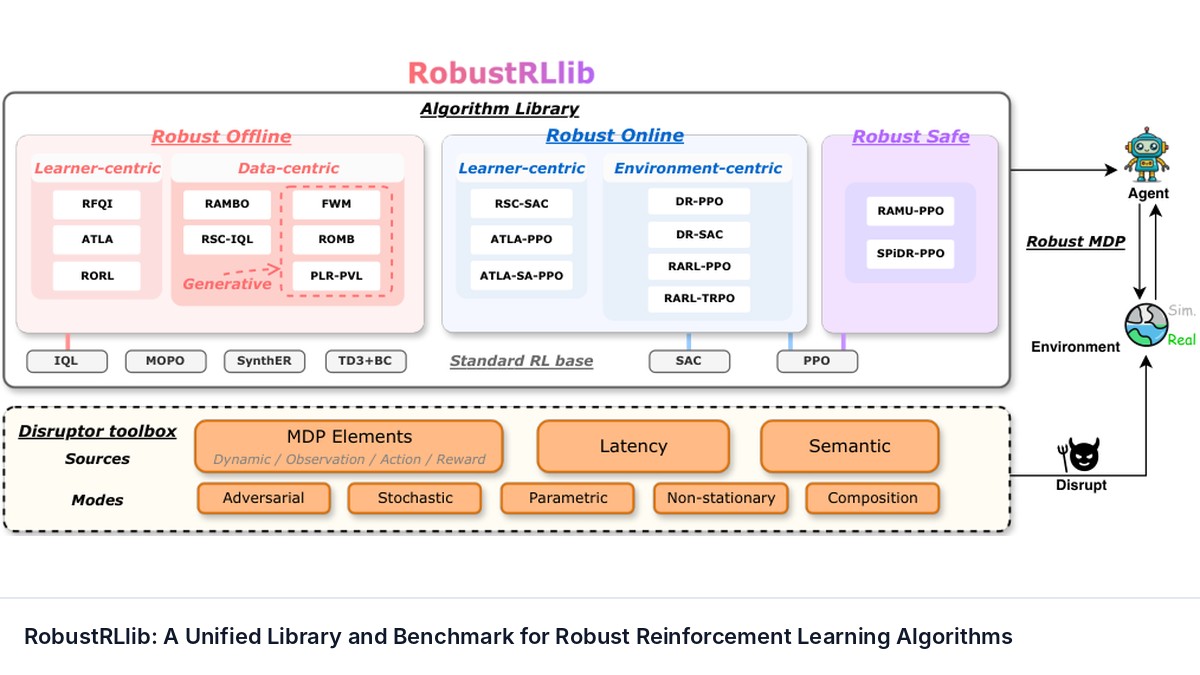
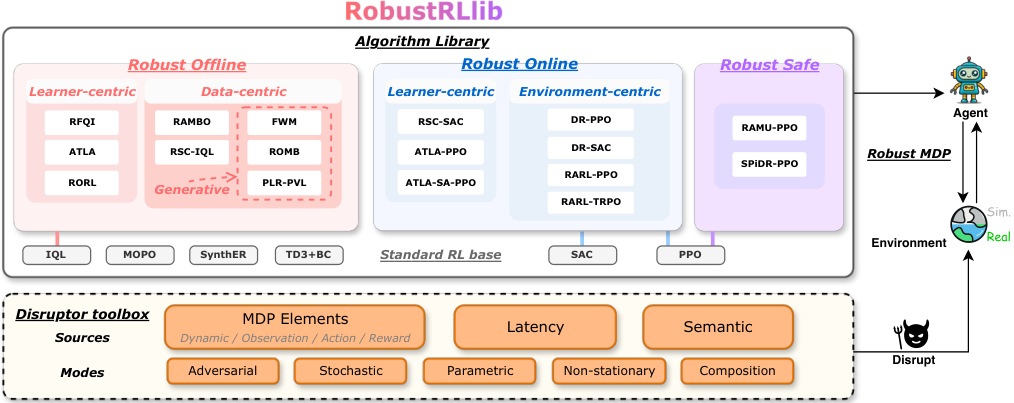
RobustRLlib is organized around algorithm attribution : it records how a robust RL method changes learning, which shift the method claims to address, and which base algorithm realizes the method. The disruptor toolbox then instantiates the claimed target shift independently of the base learner, while the evaluation platform measures both common robustness and method-specific specialization.
Experimental Evaluation
The evaluation proceeds in three blocks over our library. Section 4.1 measures how much robust methods gain across the whole library and how that gain behaves as the shifts intensify. Section 4.2 isolates each shift source and composes them, to ask which shift source a method actually defends. Section 4.3 carries the same interface to deployment-oriented humanoid and vision–language–action (VLA) systems.
The library implements 23 algorithms: 6 standard RL references, 15 robust RL and 2 robust safe RL algorithms.
Sources and Demonstrations
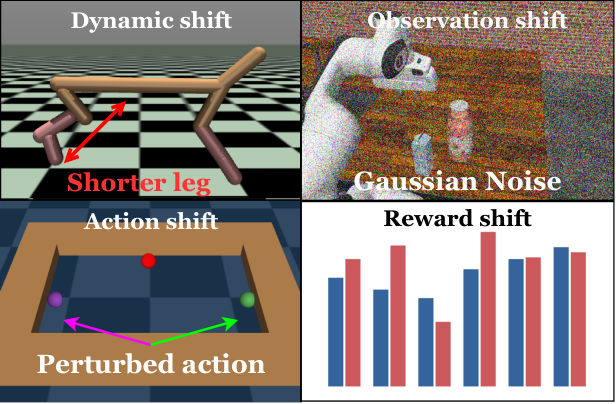
Figures are reproduced from Chen et al. See the full paper for experimental details and the project page, when the paper links one, for demonstrations and videos.
Related Papers

A Sim-to-Real Integration Pipeline for Training and Deployment of Chunk-Based VLA Manipulation Policies
Mathilde Kappel, Clémence Grislain, Mohamed Chetouani et al.
Vision-Language-Action (VLA) models have become a prominent paradigm for mapping multimodal inputs, including semantic instructions, visual observations of the scene, and proprioceptive observations, to robot actions.
Beyond Reconstruction: What Matters in Action Tokenization for Robot Policies?
Haoran Chen, Jingtian Ji, Samuel Wheeler et al.
Autoregressive action-token policies such as vision-language-action models require action tokenizers to translate discrete token sequences into precise control actions in continuous space. Many action tokenizers learn the mapping between tokens and actions via a reconstruction objective.

Capability-Aware Arbitration for Semantic Intent-Based Shared Control
Zhaoda Du, Michael Bowman, Xiaoli Zhang
Shared control often allocates robot authority based on confidence in inferred human intent, assuming reliable autonomous execution. When this assumption fails, high intent confidence can cause over-helping.
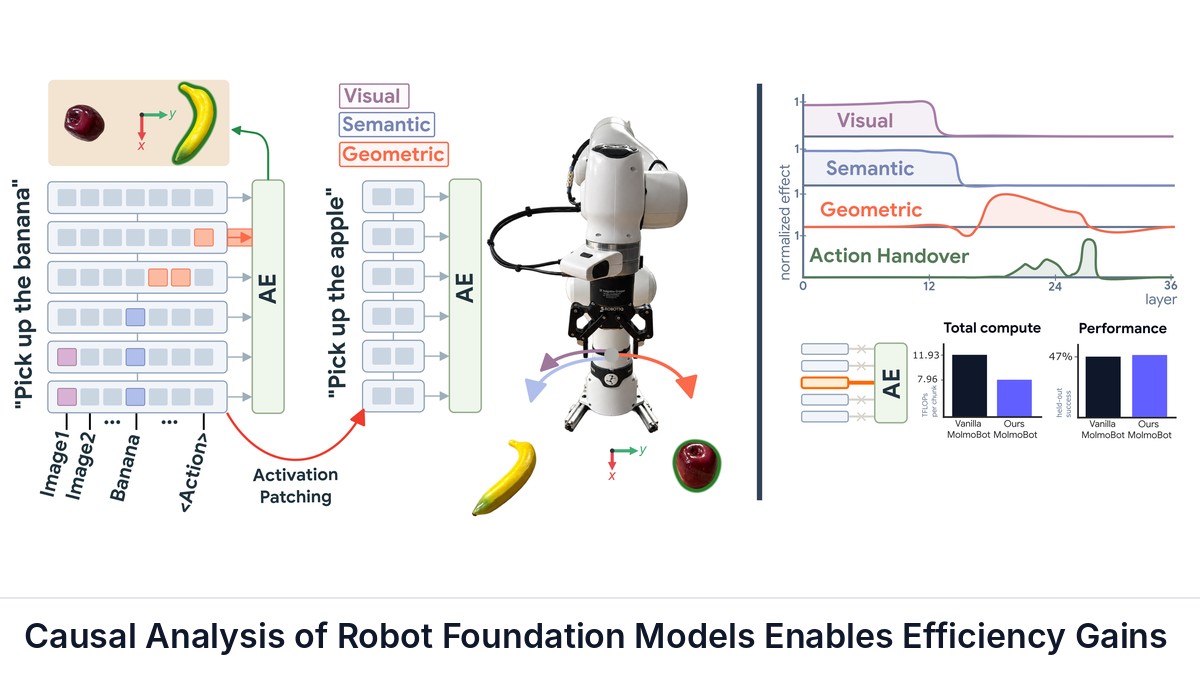
Causal Analysis of Robot Foundation Models Enables Efficiency Gains
Aiden Swann, Mathilde Papillon, Mozes Jacobs et al.
Vision-language-action (VLA) models are a promising approach to general purpose robot manipulation.