
SWIM: Vision-Language-Grounded Soft Whole-Body Interactive Manipulation
Tingcong Liu, Aye Phyu Phyu Aung, Junjie Xiong, Siyi Ma, Bo An, Ke Wu, Senthilnath Jayavelu · N/A · 2026
Framework
N/A
License
N/A
Stars
N/A
Summary
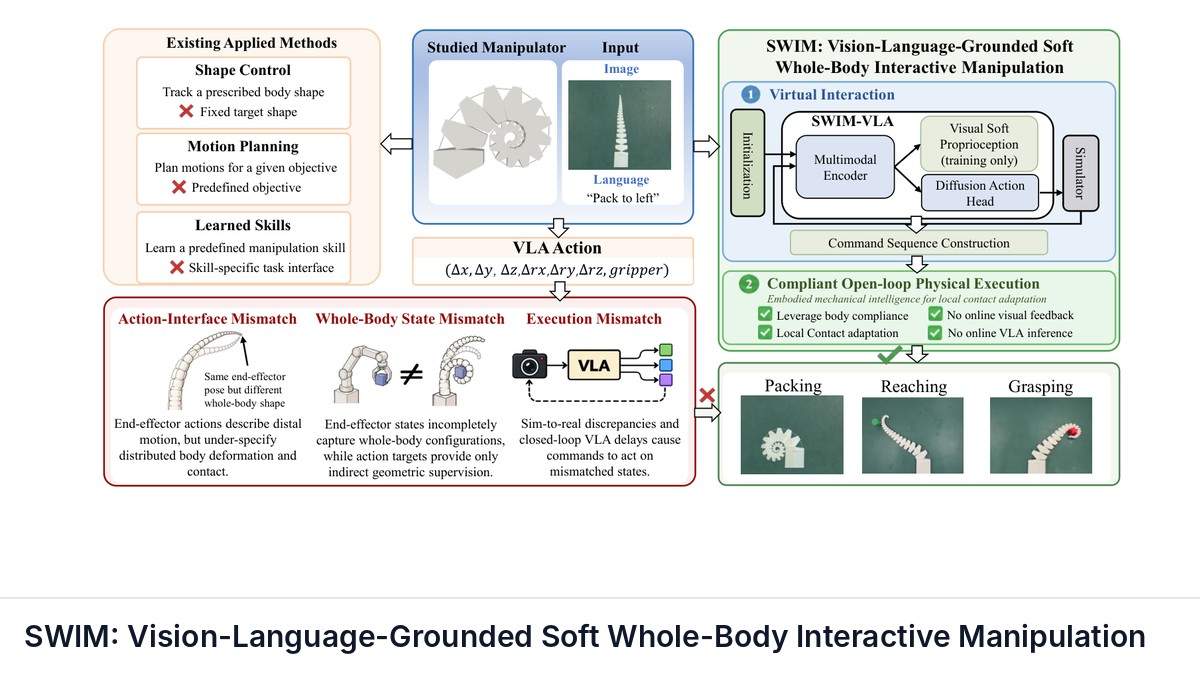
Soft and continuum robots enable manipulation through distributed body deformation and contact, yet translating language and visual context into executable whole-body actuation remains a fundamental challenge.
Abstract Summary
Key Points
- Soft and continuum robots enable manipulation through distributed body deformation and contact, yet translating language and visual context into executable whole-body actuation remains a fundamental challenge.
- We present SWIM, a framework that maps an initial RGB observation and a language instruction to a complete actuation-command sequence.
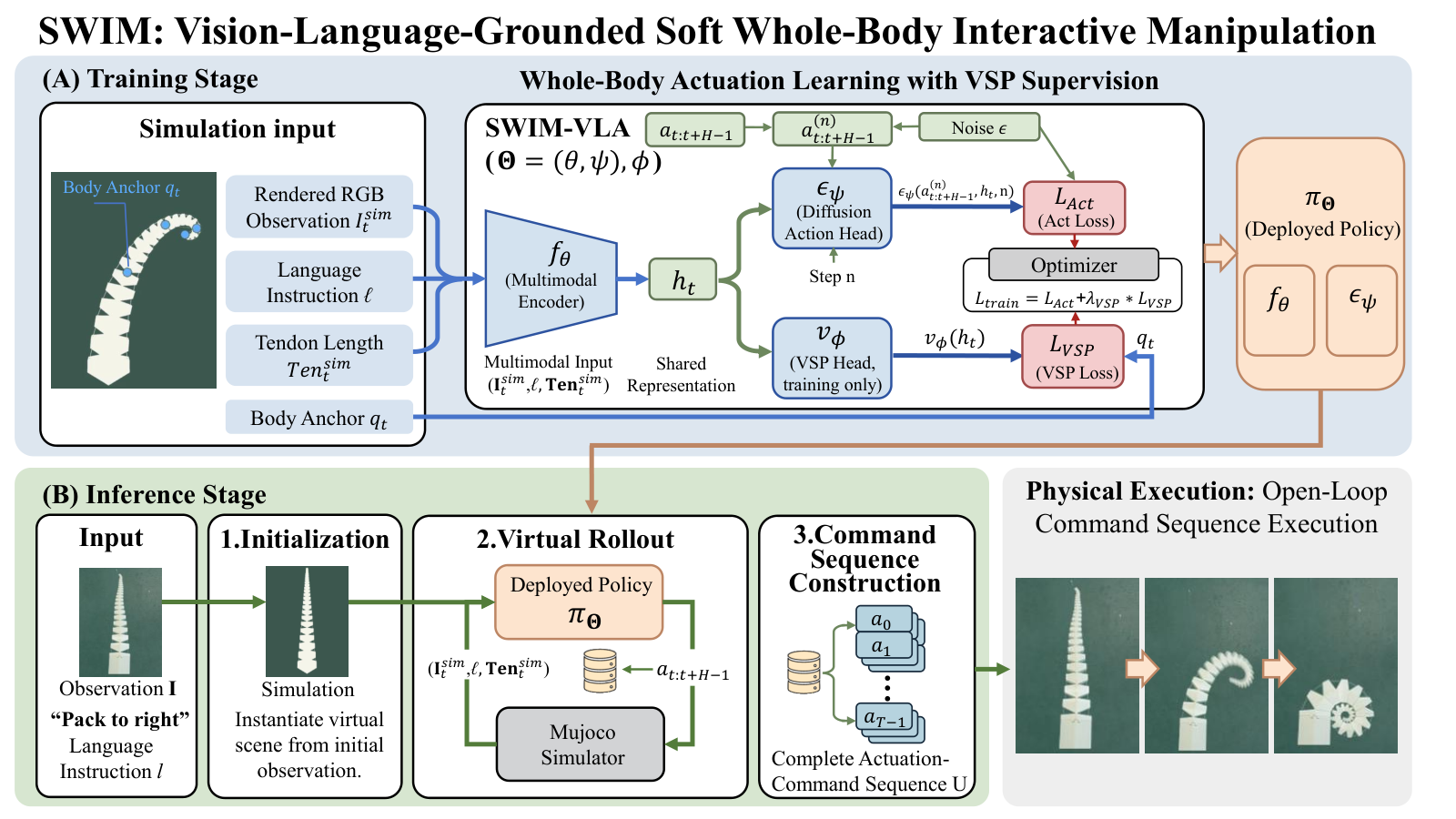
- Its vision-language-action (VLA) policy, SWIM-VLA, combines a diffusion action head with Visual Soft Proprioception (VSP) through a shared representation of RGB observations, language instructions, and tendon states.
- The diffusion head models conditional distributions of expert command chunks, while VSP supervises ordered body-anchor predictions using simulation ground truth, encouraging the representation to retain body geometry when learning from limited demonstrations.
- Embodied mechanical intelligence supports physical execution of command sequences generated through iterative virtual rollout from evolving simulated observations, with intrinsic compliance providing local contact adaptation without online policy queries.
Problem Statement
We study vision-language-grounded whole-body manipulation for soft robots. A task is specified by an initial RGB observation $\mathbf{I}$ of the robot and task scene, together with a language instruction $\ell$.
The desired output is a complete actuation-command sequence where $T$ is the number of command steps in the complete sequence, $N_{a}$ is the number of independently controlled actuation channels, and $\mathbf{a}_{t}\in\mathbb{R}^{N_{a}}$ is the command vector at step $t$.
Method
SWIM maps an initial RGB observation $\mathbf{I}$ and language instruction $\ell$ to a complete actuation-command sequence $\mathbf{U}$. As illustrated in Fig. 2 , the framework consists of two stages. During training, SWIM-VLA learns to predict command chunks through a diffusion action head from simulated whole-body interaction trajectories with VSP supervision.
During inference, SWIM uses the trained policy to construct $\mathbf{U}$ through virtual rollout, and the resulting sequence is executed open-loop on the physical robot.
Experimental Validation
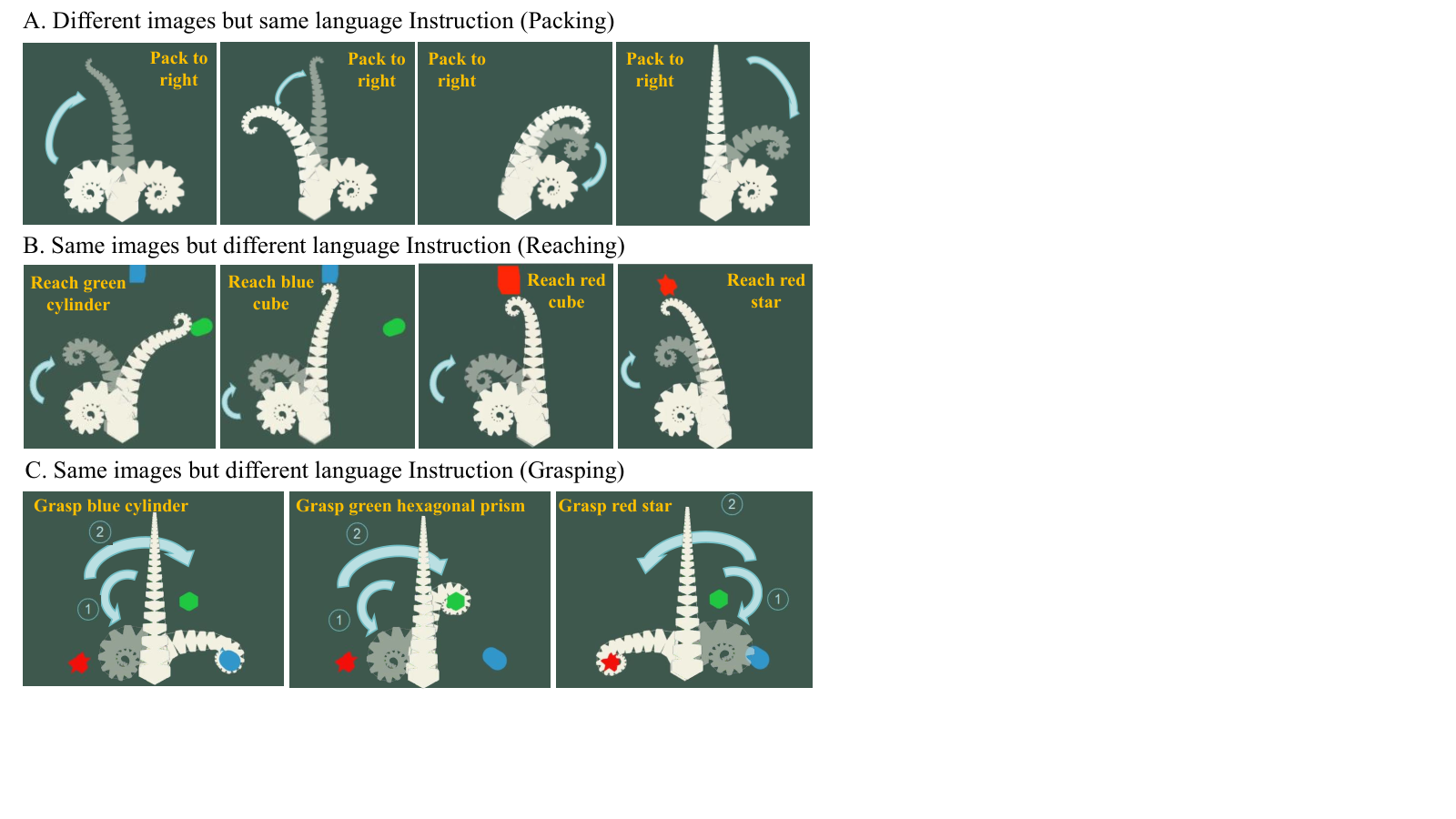
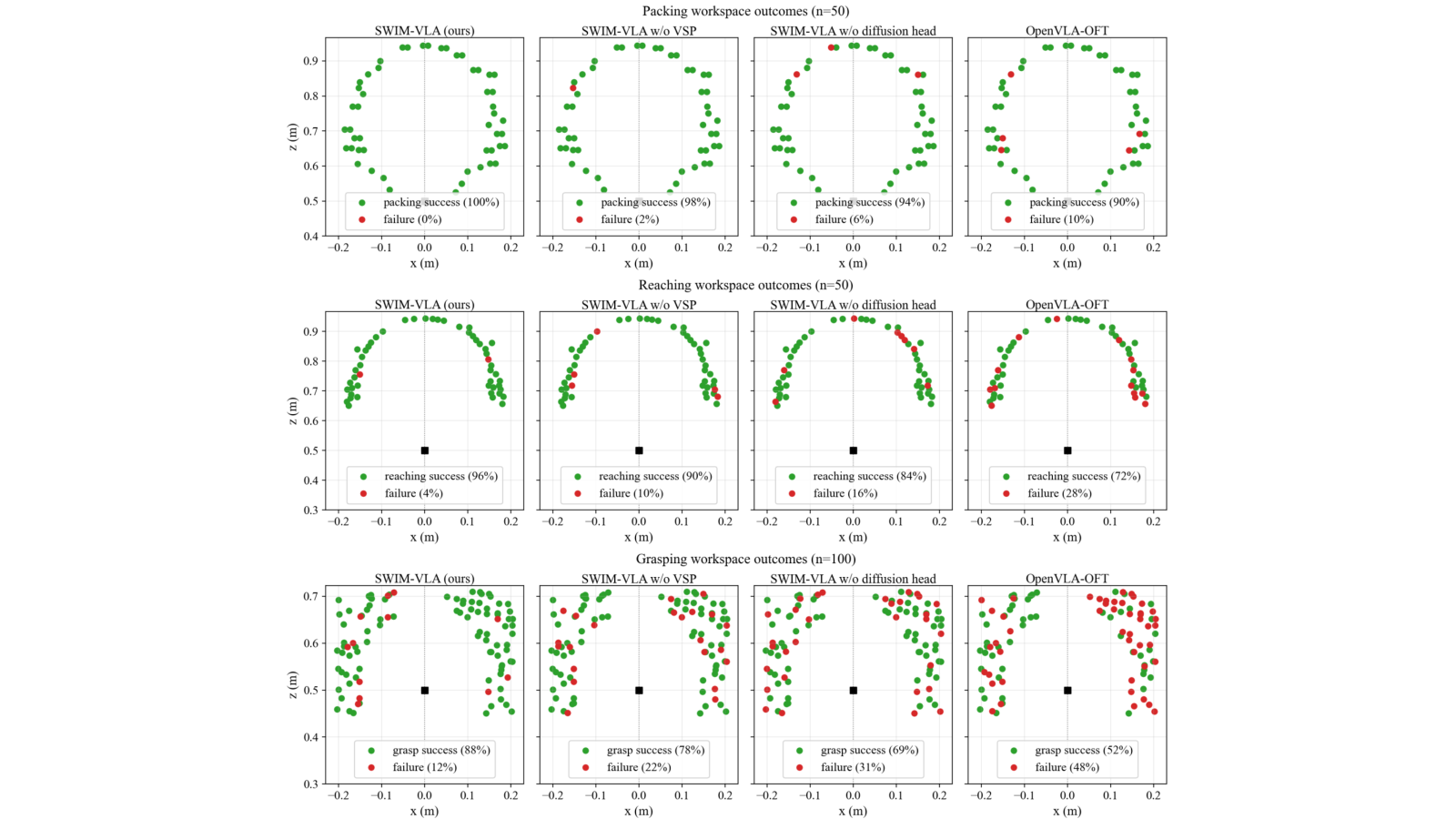
We evaluate the proposed framework from two aspects: (1) In simulation , we evaluate SWIM-VLA on packing, reaching, and grasping tasks, together with controlled ablations of VSP and the diffusion action head; (2) In physical deployment , we evaluate SWIM by comparing its virtual-rollout-based command-sequence execution with the direct online execution of the same trained SWIM-VLA policy.
Experiments are conducted using the SpiRob platform described in Sec. II-B .
Sources and Demonstrations
Figures are reproduced from Liu et al. See the full paper for experimental details and the project page, when the paper links one, for demonstrations and videos.
Related Papers

A Sim-to-Real Integration Pipeline for Training and Deployment of Chunk-Based VLA Manipulation Policies
Mathilde Kappel, Clémence Grislain, Mohamed Chetouani et al.
Vision-Language-Action (VLA) models have become a prominent paradigm for mapping multimodal inputs, including semantic instructions, visual observations of the scene, and proprioceptive observations, to robot actions.

Capability-Aware Arbitration for Semantic Intent-Based Shared Control
Zhaoda Du, Michael Bowman, Xiaoli Zhang
Shared control often allocates robot authority based on confidence in inferred human intent, assuming reliable autonomous execution. When this assumption fails, high intent confidence can cause over-helping.
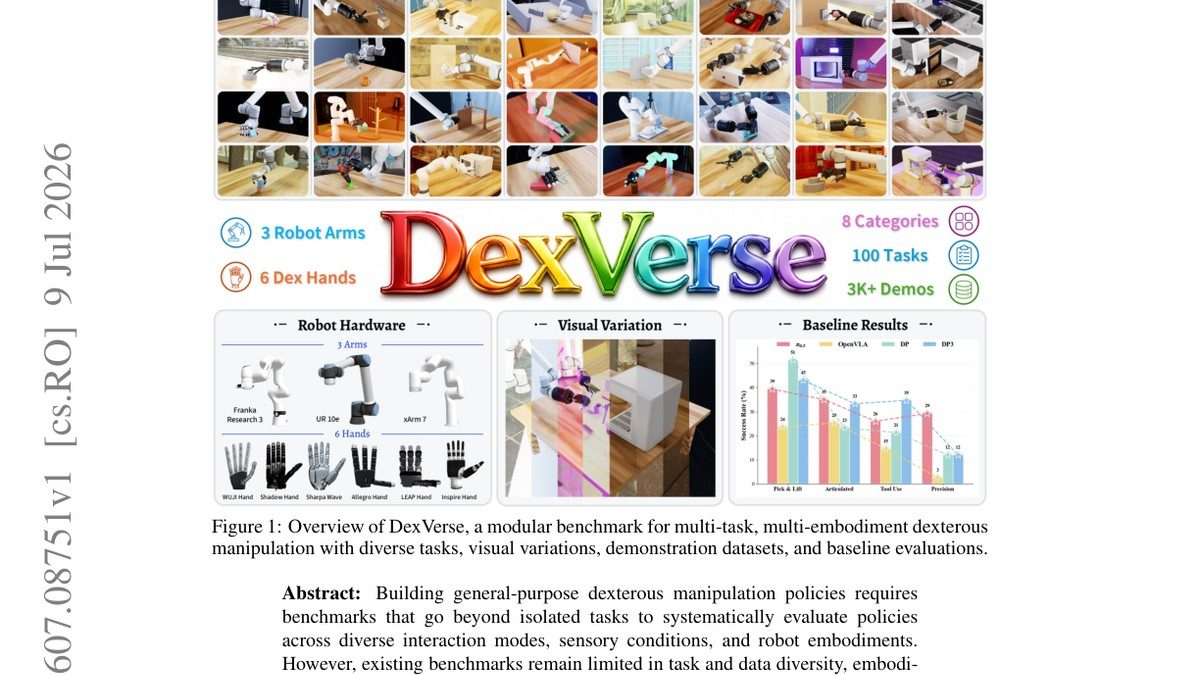
DexVerse: A Modular Benchmark for Multi-Task, Multi-Embodiment Dexterous Manipulation
Yunchao Yao, Zhuxiu Xu, Tianqi Zhang et al.
Building general-purpose dexterous manipulation policies requires benchmarks that go beyond isolated tasks to systematically evaluate policies across diverse interaction modes, sensory conditions, and robot embodiments.
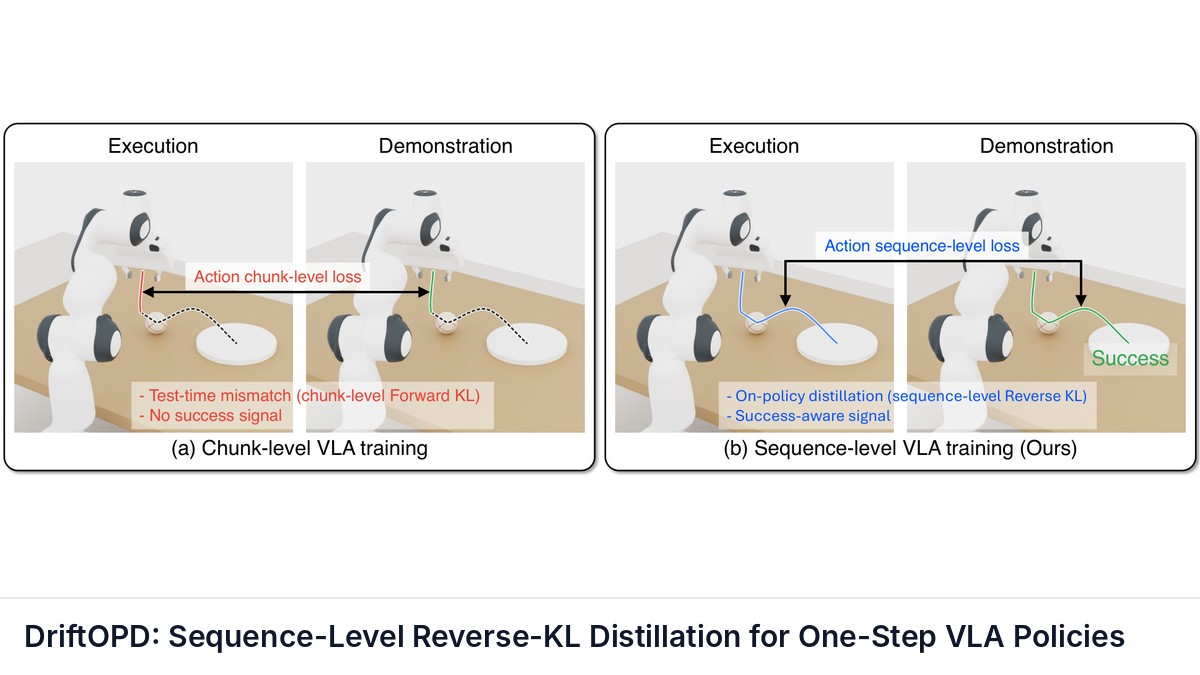
DriftOPD: Sequence-Level Reverse-KL Distillation for One-Step VLA Policies
Youngjun Jun, Kyumin Choi, Youngmin Kim et al.
Vision-Language-Action (VLA) models increasingly rely on action experts that generate short action chunks under receding-horizon control.