
Memorize, Adapt, Ignore: Diagnosing Robot Learning Mechanisms under Training Data Variation
Ke Zhang, Danica J. Sutherland, Chao Liu · N/A · 2026
Framework
N/A
License
N/A
Stars
N/A
Summary
Training data variation, whether through designing a domain randomization (DR) scheme in simulation or curating demonstrations for imitation learning, is a primary lever for improving the robustness of robotic manipulation policies.
Abstract Summary
Key Points
- Training data variation, whether through designing a domain randomization (DR) scheme in simulation or curating demonstrations for imitation learning, is a primary lever for improving the robustness of robotic manipulation policies.
- Yet its underlying mechanisms remain poorly understood, and practitioners typically select randomization parameters through expensive trial and error.
- We investigate these mechanisms through a series of case studies, randomizing object size, color, and type as well as scene lighting and linguistic prompts across settings including pick-and-place RL in ManiSkill and fine-tuning of vision-language-action (VLA) models on LIBERO and RoboTwin.
- We examine both model behavior and internal representations, using the empirical neural tangent kernel (NTK) as our primary diagnostic tool.
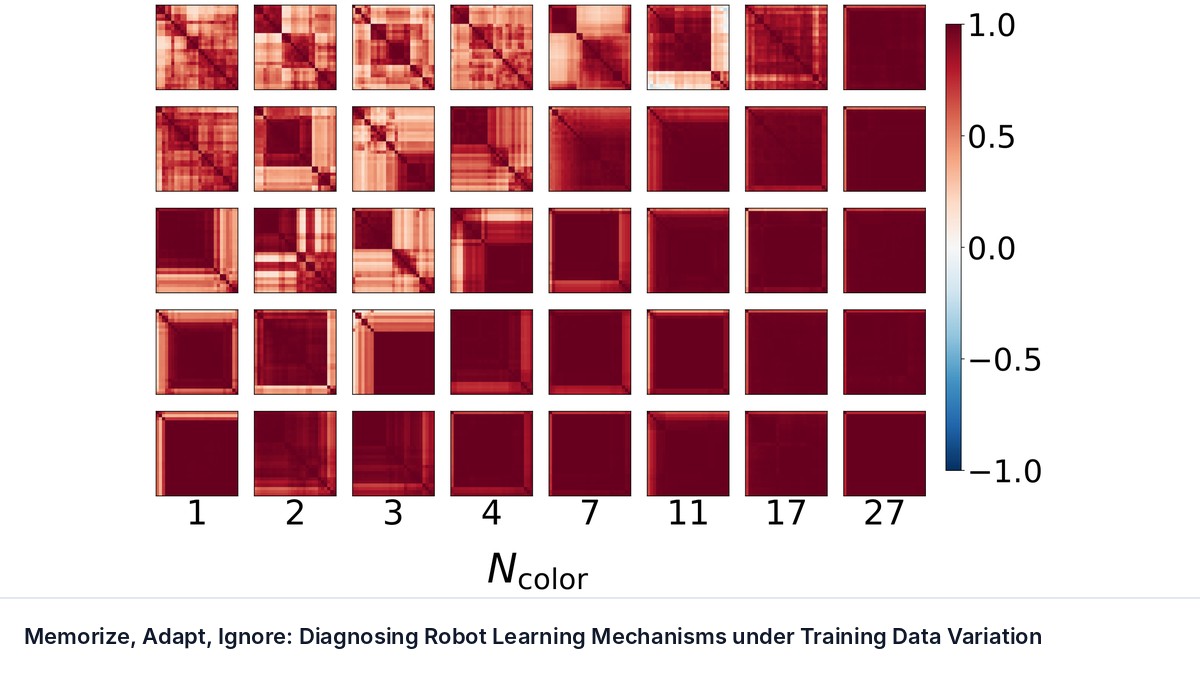
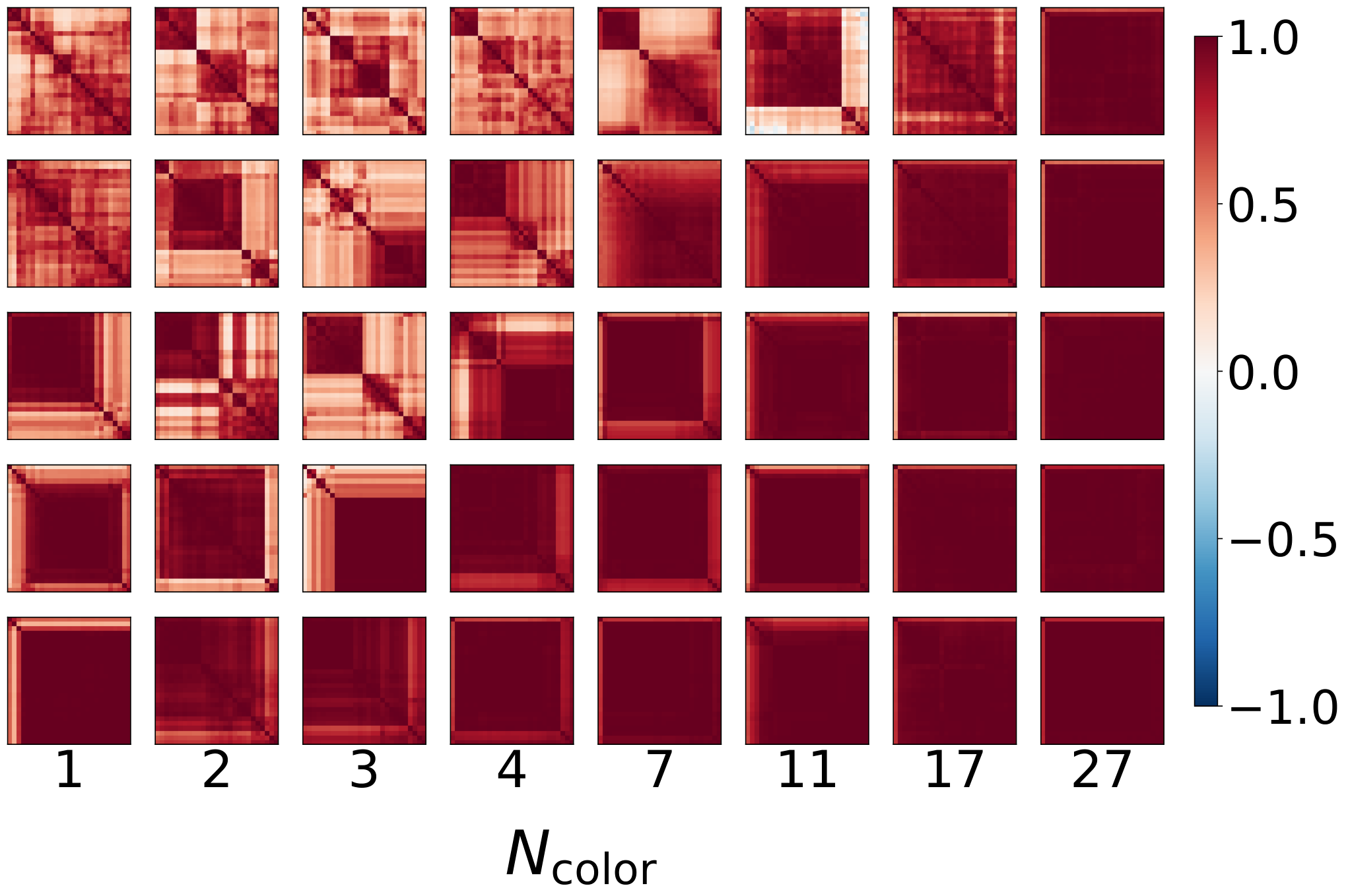
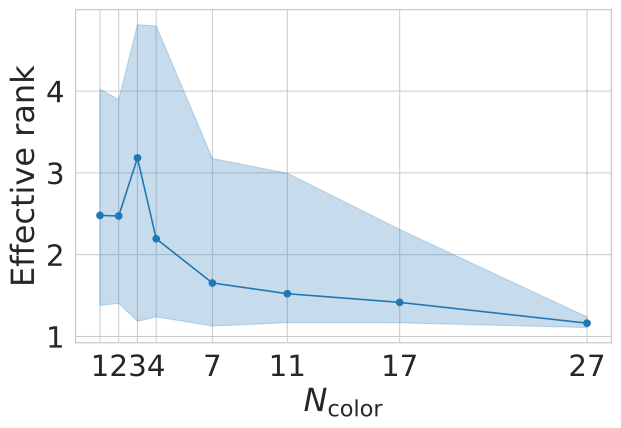
- We show that the NTK distinguishes a shift in the internal learning mechanism from \textit{memorizing} different situations with insufficient variation (e.g.\ learning what to do for a large cube, and what to do for a small cube) to \textit{adapting} to the situation at hand with sufficient variation.
Methodology
Our pipeline consists of three stages designed to isolate the effects of specific training data variation factors on a model’s internal representations. Stage 1: Controlled Training. We systematically vary one or two target factors while holding the distributions of all other factors fixed, training models across different DR configurations. Consider a robotic pick-and-place task as an example.
Experimental Analyses
We now turn to a pick-cube task in the ManiSkill simulator ( Tao et al., 2025 ) , analyzing CNN policies trained via reinforcement learning across domain randomization intensities. To investigate the internal learning mechanisms of the policy, we first establish the predictive power of the kernel geometry as a valid diagnostic proxy for empirical performance.
Figure 2(b) evaluates the Spearman rank correlation between the kernel cosine similarity and empirical success rates across unseen evaluation colors.
Sources and Demonstrations
Figures are reproduced from Zhang et al. See the full paper for experimental details and the project page, when the paper links one, for demonstrations and videos.
Related Papers

A Sim-to-Real Integration Pipeline for Training and Deployment of Chunk-Based VLA Manipulation Policies
Mathilde Kappel, Clémence Grislain, Mohamed Chetouani et al.
Vision-Language-Action (VLA) models have become a prominent paradigm for mapping multimodal inputs, including semantic instructions, visual observations of the scene, and proprioceptive observations, to robot actions.
3DThinkVLA: Endowing Vision-Language-Action Models with Latent 3D Priors via 3D-Thinking-Guided Co-training
Jiaxin Shi, Xidong Zhang, Fucai Zhu et al.
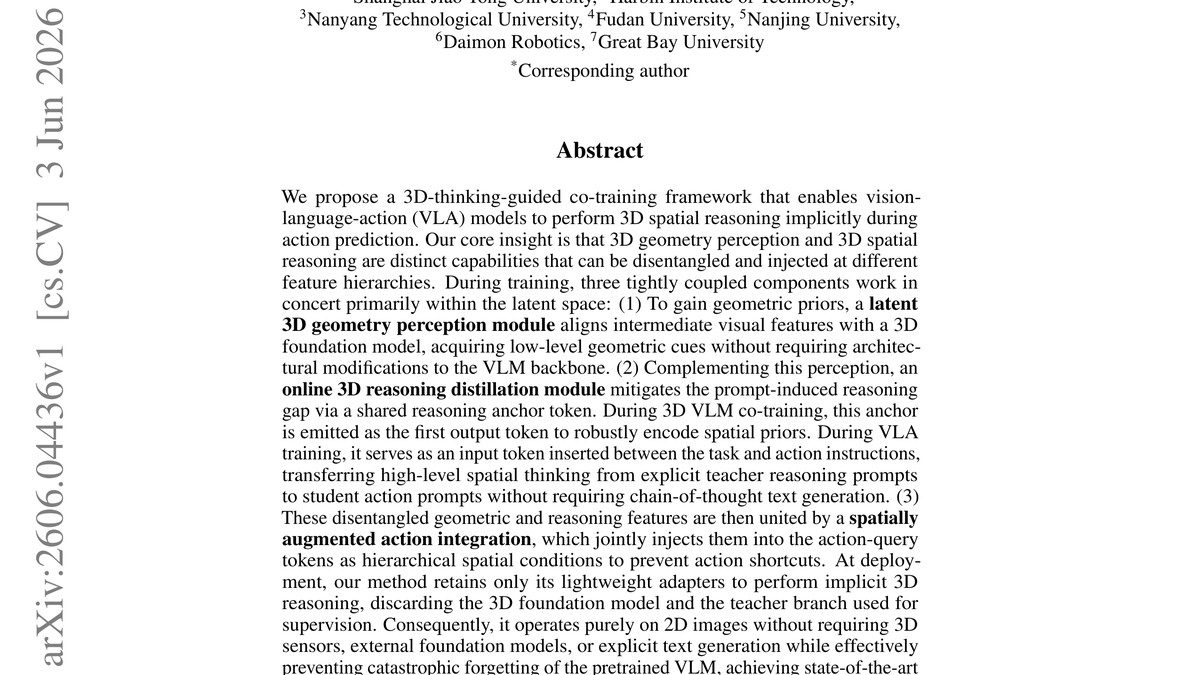
We propose a 3D-thinking-guided co-training framework that enables vision-language-action (VLA) models to perform 3D spatial reasoning implicitly during action prediction.

Capability-Aware Arbitration for Semantic Intent-Based Shared Control
Zhaoda Du, Michael Bowman, Xiaoli Zhang
Shared control often allocates robot authority based on confidence in inferred human intent, assuming reliable autonomous execution. When this assumption fails, high intent confidence can cause over-helping.
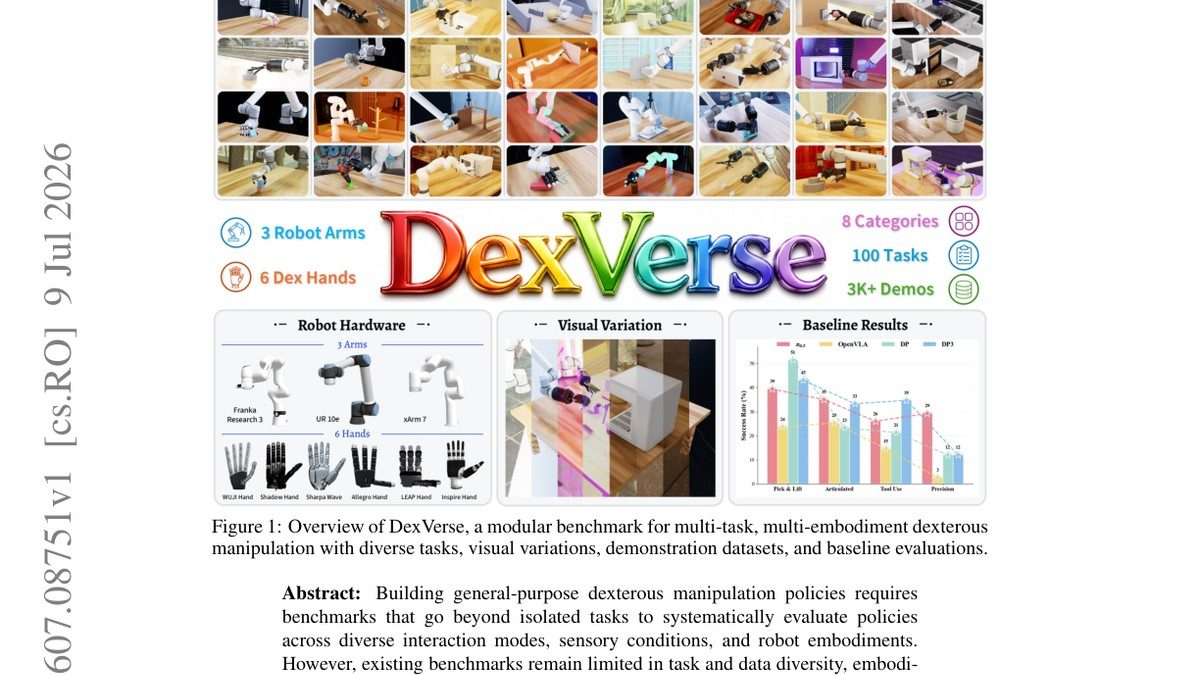
DexVerse: A Modular Benchmark for Multi-Task, Multi-Embodiment Dexterous Manipulation
Yunchao Yao, Zhuxiu Xu, Tianqi Zhang et al.
Building general-purpose dexterous manipulation policies requires benchmarks that go beyond isolated tasks to systematically evaluate policies across diverse interaction modes, sensory conditions, and robot embodiments.