
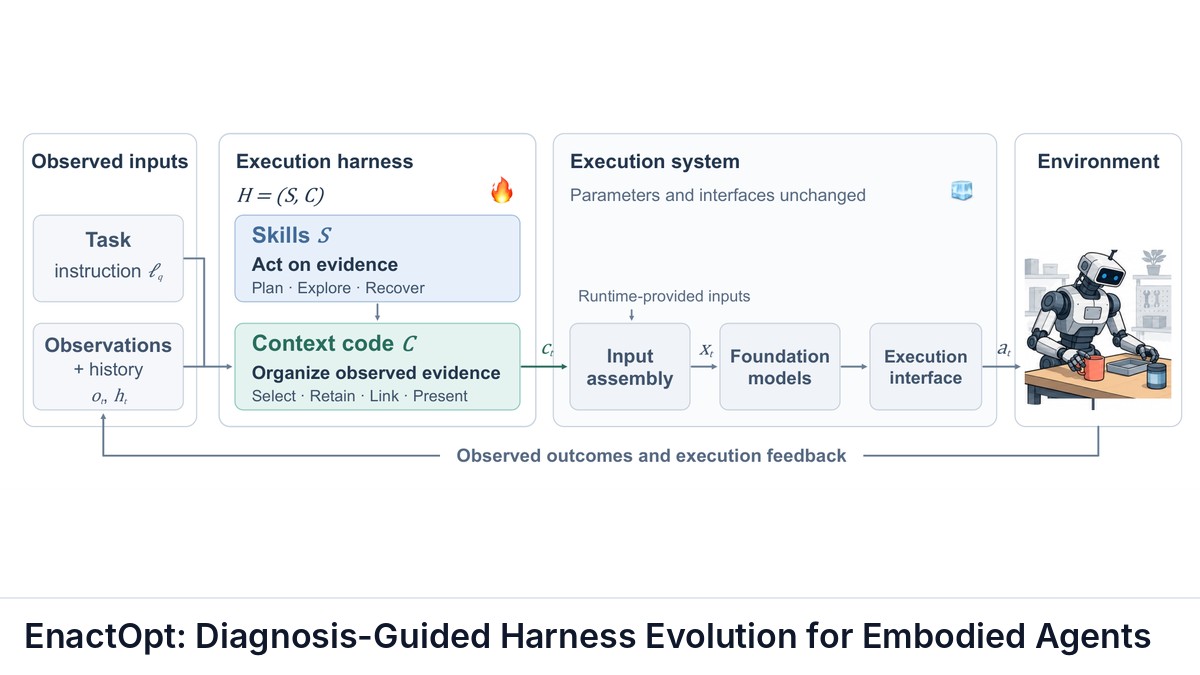
EnactOpt: Diagnosis-Guided Harness Evolution for Embodied Agents
ZhiYuan Feng, Zhuoshi Pan, Zhaolu Kang, Zhongxia Chen, Shuo Yang, Sen Ye, Heng Wang, Han Li · N/A · 2026
Framework
N/A
License
N/A
Stars
N/A
Summary
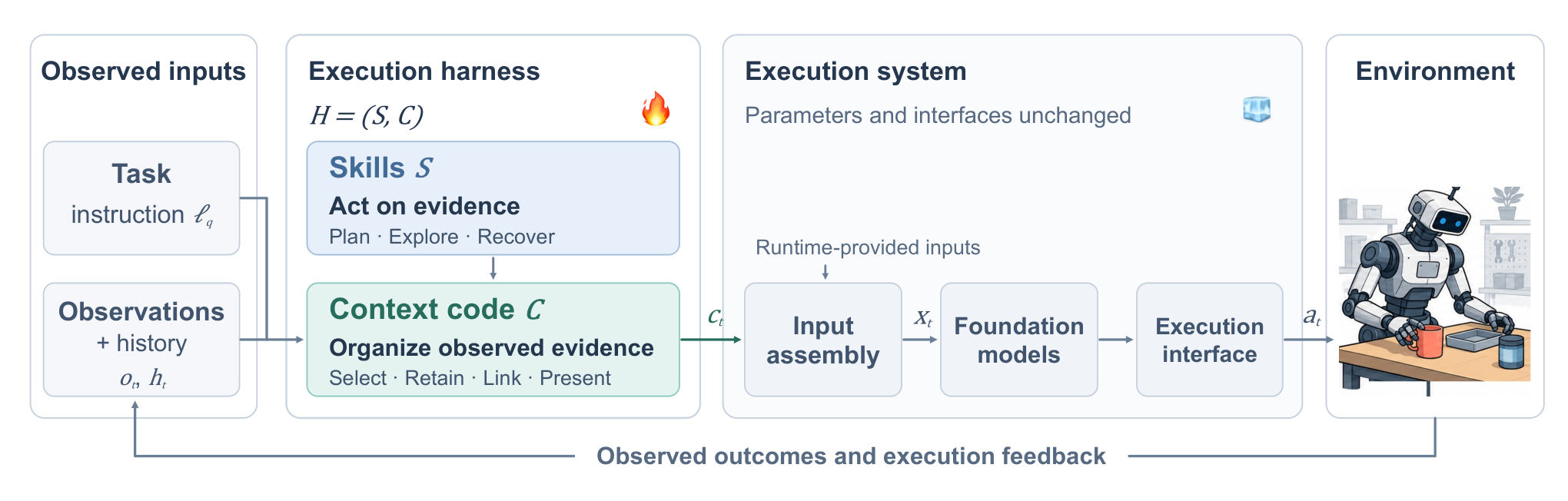
Embodied agents built on foundation models rely on an execution harness to organize observations, guide actions, and incorporate execution feedback into subsequent decisions.
Abstract Summary
Key Points
- Embodied agents built on foundation models rely on an execution harness to organize observations, guide actions, and incorporate execution feedback into subsequent decisions.
- Failures can arise not only from limited model capabilities, but also from how the harness presents evidence and guides its use.
- These model-external mechanisms provide an adaptation target without updating model parameters, but task-specific interaction experience can be costly to collect.
- Task-level outcomes alone do not reveal whether relevant evidence was missing from the model input or was available but inadequately used.
- Moreover, these two aspects are coupled: effective action guidance may require evidence that the current context omits, while exposing that evidence alone does not ensure an appropriate response.
Problem Setup
We consider an embodied task $q$ specified by an environment $\mathcal{E}_{q}$ with initial conditions, an instruction $\ell_{q}$, and a task-level success criterion. At decision step $t$, the agent selects an action $a_{t}$ using information drawn from $\ell_{q}$, the current observation $o_{t}$, and the available interaction history $h_{t}$ of prior observations, actions, and feedback.
Executing $a_{t}$ yields the next observation $o_{t+1}$ and any available execution feedback $f_{t+1}$; interaction continues until termination.
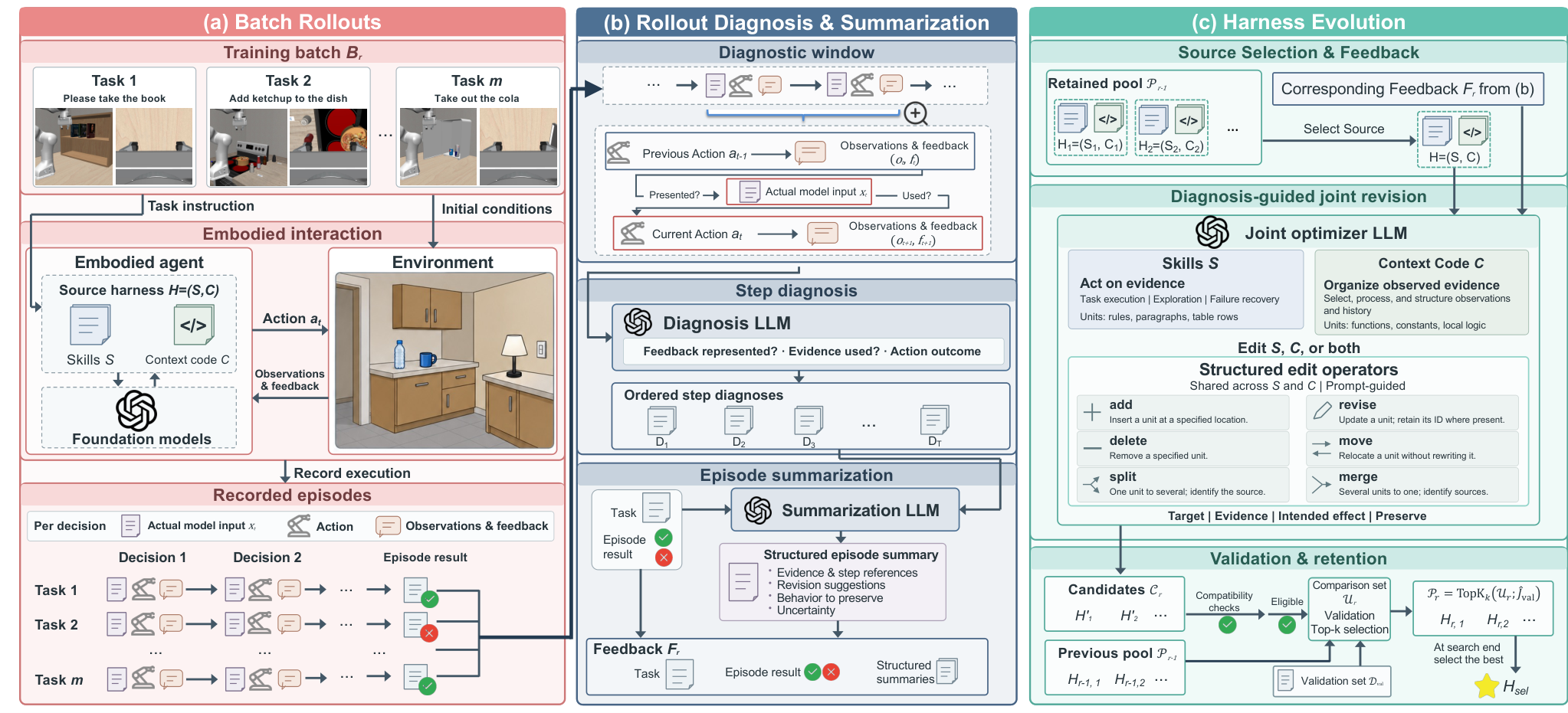
EnactOpt: Diagnosis-Guided Harness Evolution
Figure 2 summarizes EnactOpt’s iterative evolution loop. Starting from $H_{0}=(S_{0},C_{0})$, EnactOpt maintains a pool of retained harnesses while keeping $\mathcal{M}$ and $\mathcal{R}$ fixed.
At evolution iteration $r$, a source harness $H=(S,C)$ is selected from $\mathcal{P}_{r-1}$ to execute a batch $B_{r}$ from the training set $\mathcal{D}_{\mathrm{train}}$, producing rollouts and their native execution outcomes. Each rollout is analyzed through adjacent-decision diagnoses, which are aggregated into a structured episode summary.
Experiments
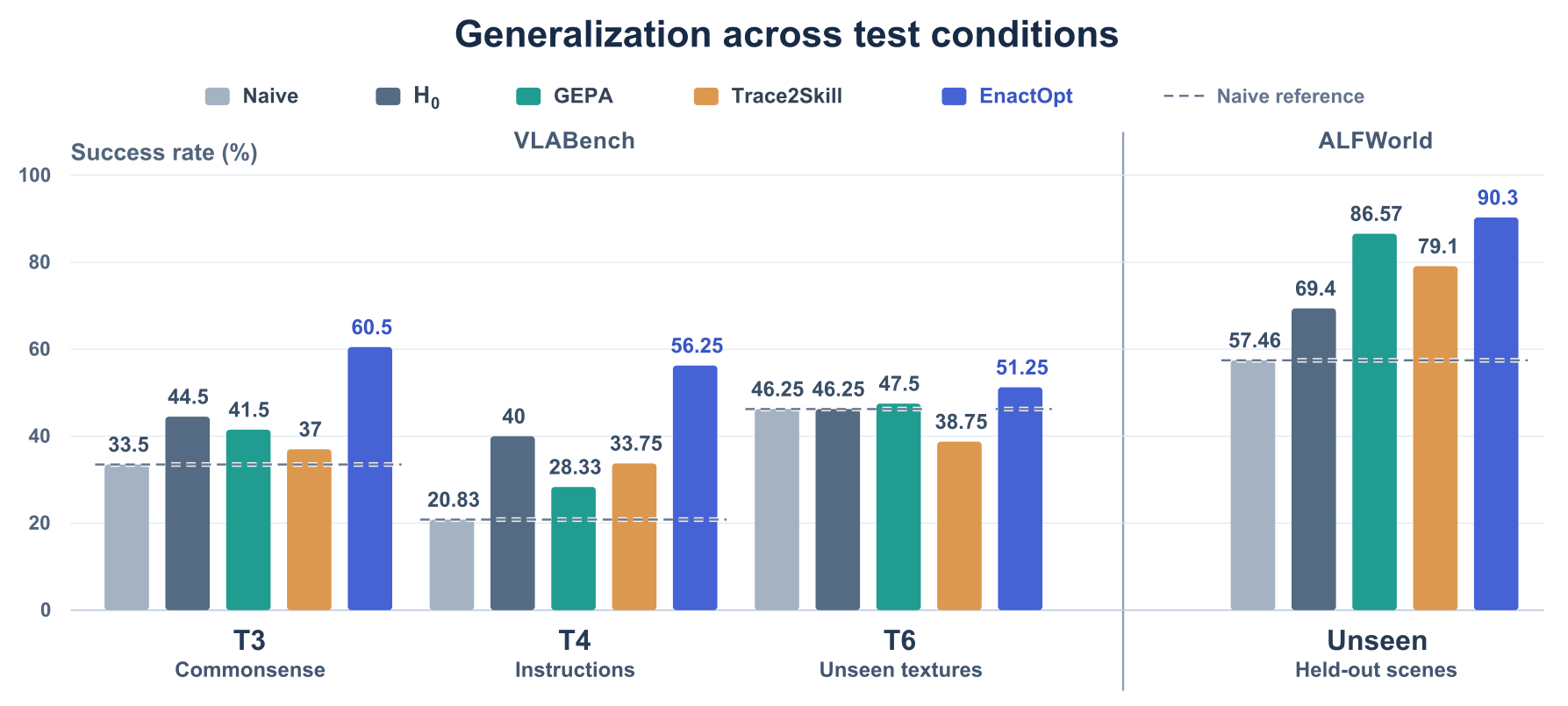
Benchmarks and protocol. We evaluate separately evolved harnesses on VLABench ( Zhang et al., 2025b ) , ALFWorld ( Shridhar et al., 2020 ) , and EAI’s VirtualHome Action Sequencing ( Li et al., 2024 ) . All MLLM components use GPT-5.4 mini ( OpenAI, 2026 ) ; VLABench additionally uses the benchmark-released $\pi_{0}$ policy ( Black et al., 2024 ) , fixed during evolution.
ALFWorld and EAI use high-level action interfaces. Train/validation/test sizes are 30/30/920 for VLABench and 30/30/282 for EAI.
Sources and Demonstrations
Figures are reproduced from Feng et al. See the full paper for experimental details and the project page, when the paper links one, for demonstrations and videos.
Related Papers
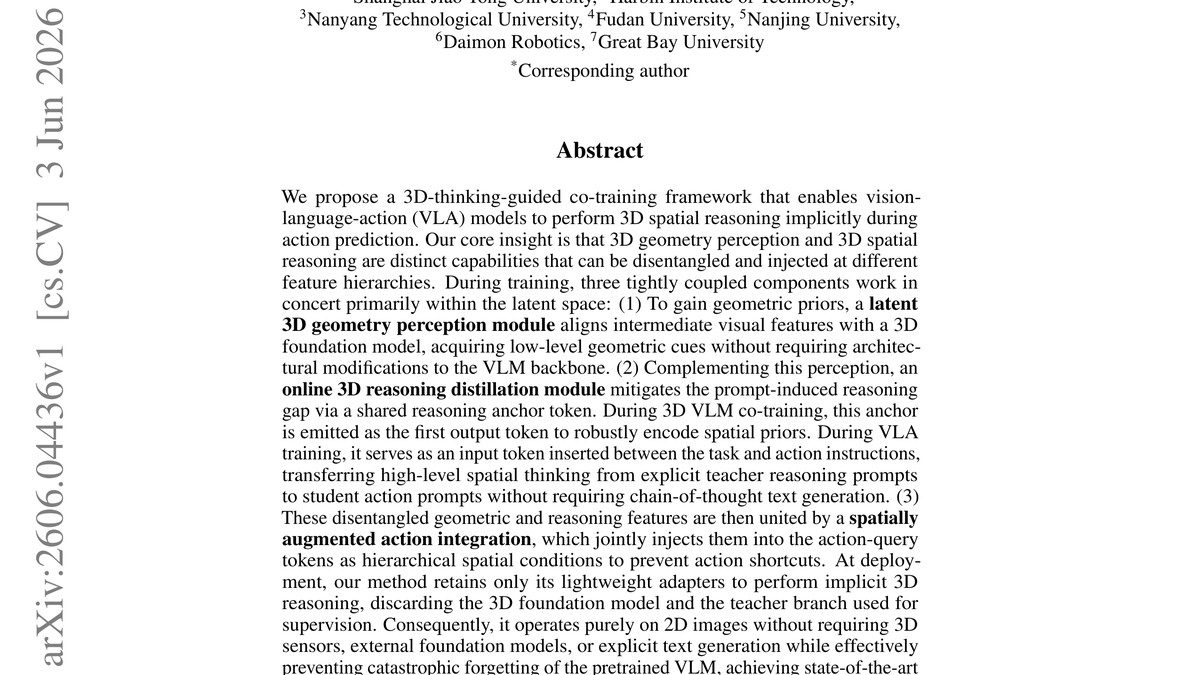
3DThinkVLA: Endowing Vision-Language-Action Models with Latent 3D Priors via 3D-Thinking-Guided Co-training
Jiaxin Shi, Xidong Zhang, Fucai Zhu et al.
We propose a 3D-thinking-guided co-training framework that enables vision-language-action (VLA) models to perform 3D spatial reasoning implicitly during action prediction.
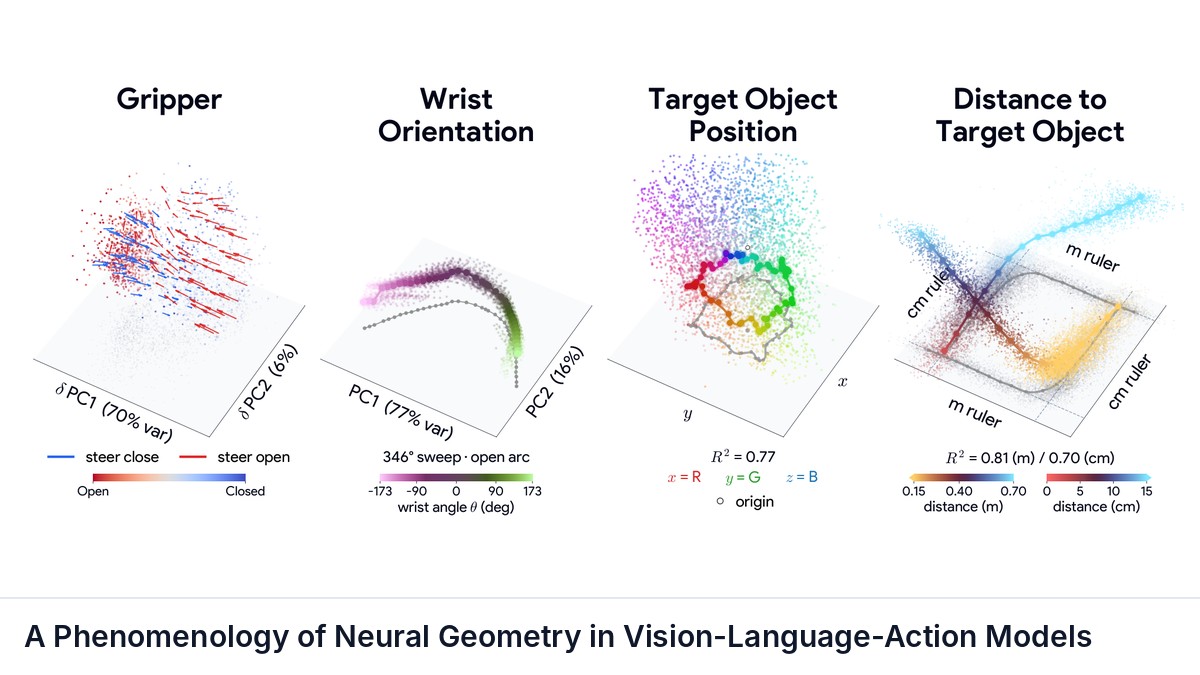
A Phenomenology of Neural Geometry in Vision-Language-Action Models
Mozes Jacobs, Aiden Swann, Mathilde Papillon et al.
Robotic manipulation is inherently geometric, but what shape does the world take inside the policy that performs it?

A Sim-to-Real Integration Pipeline for Training and Deployment of Chunk-Based VLA Manipulation Policies
Mathilde Kappel, Clémence Grislain, Mohamed Chetouani et al.
Vision-Language-Action (VLA) models have become a prominent paradigm for mapping multimodal inputs, including semantic instructions, visual observations of the scene, and proprioceptive observations, to robot actions.
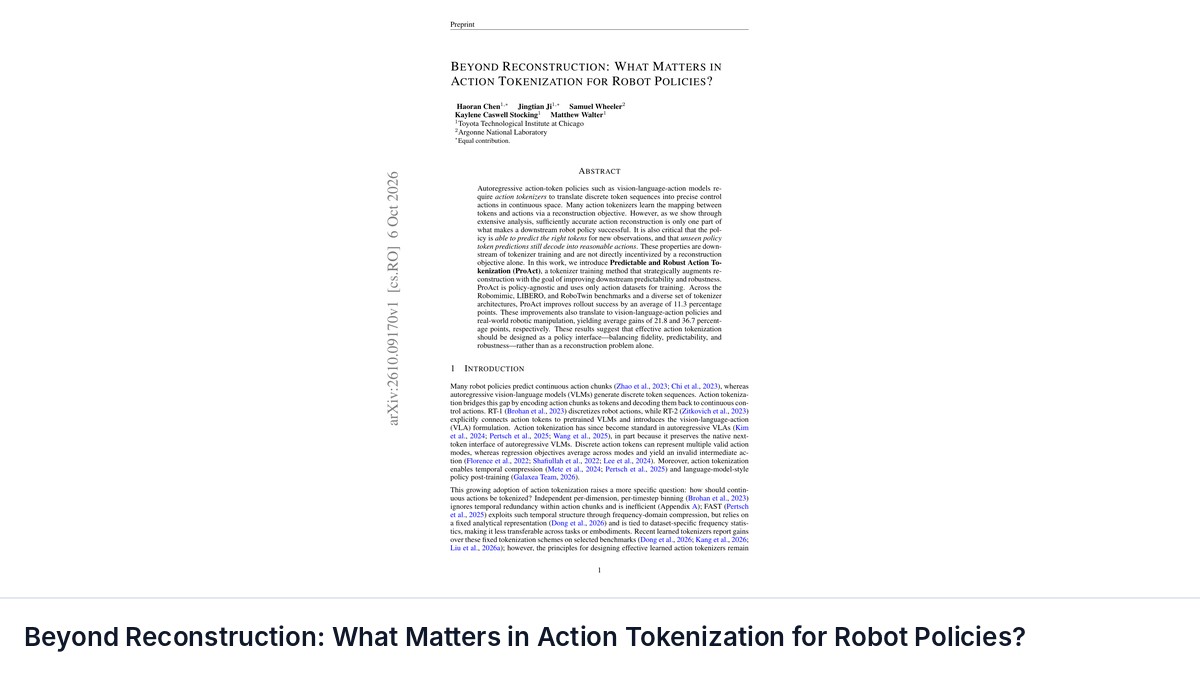
Beyond Reconstruction: What Matters in Action Tokenization for Robot Policies?
Haoran Chen, Jingtian Ji, Samuel Wheeler et al.
Autoregressive action-token policies such as vision-language-action models require action tokenizers to translate discrete token sequences into precise control actions in continuous space. Many action tokenizers learn the mapping between tokens and actions via a reconstruction objective.