
ProactiveVLA: Augmenting Embodied Memory through Proactive Environment Exploration
Shizuo Tian, Haodong Luo, Yutong Li, Yuebing Song, Yunxin Liu, Yuanchun Li · N/A · 2026
Framework
N/A
License
N/A
Stars
N/A
Summary
Rapid adaptation to a new environment requires a robot to acquire useful knowledge about local objects, states, and interactions from limited experience.
Abstract Summary
Key Points
- Rapid adaptation to a new environment requires a robot to acquire useful knowledge about local objects, states, and interactions from limited experience.
- Systems that combine a reasoning agent with a frozen vision-language-action model (VLA) can adapt through execution feedback and memory, making the choice of experience central to their effectiveness.
- Repeated practice of a target task may refine a familiar solution while leaving other interactions relevant to changed conditions untested.
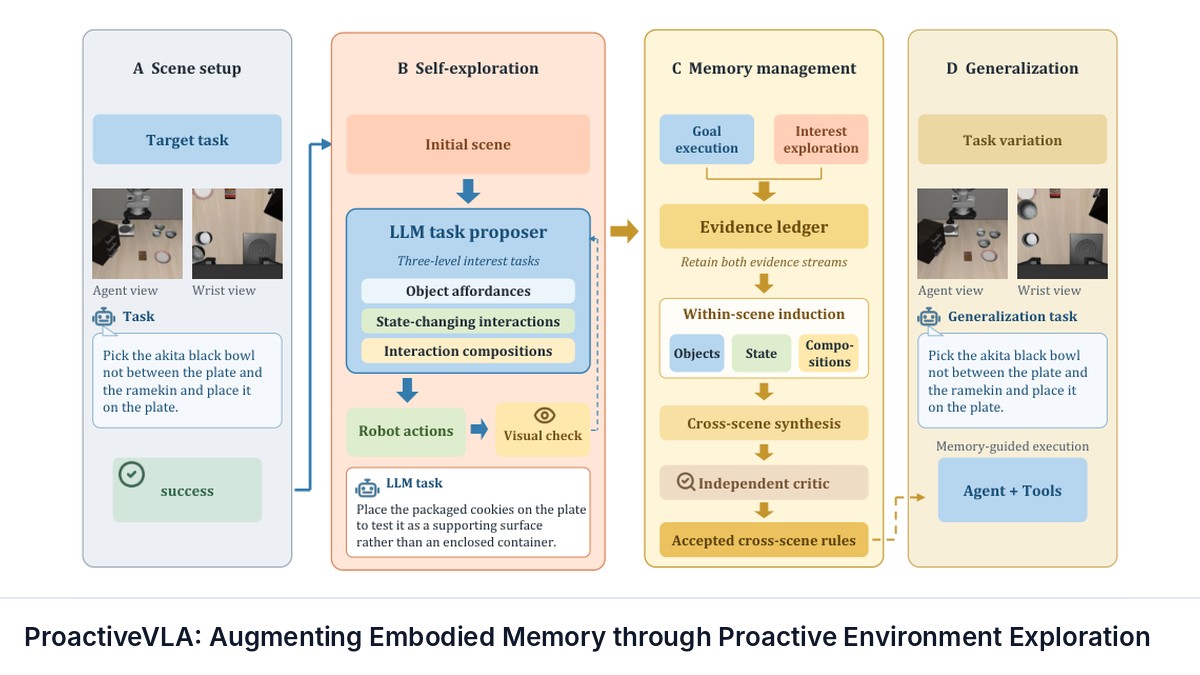
- We introduce ProactiveVLA, which uses proactive environment exploration to acquire reusable knowledge for deployment-time adaptation.
- After completing an initial task, the agent allocates the remaining interaction budget to self-proposed goals covering object affordances, state-changing interactions, and compositions of interactions.
Methodology
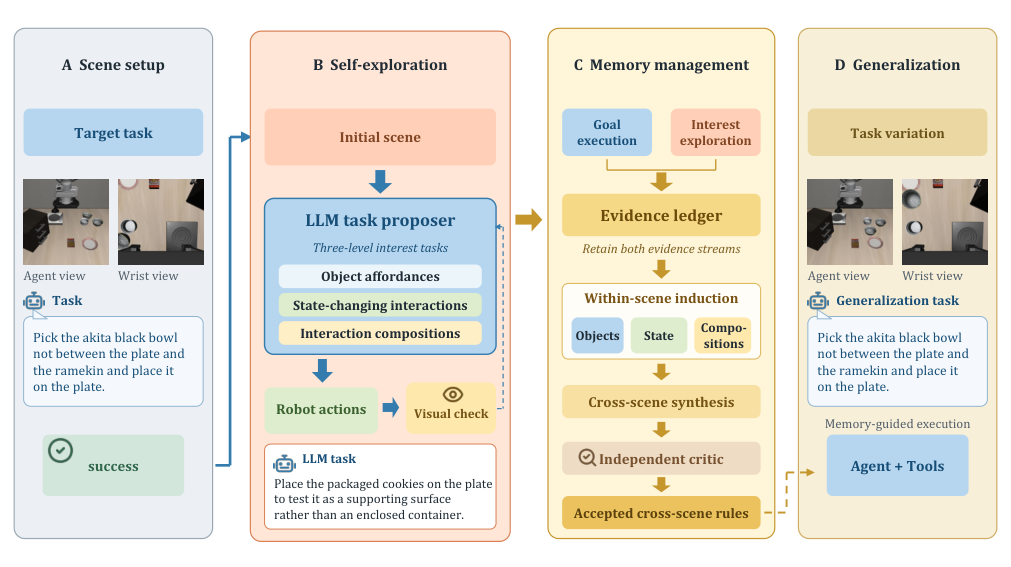
ProactiveVLA supports rapid adaptation by acquiring environment experience, consolidating it into a global memory, and using that memory to guide subsequent behavior. A high-level agent interacts with the environment through a set of robot primitives, such as moving to a target pose, adjusting the robot posture, controlling the gripper, and VLAs.
Each adaptation instance consists of a scene and an environment-provided task, with a shared budget of $B$ interaction turns for task execution and autonomous exploration.
Experiments
We evaluate ProactiveVLA with one reference instance per task, where the agent is given a fixed interaction budget before being evaluated, testing whether proactively acquired environment knowledge transfers beyond the conditions encountered during adaptation. Harness VLA serves as the task-refinement baseline. Both ProactiveVLA and Harness VLA receive the same reference instance.
Analysis
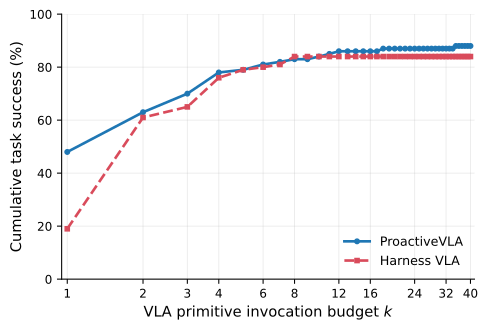
Figure 2 reports the fraction of evaluation instances completed with at most $k$ VLA primitive invocations. Figure 2 (a) reports our Goal-T re-evaluation for the VLA-invocation analysis. ProactiveVLA completes 48% of instances with at most one VLA call, compared with 19% for Harness VLA.
The strongest separation therefore appears at the smallest call budget, where additional controller calls are unavailable to compensate for a less effective execution strategy.

Sources and Demonstrations
Figures are reproduced from Tian et al. See the full paper for experimental details and the project page, when the paper links one, for demonstrations and videos.
Related Papers
Context-Aware Adaptive Pesticide Spraying for Agricultural Robots under Changing Weather and Terrain Using Vision-Language Models
Cong-Thanh Vu, Yen-Chen Liu
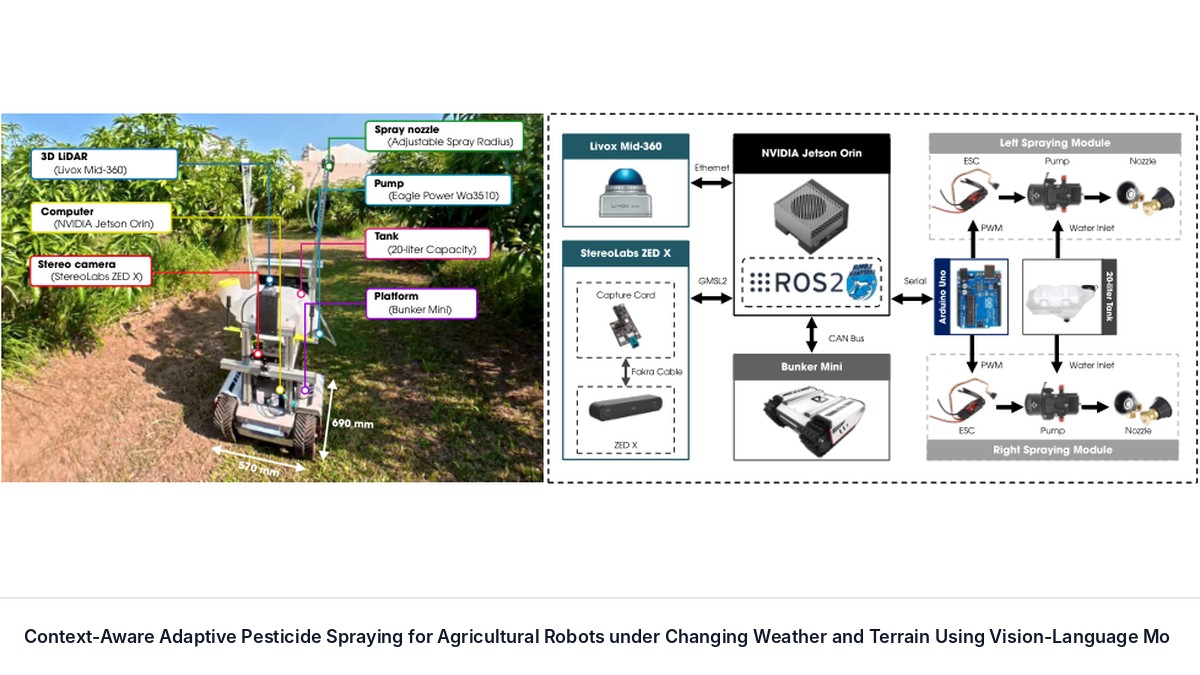
Precision pesticide spraying is essential for optimizing application efficiency and ensuring uniform chemical distribution.
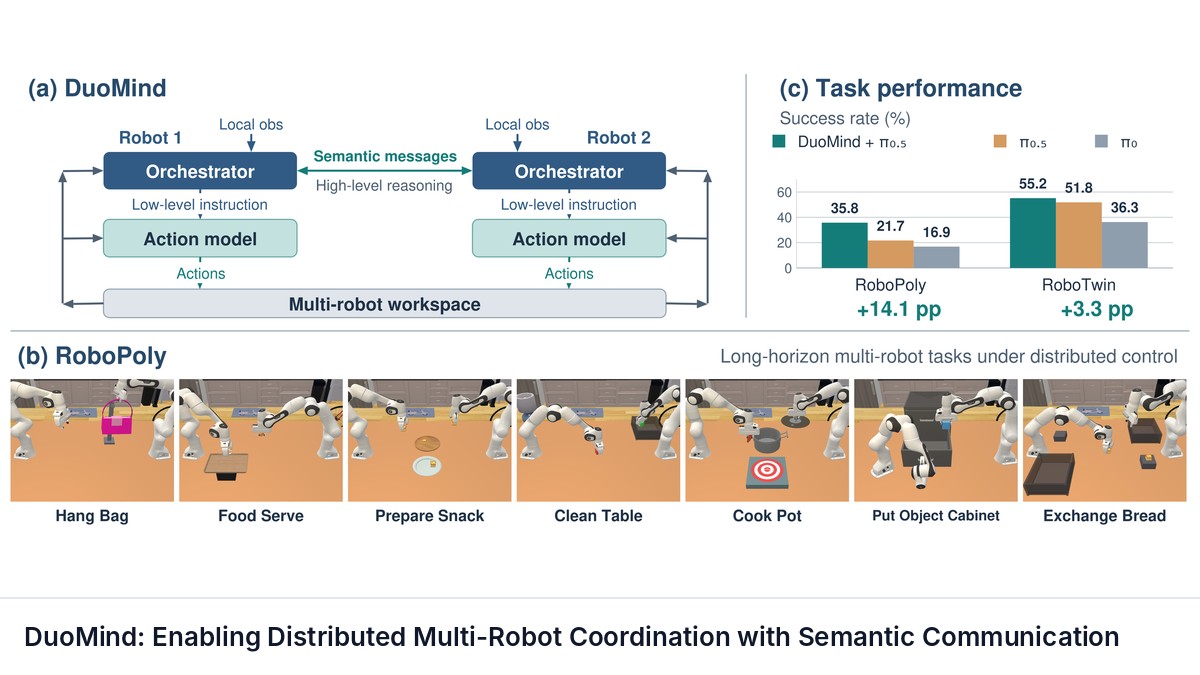
DuoMind: Enabling Distributed Multi-Robot Coordination with Semantic Communication
Hanchu Zhou, Dechen Gao, Hang Wang et al.
Vision-language models (VLMs) and vision-language-action models (VLAs) have recently driven rapid progress in general-purpose robots, yet most progress has focused on single-robot settings.
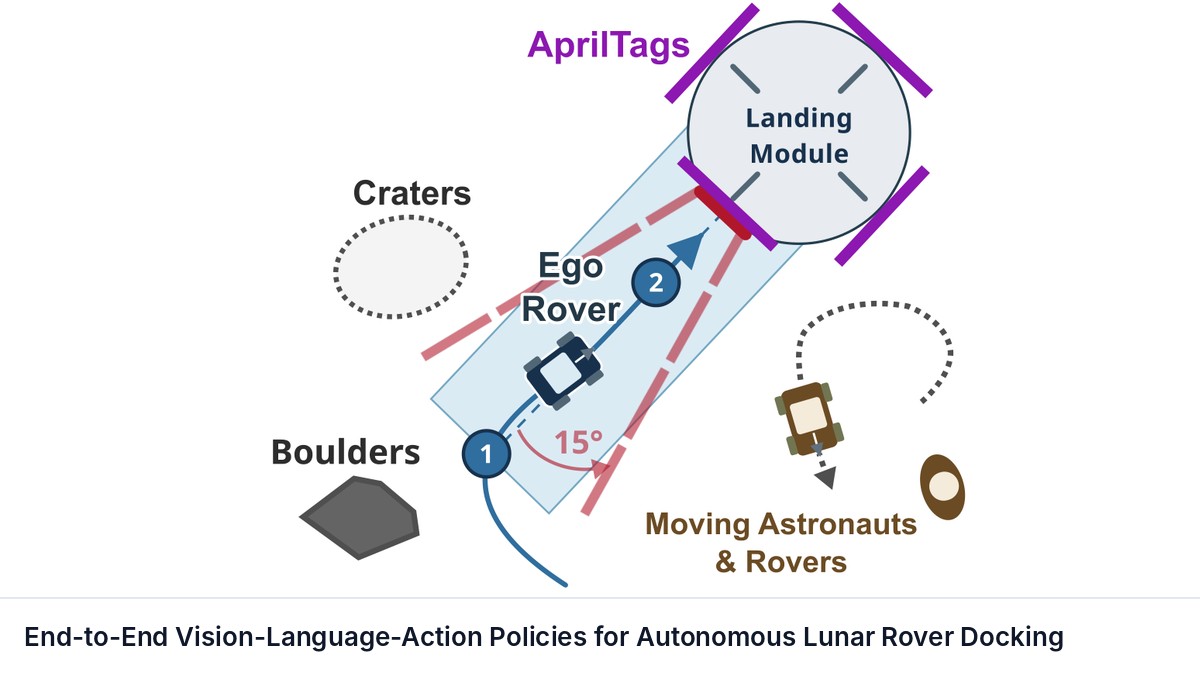
End-to-End Vision-Language-Action Policies for Autonomous Lunar Rover Docking
Sitan Huang, Grace Gao
Surface navigation on the Moon is subject to extreme illumination contrast and deployment-time perceptual disturbances.
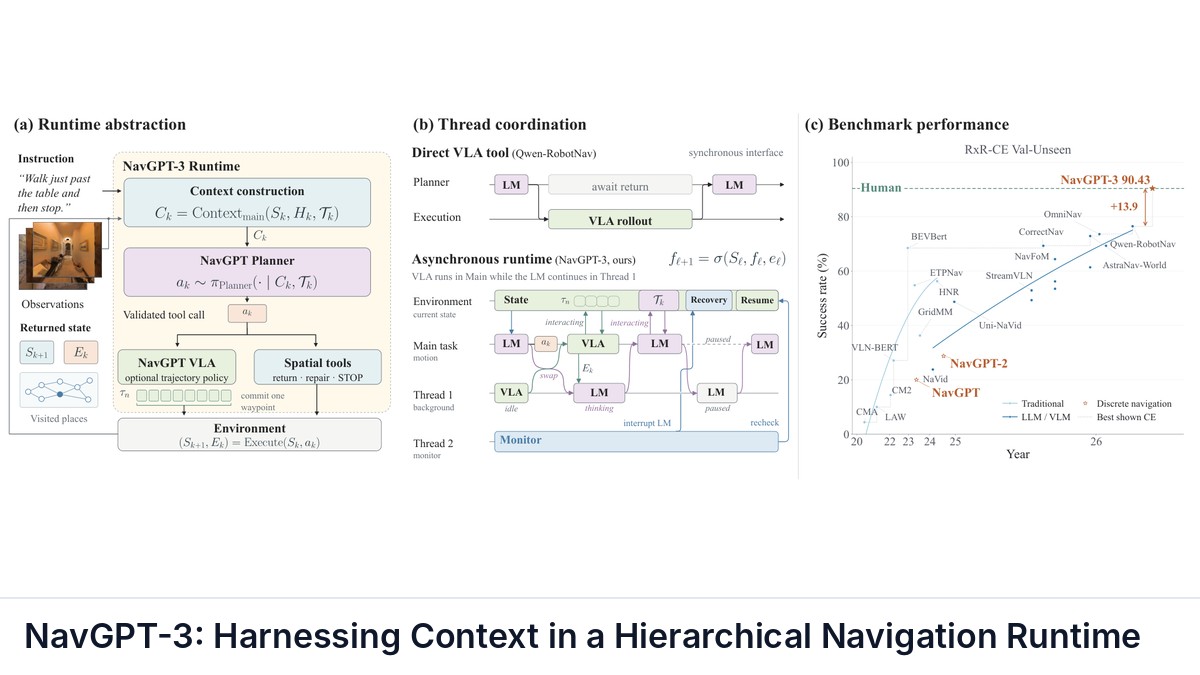
NavGPT-3: Harnessing Context in a Hierarchical Navigation Runtime
Gengze Zhou, Yicong Hong, Jiazhao Zhang et al.
Language models trained with long-horizon agentic reinforcement learning can generalize knowledge through reasoning, express precise actions, and pursue goals over many steps, raising the ceiling on what an embodied agent can understand and decide.