
DuoMind: Enabling Distributed Multi-Robot Coordination with Semantic Communication
Hanchu Zhou, Dechen Gao, Hang Wang, Brendan Lynch, Boqi Zhao, Qiyao Ma, Raman Goyal, Junshan Zhang · N/A · 2026
Framework
N/A
License
N/A
Stars
N/A
Summary
Vision-language models (VLMs) and vision-language-action models (VLAs) have recently driven rapid progress in general-purpose robots, yet most progress has focused on single-robot settings.
Abstract Summary
Key Points
- Vision-language models (VLMs) and vision-language-action models (VLAs) have recently driven rapid progress in general-purpose robots, yet most progress has focused on single-robot settings.
- Extending these capabilities to multi-robot systems remains challenging because robots must coordinate long-horizon behaviors while maintaining reliable, fine-grained execution.
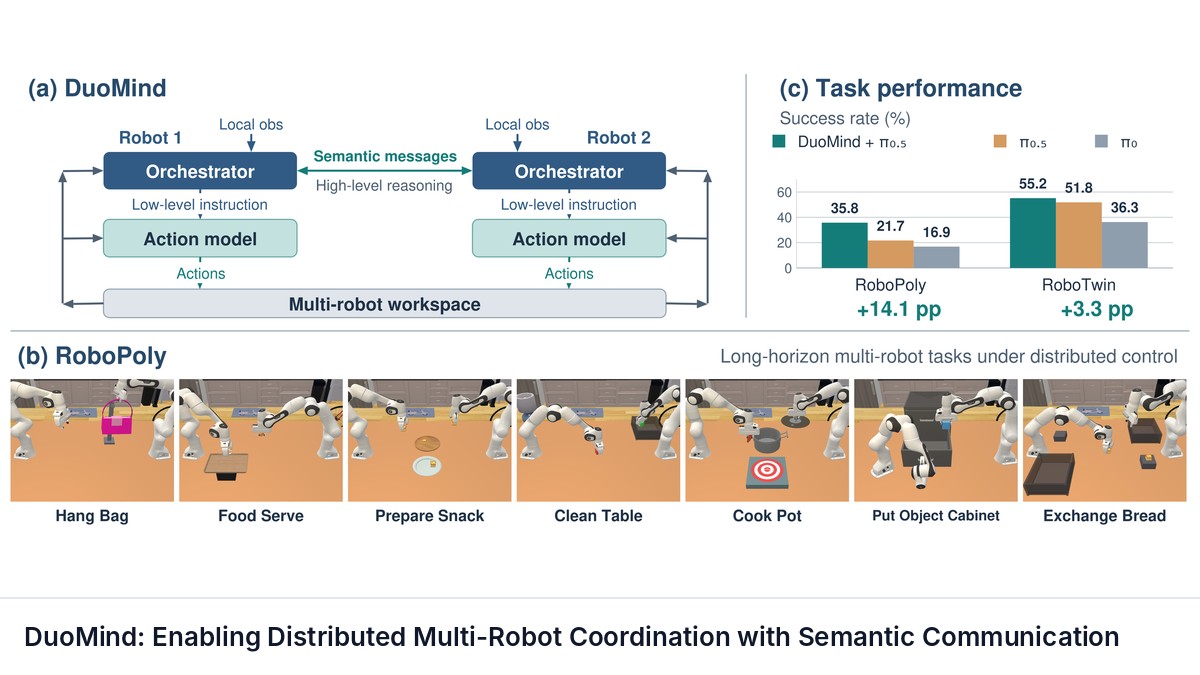
- We introduce DuoMind, a distributed hierarchical framework for multi-robot coordination through semantic communication.
- Each robot uses a VLA-based action model for low-level execution and a VLM-based orchestrator for high-level reasoning and inter-agent coordination.
- At each planning step, the orchestrator at each robot reasons over the task instruction, local observations, and messages received from other robots.
DuoMind : Distributed Hierarchical Multi-Agent Framework
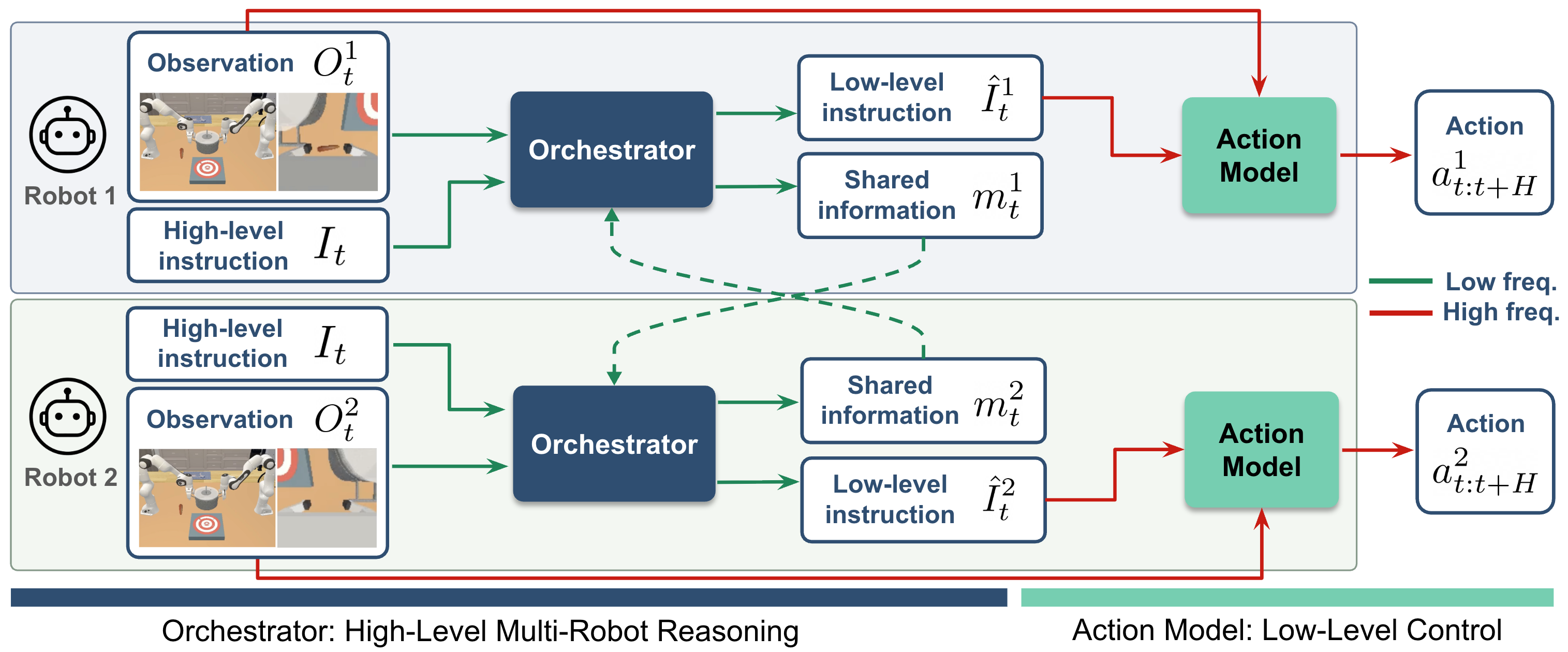
We introduce DuoMind , a distributed hierarchical framework for multi-agent robotic coordination. We first present the VLM-based orchestrator for high-level planning ( 2.1 ). We then describe how we bridges high-level planning and low-level control via embodied reasoning and agentic harness ( 2.2 ). Finally, we highlight the structured inter-agent communication ( 2.3 ).
RoboPoly
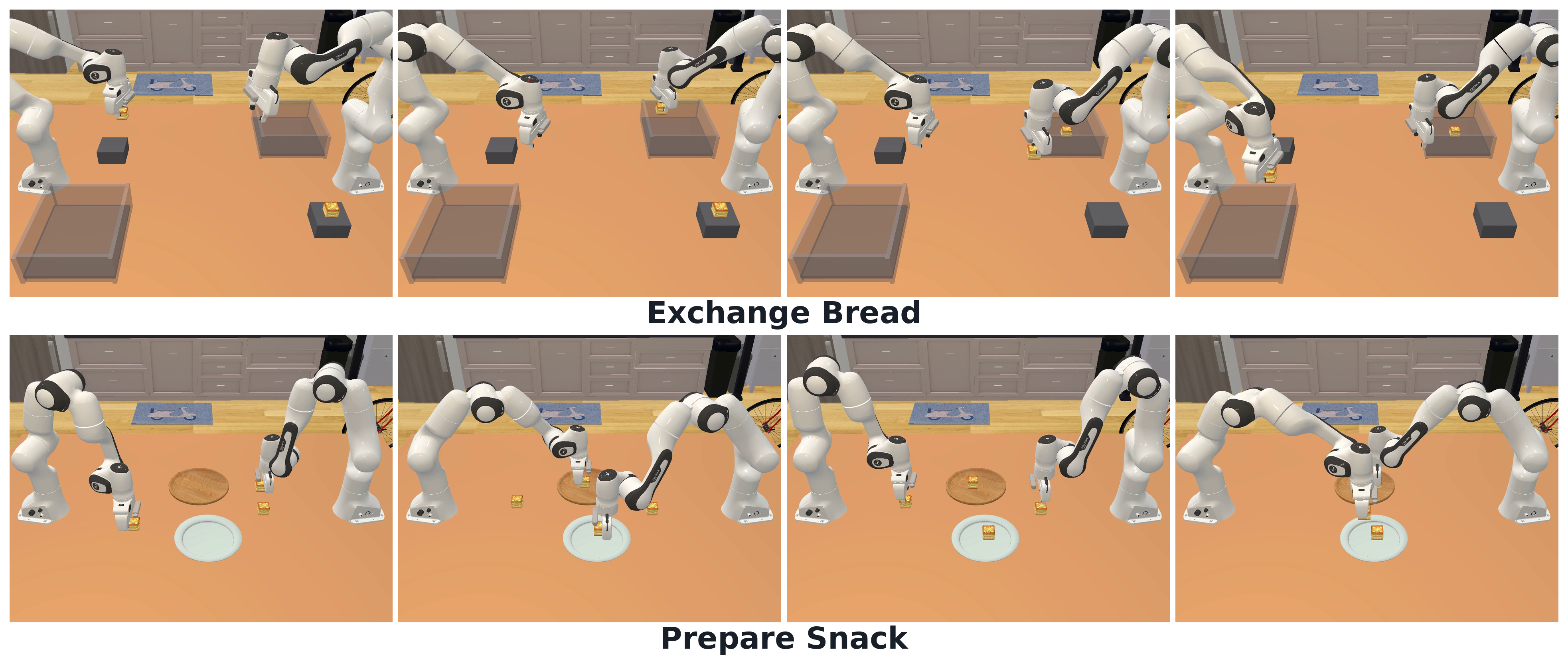
RoboPoly is designed to facilitate research on multi-robot manipulation by providing challenging long-horizon tasks with explicit cooperation requirements. Unlike RoboTwin Chen et al.
(2025c) , which primarily targets dual-arm manipulation with two arms on the same embodiment and does not necessarily require explicit cooperation, RoboPoly considers two independent robots and tasks specifically designed around multi-robot coordination.
Experiments
We evaluate DuoMind on 7 tasks from our RoboPoly and 8 dual-arm tasks from RoboTwin 2.0 ( Chen et al., 2025c ) , both under distributed control. Since RoboTwin originally adopts centralized control over the dual-arm robot, we adapt its setting by treating the two arms as independent robots and control them separately. Task overview are shown in fig. 5 and fig. 6 .
All the finetuning and evaluation tasks are conducted on 4 NVIDIA A100 GPU, each taking 10–24 hours.
Sources and Demonstrations
Figures are reproduced from Zhou et al. See the full paper for experimental details and the project page, when the paper links one, for demonstrations and videos.
Related Papers

A Sim-to-Real Integration Pipeline for Training and Deployment of Chunk-Based VLA Manipulation Policies
Mathilde Kappel, Clémence Grislain, Mohamed Chetouani et al.
Vision-Language-Action (VLA) models have become a prominent paradigm for mapping multimodal inputs, including semantic instructions, visual observations of the scene, and proprioceptive observations, to robot actions.
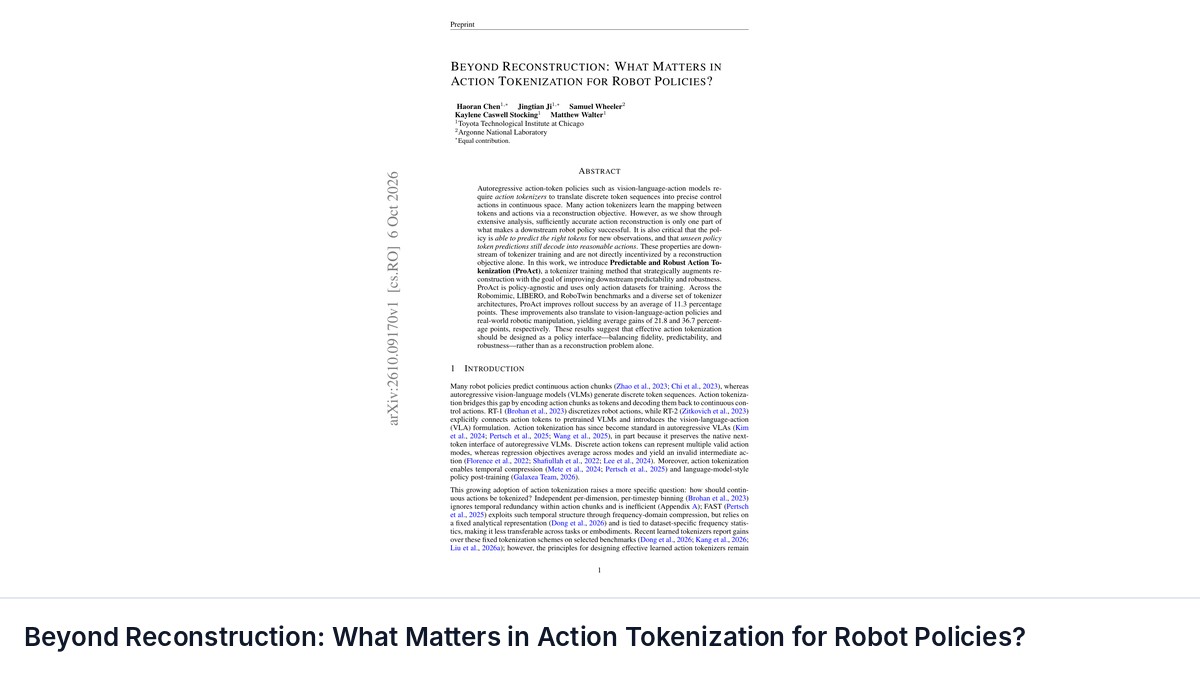
Beyond Reconstruction: What Matters in Action Tokenization for Robot Policies?
Haoran Chen, Jingtian Ji, Samuel Wheeler et al.
Autoregressive action-token policies such as vision-language-action models require action tokenizers to translate discrete token sequences into precise control actions in continuous space. Many action tokenizers learn the mapping between tokens and actions via a reconstruction objective.
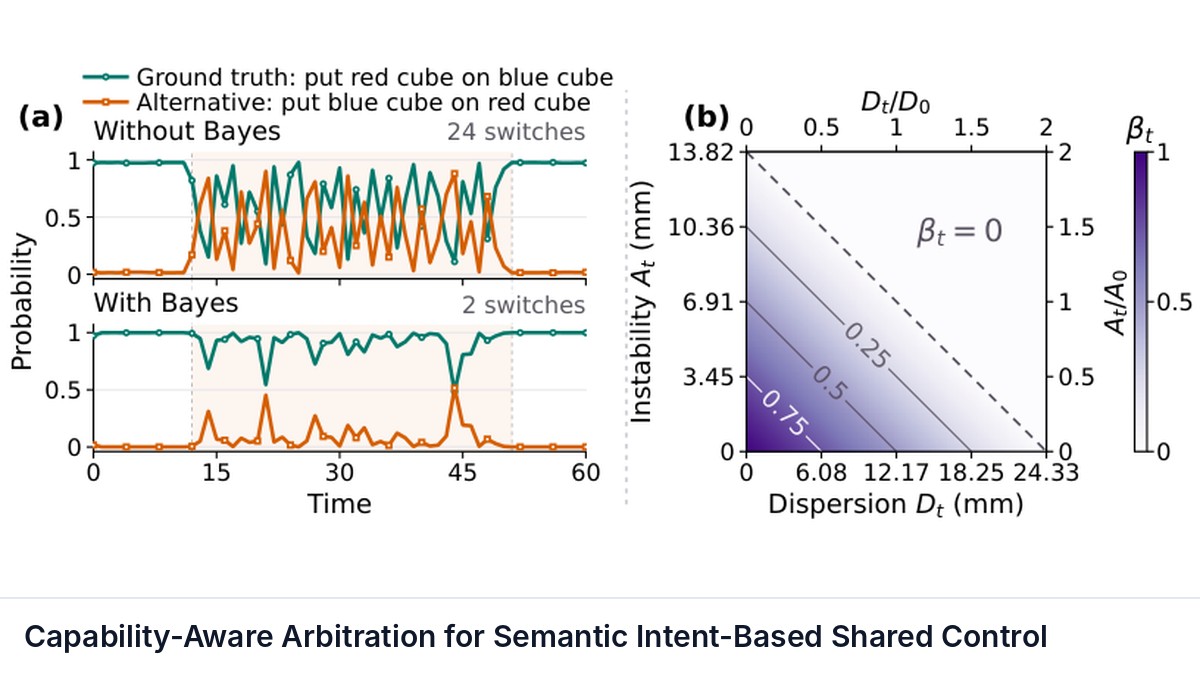
Capability-Aware Arbitration for Semantic Intent-Based Shared Control
Zhaoda Du, Michael Bowman, Xiaoli Zhang
Shared control often allocates robot authority based on confidence in inferred human intent, assuming reliable autonomous execution. When this assumption fails, high intent confidence can cause over-helping.
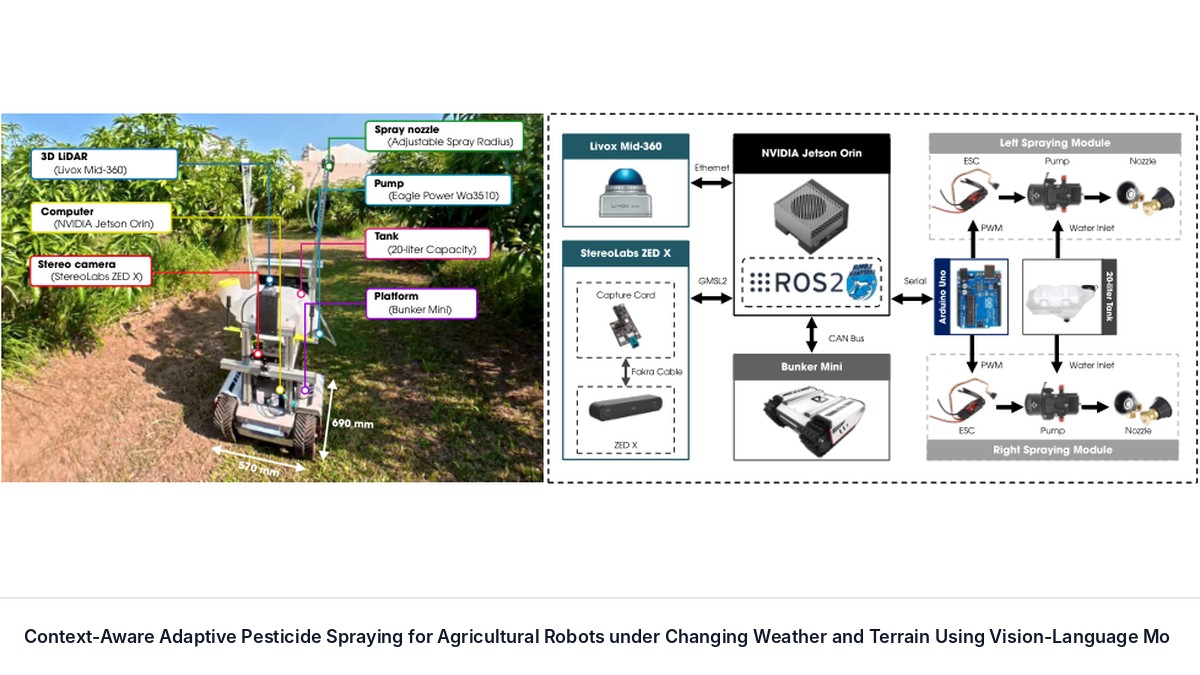
Context-Aware Adaptive Pesticide Spraying for Agricultural Robots under Changing Weather and Terrain Using Vision-Language Models
Cong-Thanh Vu, Yen-Chen Liu
Precision pesticide spraying is essential for optimizing application efficiency and ensuring uniform chemical distribution.