
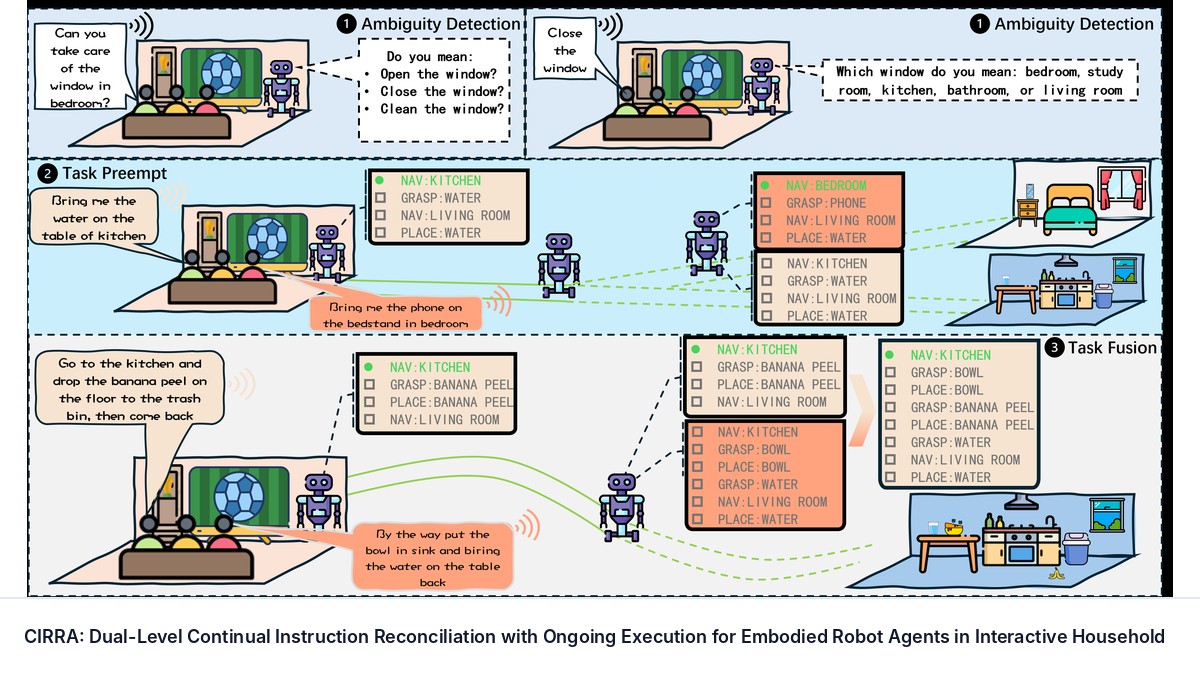
CIRRA: Dual-Level Continual Instruction Reconciliation with Ongoing Execution for Embodied Robot Agents in Interactive Household Tasks
Ci Zhang, Enfu Nan, Arman Akbari, Lin Zhao, Li Wang, Chen Wang, Weiwei Chen, Yanzhi Wang, Geng Yuan · N/A · 2026
Framework
N/A
License
N/A
Stars
N/A
Summary
Household robots must accommodate new user instructions while executing ongoing tasks. Existing agents often regenerate or extensively revise the remaining task sequence, introducing plan ambiguity, logical inconsistency, and redundant execution.
Abstract Summary
Key Points
- Household robots must accommodate new user instructions while executing ongoing tasks
- Existing agents often regenerate or extensively revise the remaining task sequence, introducing plan ambiguity, logical inconsistency, and redundant execution.
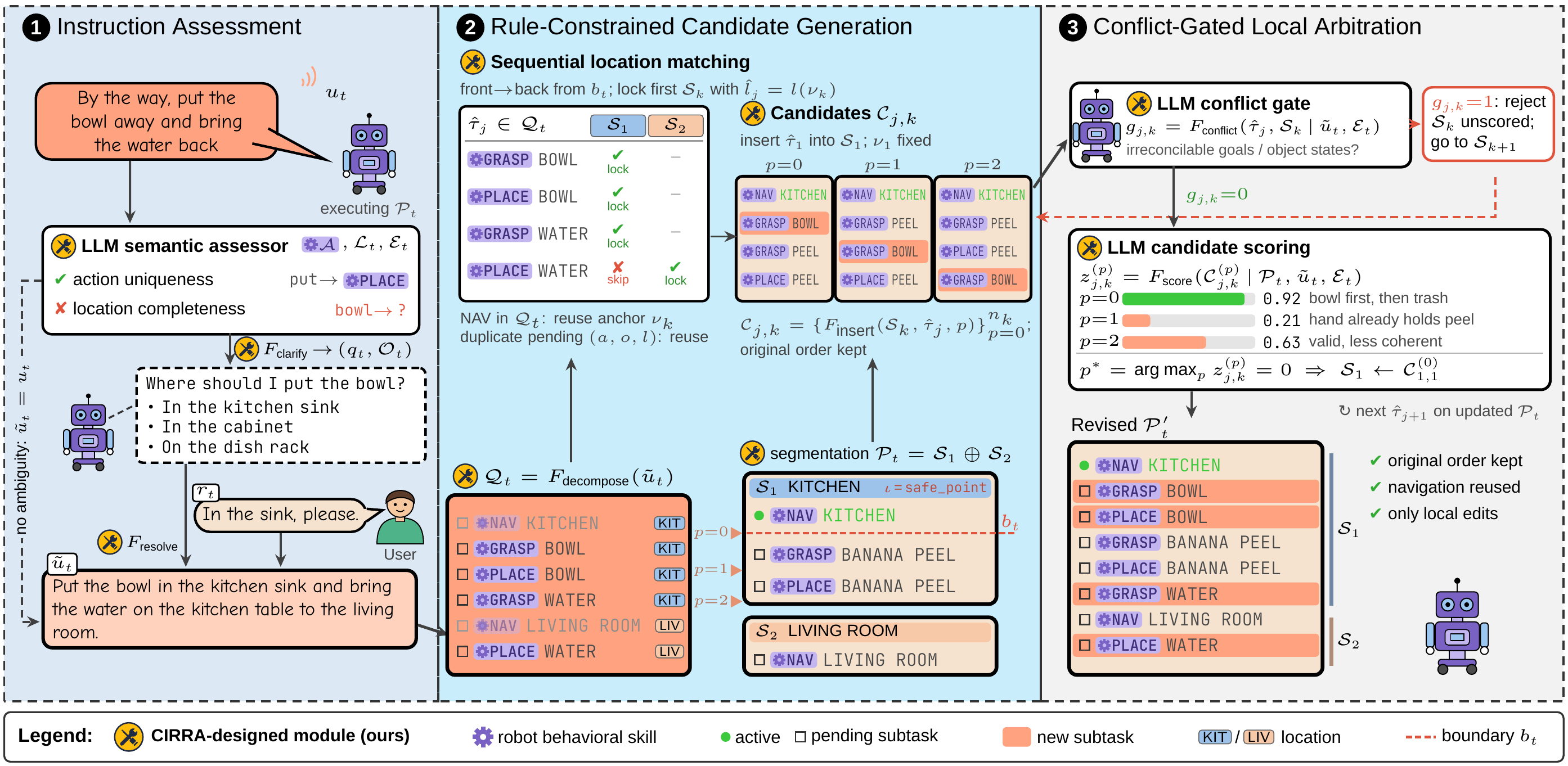
- We formulate continual instruction reconciliation and propose CIRRA (Continual Instruction Reconciliation for Robot Agents), a dual-level framework combining LLM-based semantic reasoning with rule-constrained structural integration.
- CIRRA first grounds incoming instructions to unique executable skills and resolves underspecified actions and execution locations.
- It then preserves the ongoing subtask sequence as an execution backbone and generates integration candidates by inserting incoming subtasks into location-matched segments.
Methodology
We consider an embodied robot agent that receives a new user instruction while executing an existing household task. At time step $t$, the agent maintains an ongoing task sequence where each subtask is represented using a unified tuple Here, $a_{i}$ denotes an executable robot skill.
We divide the robot skill set $\mathcal{A}$ into navigation skills $\mathcal{A}_{\mathrm{nav}}$ and non-navigation behavioral skills $\mathcal{A}_{\mathrm{beh}}$. The meanings of $o_{i}$ and $l_{i}$ depend on the corresponding skill type.
Experiments
CHIRP contains 120 episodes set in a simulated home with eight rooms, covering six action categories of 20 episodes each (appliance control, cleaning, tidying, cooking, fetch and delivery, and waste handling). Each episode freezes the moment a new utterance arrives during an ongoing task and asks for the agent’s reaction.
Episodes are built as minimal pairs with nearly identical wording but different execution states, so a method that ignores execution state must miss one episode of each pair.
Sources and Demonstrations
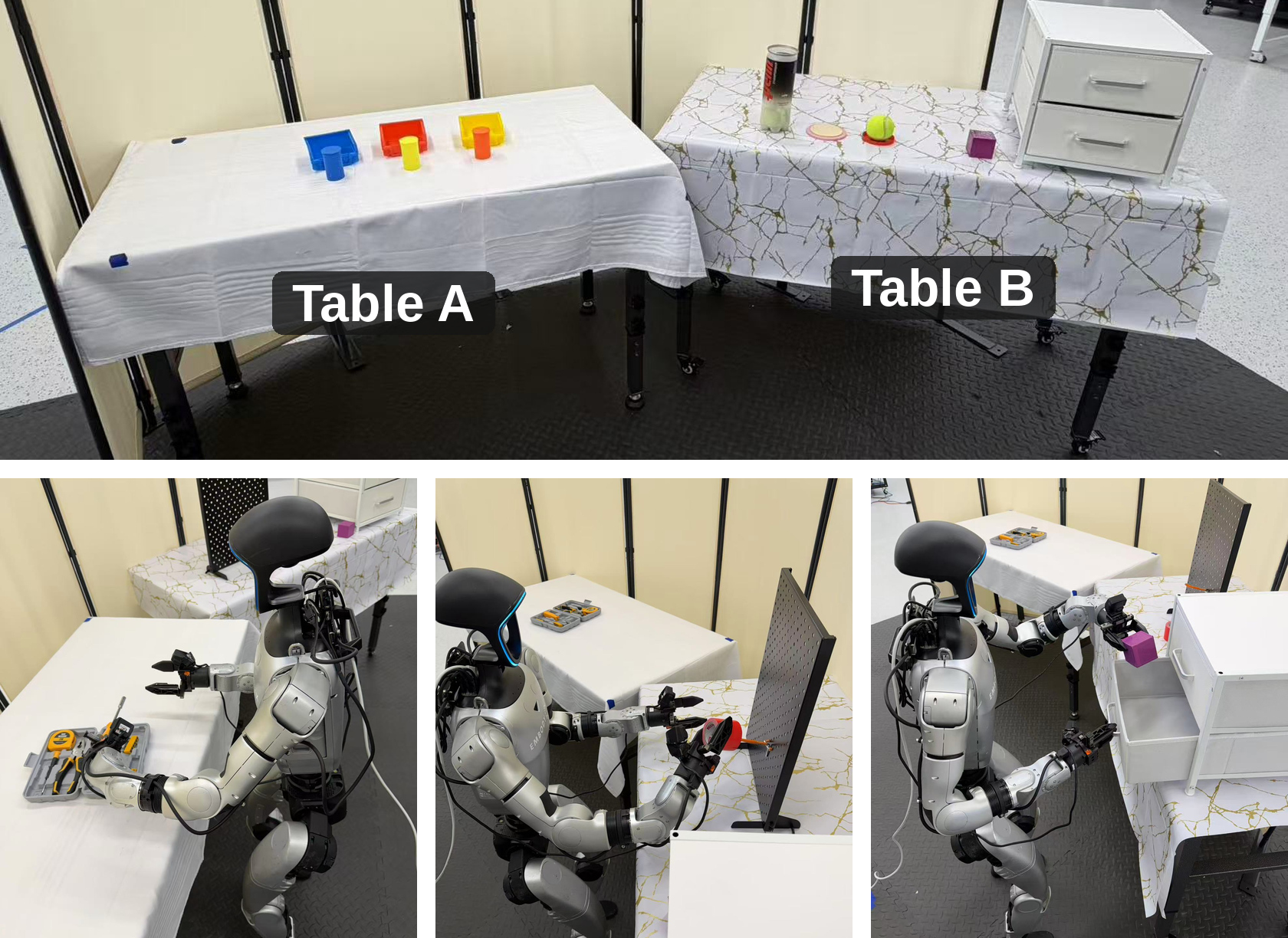
Figures are reproduced from Zhang et al. See the full paper for experimental details and the project page, when the paper links one, for demonstrations and videos.
Related Papers
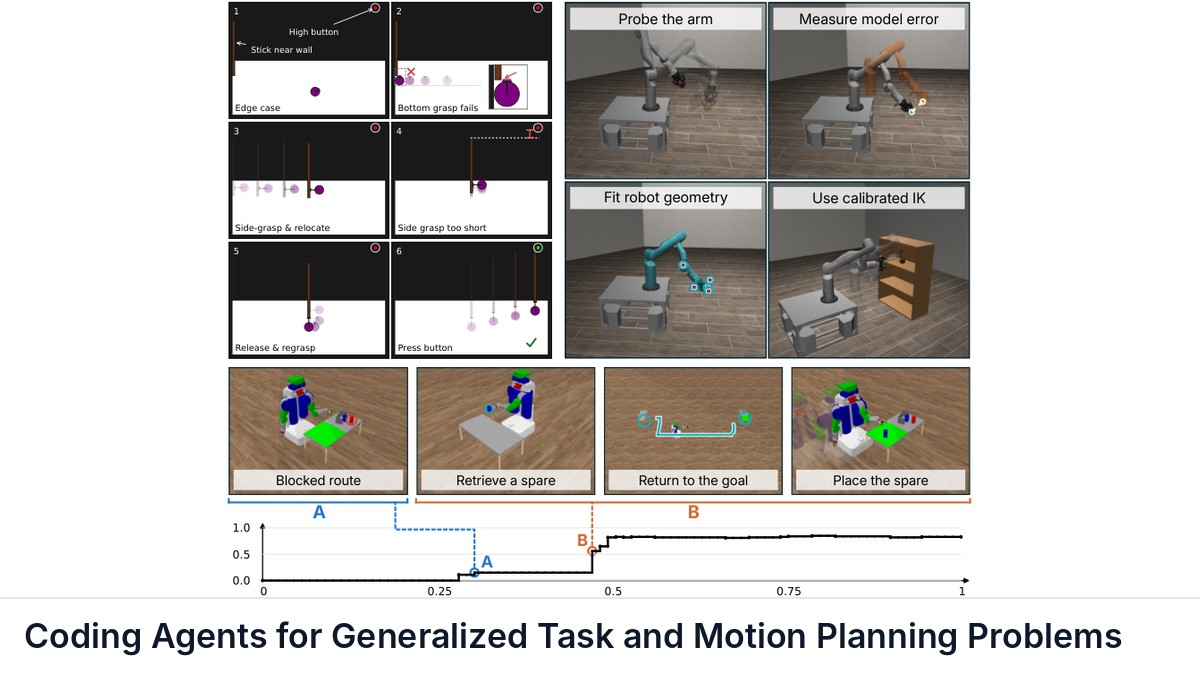
Coding Agents for Generalized Task and Motion Planning Problems
Matteo Merler, Bowen Li, Josh Roy et al.
Task and motion planning (TAMP) problems remain difficult even with full observability and object-centric states because discrete decisions are tightly coupled to geometric, kinematic, and dynamic constraints.
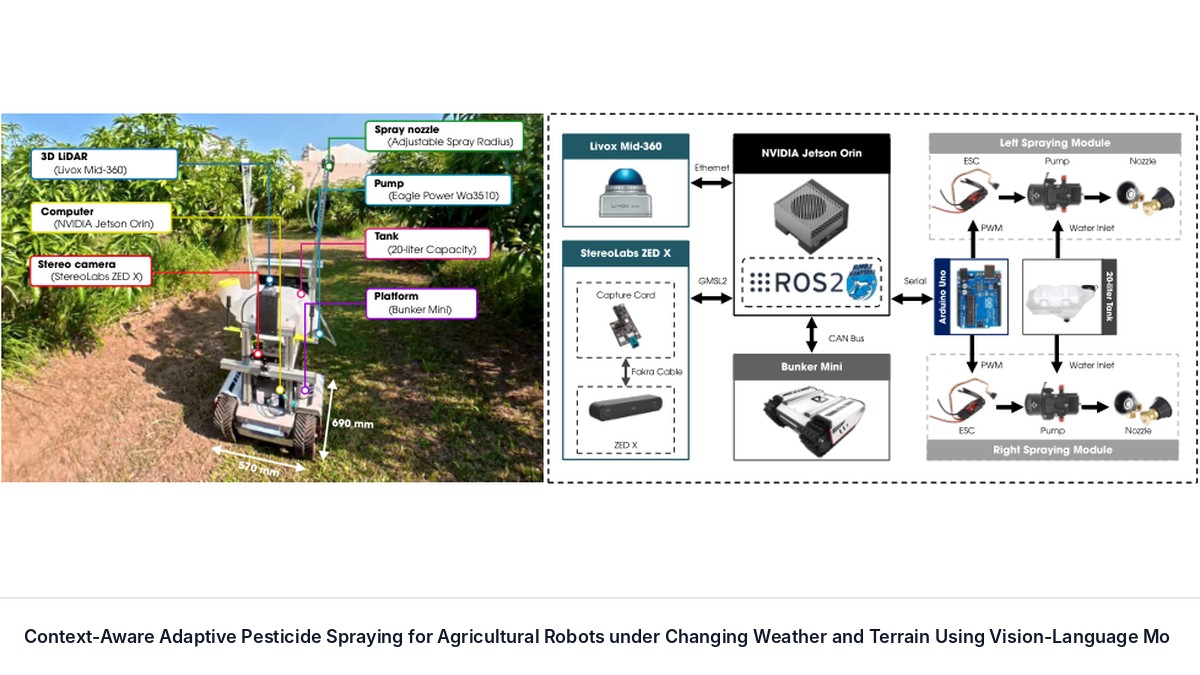
Context-Aware Adaptive Pesticide Spraying for Agricultural Robots under Changing Weather and Terrain Using Vision-Language Models
Cong-Thanh Vu, Yen-Chen Liu
Precision pesticide spraying is essential for optimizing application efficiency and ensuring uniform chemical distribution.
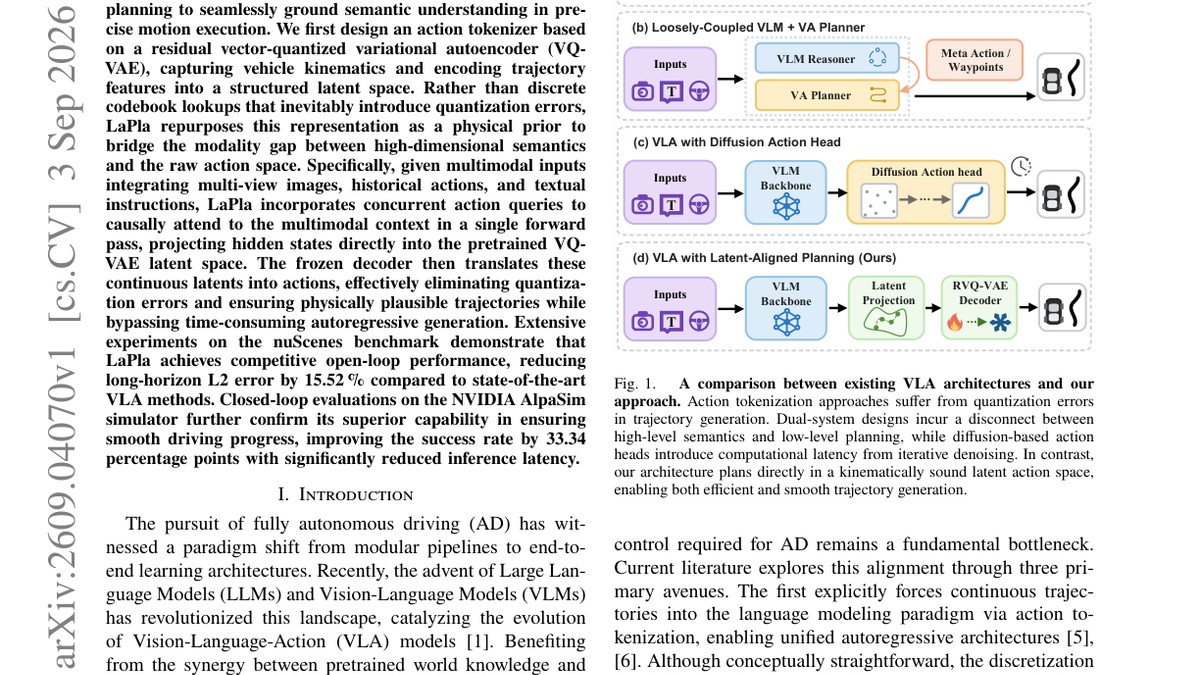
Continuous Actions from Discrete Minds: Latent-Aligned Planning for End-to-End Autonomous Driving
Ruoyu Yao, Yusen Xie, Qingzhao Liu et al.
Bridging the gap between the discrete reasoning of Vision-Language Models and the continuous, physics-constrained nature of autonomous driving remains a significant challenge.
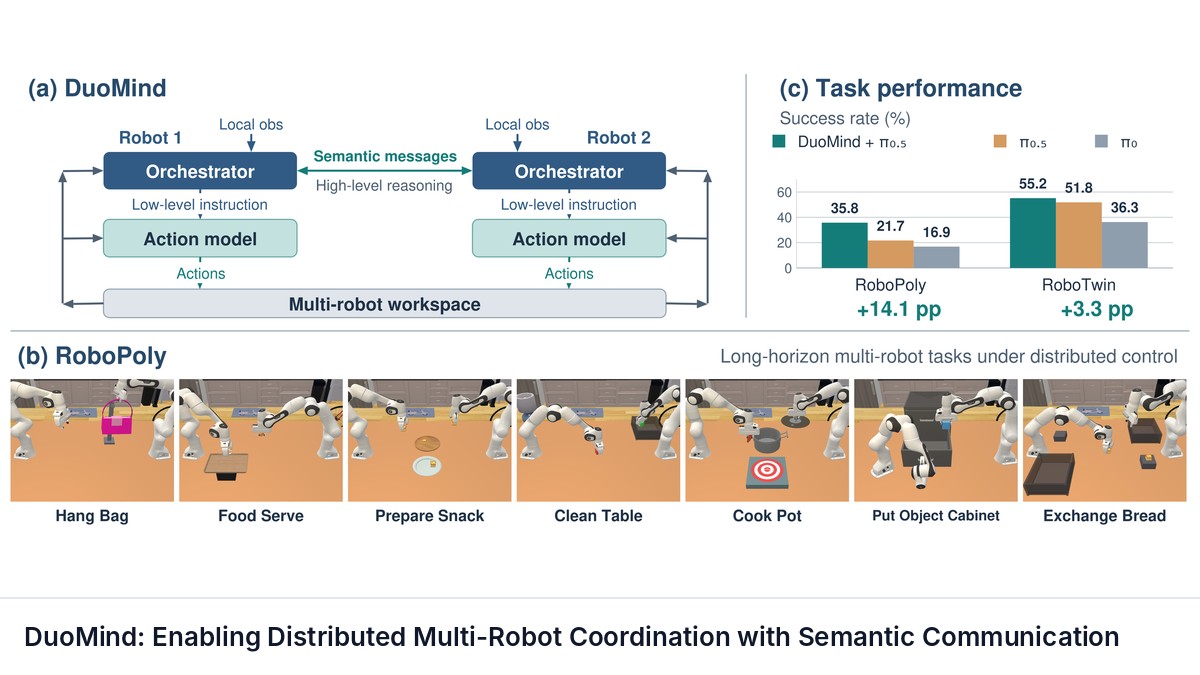
DuoMind: Enabling Distributed Multi-Robot Coordination with Semantic Communication
Hanchu Zhou, Dechen Gao, Hang Wang et al.
Vision-language models (VLMs) and vision-language-action models (VLAs) have recently driven rapid progress in general-purpose robots, yet most progress has focused on single-robot settings.