
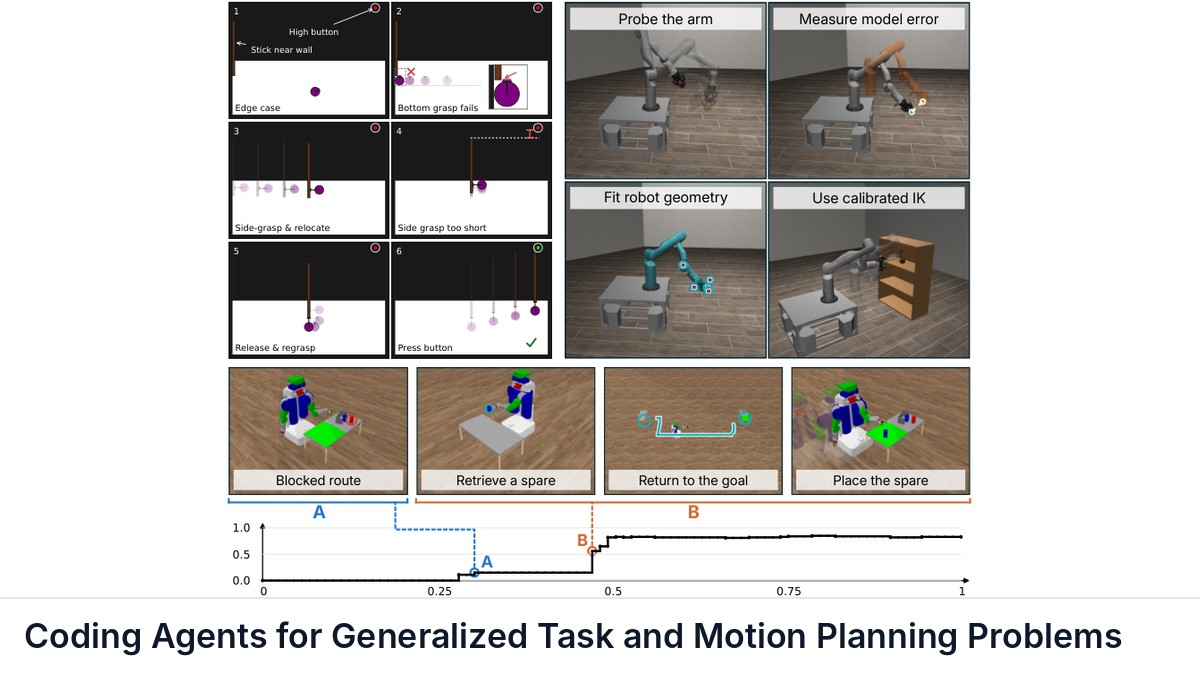
Coding Agents for Generalized Task and Motion Planning Problems
Matteo Merler, Bowen Li, Josh Roy, Yichao Liang, Qianwei Wang, Yixuan Huang, Tom Silver · N/A · 2026
Framework
N/A
License
N/A
Stars
N/A
Summary
Task and motion planning (TAMP) problems remain difficult even with full observability and object-centric states because discrete decisions are tightly coupled to geometric, kinematic, and dynamic constraints.
Abstract Summary
Key Points
- Task and motion planning (TAMP) problems remain difficult even with full observability and object-centric states because discrete decisions are tightly coupled to geometric, kinematic, and dynamic constraints.
- Generalized TAMP addresses this difficulty by exploiting regularities across problem instances to reduce planning effort on new instances.
- However, existing methods require substantial TAMP-specific engineering
- We investigate whether coding agents can automate this process by synthesizing programs that generalize across instances.
- Given a task description and simulator access, each agent chooses how to interact with the environment while developing a program within a fixed synthesis budget.
Problem Setting
We study finite-horizon, goal-directed Markov decision processes (MDPs). An MDP is a tuple $\mathcal{M}=\langle\mathcal{S},\mathcal{A},P,R,\rho,H\rangle$, where $\mathcal{S}$ and $\mathcal{A}$ are the state and action spaces, $P$ is the transition model, $R$ is a sparse reward function indicating goal achievement, $\rho$ is the initial-state distribution, and $H$ is the horizon.
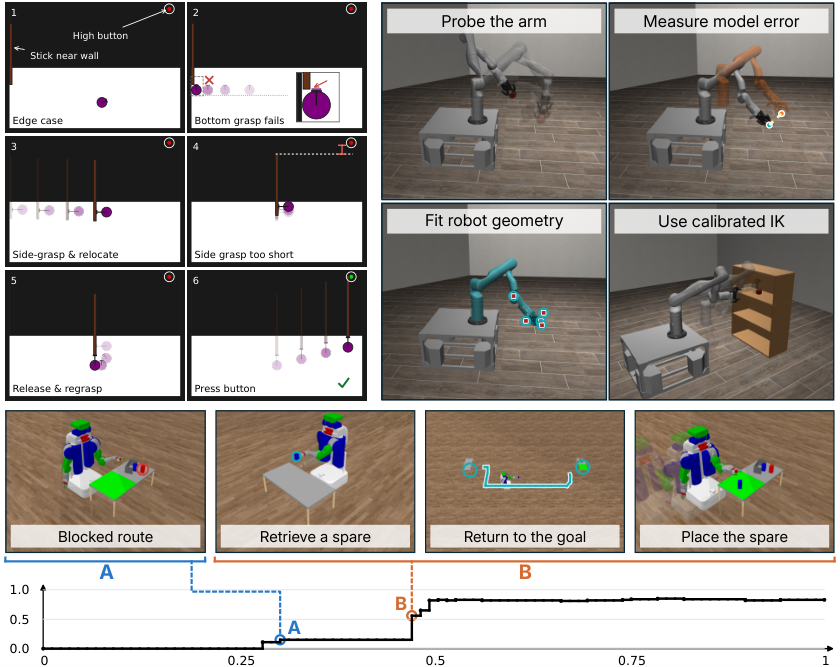
Generalized TAMP with Coding Agents
We instantiate the synthesis method described in Section II using off-the-shelf coding agents from two providers: Claude Code running Opus 5 (high), and Codex running GPT-5.6 Sol (medium) and GPT-6 Astra (high). We choose Opus 5 as the model for all baselines, so that methods are compared with the same model.
Coding agents integrate frontier LLMs with harnesses that enable them to read files, write programs, and execute arbitrary commands.
Experiments
We design experiments to answer the following questions about the efficacy and efficiency of AgenticGenPlan: Can agents write generalized programs for TAMP? What strategies do agents discover? What advantage does being “agentic” give? How efficient are the synthesized programs? Does access to environment source code help? We select the KinDER benchmark [ 20 ] as our primary benchmark.
This covers 25 environments, grouped into four families: Kinematic2D , Dynamic2D , Kinematic3D , and Dynamic3D .
Sources and Demonstrations
Figures are reproduced from Merler et al. See the full paper for experimental details and the project page, when the paper links one, for demonstrations and videos.
Related Papers
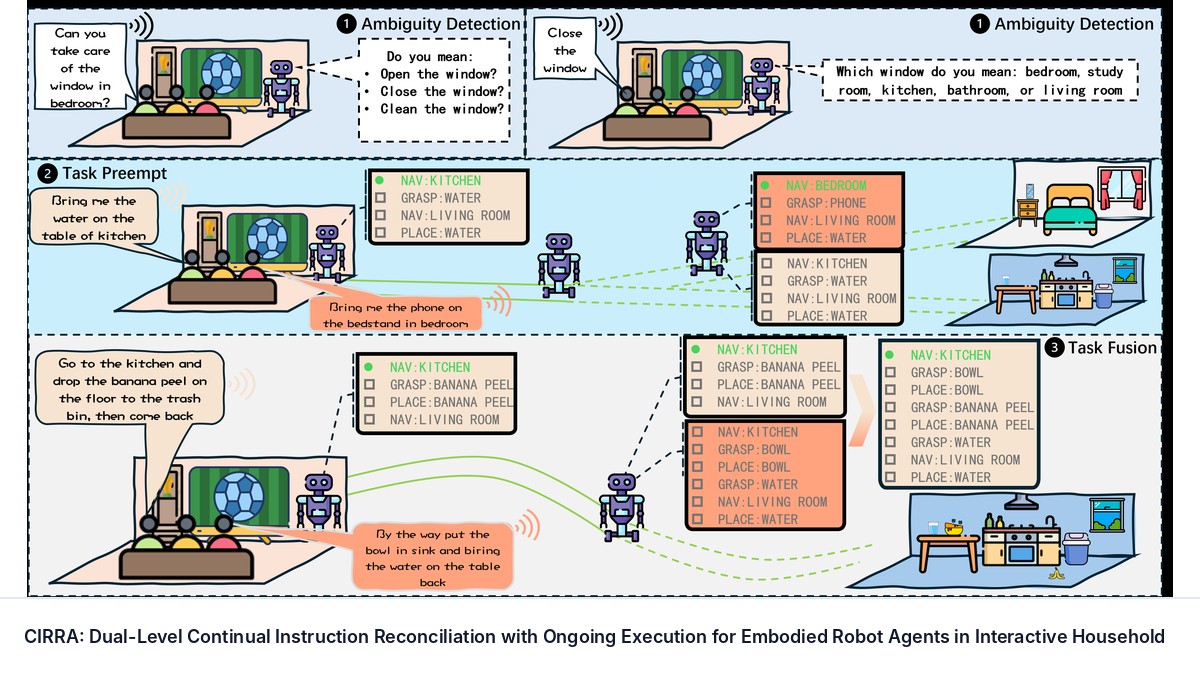
CIRRA: Dual-Level Continual Instruction Reconciliation with Ongoing Execution for Embodied Robot Agents in Interactive Household Tasks
Ci Zhang, Enfu Nan, Arman Akbari et al.
Household robots must accommodate new user instructions while executing ongoing tasks. Existing agents often regenerate or extensively revise the remaining task sequence, introducing plan ambiguity, logical inconsistency, and redundant execution.
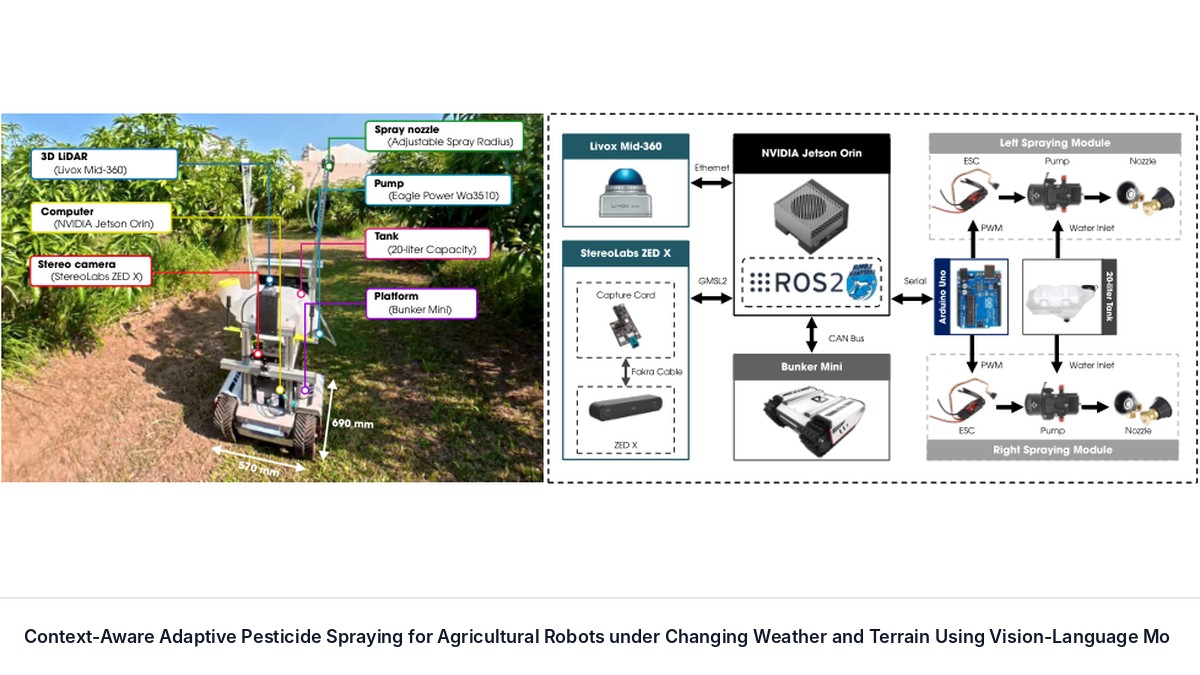
Context-Aware Adaptive Pesticide Spraying for Agricultural Robots under Changing Weather and Terrain Using Vision-Language Models
Cong-Thanh Vu, Yen-Chen Liu
Precision pesticide spraying is essential for optimizing application efficiency and ensuring uniform chemical distribution.
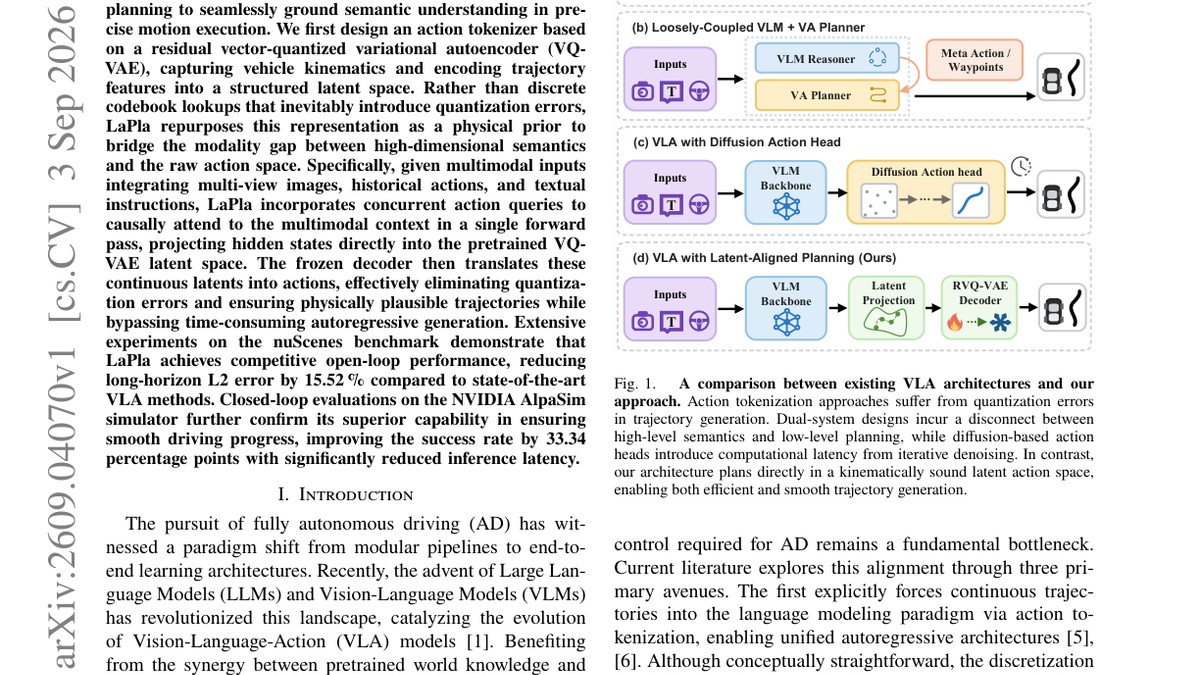
Continuous Actions from Discrete Minds: Latent-Aligned Planning for End-to-End Autonomous Driving
Ruoyu Yao, Yusen Xie, Qingzhao Liu et al.
Bridging the gap between the discrete reasoning of Vision-Language Models and the continuous, physics-constrained nature of autonomous driving remains a significant challenge.
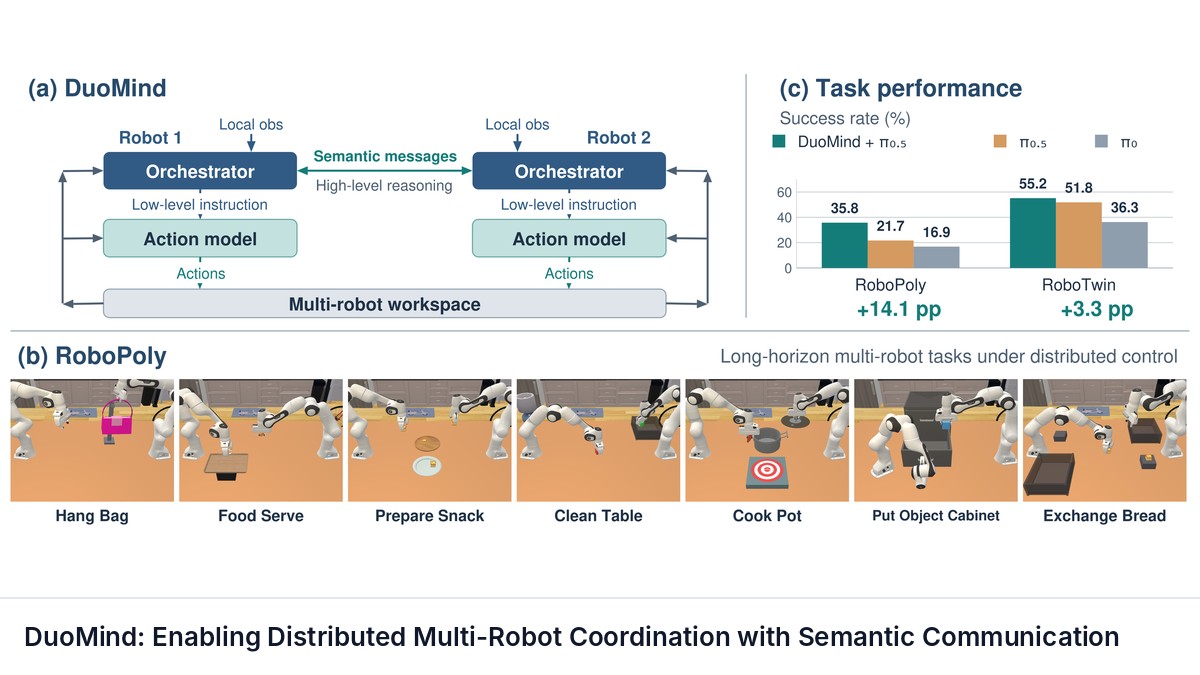
DuoMind: Enabling Distributed Multi-Robot Coordination with Semantic Communication
Hanchu Zhou, Dechen Gao, Hang Wang et al.
Vision-language models (VLMs) and vision-language-action models (VLAs) have recently driven rapid progress in general-purpose robots, yet most progress has focused on single-robot settings.