
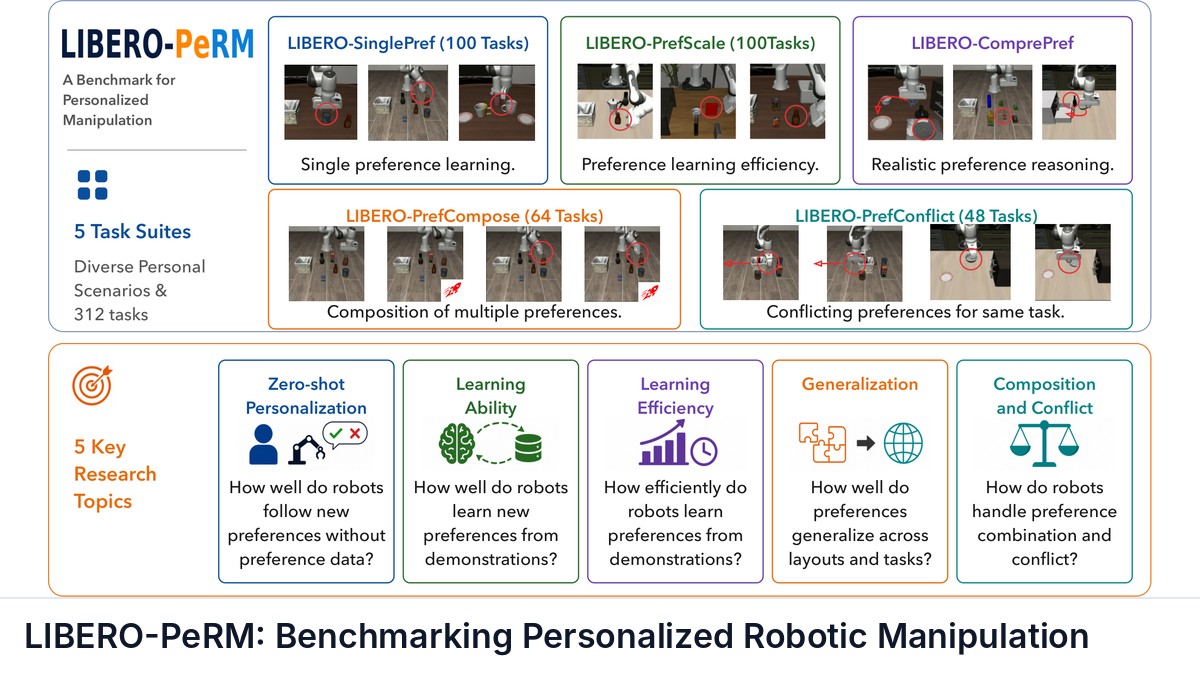
LIBERO-PeRM: Benchmarking Personalized Robotic Manipulation
Zhixu Li, Keqian Tang, Litian Gong, Jingyu Yao, Wenqian Zhang, Tianze Xu, Zehao Wang, Yuping Wang, Junge Zhang, Jiachen Li · N/A · 2026
Framework
N/A
License
N/A
Stars
N/A
Summary
Personalization is essential for general-purpose robots to transition into household environments and achieve true practicality.
Abstract Summary
Key Points
- Personalization is essential for general-purpose robots to transition into household environments and achieve true practicality.
- While general robotic manipulation has been extensively studied, personalized robotic manipulation (PeRM) lacks a controlled benchmark for separating task completion from preference satisfaction.
- We introduce LIBERO-PeRM, a benchmark for preference learning in embodied agents
- LIBERO-PeRM studies five questions: 1) how policies follow preferences in zero-shot settings; 2) how they learn single preferences from demonstrations; 3) how efficiently they acquire preferences as demonstrations increase; 4) how learned preferences generalize across layouts and tasks; and 5) how policies compose preferences and behave under conflicts.
- We propose a controlled formulation and taxonomy of observable preferences in simulation, covering motion, skill, and user-profile choices.
The LIBERO-PeRM Benchmark
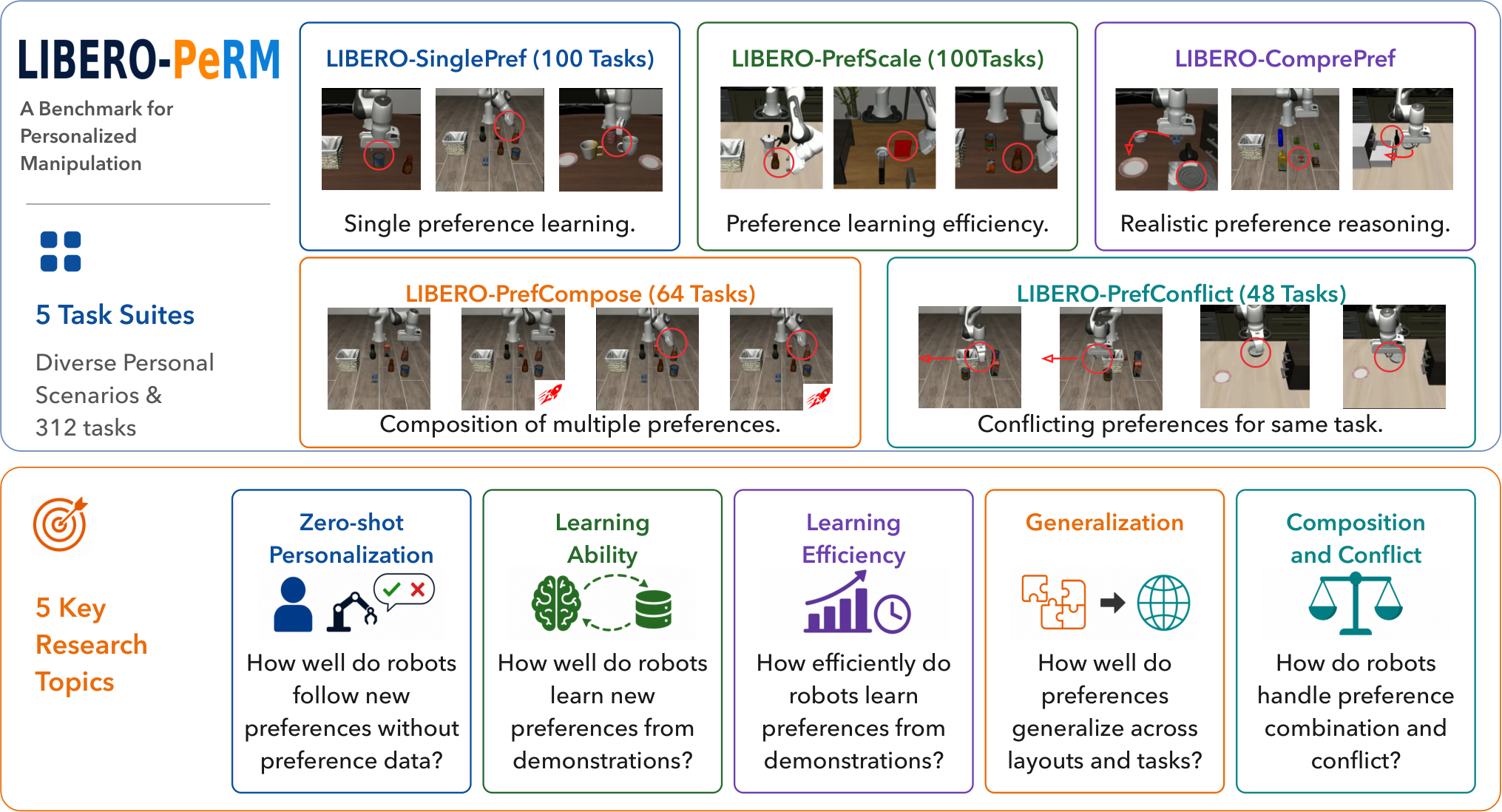
This section introduces the four components of LIBERO-PeRM. Section 3.1 defines what preferences are; Section 3.2 describes the procedural preference data generation pipeline; Section 3.3 defines the five task suites used for benchmarking; and Section 3.4 defines the evaluation methodologies. Preference describes the relative desirability among alternatives [ 71 ] .
Experiments
We conduct experiments on the five task suites introduced in Section 3.3 to evaluate zero-shot personalization, preference learning ability, preference learning efficiency, preference generalization, composition, and behavior under conflicts. Our experiments focus on the following research questions: Q1. Can off-the-shelf policies follow preferences without preference-specific training? Q2.
Can supervised fine-tuning teach policies to satisfy preferences on seen tasks and layouts? Q3.
Sources and Demonstrations
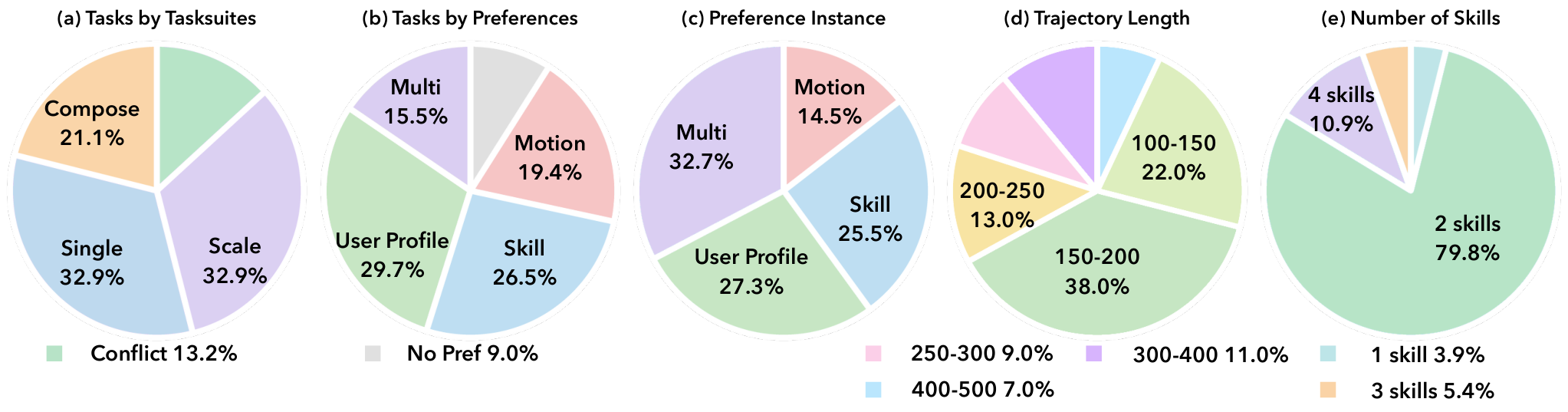
Figures are reproduced from Li et al. See the full paper for experimental details and the project page, when the paper links one, for demonstrations and videos.
Related Papers

A Sim-to-Real Integration Pipeline for Training and Deployment of Chunk-Based VLA Manipulation Policies
Mathilde Kappel, Clémence Grislain, Mohamed Chetouani et al.
Vision-Language-Action (VLA) models have become a prominent paradigm for mapping multimodal inputs, including semantic instructions, visual observations of the scene, and proprioceptive observations, to robot actions.

Capability-Aware Arbitration for Semantic Intent-Based Shared Control
Zhaoda Du, Michael Bowman, Xiaoli Zhang
Shared control often allocates robot authority based on confidence in inferred human intent, assuming reliable autonomous execution. When this assumption fails, high intent confidence can cause over-helping.
DexVerse: A Modular Benchmark for Multi-Task, Multi-Embodiment Dexterous Manipulation
Yunchao Yao, Zhuxiu Xu, Tianqi Zhang et al.
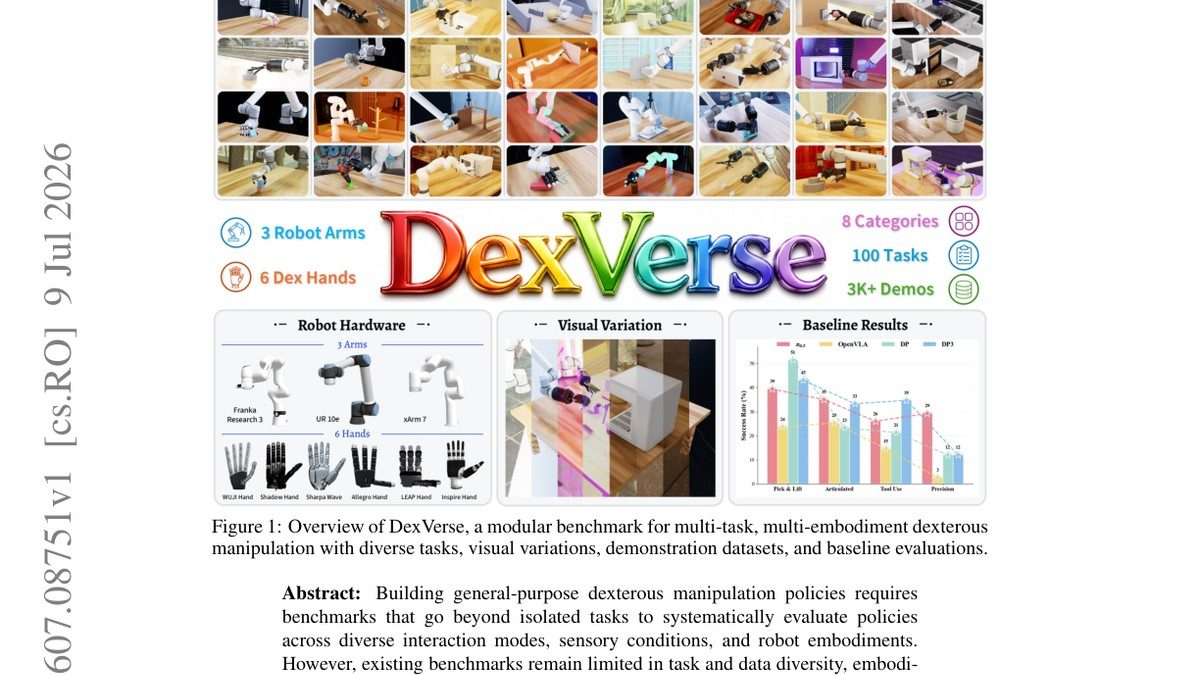
Building general-purpose dexterous manipulation policies requires benchmarks that go beyond isolated tasks to systematically evaluate policies across diverse interaction modes, sensory conditions, and robot embodiments.
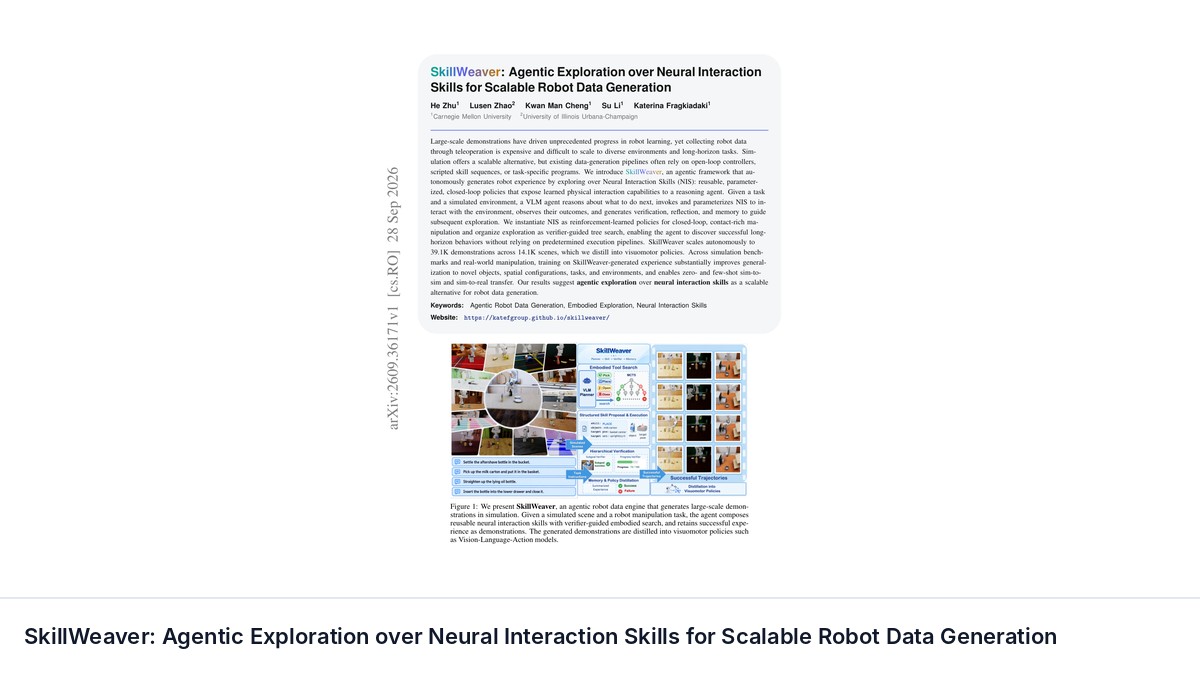
SkillWeaver: Agentic Exploration over Neural Interaction Skills for Scalable Robot Data Generation
He Zhu, Lusen Zhao, Kwan Man Cheng et al.
Large-scale demonstrations have driven unprecedented progress in robot learning, yet collecting robot data through teleoperation is expensive and difficult to scale to diverse environments and long-horizon tasks.