
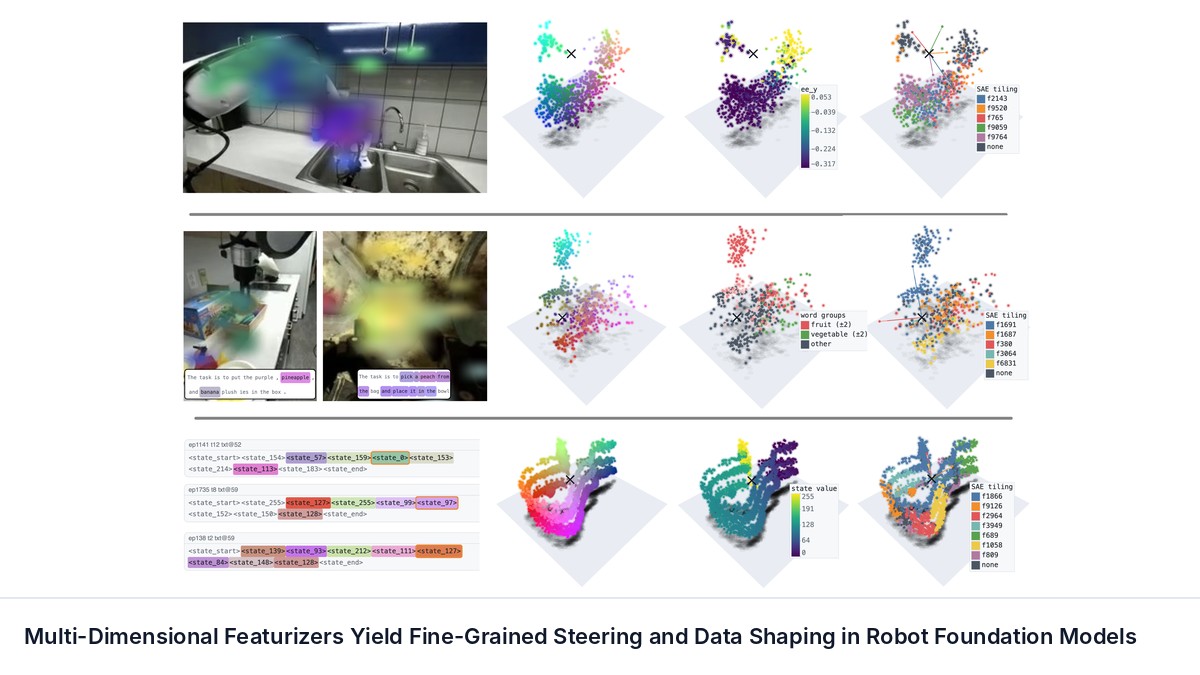
Multi-Dimensional Featurizers Yield Fine-Grained Steering and Data Shaping in Robot Foundation Models
Aiden Swann, Mozes Jacobs, Mathilde Papillon, Siddharth Boppana, David Chanin, Dron Hazra, Usha Bhalla, Curt Tigges, Mac Schwager, Owen Lewis, Jack Merullo, Ekdeep Singh Lubana, Atticus Geiger, Thomas Fel, Matthew Kowal · N/A · 2026
Framework
N/A
License
N/A
Stars
N/A
Summary
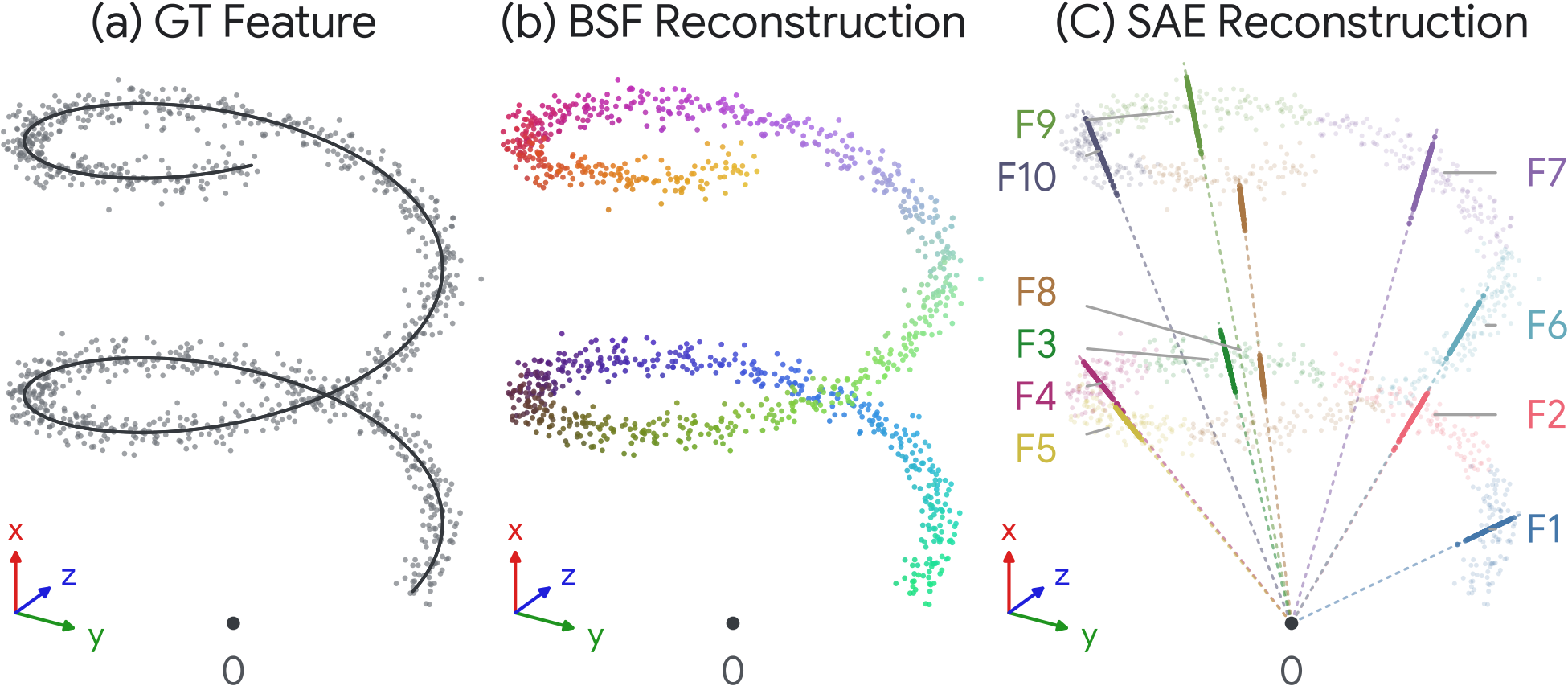
Can better feature discovery improve control over robot behavior through internal interventions and training data? Recent work in vision and language models reveals multidimensional features, motivating block-sparse featurizers (BSFs), which represent each feature in a low-dimensional subspace.
Abstract Summary
Key Points
- Can better feature discovery improve control over robot behavior through internal interventions and training data?
- Recent work in vision and language models reveals multidimensional features, motivating block-sparse featurizers (BSFs), which represent each feature in a low-dimensional subspace.
- We investigate whether recovering this structure provides an interpretable interface for steering vision-language-action models and shaping the data from which they learn.
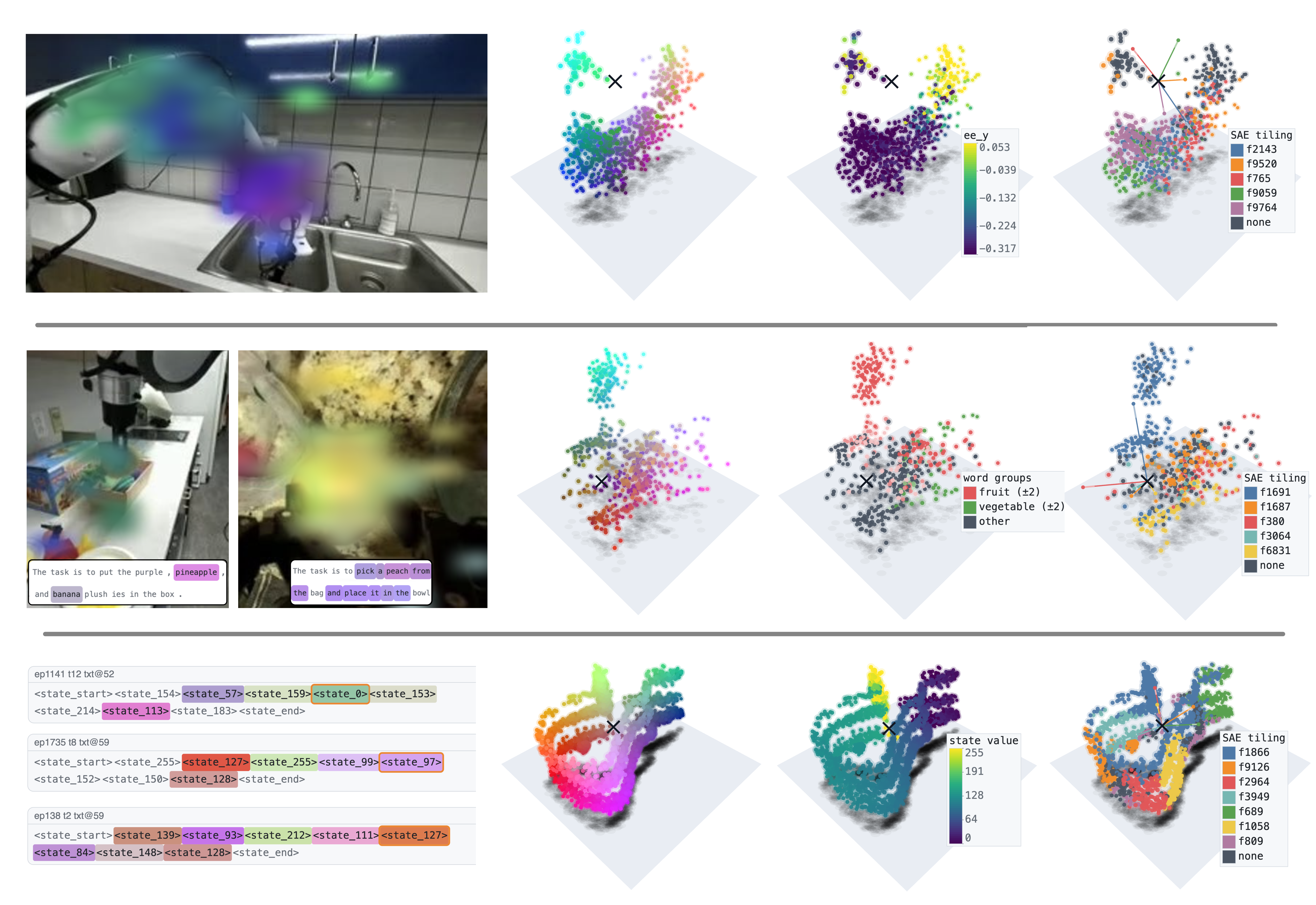
- We show that BSFs recover several multi-dimensional task-relevant features underlying the model's computation (e.g., perception, language, proprioceptive state, episode phase, and control variables).
- We causally validate these features through fine-grained steering: targeted changes in visual perception, semantic representation, and spatial localization produce predictable changes in downstream action prediction.
From Sparse Directions to Sparse Subspaces
The goal of a featurizer is to factorize model activations into a set of interpretable concepts ( Huben et al., 2024 ; Bricken et al., 2023 ; Gao et al., 2025 ; Bussmann et al., 2024 ; Rajamanoharan et al., 2024 ; Fel et al., 2025 ; Hindupur et al., 2025 ; Bussmann et al., 2025 ) . Moreover, each featurizer also implicitly encodes a hypothesis about how activations are generated Hindupur et al. (2025) .
Choosing a featurizer for a VLA therefore requires matching this geometry to the variables the policy represents and computes.
Results
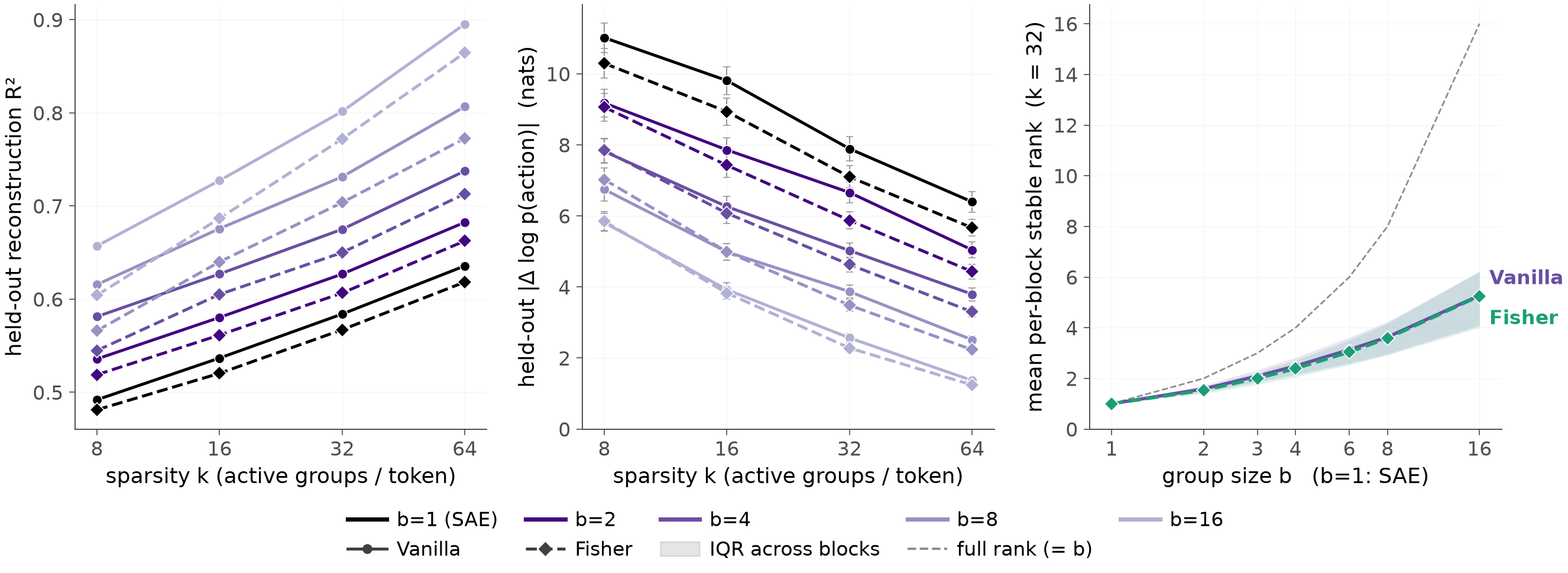
Given the featurizers covered in Section 2 , we now turn to the features they discover and the understanding and control they admit. We first perform a quantitative comparison of BSFs to SAEs ( Section 3.1 ) and causally validate the discovered features through open- and closed-loop steering experiments ( Section 3.2 ).
We then review a broad range of feature phenomenology, spanning visual, language, control, and proprioceptive features ( Section 3.3 ).
Application: Behavior Shaping via Data Attribution
We next ask whether a discovered feature can identify training data responsible for a policy behavior, and whether filtering that data predictably changes the learned policy. We focus on F1515 (Figure 9 ), a three-dimensional BSF feature in layer nine of $\pi_{0.5}$ that activates during recovery from failed grasps .
We identified it using a small dataset of our own rollouts Figure 9 shows the feature’s geometry and activations during repeated grasp failures and corrections in a DROID demonstration (top) and a real-robot rollout (bottom).
Sources and Demonstrations
Figures are reproduced from Swann et al. See the full paper for experimental details and the project page, when the paper links one, for demonstrations and videos.
Related Papers

A Sim-to-Real Integration Pipeline for Training and Deployment of Chunk-Based VLA Manipulation Policies
Mathilde Kappel, Clémence Grislain, Mohamed Chetouani et al.
Vision-Language-Action (VLA) models have become a prominent paradigm for mapping multimodal inputs, including semantic instructions, visual observations of the scene, and proprioceptive observations, to robot actions.
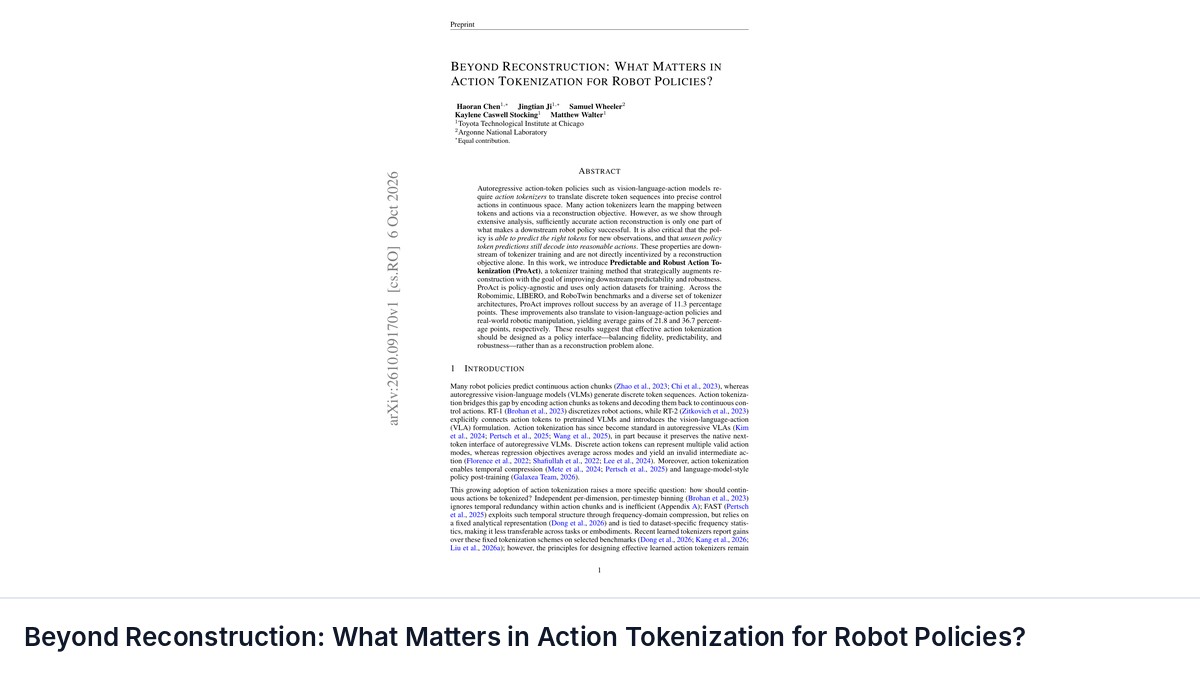
Beyond Reconstruction: What Matters in Action Tokenization for Robot Policies?
Haoran Chen, Jingtian Ji, Samuel Wheeler et al.
Autoregressive action-token policies such as vision-language-action models require action tokenizers to translate discrete token sequences into precise control actions in continuous space. Many action tokenizers learn the mapping between tokens and actions via a reconstruction objective.

Capability-Aware Arbitration for Semantic Intent-Based Shared Control
Zhaoda Du, Michael Bowman, Xiaoli Zhang
Shared control often allocates robot authority based on confidence in inferred human intent, assuming reliable autonomous execution. When this assumption fails, high intent confidence can cause over-helping.
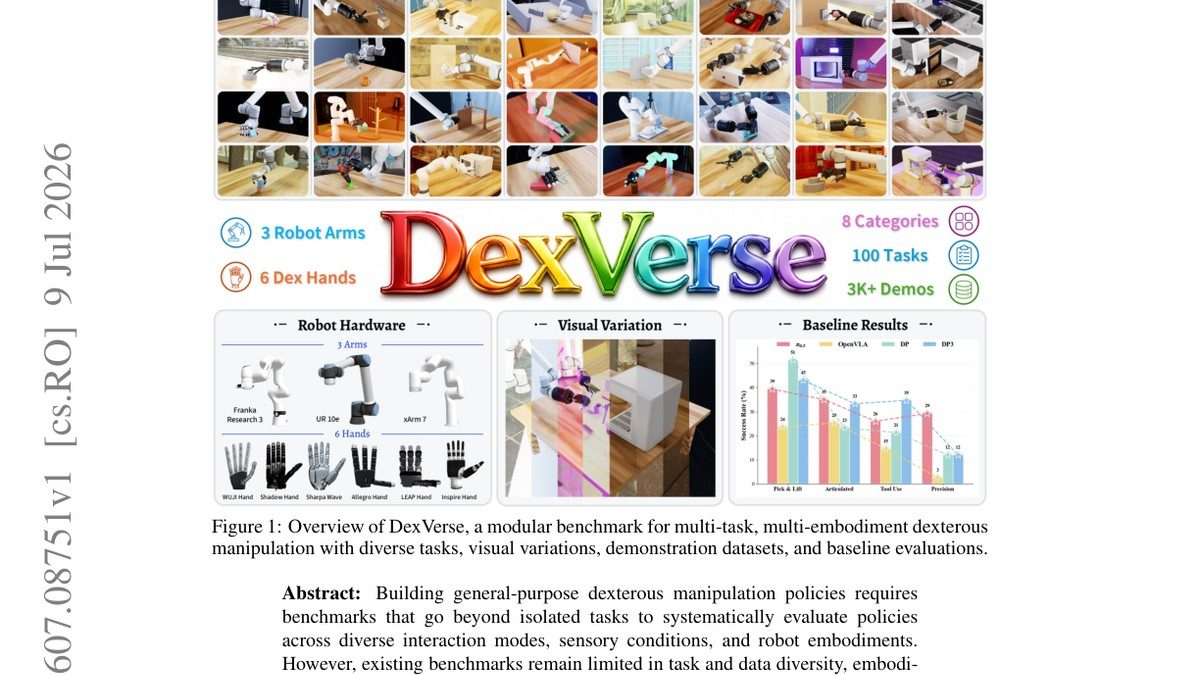
DexVerse: A Modular Benchmark for Multi-Task, Multi-Embodiment Dexterous Manipulation
Yunchao Yao, Zhuxiu Xu, Tianqi Zhang et al.
Building general-purpose dexterous manipulation policies requires benchmarks that go beyond isolated tasks to systematically evaluate policies across diverse interaction modes, sensory conditions, and robot embodiments.