
Training-Free Multi-Agent Cooperative Embodied Search from Uncertain Vision-Language Priors
Fan Pu, Keshu Wu, Jiwan Jiang, Shiyu Shen, Zhiwen Fan, Zhengzhong Tu, Jiachen Li, Yang Zhou · N/A · 2026
Framework
N/A
License
N/A
Stars
N/A
Summary
Real-world Vision-Language Navigation (VLN) requires agents to act under partial observability, where map structure, semantic cues, and target locations may be incomplete or incorrectly inferred by foundation models.
Abstract Summary
Key Points
- Real-world Vision-Language Navigation (VLN) requires agents to act under partial observability, where map structure, semantic cues, and target locations may be incomplete or incorrectly inferred by foundation models.
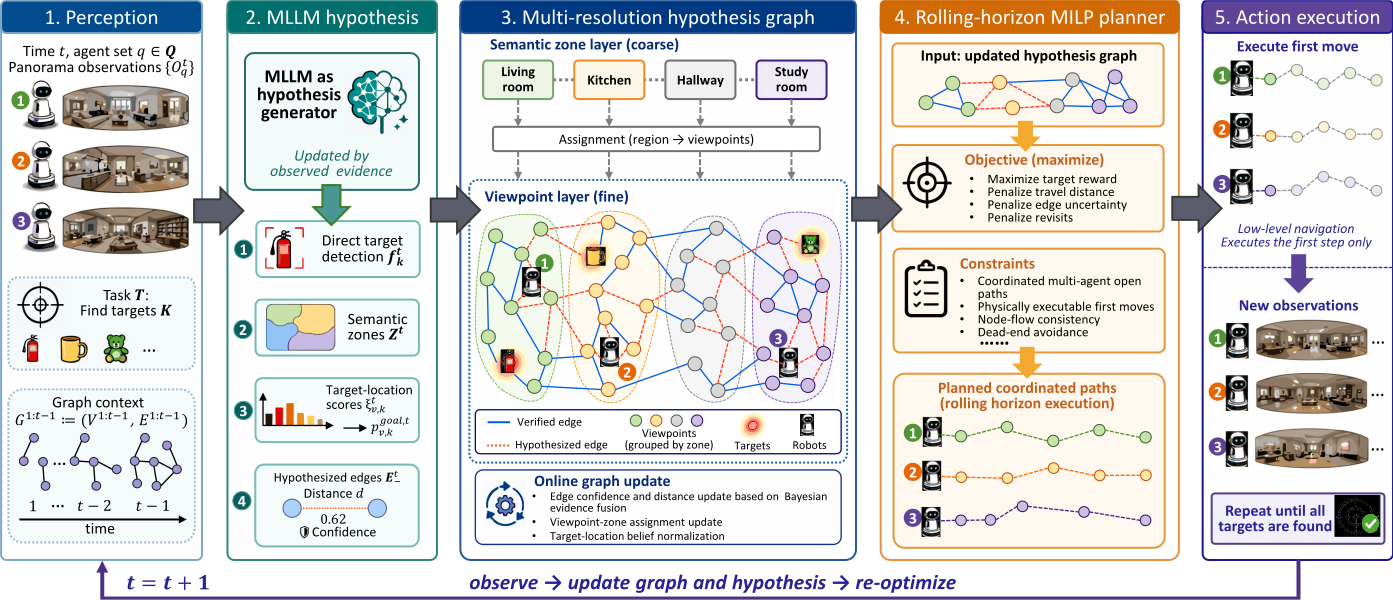
- This paper presents a lightweight, training-free, and uncertainty-aware framework for cooperative multi-agent multi-target search in mapless environments.
- Instead of learning an end-to-end navigation policy, the framework separates high-level semantic reasoning from low-level execution through a scalable graph-optimization backbone.
- Multimodal Large Language Models (MLLMs) serve only as hypothesis generators, proposing semantic zones, target-location cues, and possible navigable connections.
- These outputs are treated as uncertain priors and further refined using online observations and graph-context evidence.
Problem Formulation
We consider cooperative embodied search in partially observed, mapless environments, where a team of robots $\mathbf{Q}$ must locate multiple targets $\mathbf{K}$ without prior knowledge of the environment topology, semantic regions, traversable connections, or target locations. As illustrated in Figure 1 , the proposed framework follows a closed-loop hypothesize–verify–optimize–execute process.
Experiments
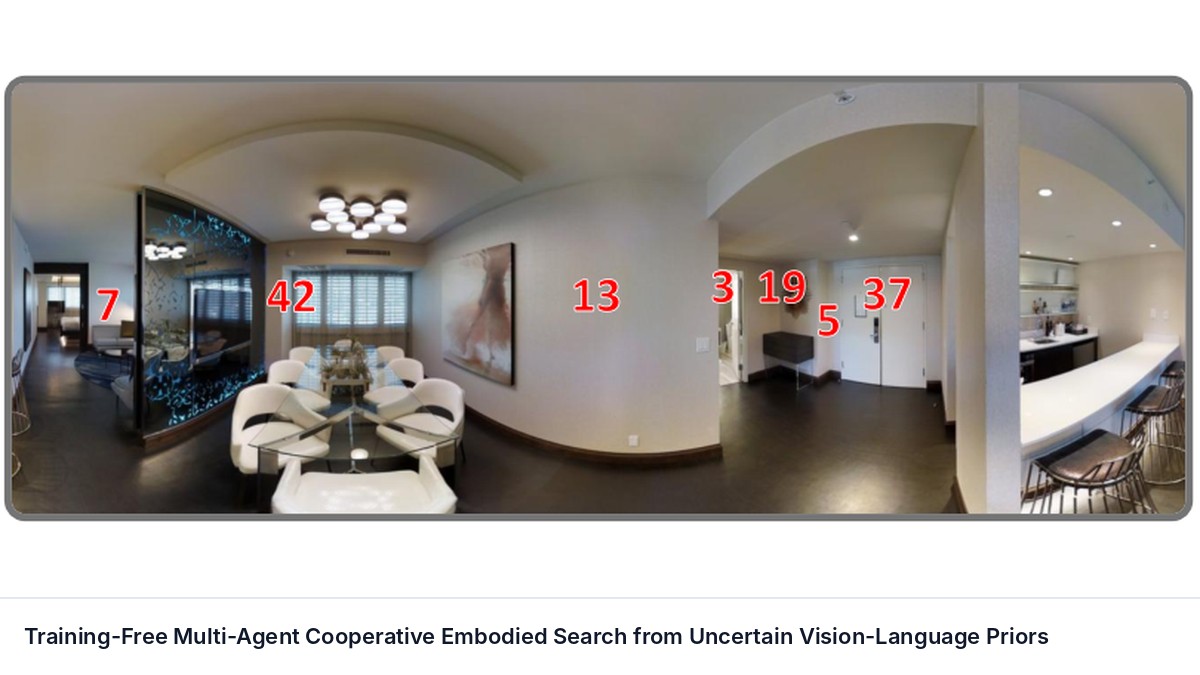
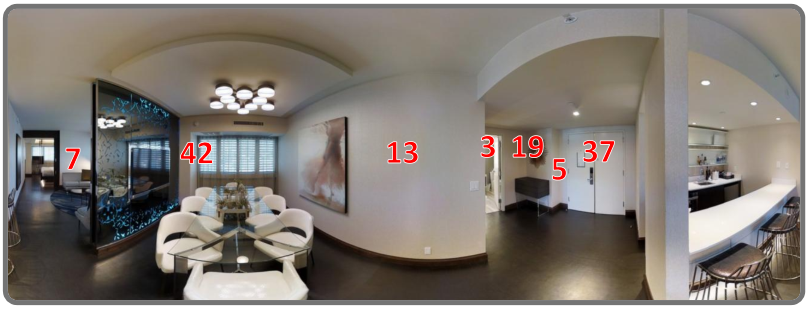
We evaluate the proposed framework and comparison methods in the Matterport3D Simulator [ 6 ] . The evaluation consists of 100 test cases drawn from five indoor scans in the Matterport3D dataset [ 55 ] . For each scan, target objects are manually selected and annotated with a textual description and the indices of viewpoints whose panoramas contain the target.
These visibility annotations are used exclusively by the offline Oracle and for performance evaluation.
Sources and Demonstrations
Figures are reproduced from Pu et al. See the full paper for experimental details and the project page, when the paper links one, for demonstrations and videos.
Related Papers
End-to-End Vision-Language-Action Policies for Autonomous Lunar Rover Docking
Sitan Huang, Grace Gao
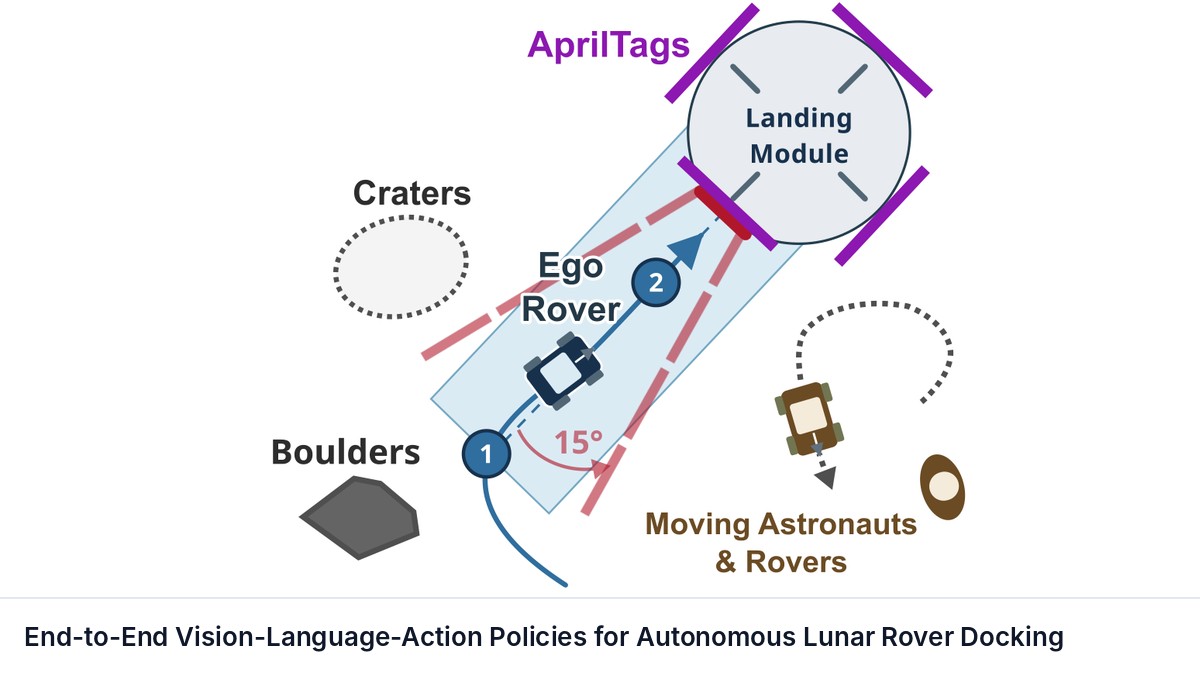
Surface navigation on the Moon is subject to extreme illumination contrast and deployment-time perceptual disturbances.
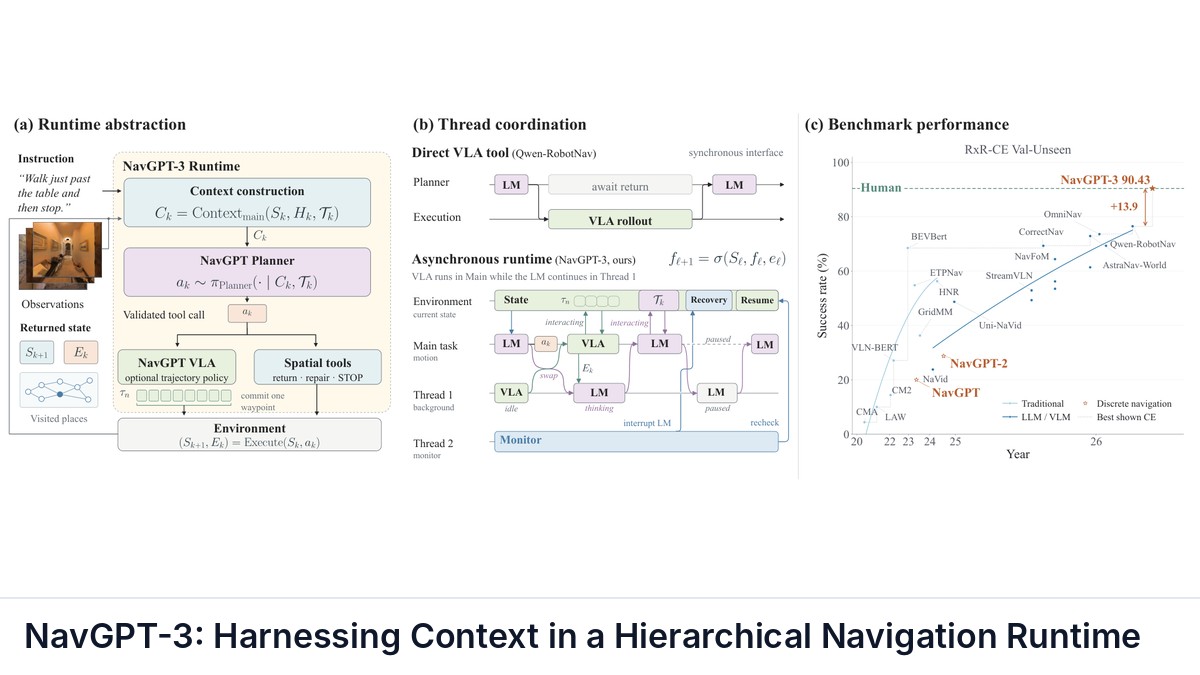
NavGPT-3: Harnessing Context in a Hierarchical Navigation Runtime
Gengze Zhou, Yicong Hong, Jiazhao Zhang et al.
Language models trained with long-horizon agentic reinforcement learning can generalize knowledge through reasoning, express precise actions, and pursue goals over many steps, raising the ceiling on what an embodied agent can understand and decide.
Planning-Oriented End-to-End Autonomous Driving: Architectures, Evaluation, and Emerging Paradigms
Yanchen Guan, Xingcheng Liu, Bin Rao et al.
End-to-end autonomous driving has evolved from camera-to-control regression toward planning-oriented systems that use structured representations, trajectory-level outputs, and increasingly realistic evaluation protocols.
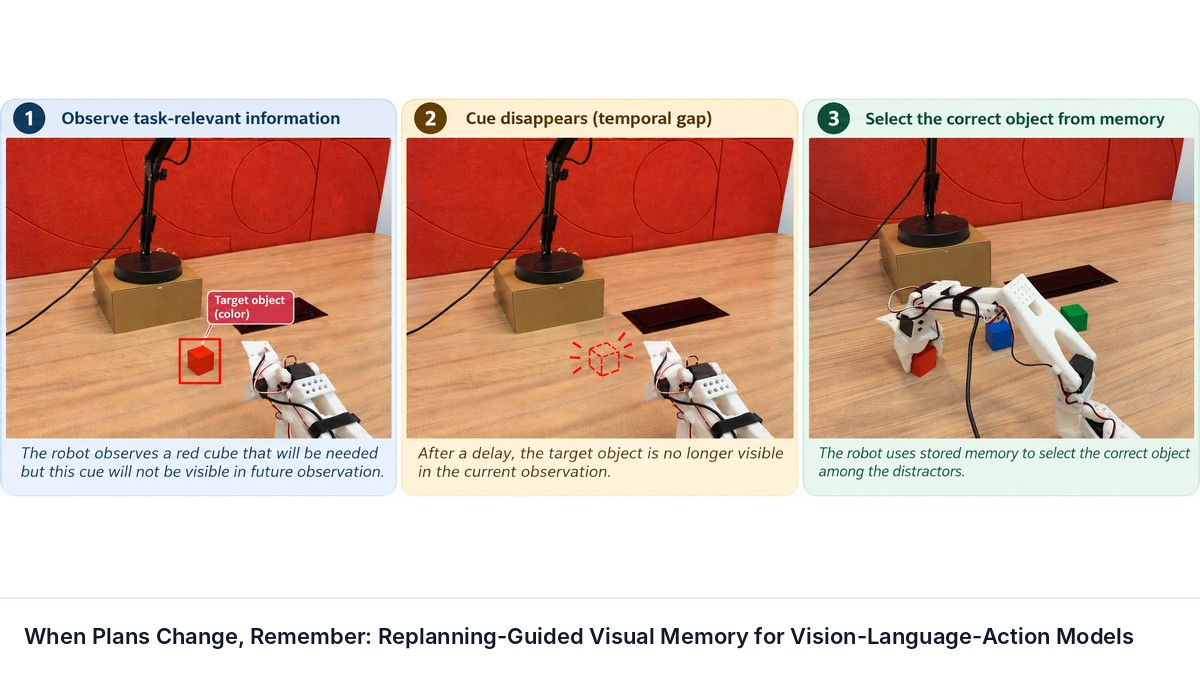
When Plans Change, Remember: Replanning-Guided Visual Memory for Vision-Language-Action Models
Victoria Smelova, Daniil Kazachkov, Georgiy Kazantsev et al.
Long-horizon, multi-stage Vision-Language-Action (VLA) policies often require visual information that is no longer present in the current observation. Retaining the complete observation history is computationally expensive and highly redundant, motivating selective visual memory.