
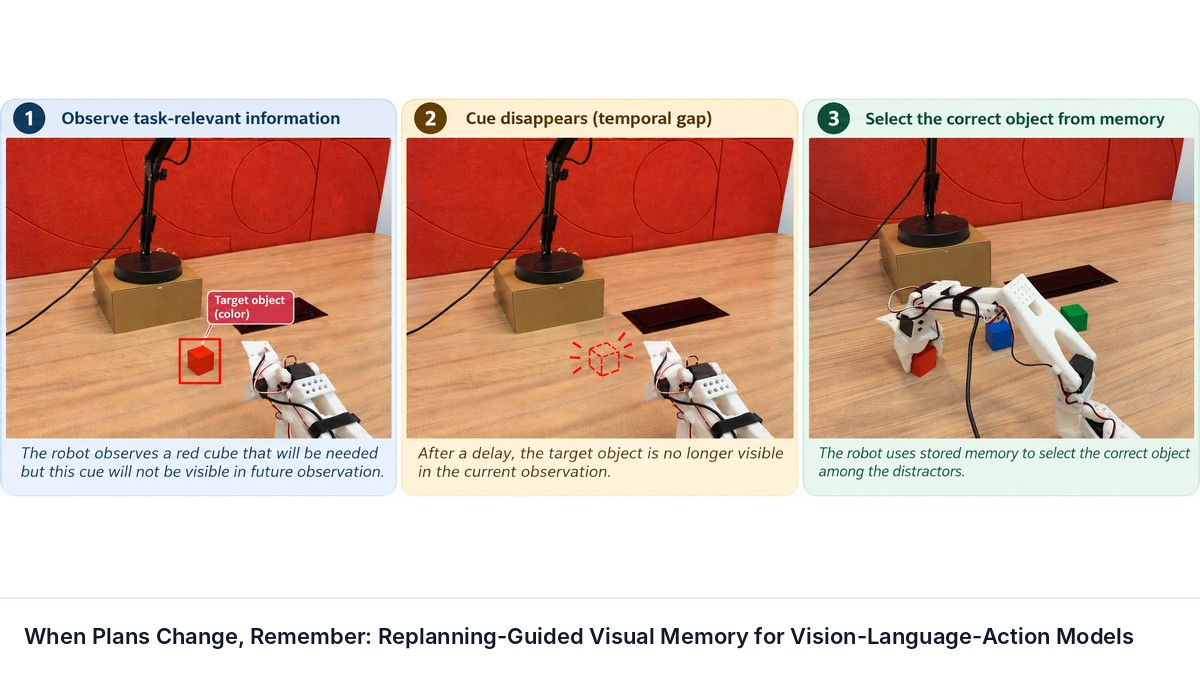
When Plans Change, Remember: Replanning-Guided Visual Memory for Vision-Language-Action Models
Victoria Smelova, Daniil Kazachkov, Georgiy Kazantsev, Iuliia Tsvetkova, Egor Cherepanov, Nikita Kachaev, Artem Latyshev, Aleksandr I. Panov, Alexey K. Kovalev · N/A · 2026
Framework
N/A
License
N/A
Stars
N/A
Summary
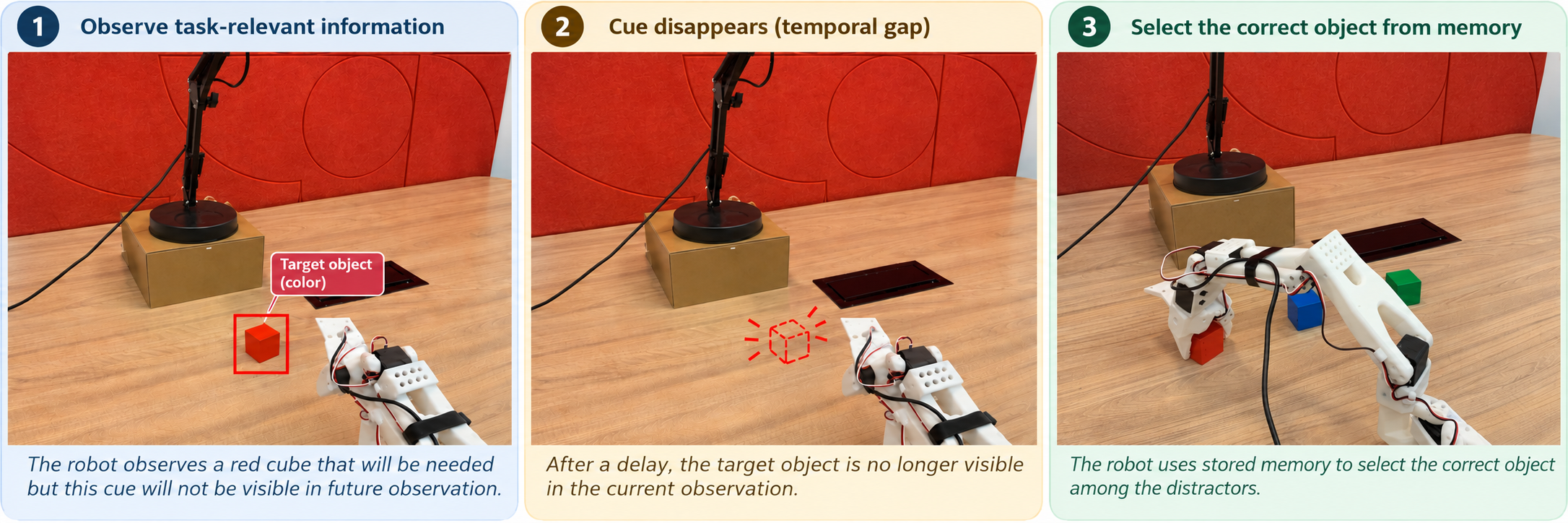
Long-horizon, multi-stage Vision-Language-Action (VLA) policies often require visual information that is no longer present in the current observation. Retaining the complete observation history is computationally expensive and highly redundant, motivating selective visual memory.
Abstract Summary
Key Points
- Long-horizon, multi-stage Vision-Language-Action (VLA) policies often require visual information that is no longer present in the current observation.
- Retaining the complete observation history is computationally expensive and highly redundant, motivating selective visual memory.
- We introduce RePlanMem-VLA (Replanning-Guided Keyframe Memory for VLA), which turns a policy's own plan revisions into an online memory-write signal.
- Under receding-horizon execution, consecutive action chunks predict some of the same future actions
- RePlanMem-VLA treats unusually large disagreement between these temporally aligned predictions as evidence of a task-relevant event.
RePlanMem-VLA
In long-horizon manipulation, task-relevant visual information often leaves the cameras before it is needed. A policy that sees only the current frame cannot recover that cue, so we concatenate the live views with a bounded visual memory of $B$ slots. Slots are empty at the start of an episode and are never carried across episode boundaries.
The policy predicts a chunk of $K$ actions from one observation and executes only the first $H 1 and 4 and Algorithm 1 summarize the procedure.
Experimental evaluation
Does revision of overlapping action chunks contain a task-relevant signal, and which disagreement measures extract it most reliably? Does this signal transfer to pretrained VLA policies across different backbones and replanning frequencies, and can it support accurate online event detection? Can the resulting surprise signal be used to drive selective visual-memory updates during VLA fine-tuning?
We first examine whether disagreement between overlapping action predictions contains task-relevant information using single-task autoregressive and F...

Sources and Demonstrations
Figures are reproduced from Smelova et al. See the full paper for experimental details and the project page, when the paper links one, for demonstrations and videos.
Related Papers
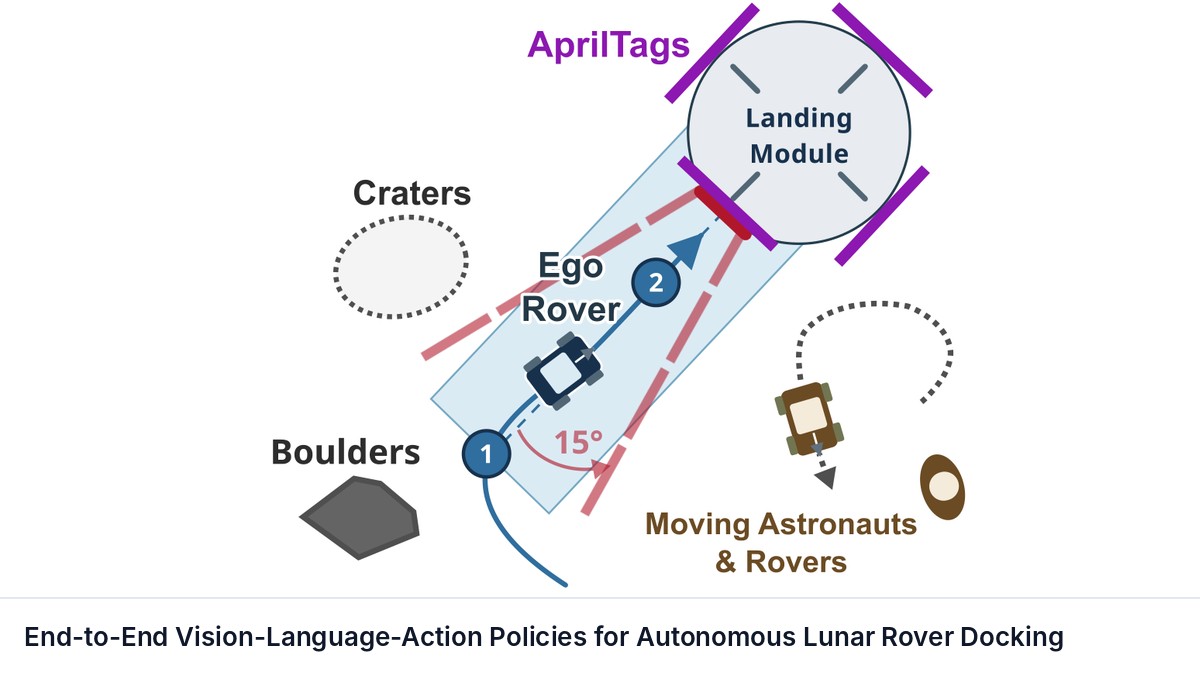
End-to-End Vision-Language-Action Policies for Autonomous Lunar Rover Docking
Sitan Huang, Grace Gao
Surface navigation on the Moon is subject to extreme illumination contrast and deployment-time perceptual disturbances.
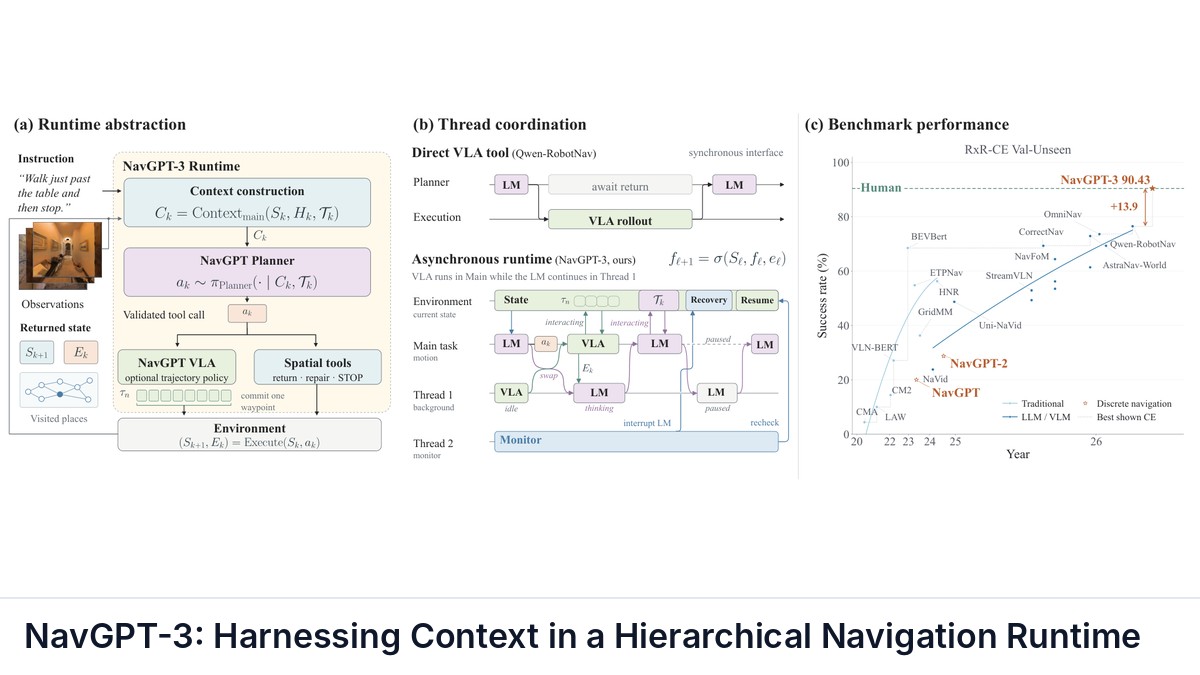
NavGPT-3: Harnessing Context in a Hierarchical Navigation Runtime
Gengze Zhou, Yicong Hong, Jiazhao Zhang et al.
Language models trained with long-horizon agentic reinforcement learning can generalize knowledge through reasoning, express precise actions, and pursue goals over many steps, raising the ceiling on what an embodied agent can understand and decide.
Planning-Oriented End-to-End Autonomous Driving: Architectures, Evaluation, and Emerging Paradigms
Yanchen Guan, Xingcheng Liu, Bin Rao et al.
End-to-end autonomous driving has evolved from camera-to-control regression toward planning-oriented systems that use structured representations, trajectory-level outputs, and increasingly realistic evaluation protocols.
Training-Free Multi-Agent Cooperative Embodied Search from Uncertain Vision-Language Priors
Fan Pu, Keshu Wu, Jiwan Jiang et al.
Real-world Vision-Language Navigation (VLN) requires agents to act under partial observability, where map structure, semantic cues, and target locations may be incomplete or incorrectly inferred by foundation models.