
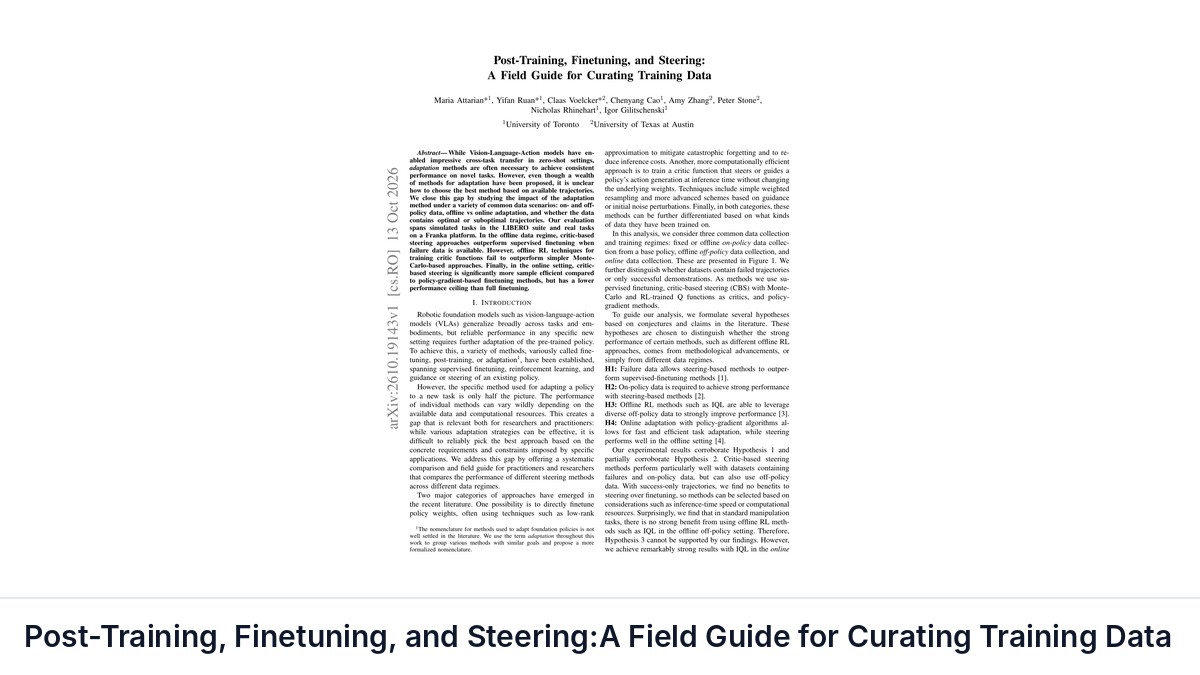
Post-Training, Finetuning, and Steering:A Field Guide for Curating Training Data
Maria Attarian, Yifan Ruan, Claas Voelcker, Chenyang Cao, Amy Zhang, Peter Stone, Nicholas Rhinehart, Igor Gilitschenski · N/A · 2026
Framework
N/A
License
N/A
Stars
N/A
Summary
While Vision-Language-Action models have enabled impressive cross-task transfer in zero-shot settings, \emph{adaptation} methods are often necessary to achieve consistent performance on novel tasks.
Abstract Summary
Key Points
- While Vision-Language-Action models have enabled impressive cross-task transfer in zero-shot settings, \emph{adaptation} methods are often necessary to achieve consistent performance on novel tasks.
- However, even though a wealth of methods for adaptation have been proposed, it is unclear how to choose the best method based on available trajectories.
- We close this gap by studying the impact of the adaptation method under a variety of common data scenarios: on- and off-policy data, offline vs online adaptation, and whether the data contains optimal or suboptimal trajectories.
- Our evaluation spans simulated tasks in the LIBERO suite and real tasks on a Franka platform
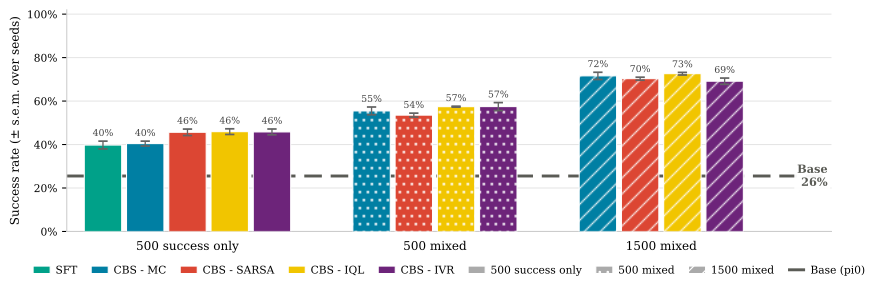
- In the offline data regime, critic-based steering approaches outperform supervised finetuning when failure data is available.
An Overview of Policy Adaptation
We will first establish policy adaptation formally, and then discuss different data regimes used by various adaptation methods. We use policy adaptation to refer to any technique that improves a pre-trained policy’s performance on novel tasks. For pretrained foundation models, such as VLAs, this is also called post-training .
Since foundation model training can involve several pre- and post-training stages, we adopt a less ambiguous term. Policy adaptation techniques share a common structure.

Evaluation of Adaptation Approaches in Simulation
We test the ability of four representative approaches to improve performance of a pre-trained VLA on tasks from the LIBERO benchmark [ 30 ] , which offers a variety of pick-and-place tasks and setups. However, not all methods can be meaningfully combined with every data regime.
Supervised finetuning only uses success data, and is therefore inapplicable in a mixed data regime, while steering-based methods can be executed in every data regime.
Evaluation of Adaptation Approaches in the Real World
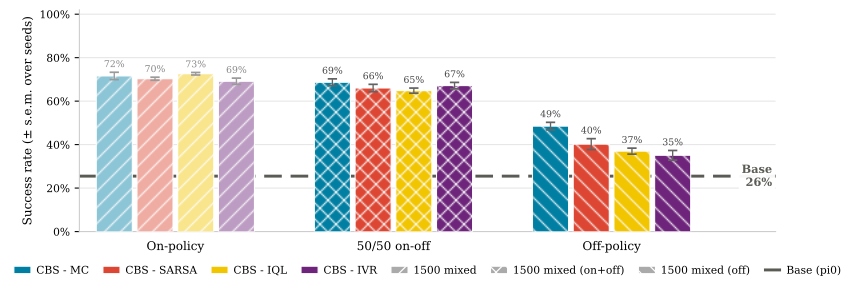
Our real world experiments serve to corroborate our main finding which is the strong impact of the data distribution on performance. As all critic training methods performed similarly to each other, we refrain from retraining all critic variants on real data. We use a Franka arm configured following the DROID setup [ 25 ] . $\pi_{0.5}$ finetuned on DROID data serves as the base policy.
Sources and Demonstrations
Figures are reproduced from Attarian et al. See the full paper for experimental details and the project page, when the paper links one, for demonstrations and videos.
Related Papers

A Sim-to-Real Integration Pipeline for Training and Deployment of Chunk-Based VLA Manipulation Policies
Mathilde Kappel, Clémence Grislain, Mohamed Chetouani et al.
Vision-Language-Action (VLA) models have become a prominent paradigm for mapping multimodal inputs, including semantic instructions, visual observations of the scene, and proprioceptive observations, to robot actions.
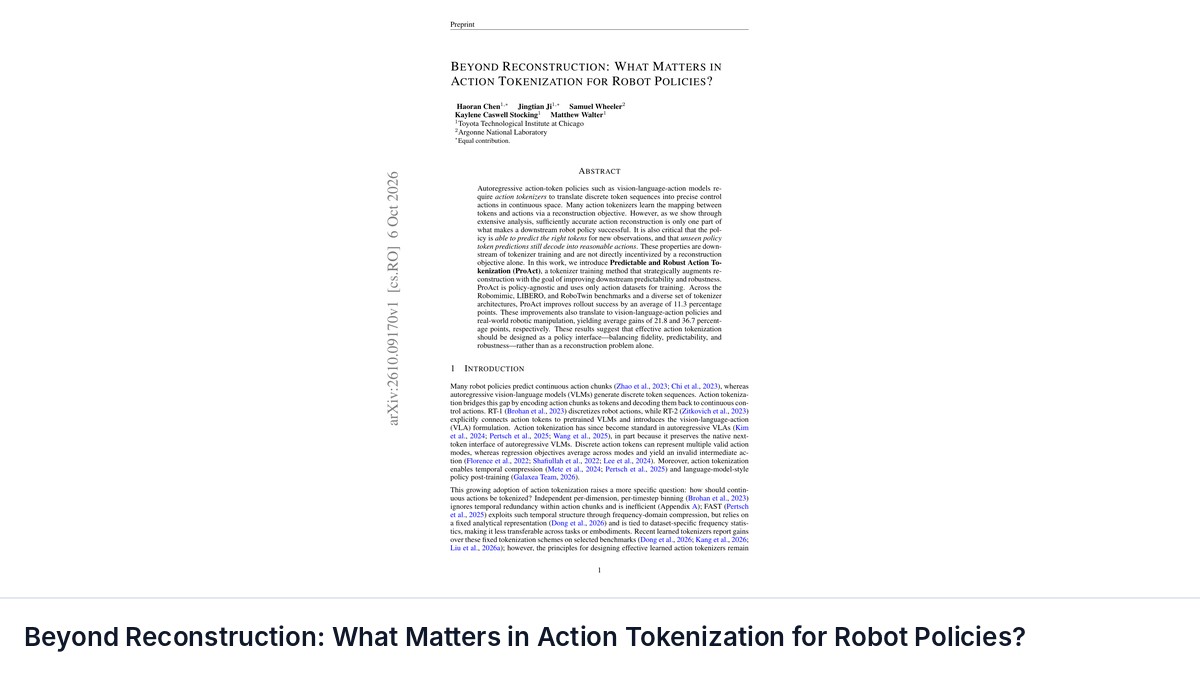
Beyond Reconstruction: What Matters in Action Tokenization for Robot Policies?
Haoran Chen, Jingtian Ji, Samuel Wheeler et al.
Autoregressive action-token policies such as vision-language-action models require action tokenizers to translate discrete token sequences into precise control actions in continuous space. Many action tokenizers learn the mapping between tokens and actions via a reconstruction objective.

Capability-Aware Arbitration for Semantic Intent-Based Shared Control
Zhaoda Du, Michael Bowman, Xiaoli Zhang
Shared control often allocates robot authority based on confidence in inferred human intent, assuming reliable autonomous execution. When this assumption fails, high intent confidence can cause over-helping.
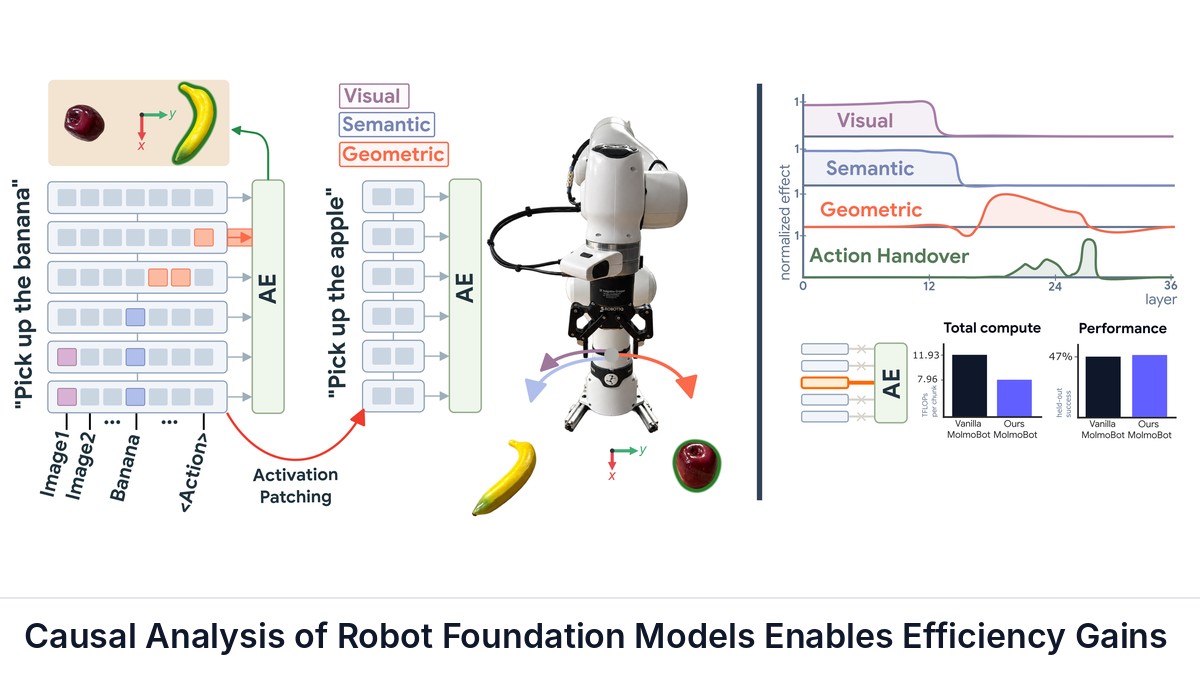
Causal Analysis of Robot Foundation Models Enables Efficiency Gains
Aiden Swann, Mathilde Papillon, Mozes Jacobs et al.
Vision-language-action (VLA) models are a promising approach to general purpose robot manipulation.