
Self-Adaptive VLA for Robust Robot Deployment
Hongxin Zhang, Chunru Lin, Tsun-Hsuan Wang, Zhenjia Xu, Chuang Gan · N/A · 2026
Framework
N/A
License
N/A
Stars
N/A
Summary
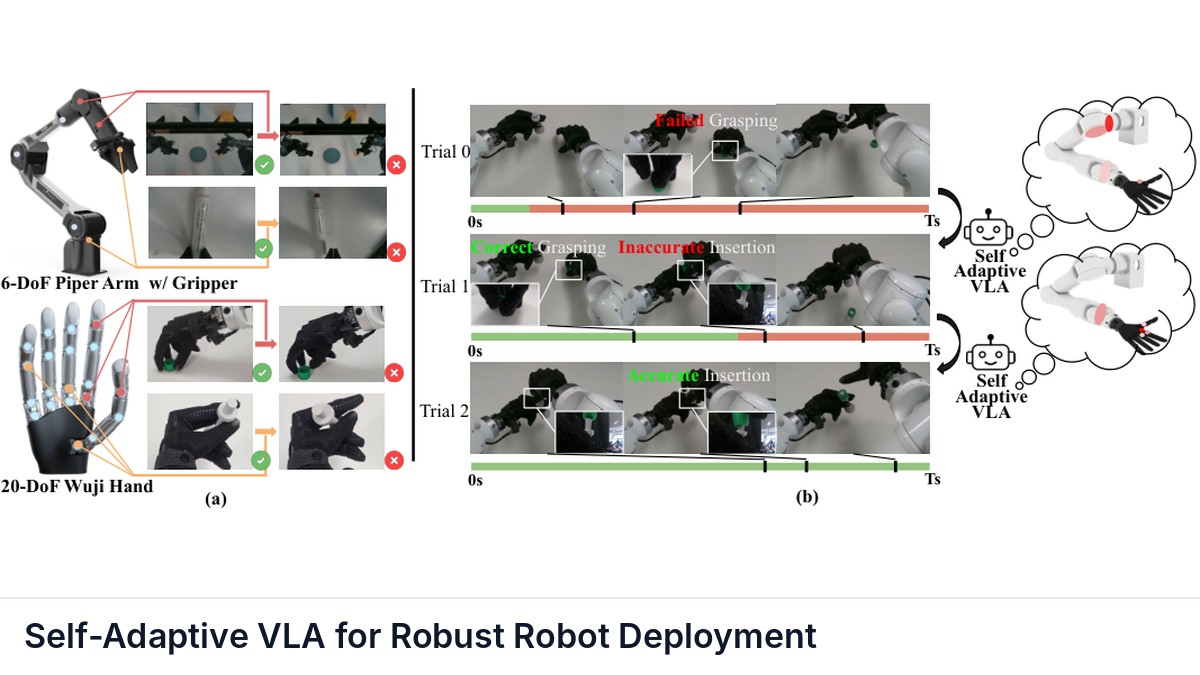
While Vision-Language-Action (VLA) models demonstrate impressive capabilities in robotic manipulation, their memoryless nature renders them brittle to test-time environment shifts, particularly hardware shifts caused by wear or imperfect calibration.
Abstract Summary
Key Points
- While Vision-Language-Action (VLA) models demonstrate impressive capabilities in robotic manipulation, their memoryless nature renders them brittle to test-time environment shifts, particularly hardware shifts caused by wear or imperfect calibration.
- Enabling these models to self-adapt during deployment without requiring continuous on-site recalibration remains a critical bottleneck for real-world scalability.
- In this work, we introduce Self-Adaptive VLA, a novel post-training recipe that enables the policy to iteratively adapt to deployment-time hardware shifts leveraging its own rollouts as context.
- To do so, we first collect policy rollouts under deliberately injected hardware shifts
- We then transform the base policy's training data into shift-conditioned expert demonstrations by pre-compensating the expert actions for these known shifts.
Problem Setup
We study Vision-Language-Action (VLA) policies $\pi(A_{t}/l,o_{t},q_{t})$ that learns to predict a chunk of $h$ future actions $A_{t}=a_{t+1,...,t+h}$ given language instruction $l$, an image observation $o_{t}$ and a proprioceptive state $q_{t}$. The base policies are learned or fine-tuned from human expert demonstrations $\mathcal{D}_{base}$ collected under a specific training hardware configuration $H_{train}$.
Method
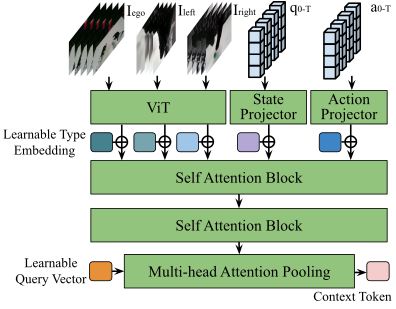
We propose a novel post-training recipe Self-Adaptive VLA to enable VLAs to leverage failure rollouts as context for adapting to test-time hardware shifts. In Section IV-A , we introduce an automated pipeline to synthesize hardware-shift-conditioned expert data from standard demonstration datasets.
We then detail the design of the plug-in context encoder and its AdaLN-based integration with the base VLA policy in Section IV-B . Finally, Section IV-C outlines our ensembling strategy for iterative, step-by-step policy adaptation.
Experiments
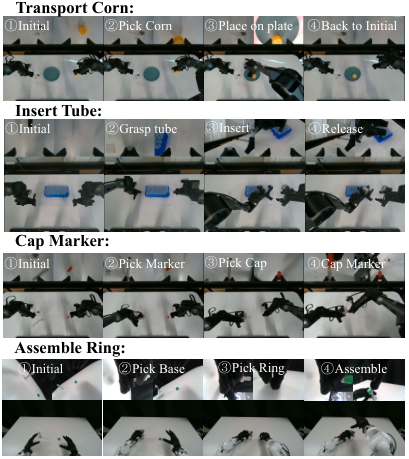
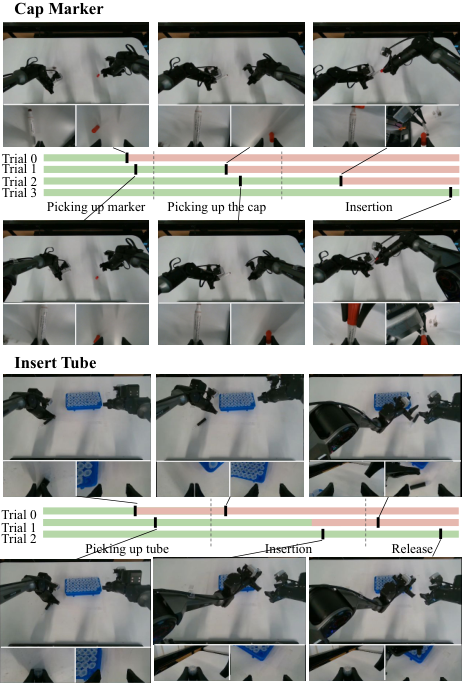
We conduct experiments on four bi-manual and dexterous manipulation tasks requiring precise grasping and insertion (overview in Figure 4 ). Three tasks, Transport Corn , Insert Tube , and Cap Marker , are executed using 6-DoF Piper or Piper-X arms equipped with parallel grippers. The fourth task, Assemble Ring , utilizes two 7-DoF Marvin Arms paired with a 20-DoF Wuji Hand.
All robots are equipped with one ego camera and two wrist cameras. For each task, we first train a base policy using human-teleoperated expert demonstrations.
Sources and Demonstrations
Figures are reproduced from Zhang et al. See the full paper for experimental details and the project page, when the paper links one, for demonstrations and videos.
Related Papers

A Sim-to-Real Integration Pipeline for Training and Deployment of Chunk-Based VLA Manipulation Policies
Mathilde Kappel, Clémence Grislain, Mohamed Chetouani et al.
Vision-Language-Action (VLA) models have become a prominent paradigm for mapping multimodal inputs, including semantic instructions, visual observations of the scene, and proprioceptive observations, to robot actions.
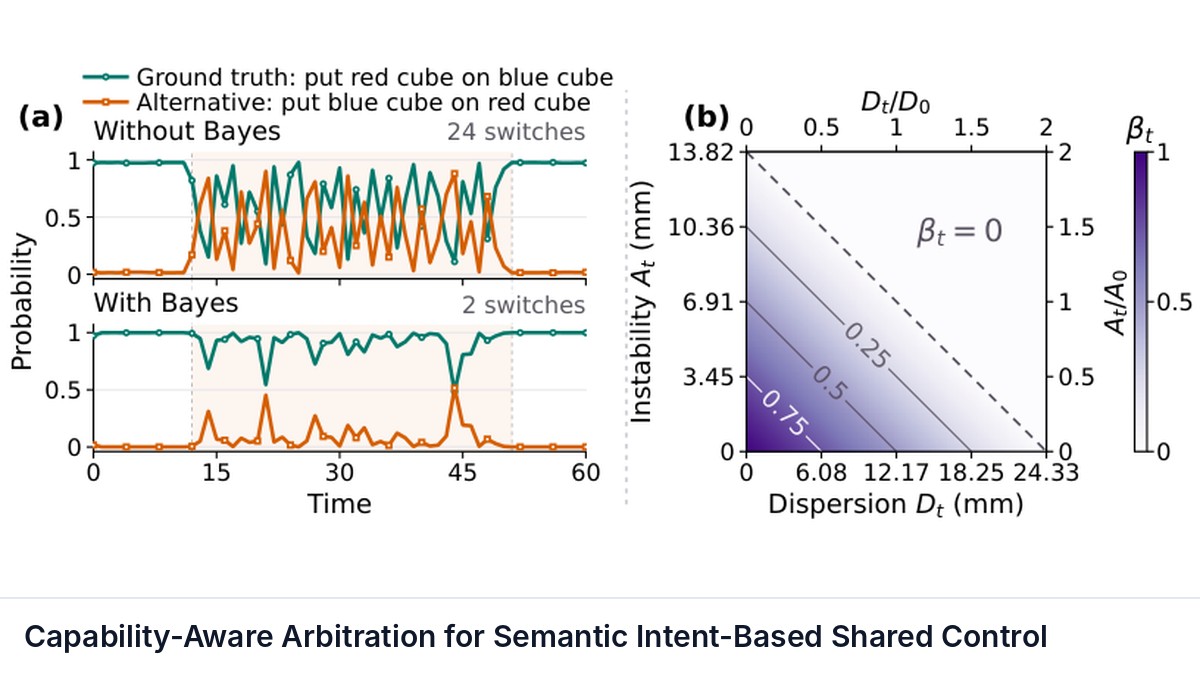
Capability-Aware Arbitration for Semantic Intent-Based Shared Control
Zhaoda Du, Michael Bowman, Xiaoli Zhang
Shared control often allocates robot authority based on confidence in inferred human intent, assuming reliable autonomous execution. When this assumption fails, high intent confidence can cause over-helping.
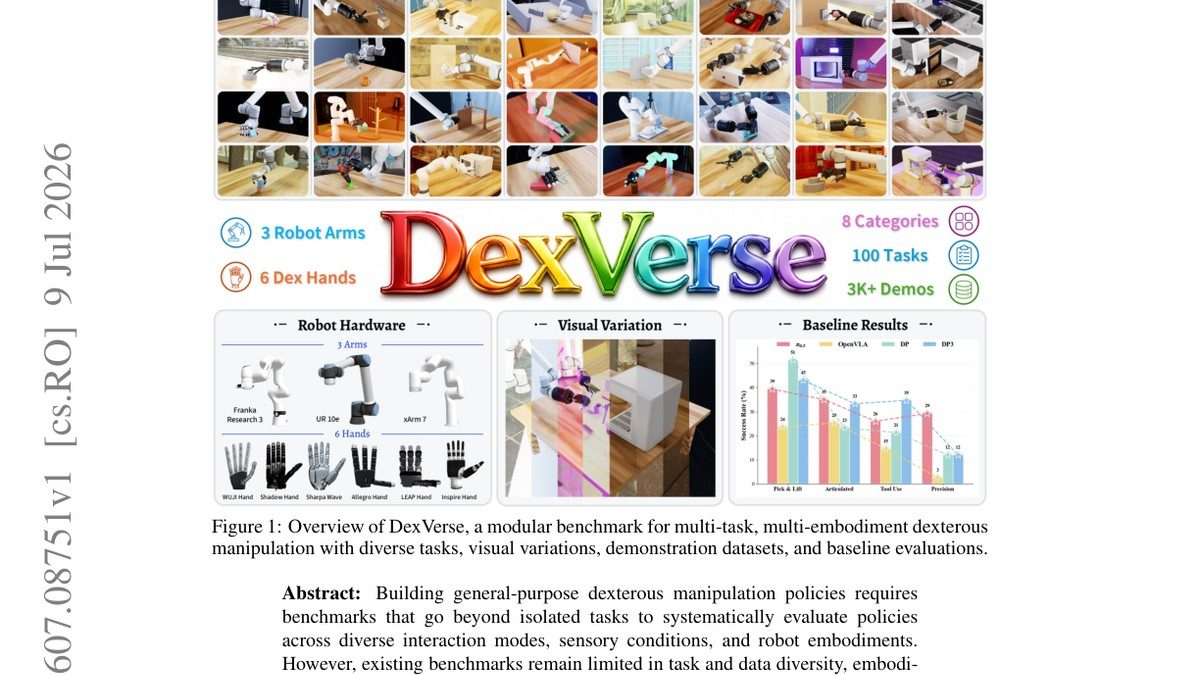
DexVerse: A Modular Benchmark for Multi-Task, Multi-Embodiment Dexterous Manipulation
Yunchao Yao, Zhuxiu Xu, Tianqi Zhang et al.
Building general-purpose dexterous manipulation policies requires benchmarks that go beyond isolated tasks to systematically evaluate policies across diverse interaction modes, sensory conditions, and robot embodiments.
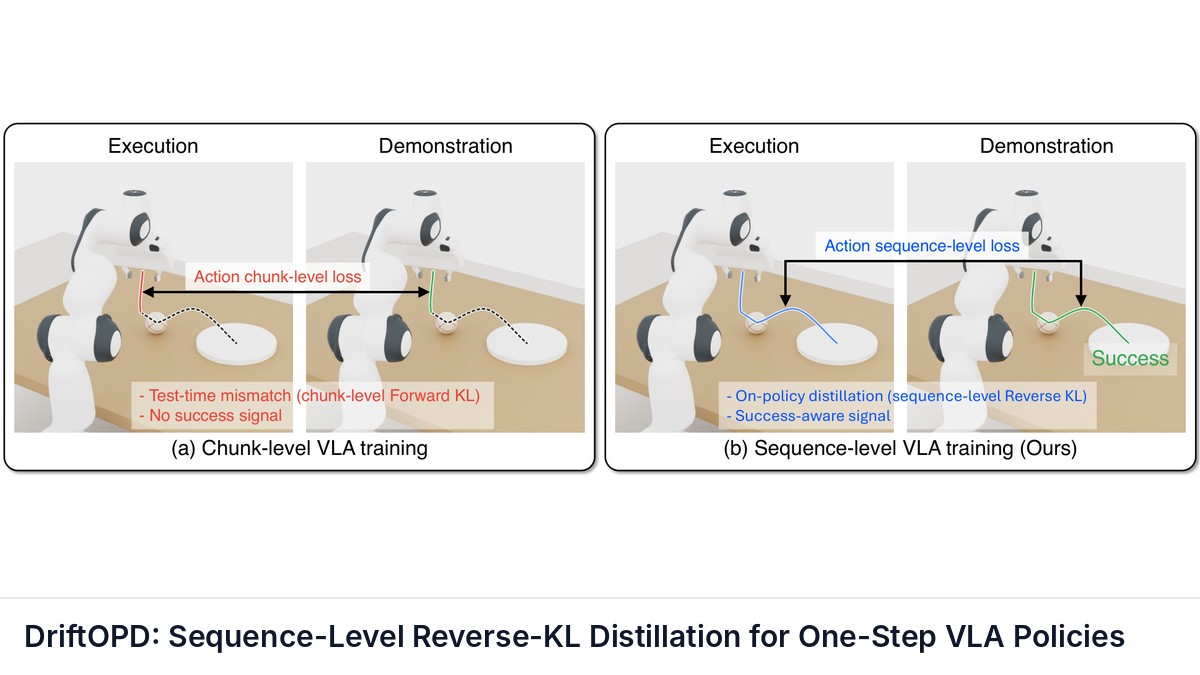
DriftOPD: Sequence-Level Reverse-KL Distillation for One-Step VLA Policies
Youngjun Jun, Kyumin Choi, Youngmin Kim et al.
Vision-Language-Action (VLA) models increasingly rely on action experts that generate short action chunks under receding-horizon control.