
VLAQuantBench: Closed-Loop Evaluation of Post-Training Quantization for Vision-Language-Action Models
Jiuyi Xu, Qing Jin, Meida Chen, Song Wang, Yang Sui, Yangming Shi · N/A · 2026
Framework
N/A
License
N/A
Stars
N/A
Summary
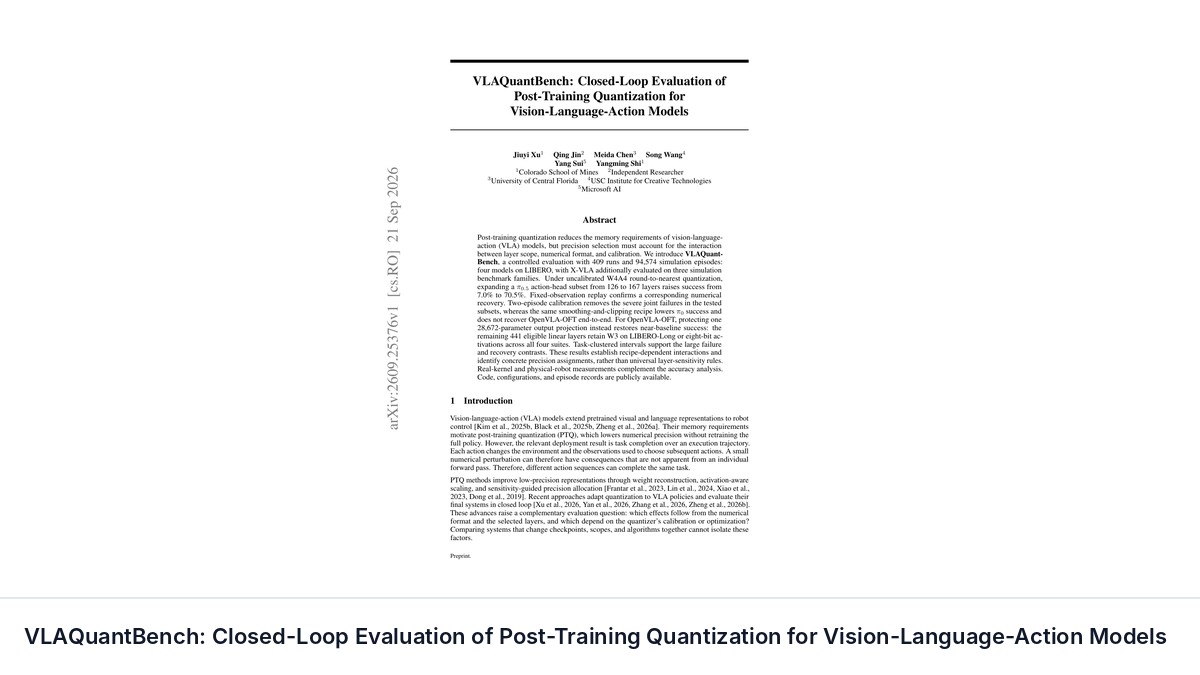
Post-training quantization reduces the memory requirements of vision-language-action (VLA) models, but precision selection must account for the interaction between layer scope, numerical format, and calibration.
Abstract Summary
Key Points
- Post-training quantization reduces the memory requirements of vision-language-action (VLA) models, but precision selection must account for the interaction between layer scope, numerical format, and calibration.
- We introduce \textbf{VLAQuantBench}, a controlled evaluation with 409 runs and 94,574 simulation episodes: four models on LIBERO, with X-VLA additionally evaluated on three simulation benchmark families.
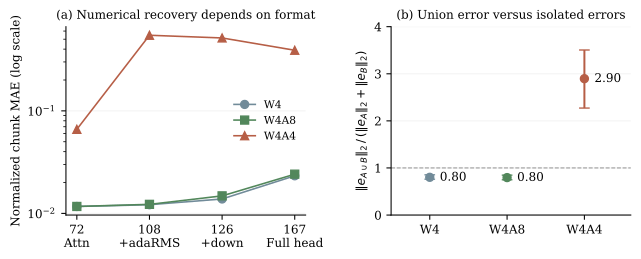
- Under uncalibrated W4A4 round-to-nearest quantization, expanding a $\pi_{0.5}$ action-head subset from 126 to 167 layers raises success from 7.0\% to 70.5\%.
- Fixed-observation replay confirms a corresponding numerical recovery
- Two-episode calibration removes the severe joint failures in the tested subsets, whereas the same smoothing-and-clipping recipe lowers $\pi_0$ success and does not recover OpenVLA-OFT end-to-end.
Benchmark Design
The benchmark separates three questions: whether a quantized policy completes tasks, which selected layers account for a change in performance, and whether an implementation saves memory or time. Task metrics are primary outcomes, while action deviations and activation statistics are auxiliary diagnostics. Figure 3 in App. A summarizes the evaluation axes.
We partition each policy into a vision encoder (VE), multimodal projector (MP) where present, language backbone (LLM), and action head (AH).
Experimental Setup
OpenVLA-OFT combines a LLaMA-2-7B backbone with parallel action decoding and a four-linear-layer L1-regression head ( Kim et al., 2025a ) . The $\pi_{0}$ and $\pi_{0.5}$ policies use PaliGemma with flow-matching action experts. $\pi_{0.5}$ additionally uses adaptive normalization conditioning ( Black et al., 2025b ; Black et al., 2025a ) .
X-VLA uses Florence-2 with a soft-prompted transformer action head ( Zheng et al., 2026a ) .
Results
Weight-only W8 closely tracks the LIBERO baselines in Table 1 , whereas W4 is not uniformly lossless. OpenVLA-OFT’s Goal success falls from 96.0% to 82.0%. The W3 result on OpenVLA-OFT-Long is particularly poor (8.0%, compared with 88.5% at W4). Thus, conclusions drawn from an average across suites can hide substantial losses in individual settings. Activation quantization produces larger differences.
OpenVLA-OFT’s W4A8 success is 21.5/2.5/2.0/76.0% on Spatial/Object/Goal/Long.
Evaluation-Stack Checks
Three implementation checks are essential to reproducing the evaluated policy. Changing MuJoCo versions altered the settling of a stored LIBERO initial state. We pin MuJoCo to 3.3.2 for OpenVLA-OFT and the $\pi$ models and examine per-task baselines; the X-VLA environment pins MuJoCo 3.1.6, which predates the change, and the version is recorded with its diagnostics.
The version and per-task baseline are recorded with the evaluation configuration.
Sources and Demonstrations
Figures are reproduced from Xu et al. See the full paper for experimental details and the project page, when the paper links one, for demonstrations and videos.
Related Papers

A Sim-to-Real Integration Pipeline for Training and Deployment of Chunk-Based VLA Manipulation Policies
Mathilde Kappel, Clémence Grislain, Mohamed Chetouani et al.
Vision-Language-Action (VLA) models have become a prominent paradigm for mapping multimodal inputs, including semantic instructions, visual observations of the scene, and proprioceptive observations, to robot actions.
Beyond Reconstruction: What Matters in Action Tokenization for Robot Policies?
Haoran Chen, Jingtian Ji, Samuel Wheeler et al.
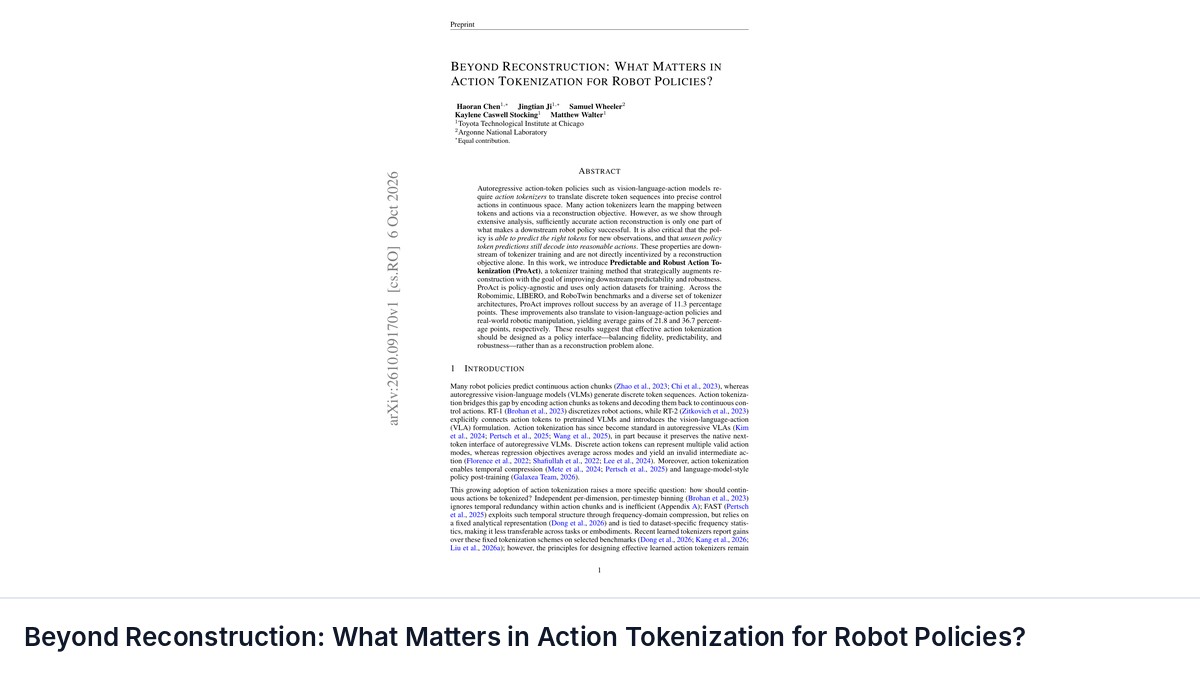
Autoregressive action-token policies such as vision-language-action models require action tokenizers to translate discrete token sequences into precise control actions in continuous space. Many action tokenizers learn the mapping between tokens and actions via a reconstruction objective.
Capability-Aware Arbitration for Semantic Intent-Based Shared Control
Zhaoda Du, Michael Bowman, Xiaoli Zhang
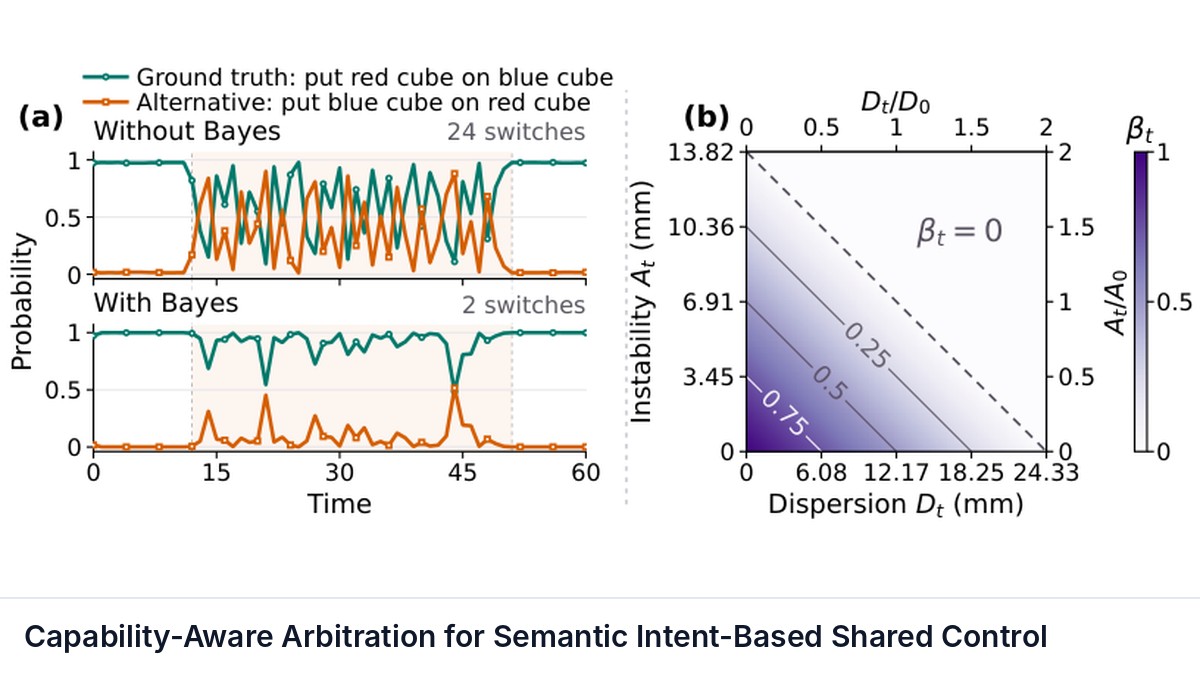
Shared control often allocates robot authority based on confidence in inferred human intent, assuming reliable autonomous execution. When this assumption fails, high intent confidence can cause over-helping.
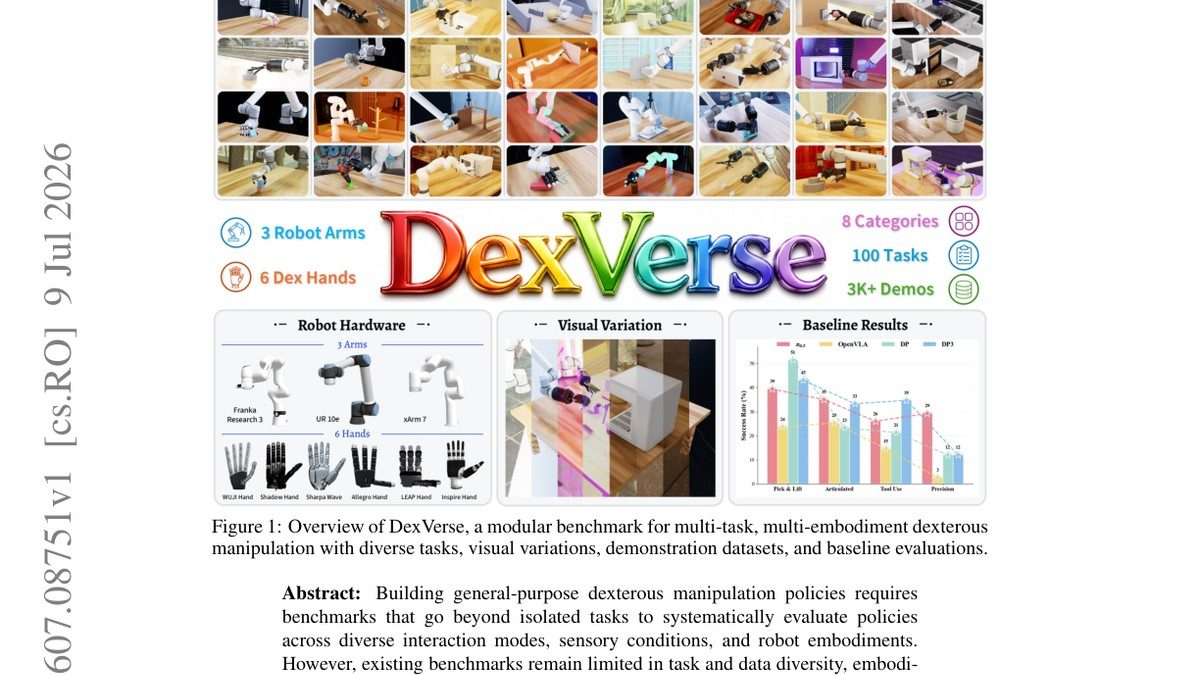
DexVerse: A Modular Benchmark for Multi-Task, Multi-Embodiment Dexterous Manipulation
Yunchao Yao, Zhuxiu Xu, Tianqi Zhang et al.
Building general-purpose dexterous manipulation policies requires benchmarks that go beyond isolated tasks to systematically evaluate policies across diverse interaction modes, sensory conditions, and robot embodiments.