
Know Your Body: A Harness for Direct and Self-Improving Robot Control with VLMs
Zeyu Lou, Yanhong Zeng, Yong Wang, Chenyang Si · N/A · 2026
Framework
N/A
License
N/A
Stars
N/A
Summary
A general-purpose vision-language model can understand a task goal without knowing how a particular robot's motion and functional parts produce the intended effect.
Abstract Summary
Key Points
- A general-purpose vision-language model can understand a task goal without knowing how a particular robot's motion and functional parts produce the intended effect.
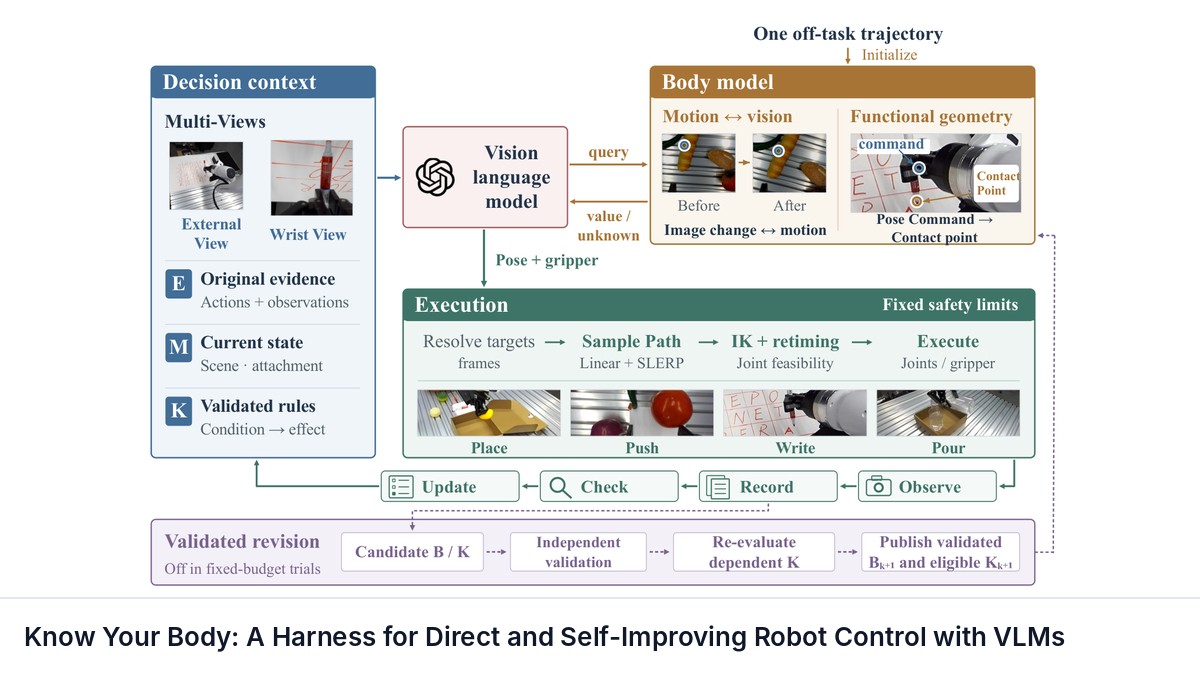
- We introduce KnowBody, a harness that makes these action-relevant body relations explicit, queryable, and revisable while keeping the model weights frozen.
- Initialized from one off-task trajectory, a partial body model guides action selection and the interpretation of past interactions.
- New evidence refines the model, and knowledge dependent on revised body estimates is rechecked before reuse.
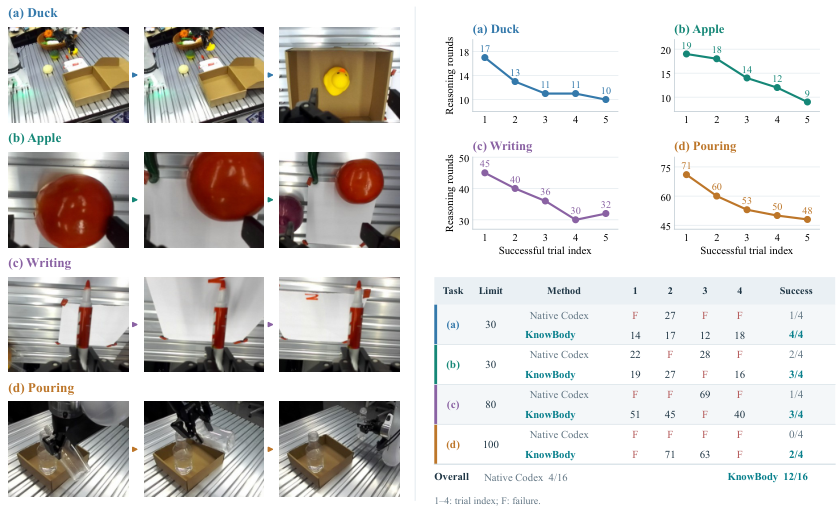
- Across 32 fixed-budget trials on four real-robot tasks, initialized KnowBody achieves 75% completion versus 25% for the native harness and requires fewer planner rounds on successful trials in tasks completed by both.
Problem and Learning Protocol
At model–tool decision $i$, a general-purpose VLM receives instruction $\ell$, current images and available depth $o_{t}$, measured pose $T_{t}=(R_{t},p_{t})$, gripper state, and available joint feedback. The index $t$ advances with fresh observations and physical transitions, not with every read-only query. Declared robot and motion limits are supplied as interface constraints.
The output $u_{i}$ is a query, observation request, motion proposal, or termination request.
Method
KnowBody organizes robot interaction around a queryable, partial body model. Before acting, the model relates motion and functional-part geometry to the commands chosen by a frozen VLM. After acting, it supports checks of the observed response and supplies the geometric conditions under which experience is interpreted.
These two roles couple body estimation to experience reuse: correcting a body estimate can change an earlier interaction’s conditions without changing its observed outcome.
Real-Robot Evaluation
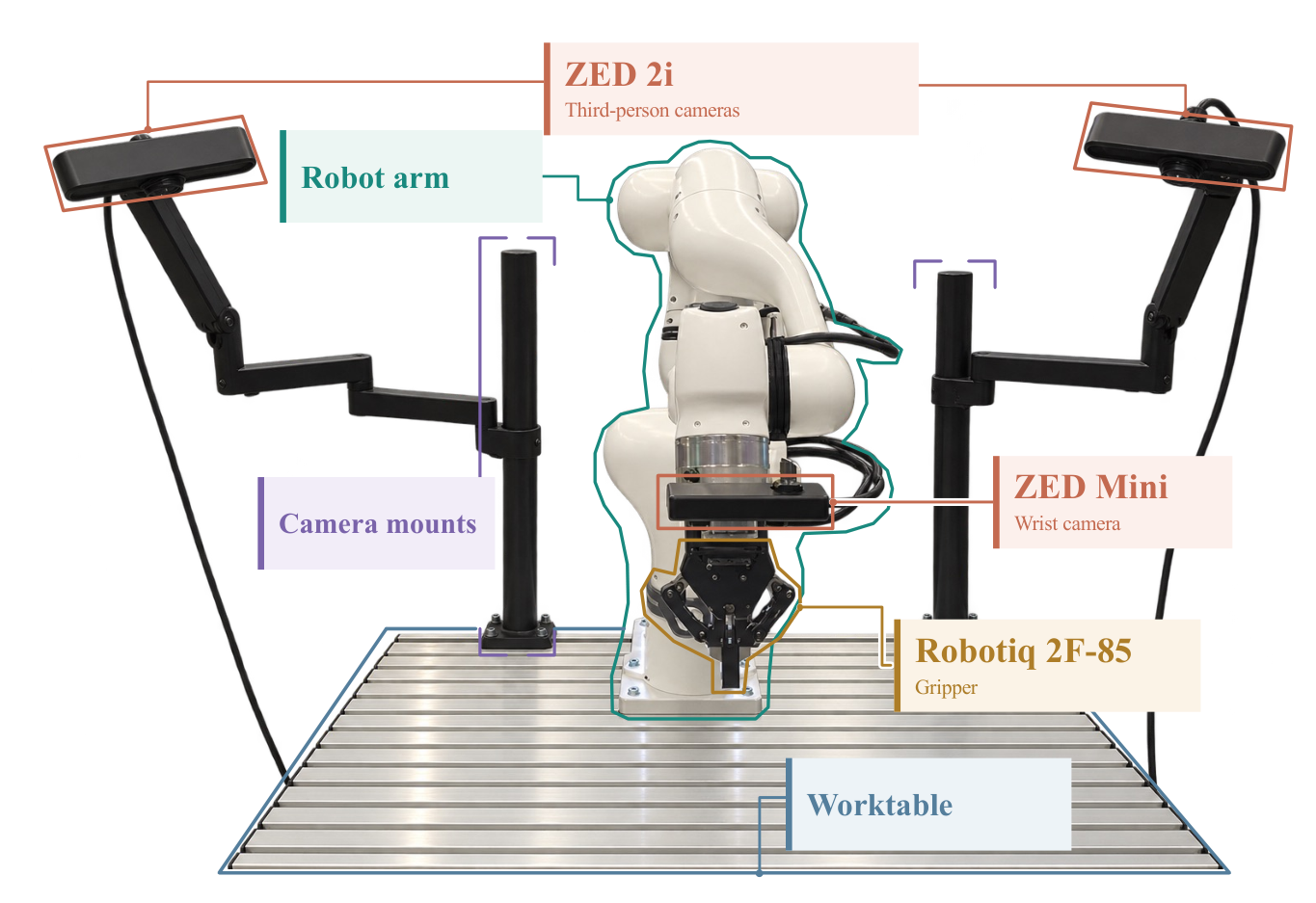
We evaluate task completion under fixed reasoning budgets and reasoning effort during continual interaction. The first protocol tests the initialized harness without accumulated experience; the second tracks successful completions as knowledge accumulates from both successful and failed attempts. As shown in Fig. 4 , we use a Franka Research 3 with a Robotiq 2F-85 gripper.
A ZED Mini provides the wrist view, and two ZED 2i cameras provide third-person views of the worktable.
Sources and Demonstrations
Figures are reproduced from Lou et al. See the full paper for experimental details and the project page, when the paper links one, for demonstrations and videos.
Related Papers
A Phenomenology of Neural Geometry in Vision-Language-Action Models
Mozes Jacobs, Aiden Swann, Mathilde Papillon et al.
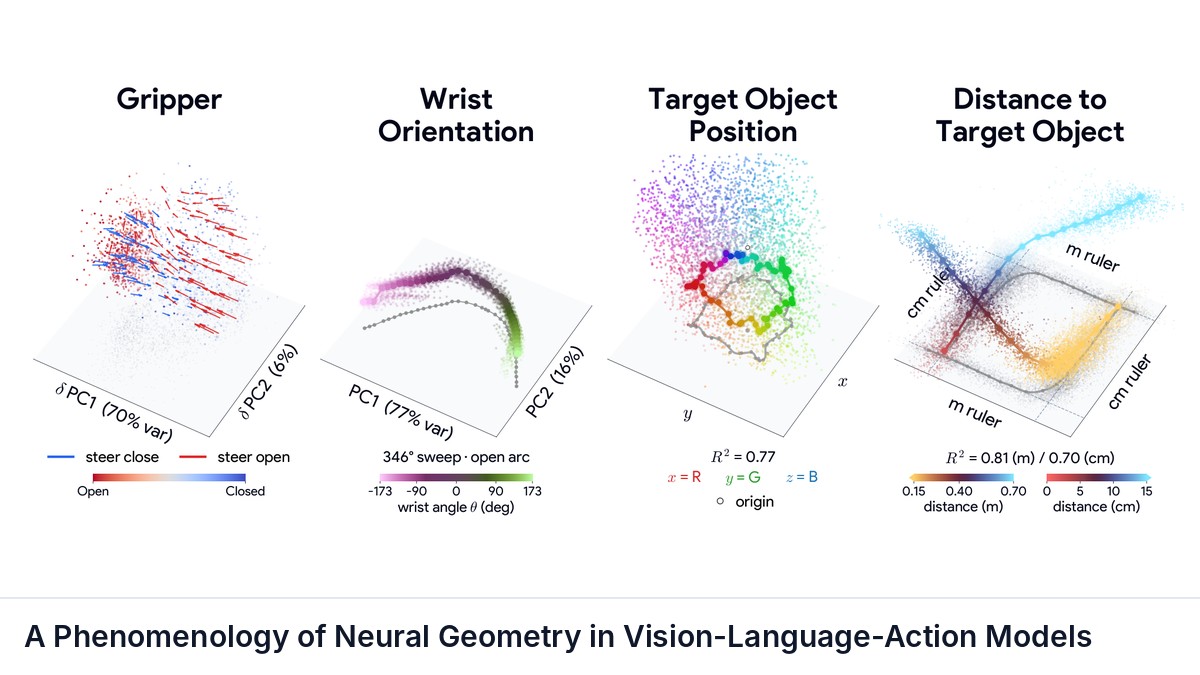
Robotic manipulation is inherently geometric, but what shape does the world take inside the policy that performs it?

A Sim-to-Real Integration Pipeline for Training and Deployment of Chunk-Based VLA Manipulation Policies
Mathilde Kappel, Clémence Grislain, Mohamed Chetouani et al.
Vision-Language-Action (VLA) models have become a prominent paradigm for mapping multimodal inputs, including semantic instructions, visual observations of the scene, and proprioceptive observations, to robot actions.
Beyond Reconstruction: What Matters in Action Tokenization for Robot Policies?
Haoran Chen, Jingtian Ji, Samuel Wheeler et al.
Autoregressive action-token policies such as vision-language-action models require action tokenizers to translate discrete token sequences into precise control actions in continuous space. Many action tokenizers learn the mapping between tokens and actions via a reconstruction objective.

Capability-Aware Arbitration for Semantic Intent-Based Shared Control
Zhaoda Du, Michael Bowman, Xiaoli Zhang
Shared control often allocates robot authority based on confidence in inferred human intent, assuming reliable autonomous execution. When this assumption fails, high intent confidence can cause over-helping.