
CFG-Policy: Unified Diffusion Policy Learning Framework via Classifier-free Guidance
Shutong Ding, Zhaoyang Liu, Yimiao Zhou, Jingya Wang, Jiayuan Gu, Ye Shi · N/A · 2026
Framework
N/A
License
N/A
Stars
N/A
Summary
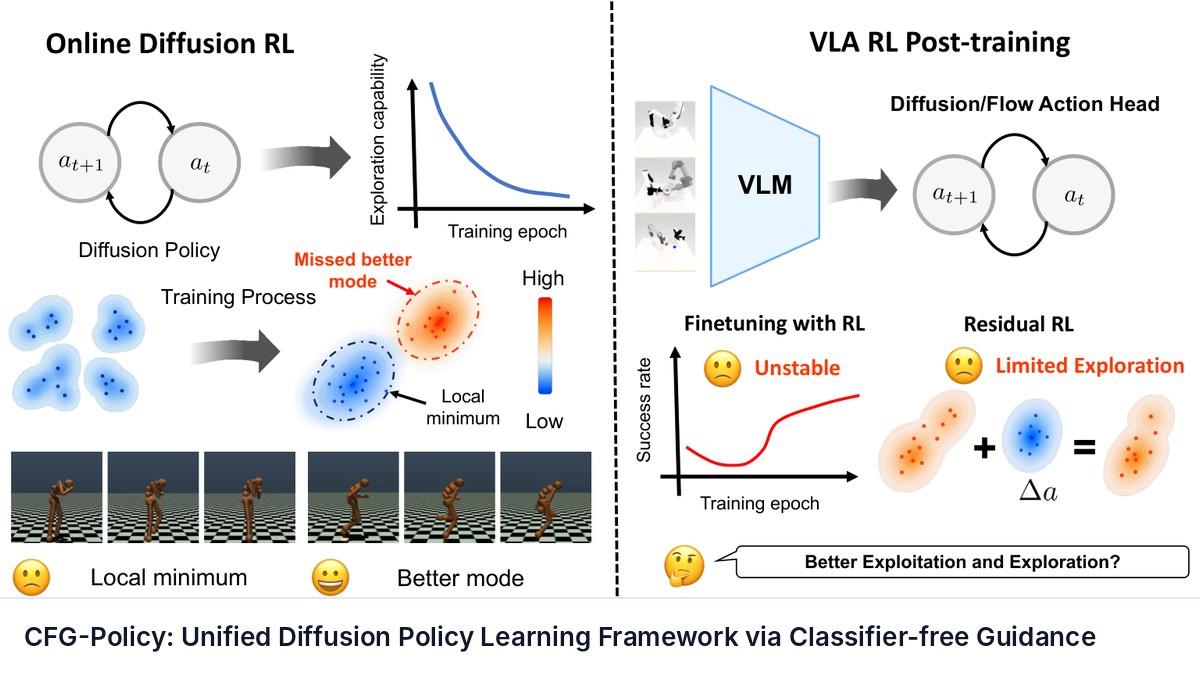
Diffusion policies are increasingly used in robotic control and manipulation, vision-language-action models, and world-model-based agents. Their ability to represent multimodal action distributions offers rich opportunities for exploration in reinforcement learning (RL).
Abstract Summary
Key Points
- Diffusion policies are increasingly used in robotic control and manipulation, vision-language-action models, and world-model-based agents.
- Their ability to represent multimodal action distributions offers rich opportunities for exploration in reinforcement learning (RL).
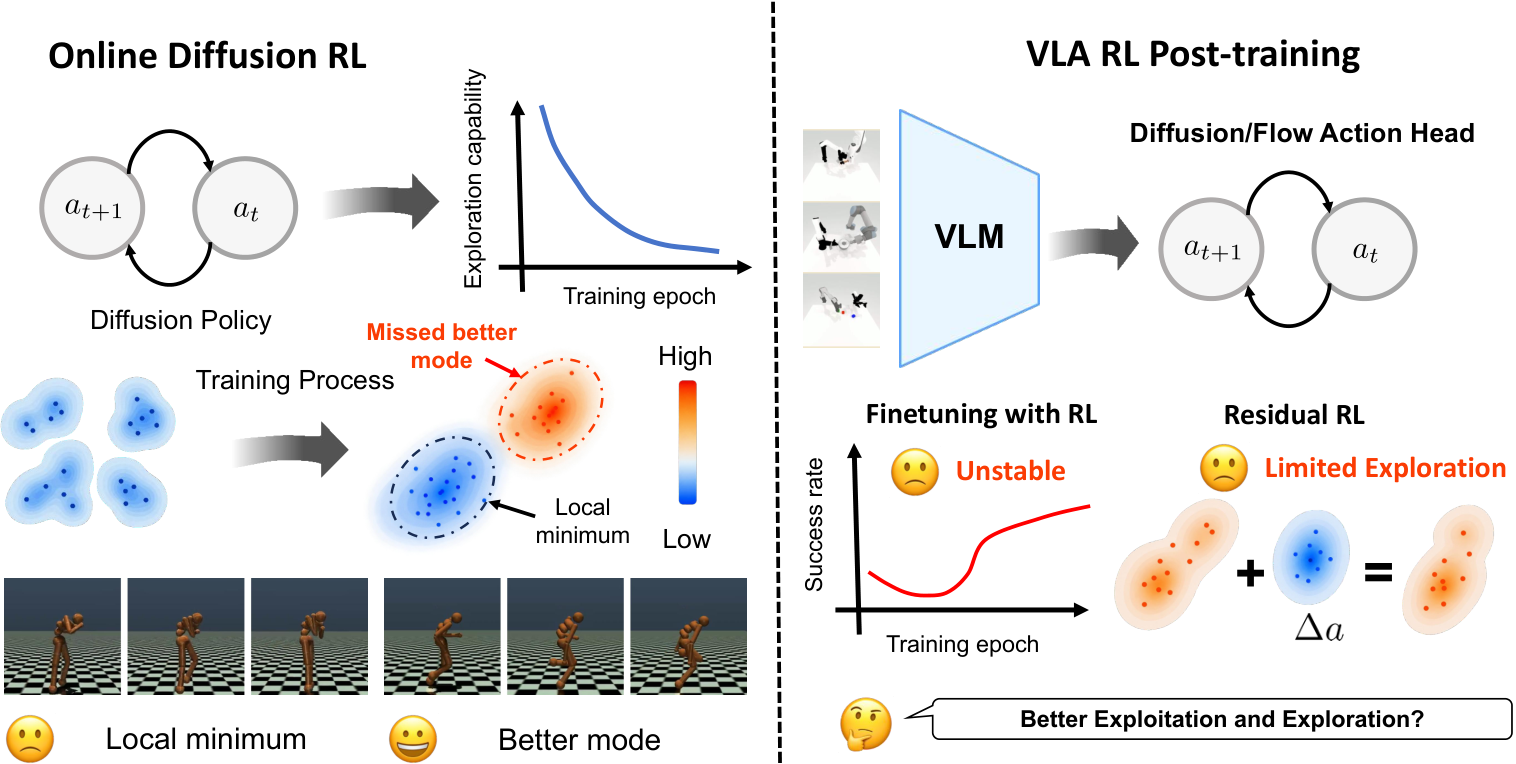
- However, optimizing diffusion policies with RL can reduce the behavioral diversity and further limit their exploration capability.
- In RL post-training, directly fine-tuning a pretrained policy may also disrupt its acquired capabilities, while action-space residuals may lack the expressive power for multimodal exploration.
- Together, these issues reveal a common challenge across online and offline-to-online diffusion RL: improving task performance while retaining the behavioral diversity and capabilities needed for continued adaptation.
Method
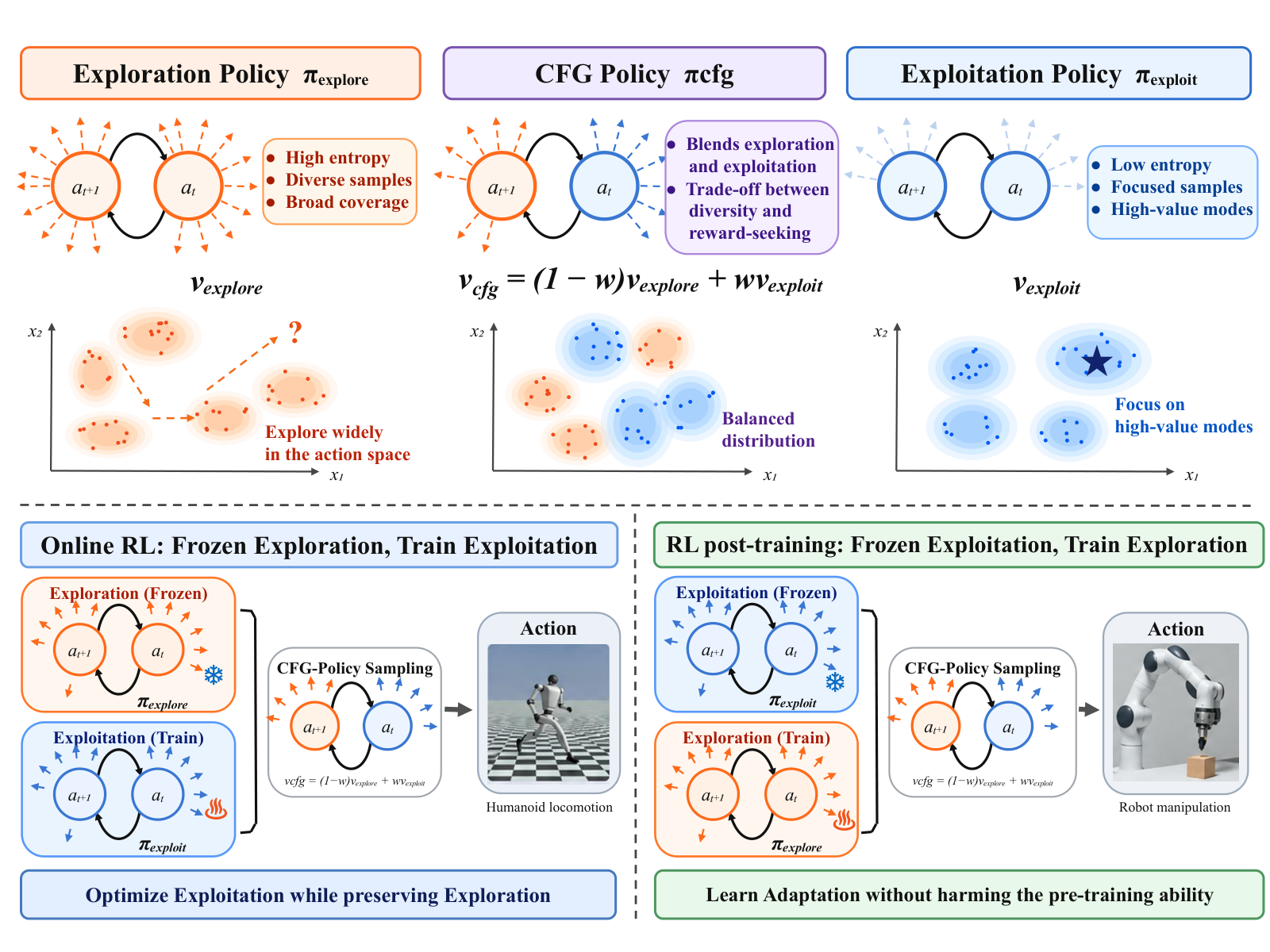
As shown in Figure 2 , we propose CFG-Policy which aims to address the two learning regimes discussed in the Introduction through a common principle: preserve one behavioral capability in a frozen generative policy while optimizing a complementary one .
The two policies are composed during diffusion or flow sampling, allowing the same mechanism to preserve exploration in online RL and pretrained behavior in RL post-training. Consider a diffusion or flow policy that generates an action $a=x_{0}$ from $x_{T}\sim\mathcal{N}(0,I)$.
Experiments
We evaluate CFG-Policy in the two complementary regimes introduced in the Method: online RL and RL post-training.
Our experiments study whether (i) CFG-Policy can be applied to different generative RL algorithms without changing their original objectives, (ii) the same compositional mechanism is effective in both learning regimes, and (iii) adaptive generative composition is preferable to fixed guidance or simple action-space blending.
We evaluate on five MuJoCo tasks: HalfCheetah-v4, Walker2d-v4, Ant-v4, Humanoid-v4, and Hopper-v4.
Sources and Demonstrations
Figures are reproduced from Ding et al. See the full paper for experimental details and the project page, when the paper links one, for demonstrations and videos.
Related Papers
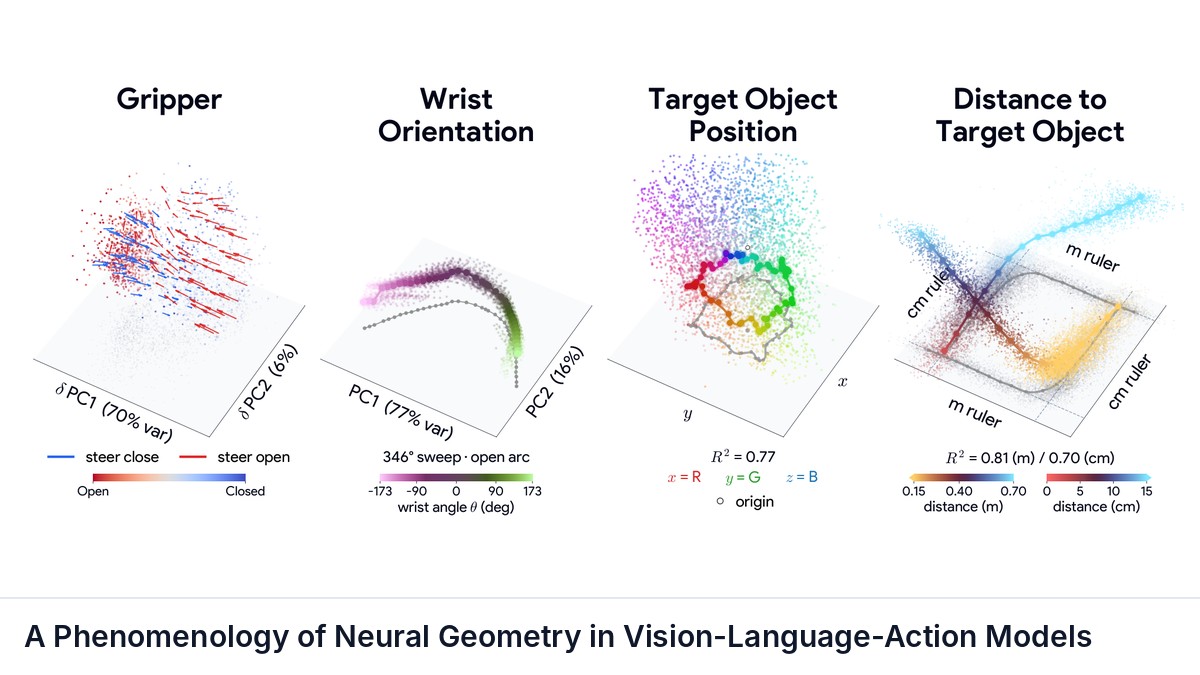
A Phenomenology of Neural Geometry in Vision-Language-Action Models
Mozes Jacobs, Aiden Swann, Mathilde Papillon et al.
Robotic manipulation is inherently geometric, but what shape does the world take inside the policy that performs it?

A Sim-to-Real Integration Pipeline for Training and Deployment of Chunk-Based VLA Manipulation Policies
Mathilde Kappel, Clémence Grislain, Mohamed Chetouani et al.
Vision-Language-Action (VLA) models have become a prominent paradigm for mapping multimodal inputs, including semantic instructions, visual observations of the scene, and proprioceptive observations, to robot actions.
Beyond Reconstruction: What Matters in Action Tokenization for Robot Policies?
Haoran Chen, Jingtian Ji, Samuel Wheeler et al.
Autoregressive action-token policies such as vision-language-action models require action tokenizers to translate discrete token sequences into precise control actions in continuous space. Many action tokenizers learn the mapping between tokens and actions via a reconstruction objective.
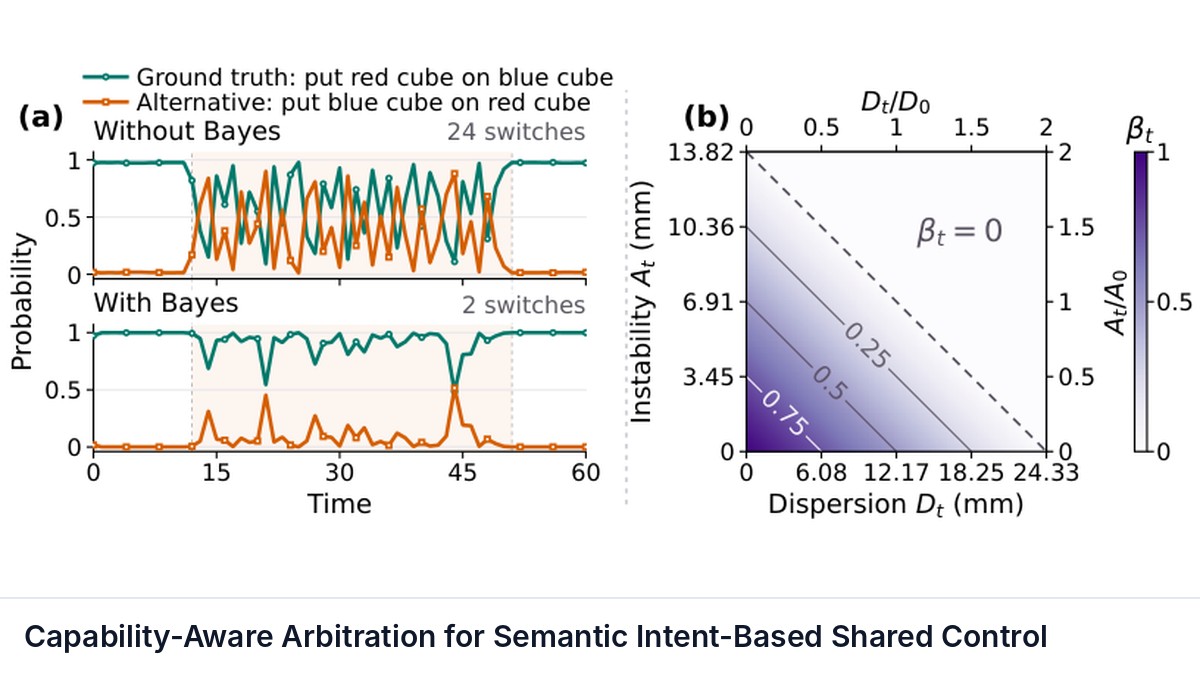
Capability-Aware Arbitration for Semantic Intent-Based Shared Control
Zhaoda Du, Michael Bowman, Xiaoli Zhang
Shared control often allocates robot authority based on confidence in inferred human intent, assuming reliable autonomous execution. When this assumption fails, high intent confidence can cause over-helping.