
CHOREO: Every Humanoid Skill as a Trajectory
Ziyi Sun, Jingwen Chen, Yuxi Wang, Xiuze Xia, Long Cheng, Zhaoxiang Zhang, Yujun Dong · N/A · 2026
Framework
N/A
License
N/A
Stars
N/A
Summary
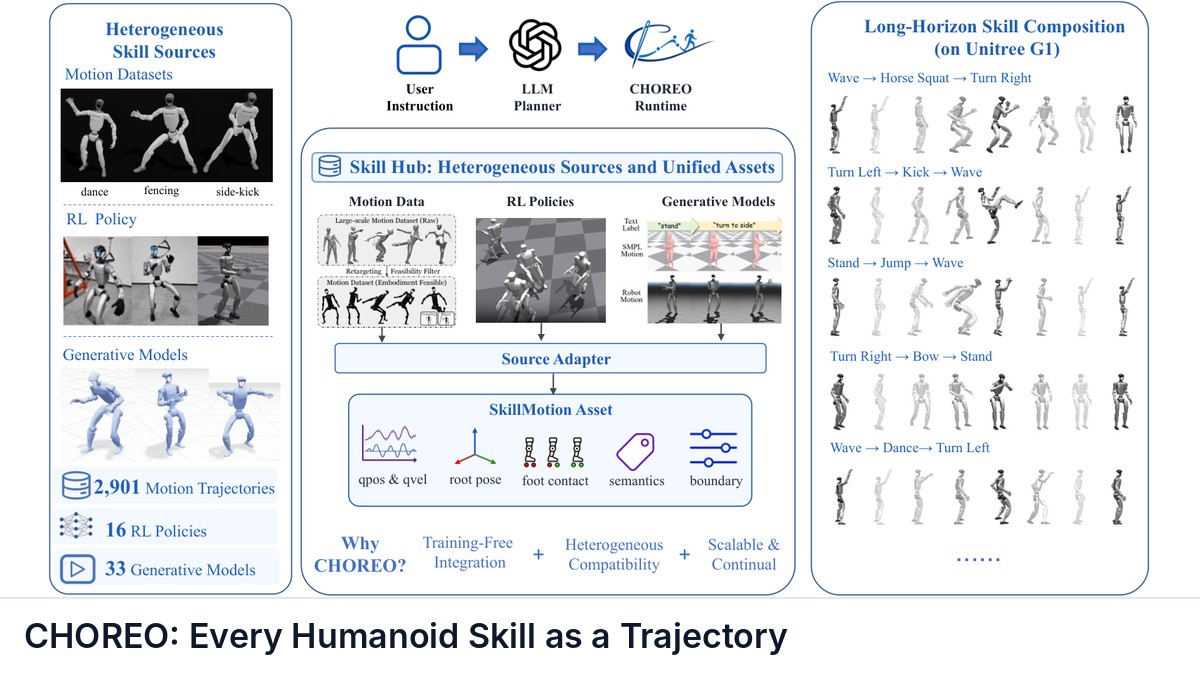
Recent advances in humanoid robotics have produced diverse skills through reinforcement learning, motion imitation, and generative modeling. Yet these capabilities remain siloed because they are built around incompatible representations, interfaces, and controllers.
Abstract Summary
Key Points
- Recent advances in humanoid robotics have produced diverse skills through reinforcement learning, motion imitation, and generative modeling.
- Yet these capabilities remain siloed because they are built around incompatible representations, interfaces, and controllers.
- We present CHOREO, a framework for training-free composition of heterogeneous humanoid skills
- Our key observation is that, regardless of how a skill is learned, it can ultimately be expressed as an executable motion trajectory.
- Based on this observation, CHOREO converts each capability into SkillMotion, a unified representation that combines motion states, contacts, semantics, and boundary conditions.
Method
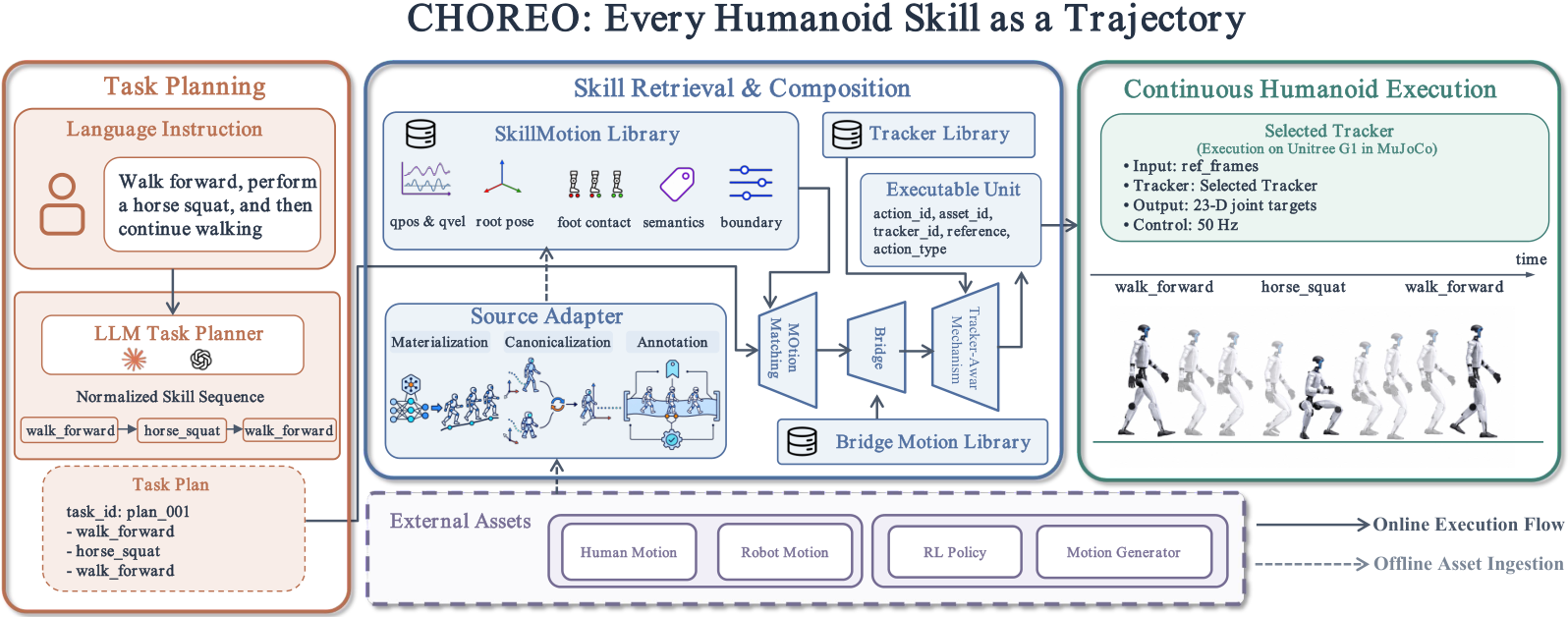
CHOREO composes skills from heterogeneous sources into long-horizon reference motions for humanoid execution.
Given a natural-language instruction $x$, a SkillMotion library $\mathcal{L}$ constructed from skill sources $\mathcal{S}$, and pretrained motion Trackers $\mathcal{T}$, CHOREO constructs an execution program where $\mathcal{M}_{1:K}$ denotes the resolved SkillMotions, $k_{1:K}$ records their associated Tracker indices, and $\Gamma_{1:K-1}$ denotes the transitions between adjacent skills. As shown in Fig.
Experiments
We evaluate CHOREO along three dimensions: long-horizon skill composition, integration of heterogeneous skill sources, and compatibility with different low-level trackers. We further ablate the transition design to identify the components that support reliable long-horizon execution. All experiments are conducted on Unitree G1 in MuJoCo using frozen low-level policies.
CHOREO uses GMT for the long-horizon and source-adaptation benchmarks, whereas the tracker benchmark evaluates each frozen tracker without parameter updates.
Sources and Demonstrations
Figures are reproduced from Sun et al. See the full paper for experimental details and the project page, when the paper links one, for demonstrations and videos.
Related Papers
A Phenomenology of Neural Geometry in Vision-Language-Action Models
Mozes Jacobs, Aiden Swann, Mathilde Papillon et al.
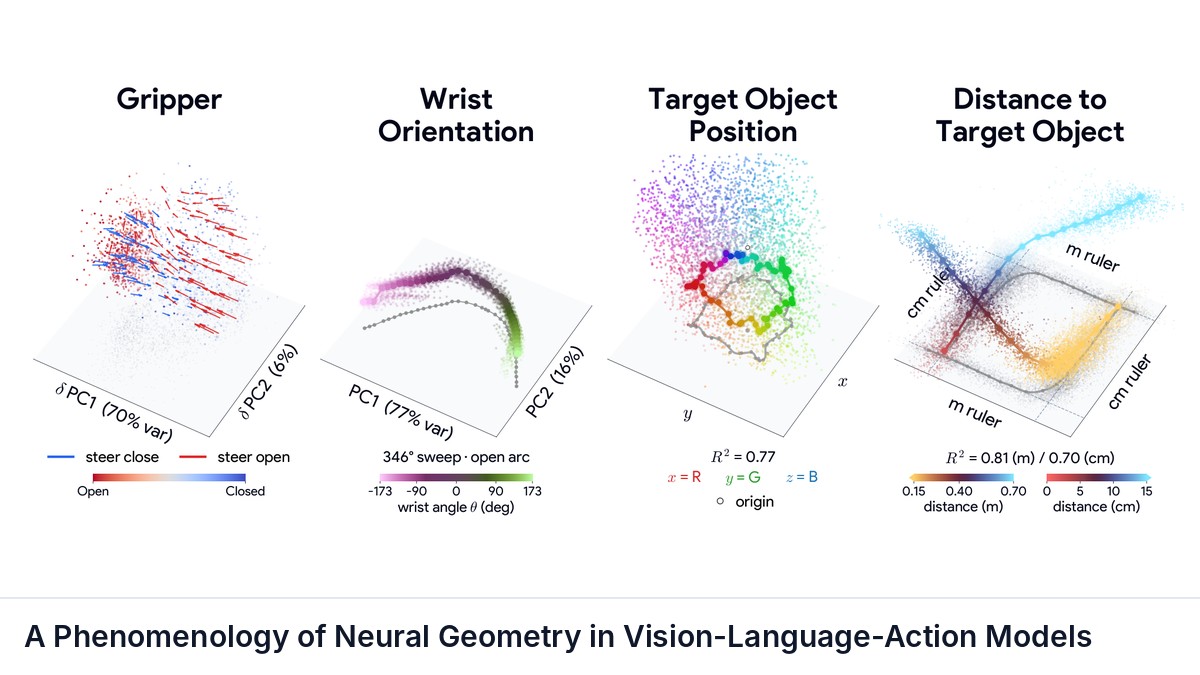
Robotic manipulation is inherently geometric, but what shape does the world take inside the policy that performs it?

A Sim-to-Real Integration Pipeline for Training and Deployment of Chunk-Based VLA Manipulation Policies
Mathilde Kappel, Clémence Grislain, Mohamed Chetouani et al.
Vision-Language-Action (VLA) models have become a prominent paradigm for mapping multimodal inputs, including semantic instructions, visual observations of the scene, and proprioceptive observations, to robot actions.
ARC: A Reasoning Recipe for Robot Foundation Models
Gokul Puthumanaillam, Tao Sun, Elie Aljalbout et al.
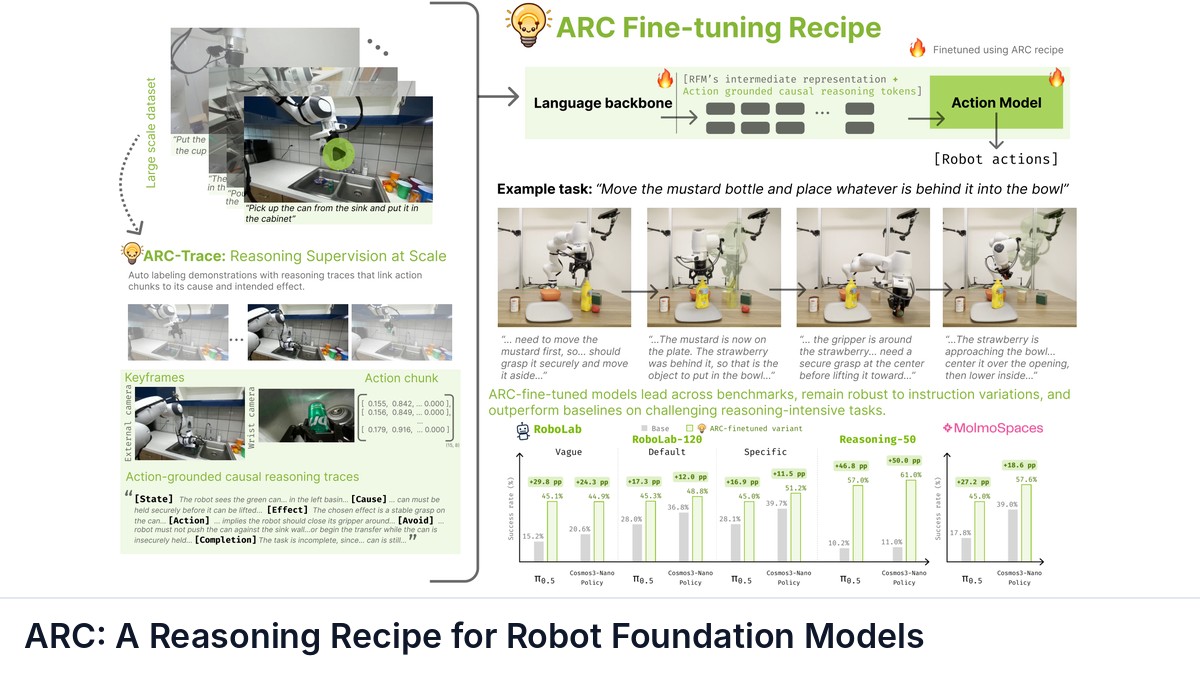
The prevailing approach to improving robot foundation models (RFMs) relies on larger models, more robot demonstrations, and costly training at scale.
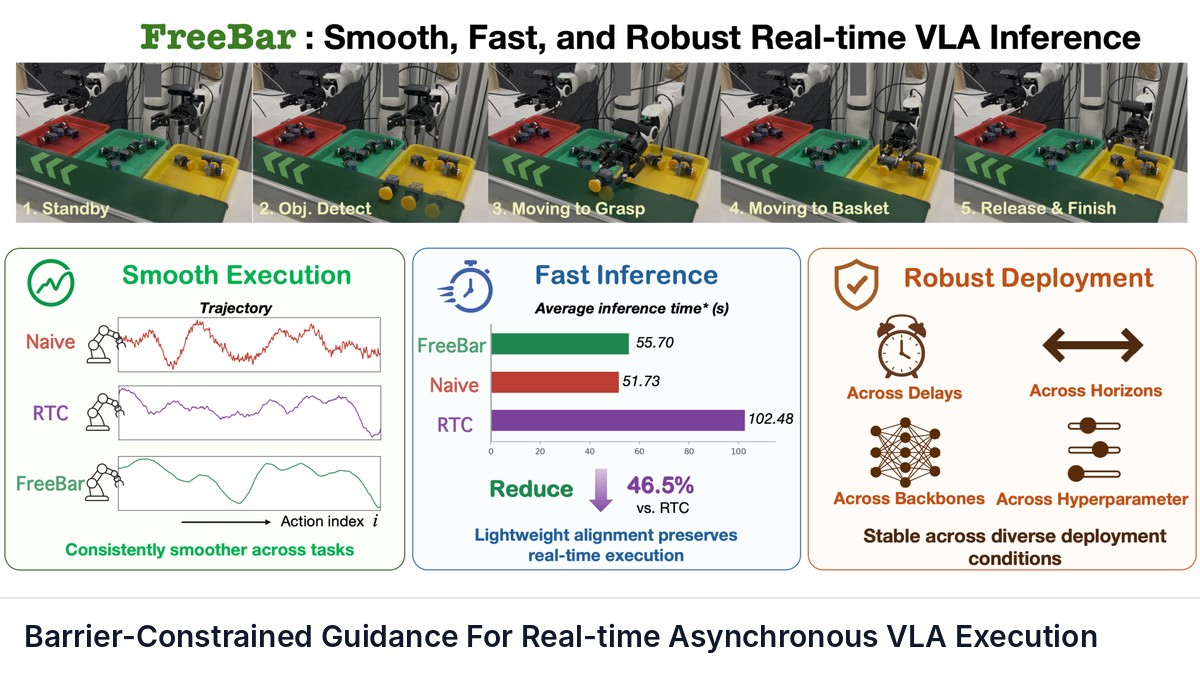
Barrier-Constrained Guidance For Real-time Asynchronous VLA Execution
Wenbo Yu, Jifan Li, Wenke Xia et al.
While asynchronous execution enables VLA models to operate in real-time environments by predicting the next chunk during execution, it inevitably introduces boundary misalignment with the committed action stream.