
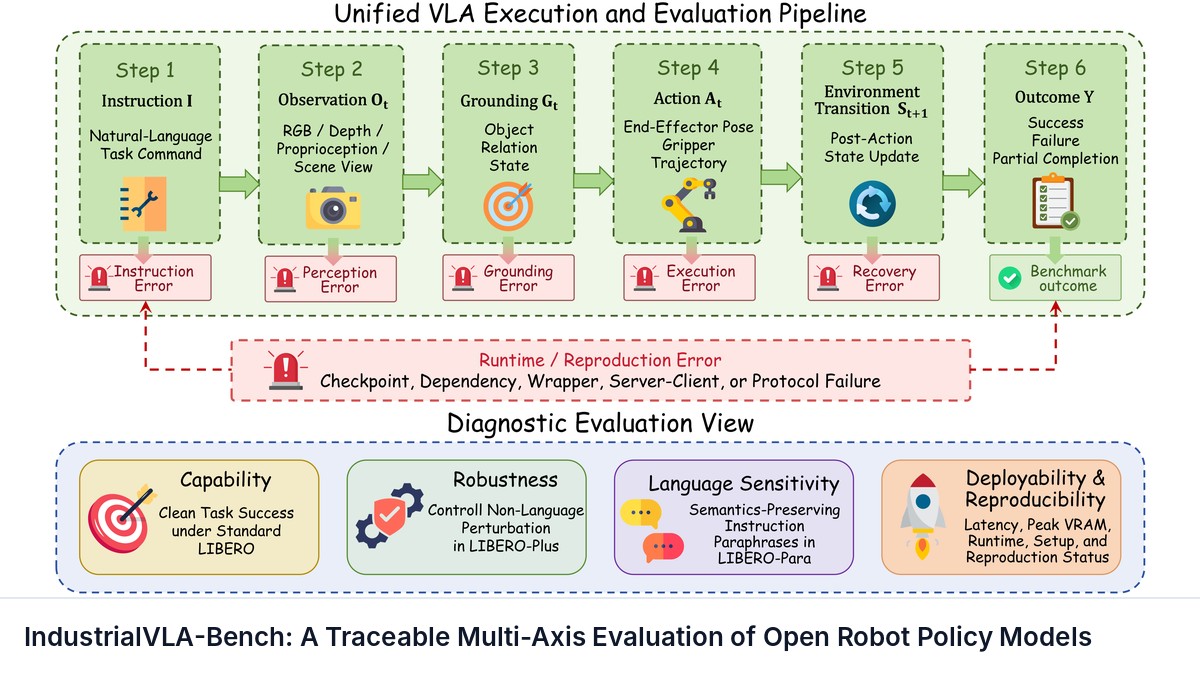
IndustrialVLA-Bench: A Traceable Multi-Axis Evaluation of Open Robot Policy Models
Yiqi Wang, Zhifeng Rao, Jiaqi Zhang, Xiaoyang Li, Zhangkai Wu, Yiqun Duan, Mingkai Zheng, Fei Wang, Shan You, Taotao Cai · N/A · 2026
Framework
N/A
License
N/A
Stars
N/A
Summary
Open robot policies increasingly follow two paradigms: vision-language-action models (VLAs) directly map observations and instructions to actions, whereas world-action models (WAMs) incorporate learned video or world dynamics into policy learning or action generation.
Abstract Summary
Key Points
- Open robot policies increasingly follow two paradigms: vision-language-action models (VLAs) directly map observations and instructions to actions, whereas world-action models (WAMs) incorporate learned video or world dynamics into policy learning or action generation.
- Although both target the same manipulation tasks and represent alternative design choices, they are commonly reported under different evaluation protocols, leaving their capability, robustness, language sensitivity, and deployment-cost trade-offs unclear.
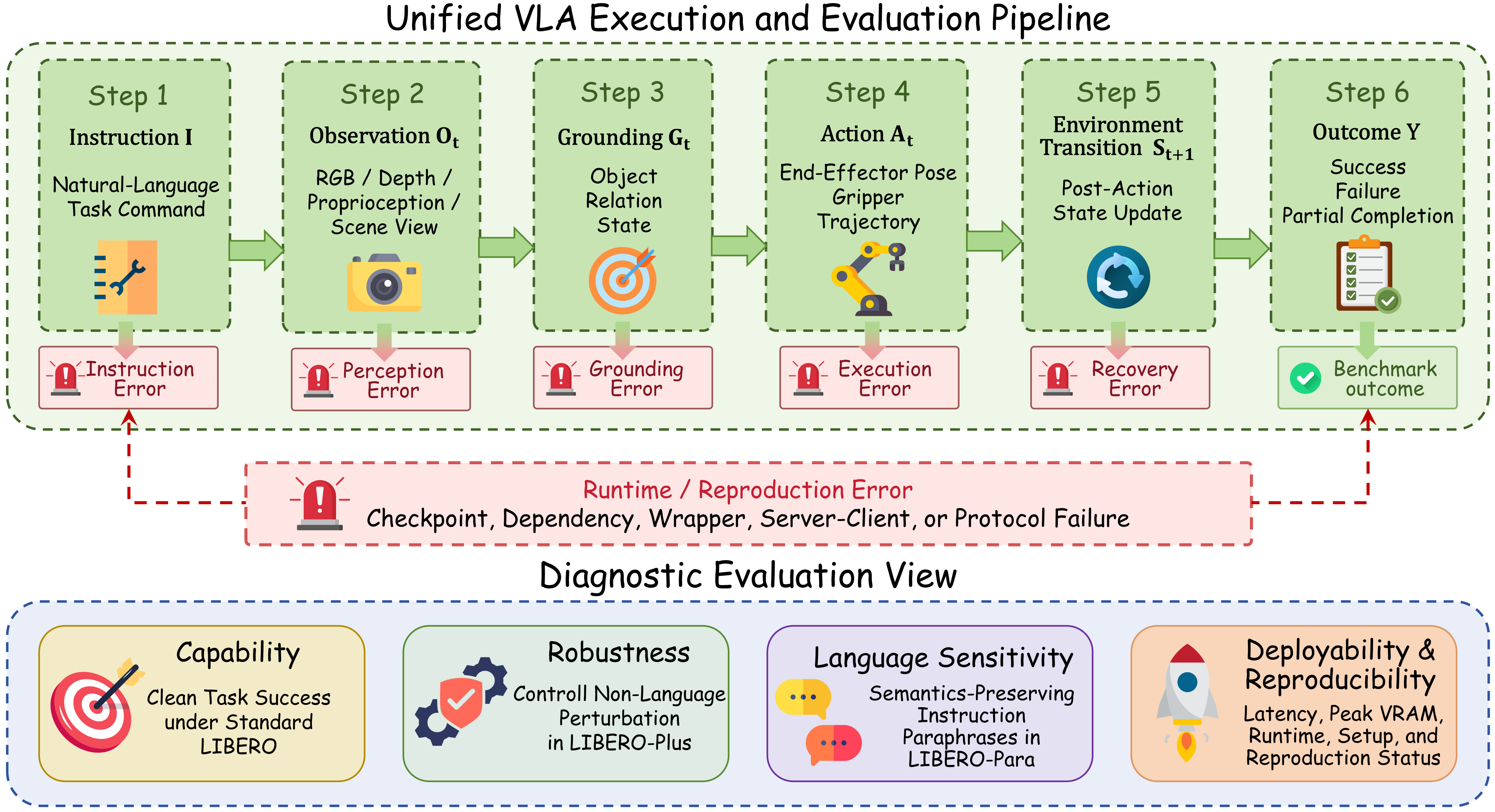
- We present IndustrialVLA-Bench, an evidence-aware evaluation of six released VLA and WAM systems under a unified reporting schema.
- It separately evaluates clean capability on LIBERO, non-language robustness on LIBERO-Plus, instruction sensitivity on LIBERO-Para, and observed execution cost.
- Reported task scores aggregate three complete evaluations with distinct random seeds under a fixed checkpoint and inference configuration.
A Unified View of Open Robot-Policy Evaluation
A central challenge in benchmarking open VLA systems is that their architectures, action representations and runtime designs are heterogeneous: released policies differ in whether actions are produced by a single vision-language stack, a separate action module, a flow or diffusion head, or a learned video representation [ 9 , 10 , 1 , 21 , 22 , 11 ] .
Comparing such systems through final success rates alone is misleading when the scores are produced under different architectural and execution assumptions.
Benchmark Design and Protocol
Rather than introducing a new architecture, IndustrialVLA-Bench defines an evaluation protocol that makes heterogeneous VLA releases comparable without hiding differences in benchmark support, runtime assumptions, or engineering cost.
MultiNet [ 17 ] , VLA-Eval [ 18 ] , and LeRobot [ 19 ] address complementary parts of the robot-policy lifecycle but differ from IndustrialVLA-Bench in their primary evaluation objective; Table 1 summarizes the distinction.
Experiments
We organize the evaluation around four questions: how well the evaluated systems solve standard LIBERO tasks under directly comparable conditions (RQ1); how much performance is retained when visual observations, camera configurations, robot appearance, and object layouts are perturbed in LIBERO-Plus (RQ2); how well task performance is preserved under semantics-preserving instruction paraphrases in LIBERO-Para (RQ3); and what computational and engineering costs reproduction and deployment require (RQ4).
Sources and Demonstrations
Figures are reproduced from Wang et al. See the full paper for experimental details and the project page, when the paper links one, for demonstrations and videos.
Related Papers

A Sim-to-Real Integration Pipeline for Training and Deployment of Chunk-Based VLA Manipulation Policies
Mathilde Kappel, Clémence Grislain, Mohamed Chetouani et al.
Vision-Language-Action (VLA) models have become a prominent paradigm for mapping multimodal inputs, including semantic instructions, visual observations of the scene, and proprioceptive observations, to robot actions.
Beyond Reconstruction: What Matters in Action Tokenization for Robot Policies?
Haoran Chen, Jingtian Ji, Samuel Wheeler et al.
Autoregressive action-token policies such as vision-language-action models require action tokenizers to translate discrete token sequences into precise control actions in continuous space. Many action tokenizers learn the mapping between tokens and actions via a reconstruction objective.
Capability-Aware Arbitration for Semantic Intent-Based Shared Control
Zhaoda Du, Michael Bowman, Xiaoli Zhang
Shared control often allocates robot authority based on confidence in inferred human intent, assuming reliable autonomous execution. When this assumption fails, high intent confidence can cause over-helping.
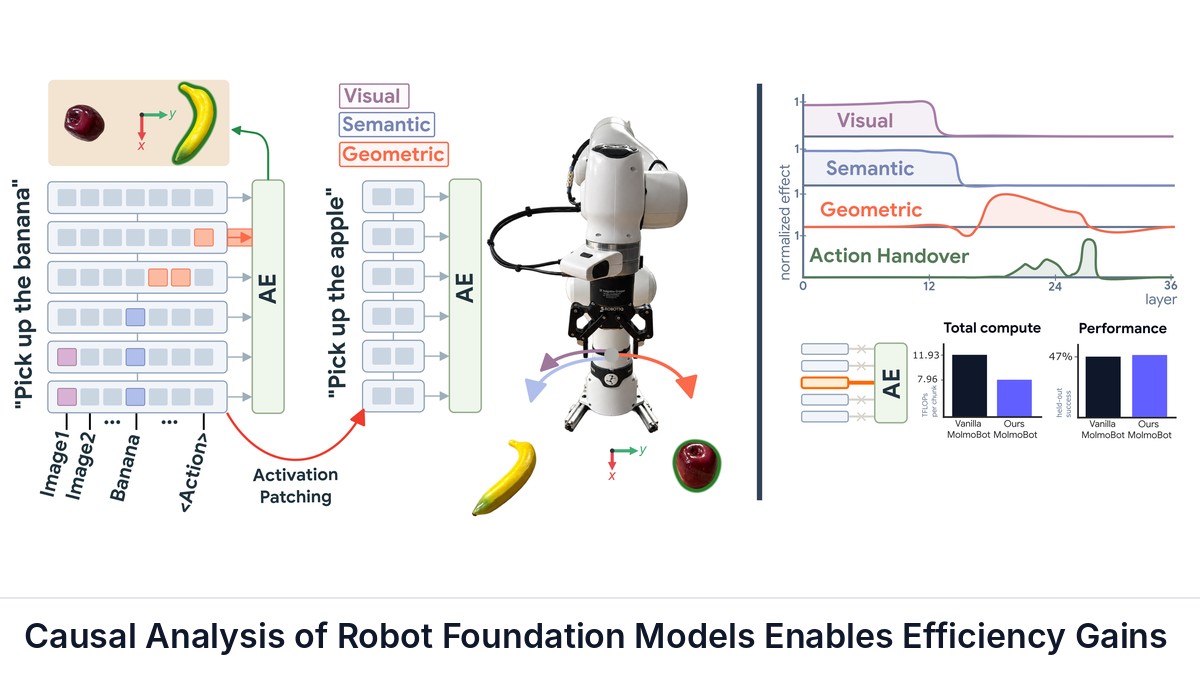
Causal Analysis of Robot Foundation Models Enables Efficiency Gains
Aiden Swann, Mathilde Papillon, Mozes Jacobs et al.
Vision-language-action (VLA) models are a promising approach to general purpose robot manipulation.