
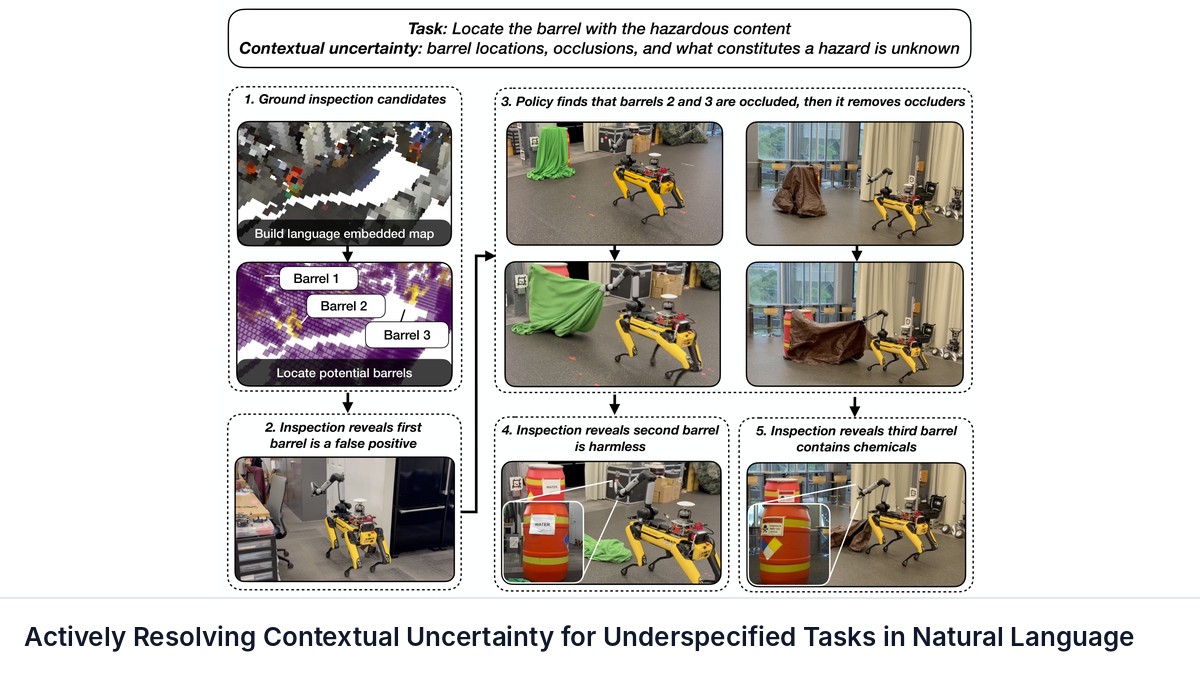
Actively Resolving Contextual Uncertainty for Underspecified Tasks in Natural Language
Zachary Ravichandran, Jonathan Diller, Fernando Cladera, Varun Murali, George J. Pappas, Vijay Kumar · N/A · 2026
Framework
N/A
License
N/A
Stars
N/A
Summary
Foundation models provide robots with the ability to interpret natural language and reason about environmental context, yet most language-conditioned policies assume that goals are well-specified and that task-relevant information is provided upfront via a prior map.
Abstract Summary
Key Points
- Foundation models provide robots with the ability to interpret natural language and reason about environmental context, yet most language-conditioned policies assume that goals are well-specified and that task-relevant information is provided upfront via a prior map.
- Operating in unfamiliar environments with underspecified tasks entails high contextual uncertainty: the robot must jointly infer what constitutes task success, what constitutes relevant information, and where (or whether) that information exists.
- We address these limitations via CLUE (Closed-Loop contextual Uncertainty rEsolution), a framework for actively resolving contextual uncertainty given underspecified tasks in natural language.
- CLUE uses an LLM-derived policy to hypothesize task-relevant concepts and potential plans
- It then uses a language-embedded map, which is constructed online, to ground these hypotheses into actions.
Problem Definition
A robot is placed in an unknown environment and must achieve an underspecified task $\ell$ in natural language. The robot is equipped with a set of high-level behaviors for navigation, inspection, and manipulation, an odometry system, and an RGB-D camera.
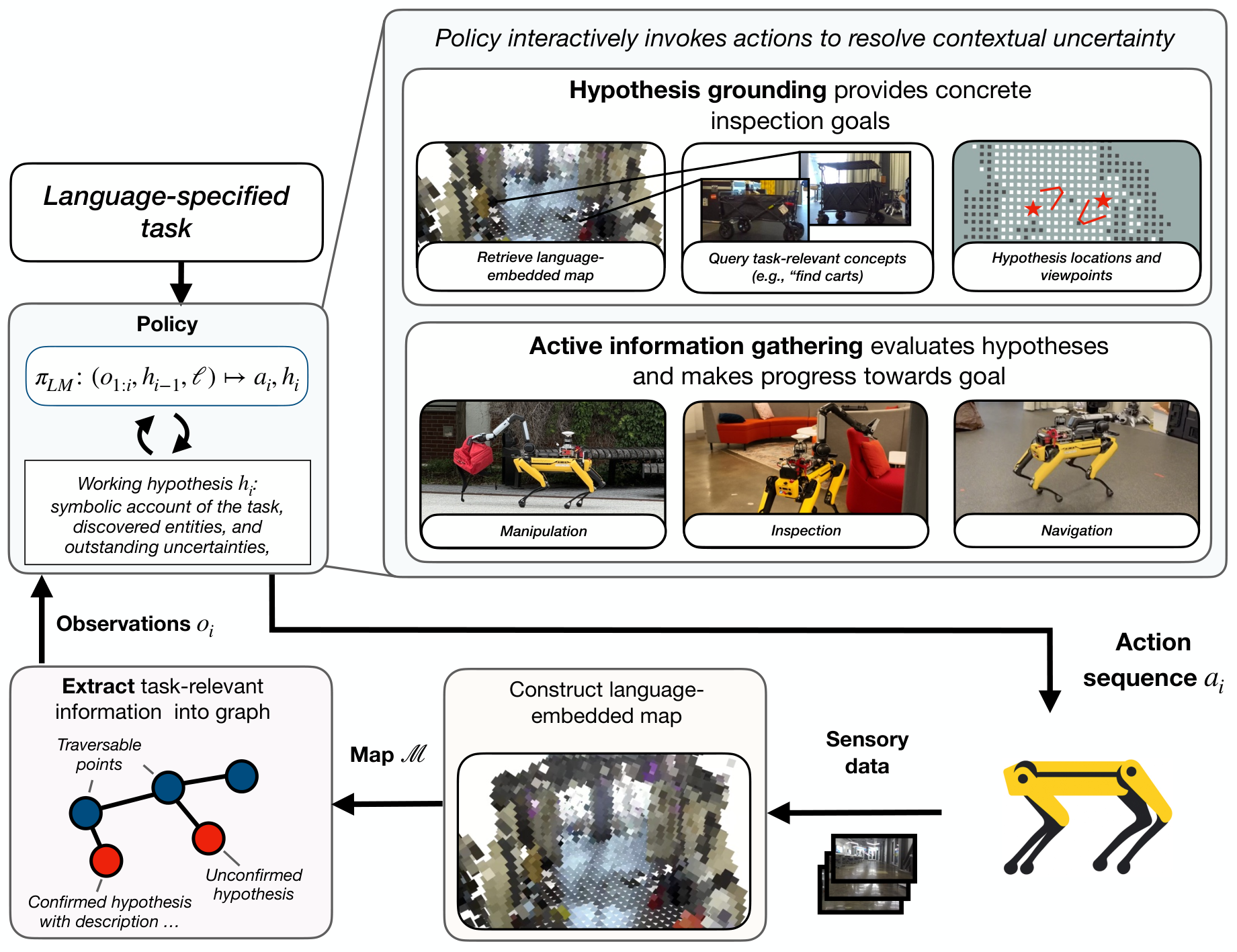
Actively Resolving Contextual Uncertainty with CLUE
We address the above problem via CLUE , a closed-loop framework that pairs an LLM-enabled policy and a language-embedded mapping framework, as shown in Figure 2 . The policy has access to two categories of actions: hypothesis grounding and active information gathering . In the first, the policy grounds hypotheses, which include task-relevant entities, into concrete action objectives.
In the second, the policy actively validates hypotheses via inspection, navigation, and manipulation, or otherwise makes progress towards the task.
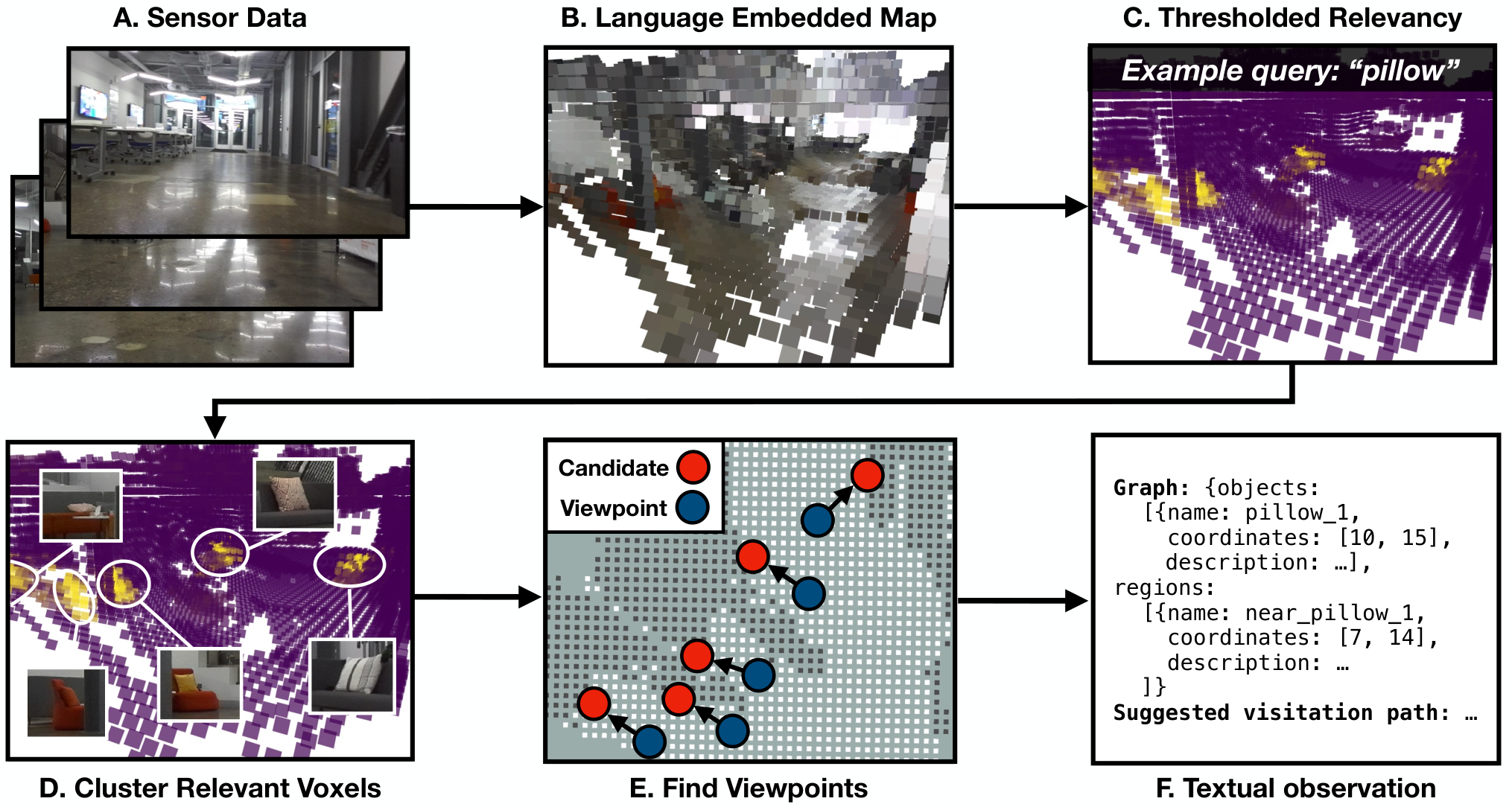
Experimental Evaluation
We design experiments to evaluate the contributions claimed in § 1 . Concretely, we aim to answer the following questions: Q1. Can CLUE realize tasks that require resolving contextual uncertainty? Q2. Is closed-loop feedback required, or does open-loop planning suffice? Q3. Is CLUE ’s grounding process necessary, or does simply building and then querying a semantic map suffice?
We describe our implementation details in § 5.1 , our experimental setup—including environments, tasks, and baselines—in § 5.2 .
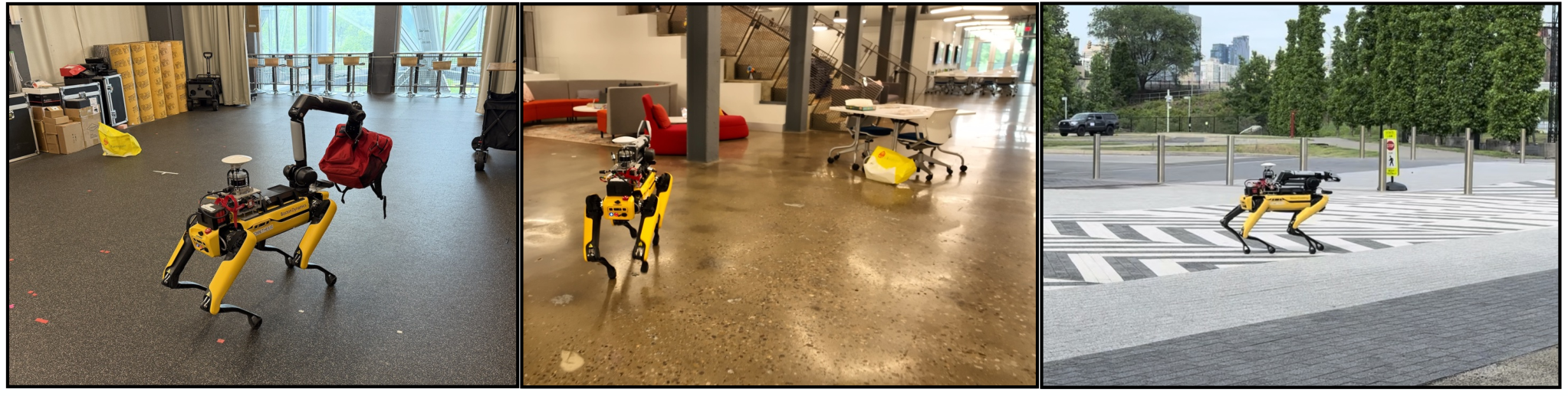
Sources and Demonstrations
Figures are reproduced from Ravichandran et al. See the full paper for experimental details and the project page, when the paper links one, for demonstrations and videos.
Related Papers
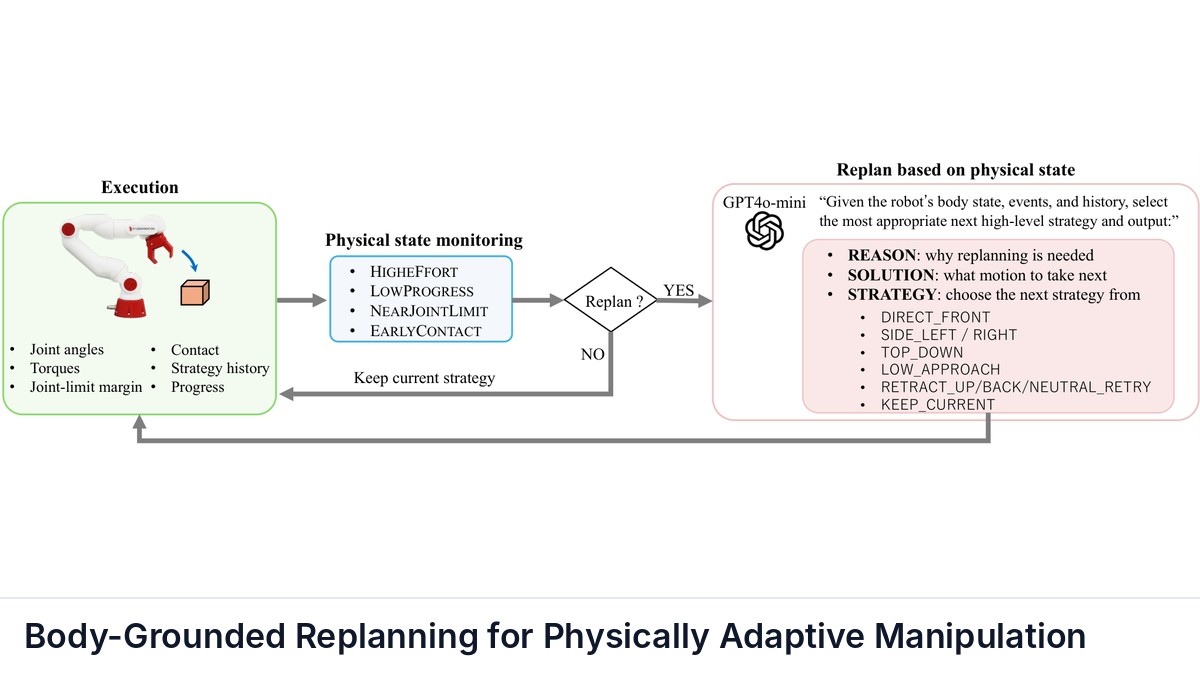
Body-Grounded Replanning for Physically Adaptive Manipulation
Namiko Saito, Hiroshi Kera
Manipulation requires not only reasoning about the external environment, but also about the robot's physical condition.
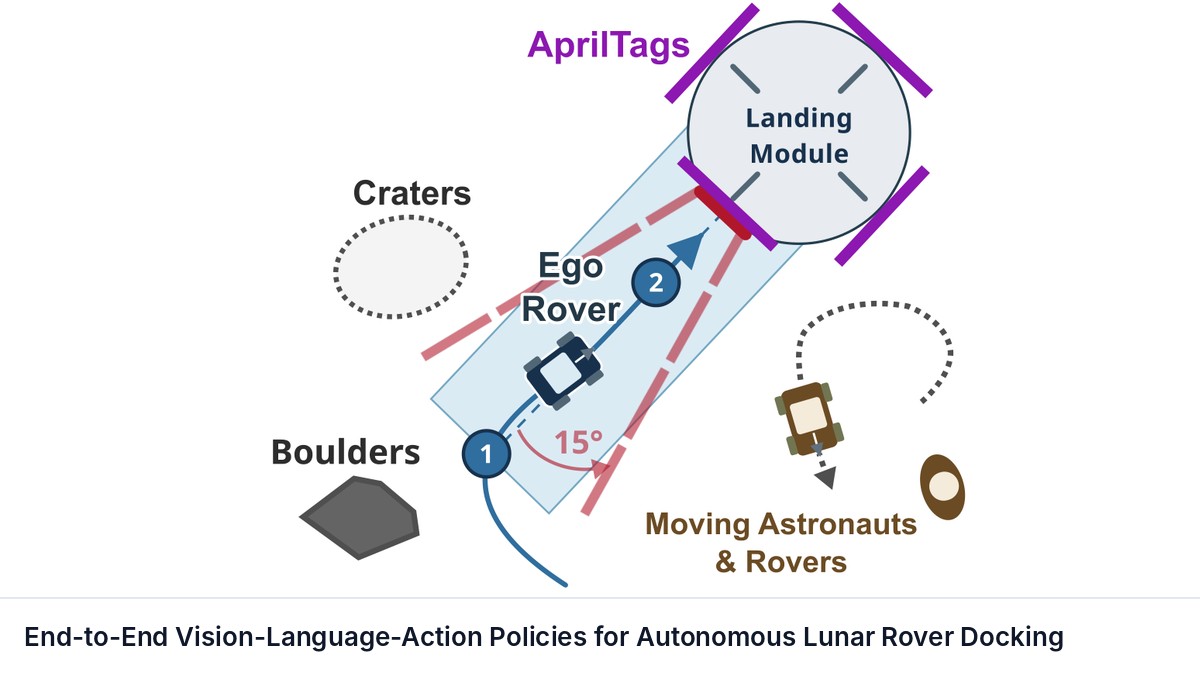
End-to-End Vision-Language-Action Policies for Autonomous Lunar Rover Docking
Sitan Huang, Grace Gao
Surface navigation on the Moon is subject to extreme illumination contrast and deployment-time perceptual disturbances.
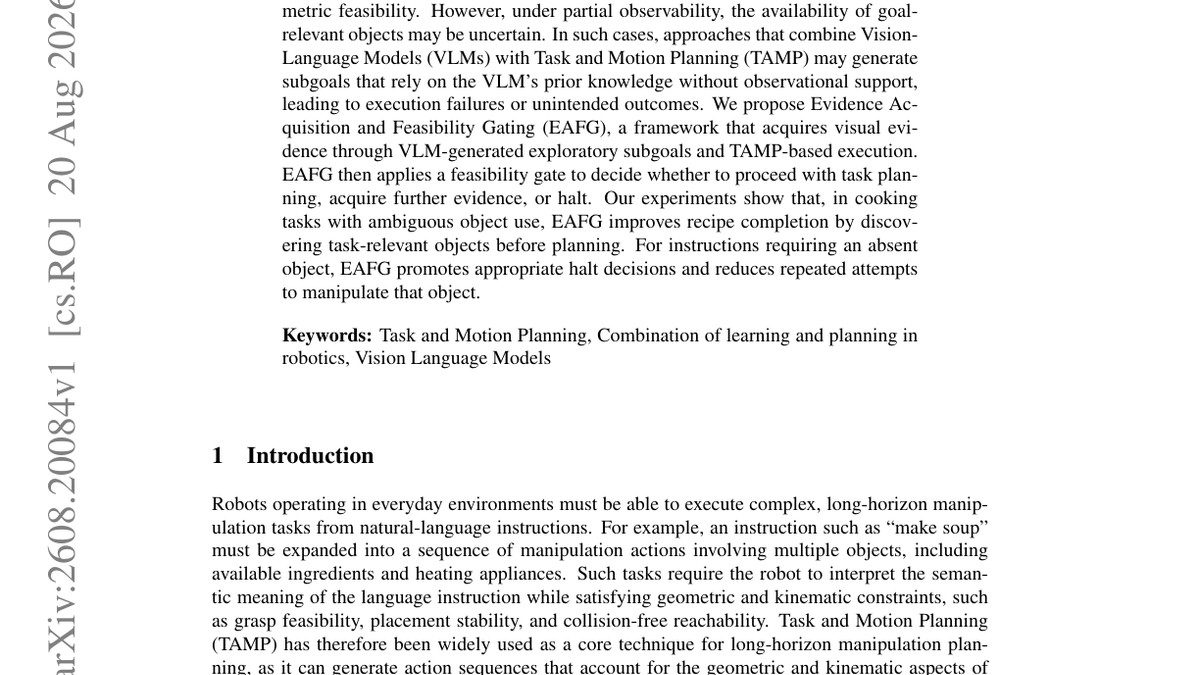
Evidence-Gated Task and Motion Planning with Vision-Language Models
Tsunehiko Tanaka, Matthew Stephenson, Alistair Macvicar et al.
Robots executing long-horizon manipulation tasks from natural-language instructions must reason about both semantic task structure and geometric feasibility. However, under partial observability, the availability of goal-relevant objects may be uncertain.
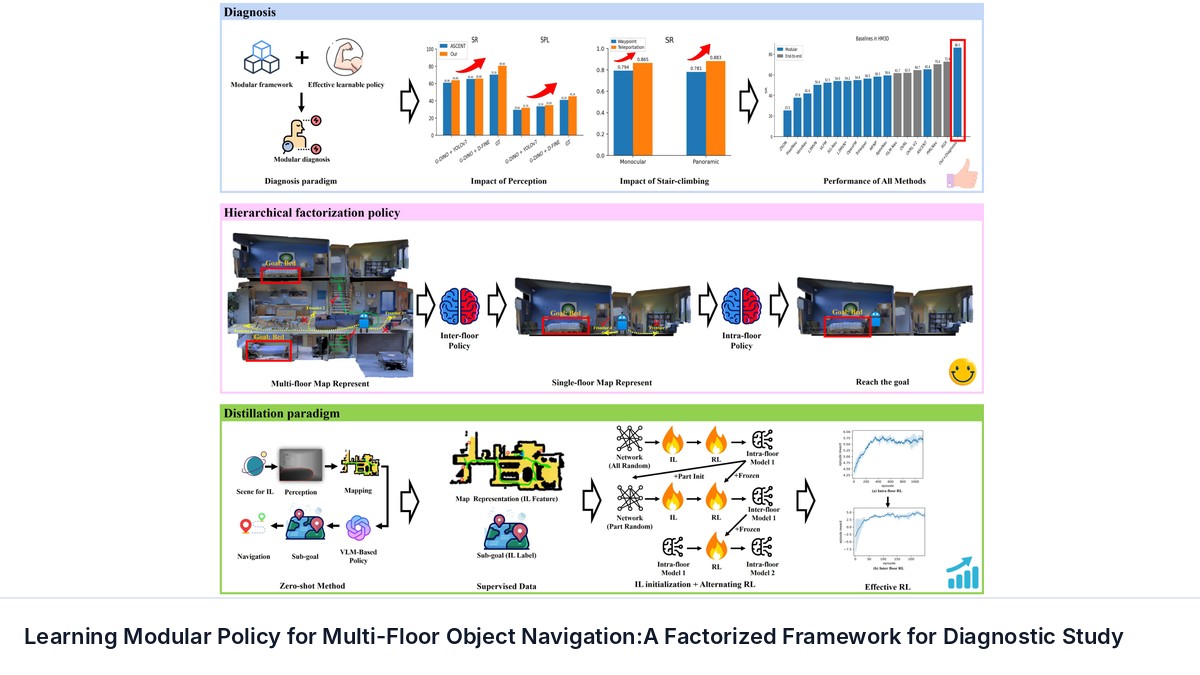
Learning Modular Policy for Multi-Floor Object Navigation:A Factorized Framework for Diagnostic Study
Shichao Zhai, Shuhao Ye, Rong Xiong et al.
Object-goal navigation (ObjectNav) in multi-floor scenarios presents a challenge due to sparse rewards caused by long-horizon decision-making.