
Learning Modular Policy for Multi-Floor Object Navigation:A Factorized Framework for Diagnostic Study
Shichao Zhai, Shuhao Ye, Rong Xiong, Yue Wang · N/A · 2026
Framework
N/A
License
N/A
Stars
N/A
Summary
Object-goal navigation (ObjectNav) in multi-floor scenarios presents a challenge due to sparse rewards caused by long-horizon decision-making.
Abstract Summary
Key Points
- Object-goal navigation (ObjectNav) in multi-floor scenarios presents a challenge due to sparse rewards caused by long-horizon decision-making.
- In this paper, we propose a diagnostic study based on a modular framework with an effective learnable policy to analyze failure factors in multi-floor scenarios.
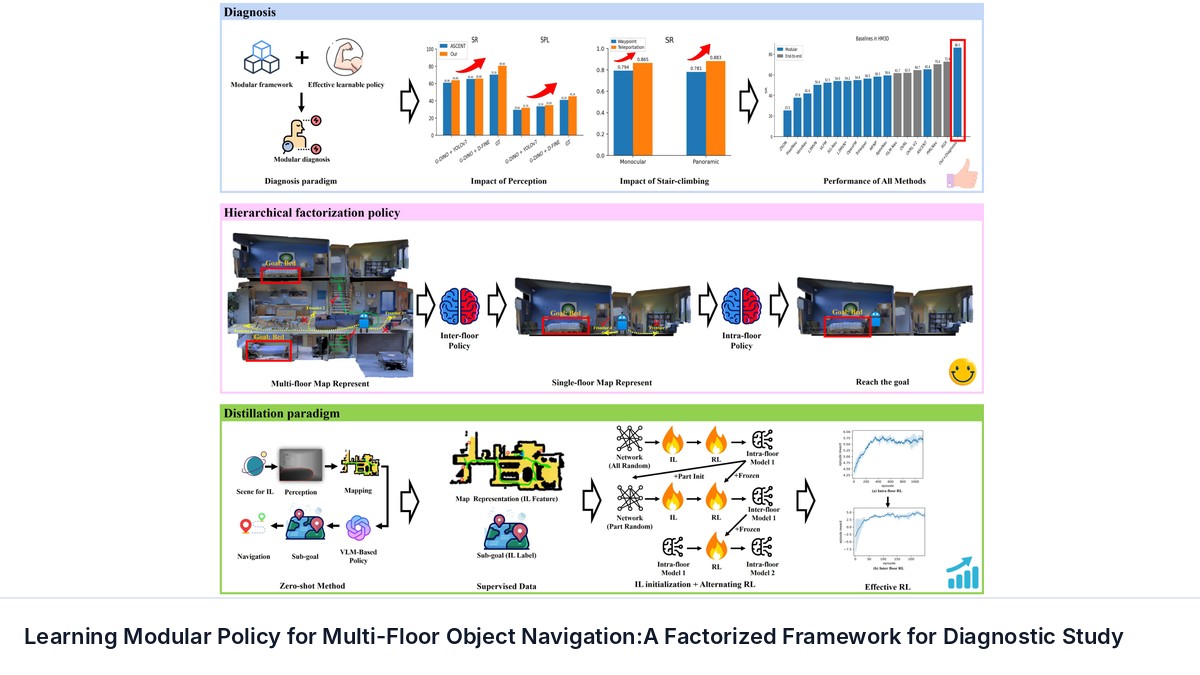
- To achieve an effective policy for diagnosis, we design the hierarchical factorization policy that deconstructs a single global policy into an intra-floor exploration policy and an inter-floor switching policy.
- To providing an effective initialization for Reinforcement Learning (RL), the lightweight intra-floor policy is learned by distilling the exploration logic of Visual Language Models (VLMs).
- Under idealized assumptions, we show that the factorized policy is theoretically equivalent to a single global policy at the policy-representation level.
Task setup
ObjectNav requires an agent to reach an object goal in an unseen environment. At each episode start, the agent is randomly initialized and assigned a goal category. At time $t$, the agent receives $O_{t}=(V_{t},P_{t})$, where $V_{t}$ is the RGBD image and $P_{t}$ is its pose, and selects from six actions: MoveForward, TurnLeft, TurnRight, LookUp, LookDown, and Stop.
An episode succeeds if the agent stops within distance $d_{\rm succ}$ of the goal and is limited to $T_{\max}$ steps.
Methodology
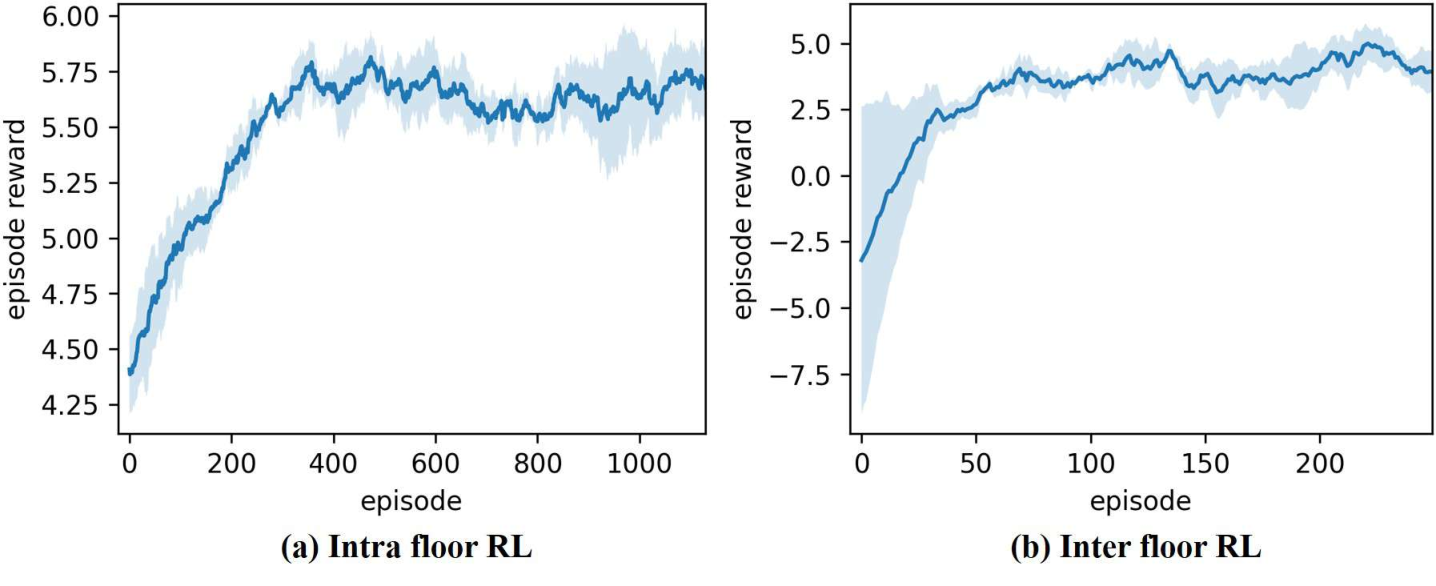
Fig. 2 illustrates our framework, which uses a diagnostic paradigm to identify the main bottlenecks in multi-floor navigation. It employs a hierarchical factorization policy composed of inter-floor and intra-floor policies, followed by the low-level navigation policy described in Sec. IV-D . First, we validate policy effectiveness through multiple rounds of alternating intra-floor and inter-floor training.
The policy is considered effective if each round improves performance and our method outperforms the zero-shot method.
Experiments
We conduct experiments on HM3D [ 17 ] and MP3D [ 18 ] . For the intra-floor policy, IL uses 80 HM3D v0.1 scenes and RL fine-tuning uses 65 other HM3D v0.2 scenes. For the inter-floor policy, IL and RL use 25 and 23 multi-floor HM3D v0.1 scenes, respectively. Diagnostics use the 20-scene HM3D v0.1 and 11-scene MP3D validation splits.
We use D-FINE [ 20 ] , Grounding DINO [ 21 ] , and MobileSAM [ 22 ] for perception, and BLIP-2 [ 23 ] as the VLM.

Sources and Demonstrations
Figures are reproduced from Zhai et al. See the full paper for experimental details and the project page, when the paper links one, for demonstrations and videos.
Related Papers
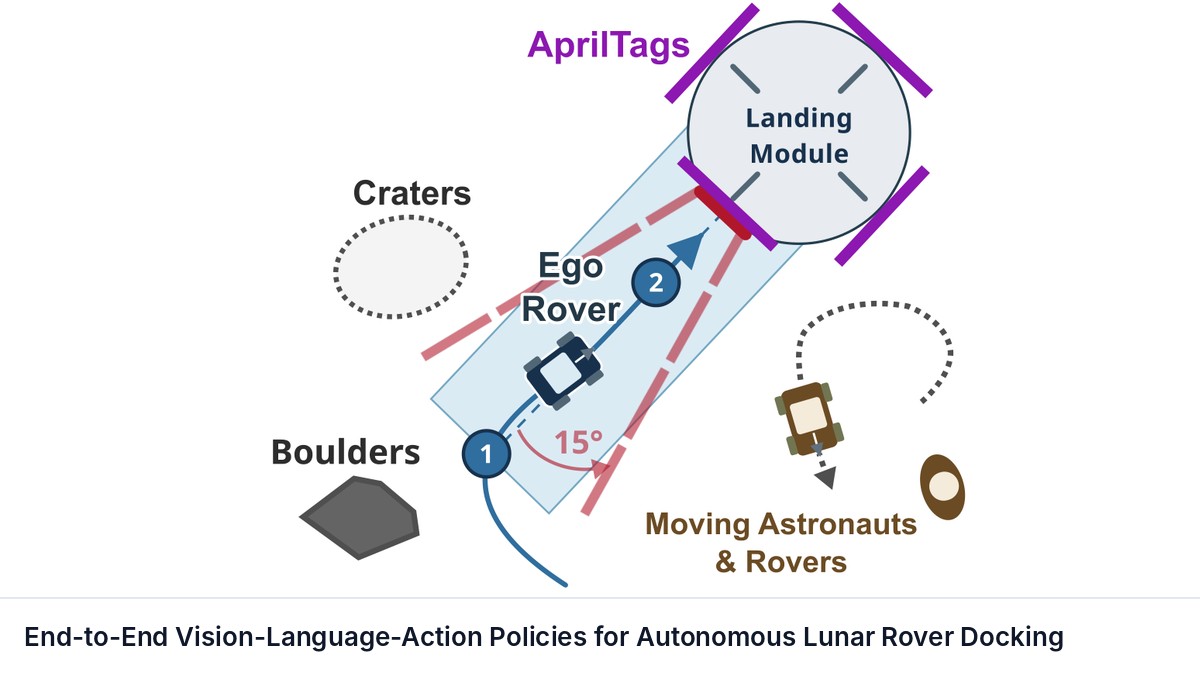
End-to-End Vision-Language-Action Policies for Autonomous Lunar Rover Docking
Sitan Huang, Grace Gao
Surface navigation on the Moon is subject to extreme illumination contrast and deployment-time perceptual disturbances.
Evidence-Gated Task and Motion Planning with Vision-Language Models
Tsunehiko Tanaka, Matthew Stephenson, Alistair Macvicar et al.
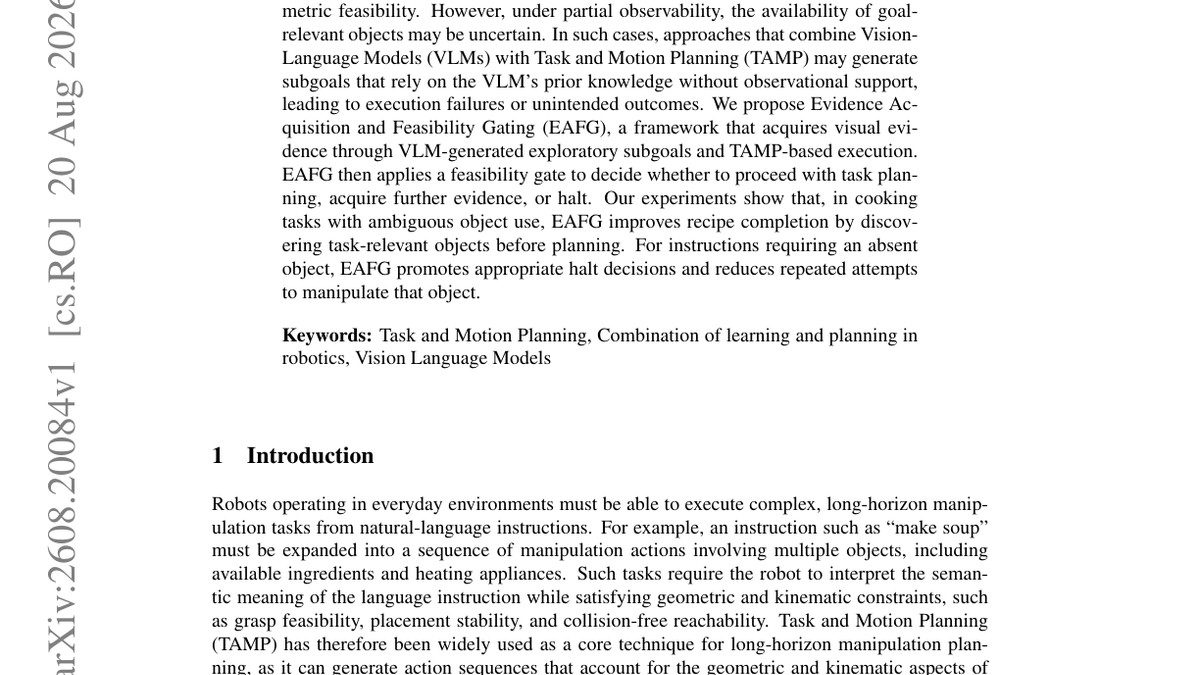
Robots executing long-horizon manipulation tasks from natural-language instructions must reason about both semantic task structure and geometric feasibility. However, under partial observability, the availability of goal-relevant objects may be uncertain.
LT-Mem: Volatility-Aware Spatio-Temporal Memory for Lifelong Scene Understanding
Lee, Yumin, Ju, Hyoseok, Kim, Giseop
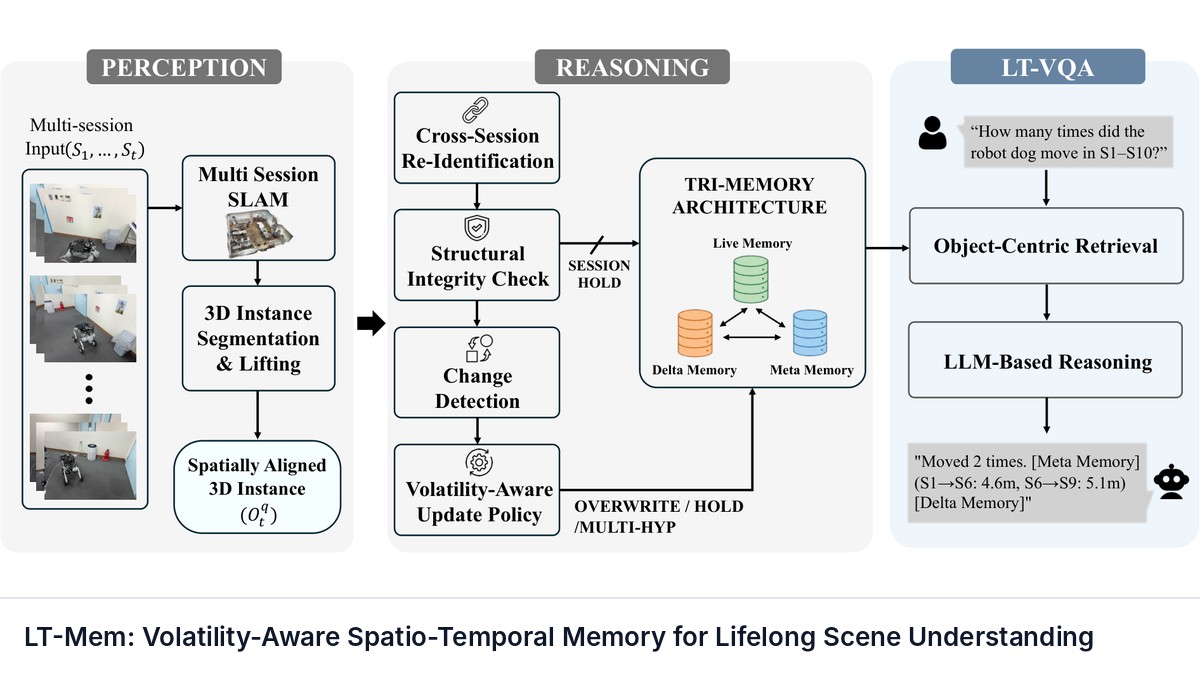
Long-term robot operation in evolving environments requires object-level understanding that persists across repeated revisits.
NavGPT-3: Harnessing Context in a Hierarchical Navigation Runtime
Gengze Zhou, Yicong Hong, Jiazhao Zhang et al.
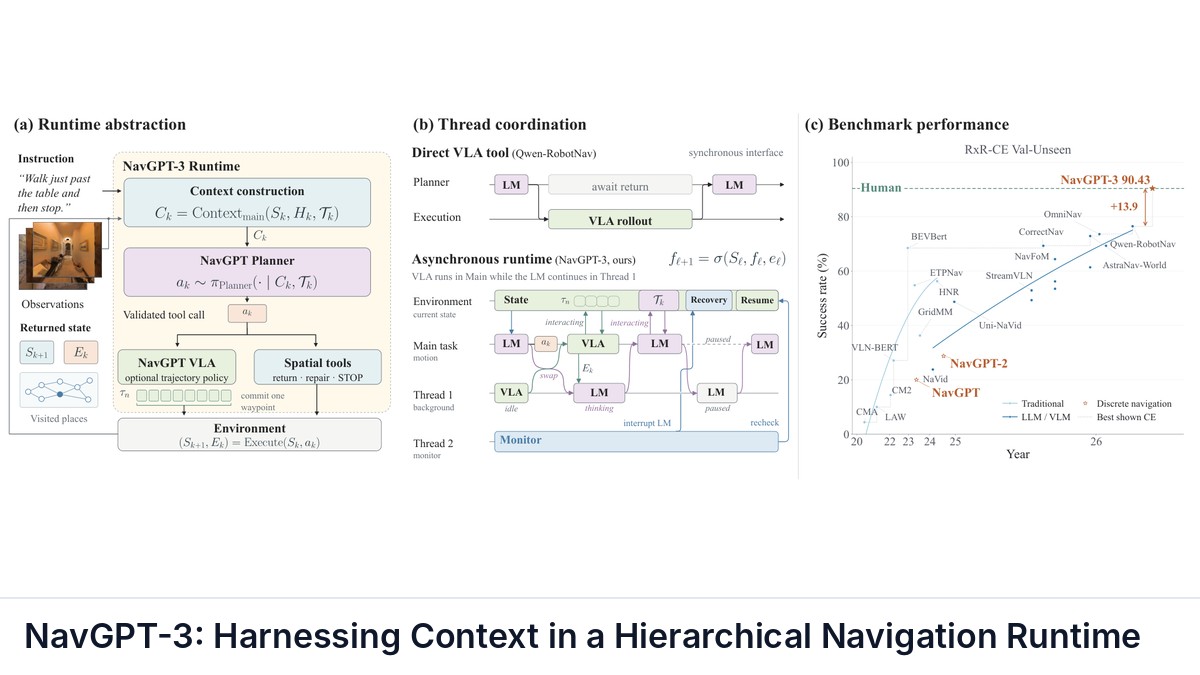
Language models trained with long-horizon agentic reinforcement learning can generalize knowledge through reasoning, express precise actions, and pursue goals over many steps, raising the ceiling on what an embodied agent can understand and decide.