
DyPES-VLA: Learning Shared Dynamics Priors and Embodiment-Specific Control for Cross-Embodiment Manipulation
Junfeng Li, Junjie He, Zhide Zhong, Yangyang Zheng, Pingyue Sheng, Jiayu Dong, Ruixin Li, Haodong Yan, Jiaguan Zhu, Tianran Zhang, Runze Yu, Wen Chen, Liuqing Yang, Yuxiang Gao, Haoang Li · N/A · 2026
Framework
N/A
License
N/A
Stars
N/A
Summary
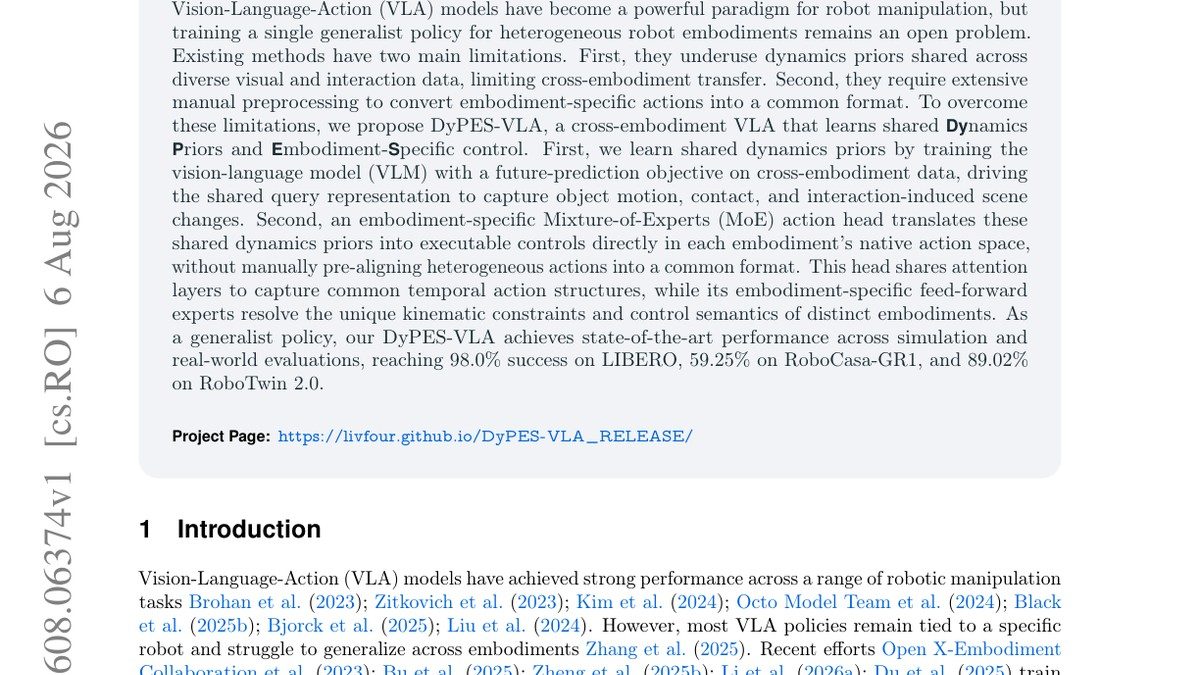
Vision-Language-Action (VLA) models have become a powerful paradigm for robot manipulation, but training a single generalist policy for heterogeneous robot embodiments remains an open problem. Existing methods have two main limitations.
Abstract Summary
Key Points
- Vision-Language-Action (VLA) models have become a powerful paradigm for robot manipulation, but training a single generalist policy for heterogeneous robot embodiments remains an open problem.
- Existing methods have two main limitations
- First, they underuse dynamics priors shared across diverse visual and interaction data, limiting cross-embodiment transfer.
- Second, they require extensive manual preprocessing to convert embodiment-specific actions into a common format.
- To overcome these limitations, we propose DyPES-VLA, a cross-embodiment VLA that learns shared Dynamics Priors and Embodiment-Specific control.
Methodology
As shown in Fig. 2 , our DyPES-VLA comprises three components that jointly learn shared dynamics priors and embodiment-specific control. 1) A pretrained VLM Bai et al. (2025) encodes the visual observations, the instruction, and the embodiment metadata, together with a set of learnable query tokens appended to the multimodal sequence; the output query states form the shared interface between the two heads.
2) A future generation head, instantiated as a SANA image generator Xie et al.
Experiments
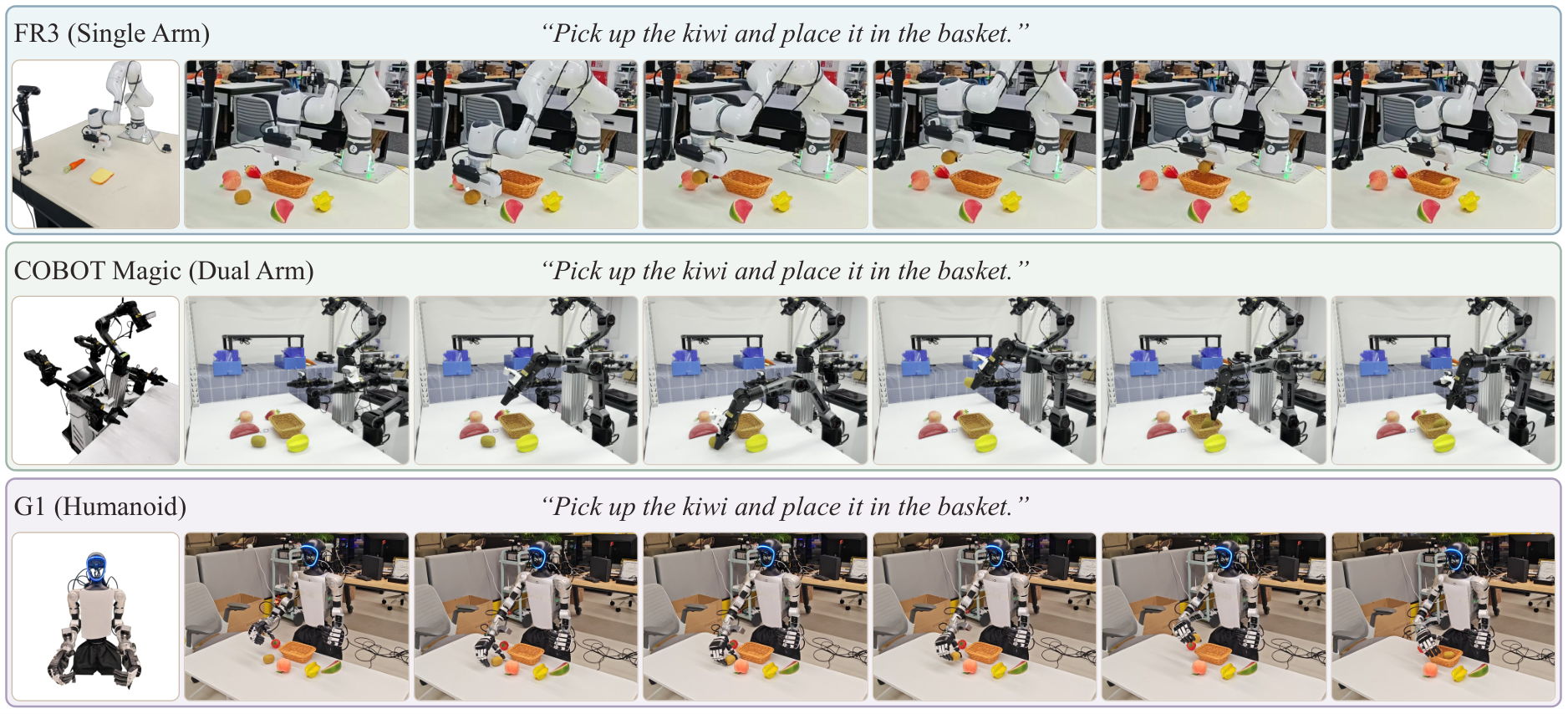
In this section, we evaluate whether future-supervised dynamics priors and the embodiment-specific MoE action head provide an effective paradigm for cross-embodiment manipulation learning. We organize the experiments around the following questions: Q1: Can our DyPES-VLA use a single checkpoint to perform across simulation benchmarks with distinct embodiments and native action spaces?
Q2: Does future supervision enrich the shared representation with dynamics priors and improve cross-embodiment policy learning? Q3: Does embodiment-specific action...
Sources and Demonstrations
Figures are reproduced from Li et al. See the full paper for experimental details and the project page, when the paper links one, for demonstrations and videos.
Related Papers

A Sim-to-Real Integration Pipeline for Training and Deployment of Chunk-Based VLA Manipulation Policies
Mathilde Kappel, Clémence Grislain, Mohamed Chetouani et al.
Vision-Language-Action (VLA) models have become a prominent paradigm for mapping multimodal inputs, including semantic instructions, visual observations of the scene, and proprioceptive observations, to robot actions.
Beyond Reconstruction: What Matters in Action Tokenization for Robot Policies?
Haoran Chen, Jingtian Ji, Samuel Wheeler et al.
Autoregressive action-token policies such as vision-language-action models require action tokenizers to translate discrete token sequences into precise control actions in continuous space. Many action tokenizers learn the mapping between tokens and actions via a reconstruction objective.
Capability-Aware Arbitration for Semantic Intent-Based Shared Control
Zhaoda Du, Michael Bowman, Xiaoli Zhang
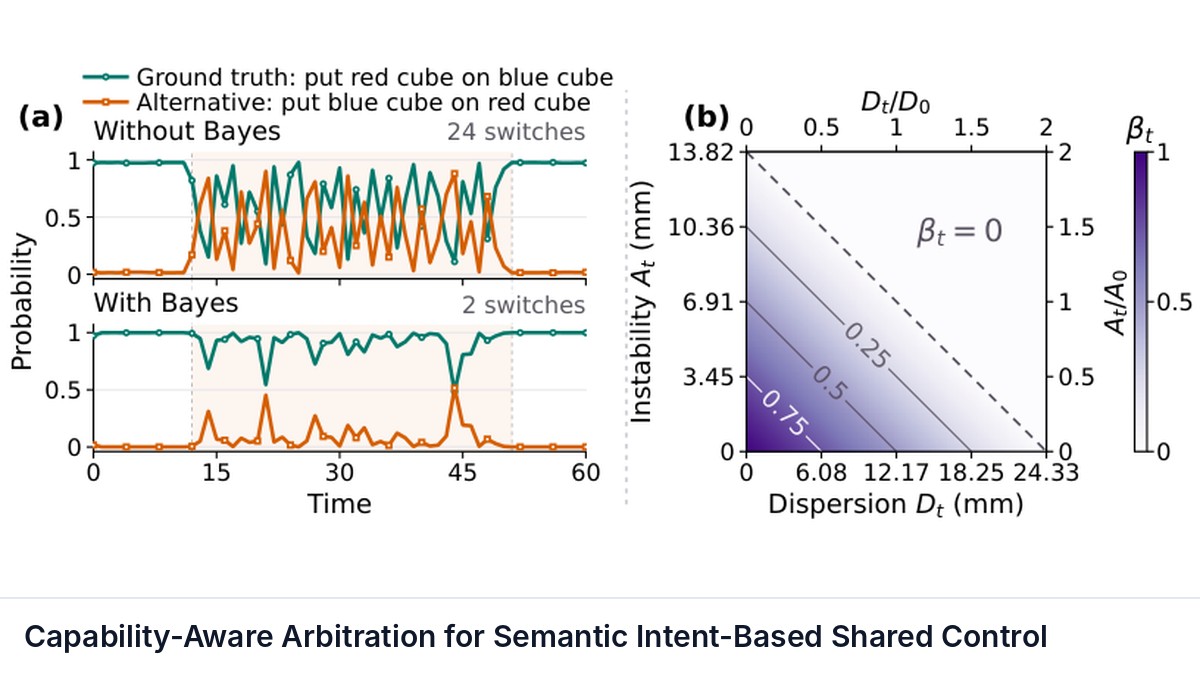
Shared control often allocates robot authority based on confidence in inferred human intent, assuming reliable autonomous execution. When this assumption fails, high intent confidence can cause over-helping.
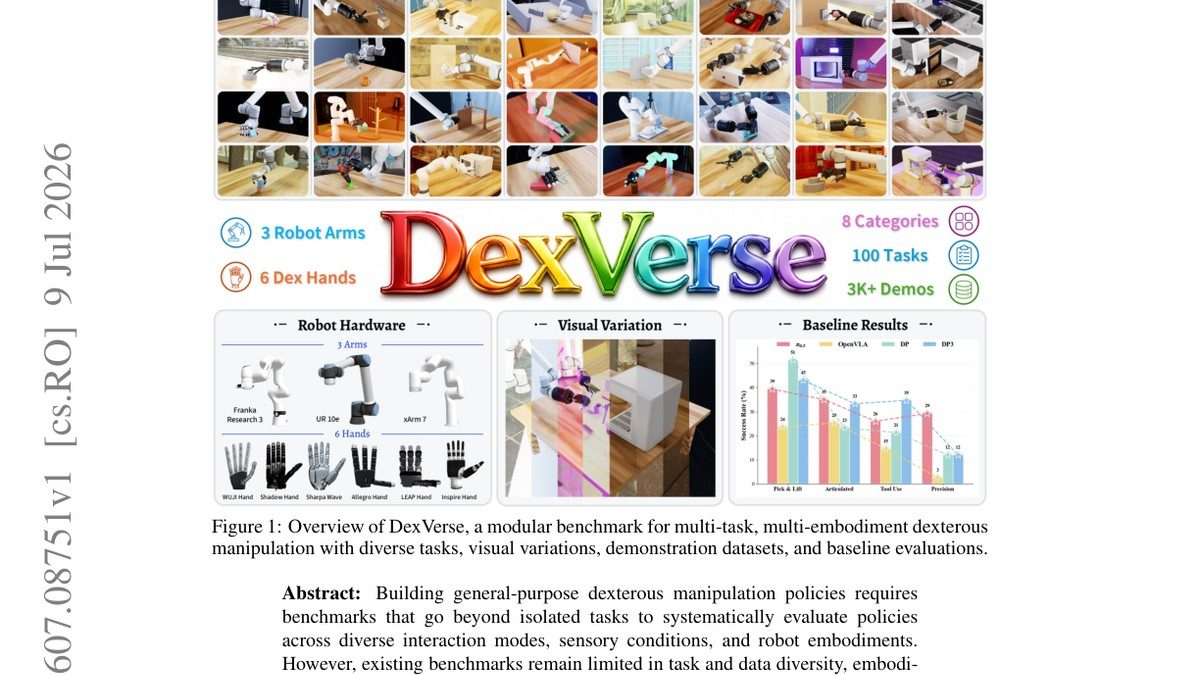
DexVerse: A Modular Benchmark for Multi-Task, Multi-Embodiment Dexterous Manipulation
Yunchao Yao, Zhuxiu Xu, Tianqi Zhang et al.
Building general-purpose dexterous manipulation policies requires benchmarks that go beyond isolated tasks to systematically evaluate policies across diverse interaction modes, sensory conditions, and robot embodiments.