
GR00T N1: An Open Foundation Model for Generalist Humanoid Robots
NVIDIA, :, Johan Bjorck, Fernando Castañeda, Nikita Cherniadev, Xingye Da, Runyu Ding, Linxi "Jim" Fan, Yu Fang, Dieter Fox, Fengyuan Hu, Spencer Huang, Joel Jang, Zhenyu Jiang, Jan Kautz, Kaushil Kundalia, Lawrence Lao, Zhiqi Li, Zongyu Lin, Kevin Lin, Guilin Liu, Edith Llontop, Loic Magne, Ajay Mandlekar, Avnish Narayan, Soroush Nasiriany, Scott Reed, You Liang Tan, Guanzhi Wang, Zu Wang, Jing Wang, Qi Wang, Jiannan Xiang, Yuqi Xie, Yinzhen Xu, Zhenjia Xu, Seonghyeon Ye, Zhiding Yu, Ao Zhang, Hao Zhang, Yizhou Zhao, Ruijie Zheng, Yuke Zhu · N/A · 2025
Framework
N/A
License
N/A
Stars
N/A
Summary
General-purpose robots need a versatile body and an intelligent mind. Recent advancements in humanoid robots have shown great promise as a hardware platform for building generalist autonomy in the human world.
Abstract Summary
Key Points
- General-purpose robots need a versatile body and an intelligent mind
- Recent advancements in humanoid robots have shown great promise as a hardware platform for building generalist autonomy in the human world.
- A robot foundation model, trained on massive and diverse data sources, is essential for enabling the robots to reason about novel situations, robustly handle real-world variability, and rapidly learn new tasks.
- To this end, we introduce GR00T N1, an open foundation model for humanoid robots
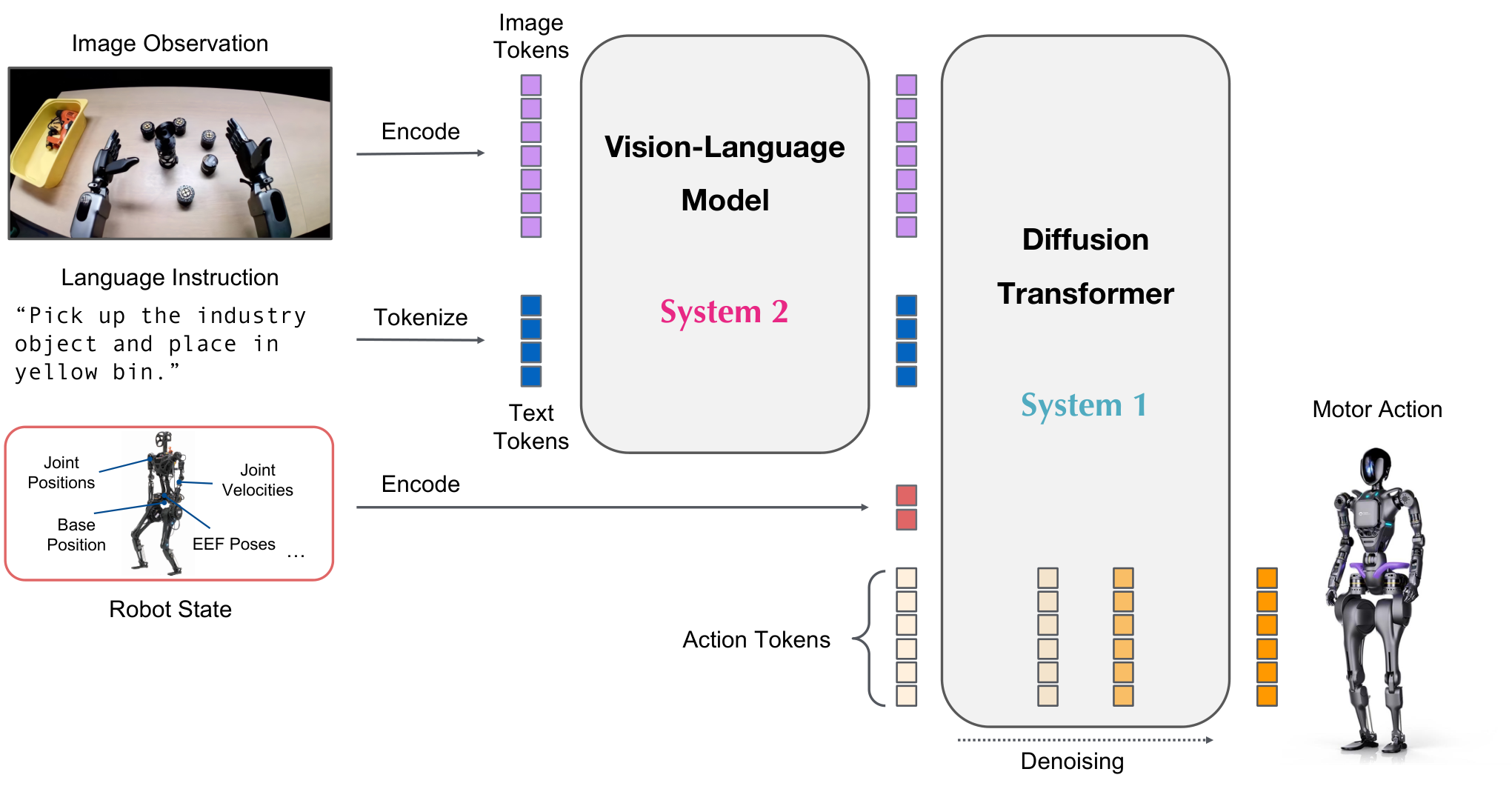
- GR00T N1 is a Vision-Language-Action (VLA) model with a dual-system architecture
GR00T N1 Foundation Model
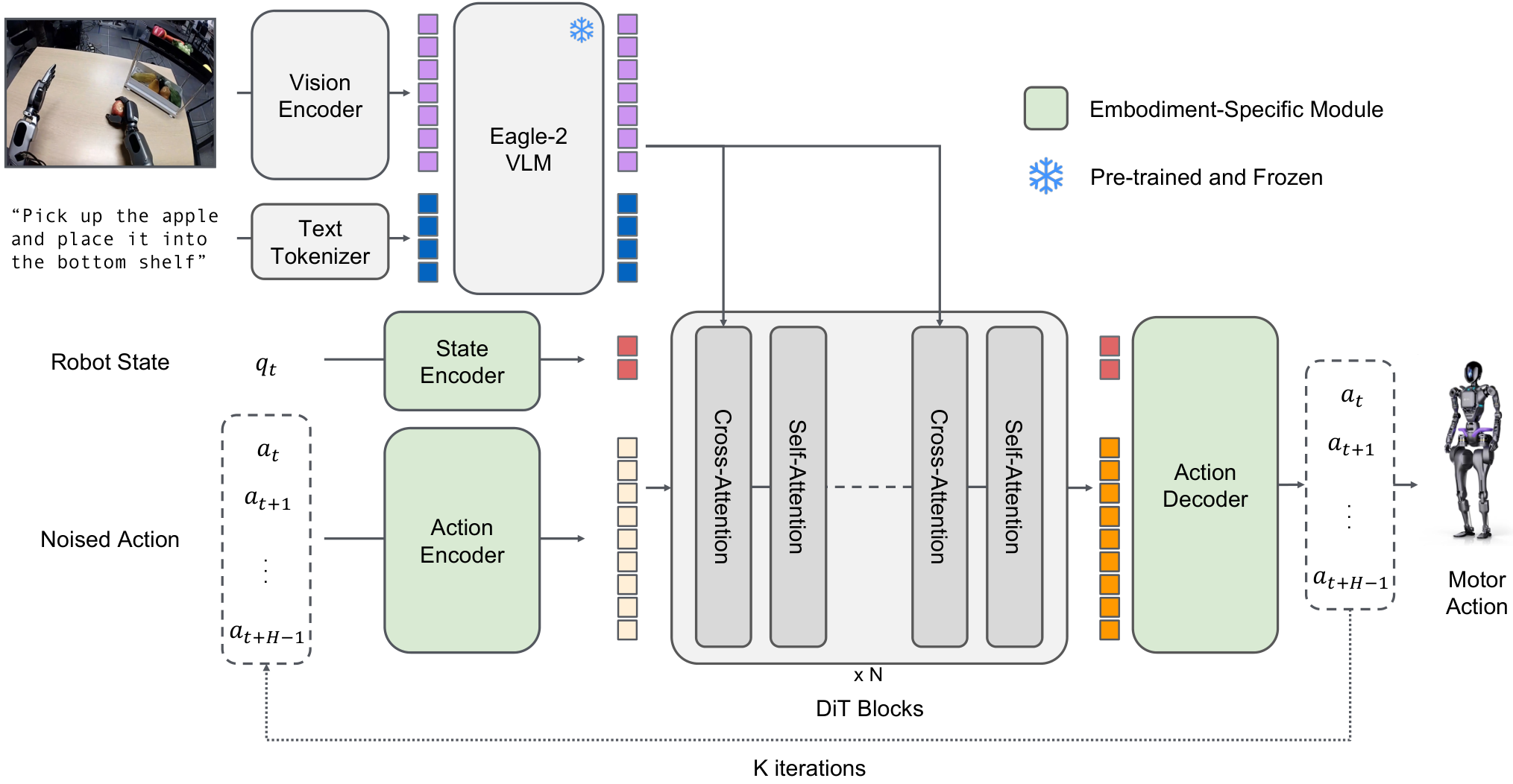
GR00T N1 is a Vision-Language-Action (VLA) model for humanoid robots trained on diverse data sources. The model contains a vision-language backbone that encodes language and image input and a DiT-based flow-matching policy that outputs high-frequency actions. We use the NVIDIA Eagle-2 VLM ( Li et al., 2025 ) as the vision-language backbone.
Specifically, our publicly released GR00T-N1-2B model has 2.2B parameters in total, with 1.34B in the VLM. The inference time for sampling a chunk of 16 actions is 63.9ms on an L40 GPU using bf16. Fig.
Pre-Training Datasets
We structure our pre-training corpus into three main categories: real-robot datasets (Sec. 3.1 ), synthetic datasets (Sec. 3.2 ), and human video datasets (Sec. 3.3 ). These roughly correspond to the peak, middle, and base of the data pyramid (Fig. 1 ), respectively. The synthetic datasets consist of both simulation trajectories and neural trajectories.
Table 1 summarizes our training data generation strategies in Sec. 2.2 and their applicable data sources correspondingly.
Evaluation
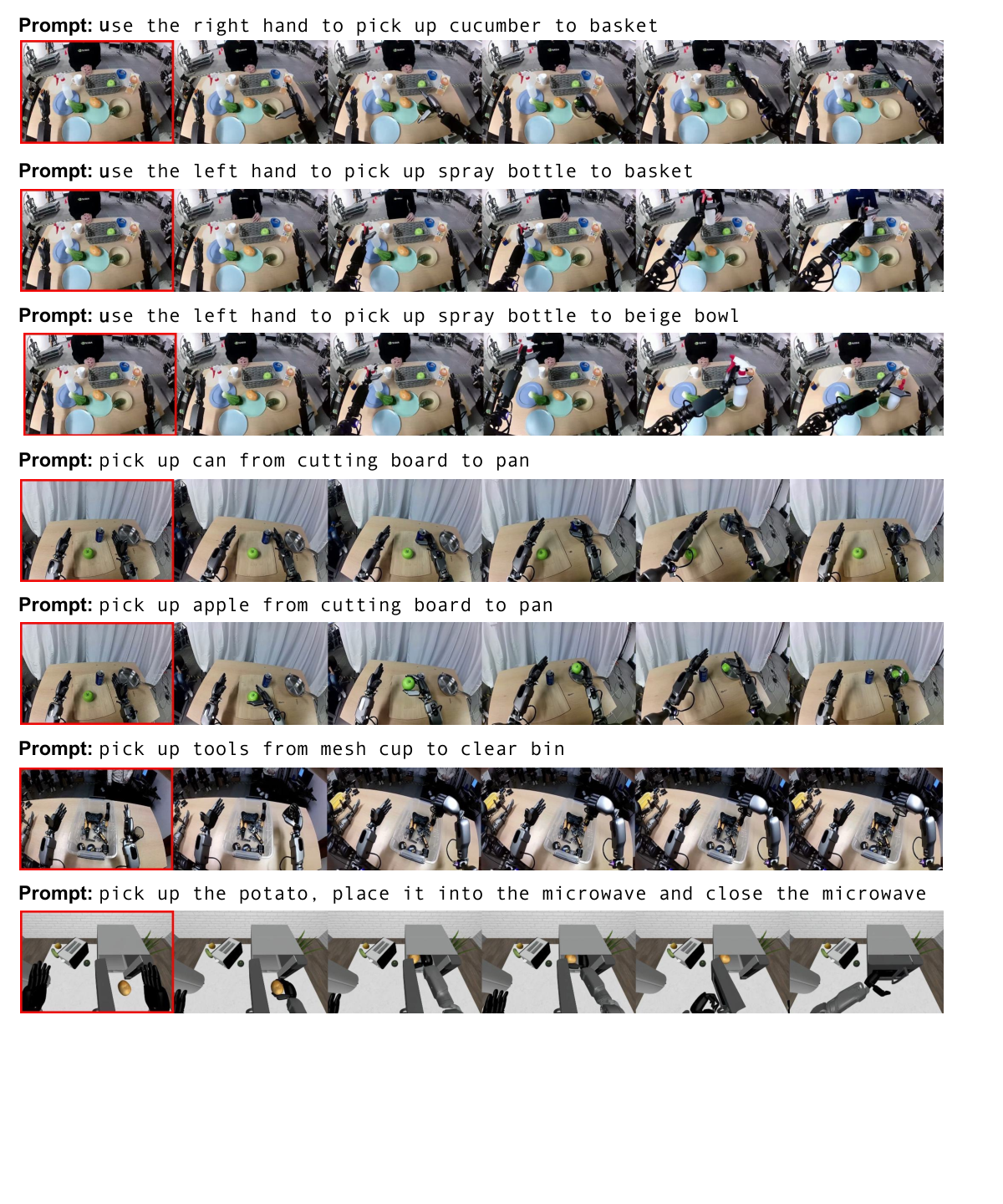
We evaluate our GR00T N1 models in a diverse set of simulated and real-world benchmarks. Our simulation experiments are conducted on three distinct benchmarks designed to systematically assess the effectiveness of our model across various robot embodiments and manipulation tasks. In our real-world experiments, we investigate the model’s capability on a suite of tabletop manipulation tasks with the GR-1 humanoid robot.
These experiments aim to demonstrate GR00T N1’s ability to acquire new skills from a limited number of human demonstrations.
Sources and Demonstrations
Figures are reproduced from NVIDIA et al. See the full paper for experimental details and the project page, when the paper links one, for demonstrations and videos.
Related Papers

A Sim-to-Real Integration Pipeline for Training and Deployment of Chunk-Based VLA Manipulation Policies
Mathilde Kappel, Clémence Grislain, Mohamed Chetouani et al.
Vision-Language-Action (VLA) models have become a prominent paradigm for mapping multimodal inputs, including semantic instructions, visual observations of the scene, and proprioceptive observations, to robot actions.

Capability-Aware Arbitration for Semantic Intent-Based Shared Control
Zhaoda Du, Michael Bowman, Xiaoli Zhang
Shared control often allocates robot authority based on confidence in inferred human intent, assuming reliable autonomous execution. When this assumption fails, high intent confidence can cause over-helping.
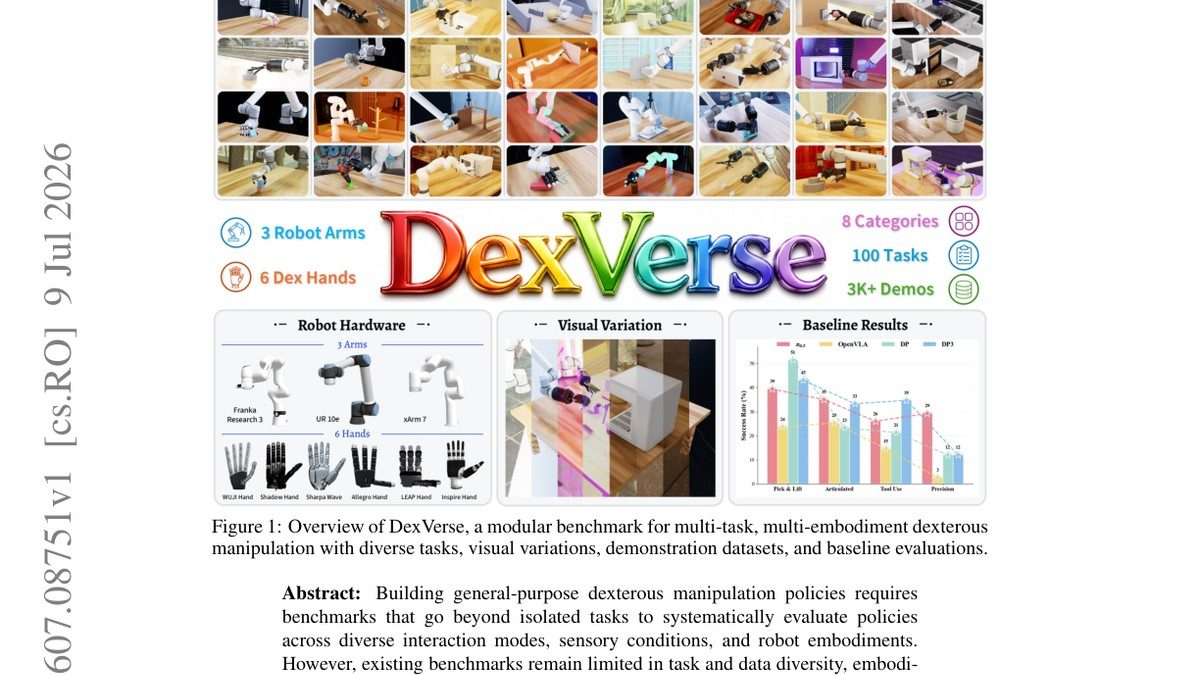
DexVerse: A Modular Benchmark for Multi-Task, Multi-Embodiment Dexterous Manipulation
Yunchao Yao, Zhuxiu Xu, Tianqi Zhang et al.
Building general-purpose dexterous manipulation policies requires benchmarks that go beyond isolated tasks to systematically evaluate policies across diverse interaction modes, sensory conditions, and robot embodiments.
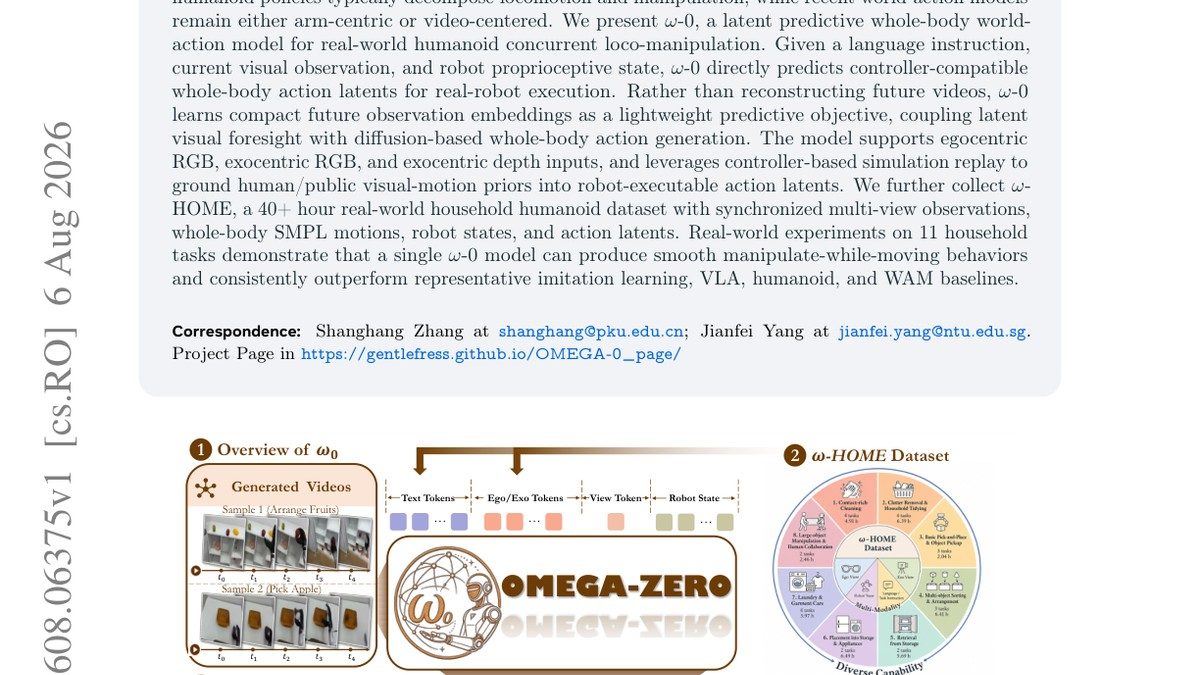
$ω$-0: A Latent Predictive World Action Model for Concurrent Humanoid Loco-Manipulation
Zhe Li, Zhenzhe Zhang, Yangyang Wei et al.
Humanoid household tasks often require concurrent loco-manipulation, where the robot must move, adjust posture, maintain balance, and manipulate objects as a single coordinated behavior.