
InterEvolve: Test-Time Evolution of Reward Programs for Humanoid Loco-Manipulation
Zhuo Lin, Sirui Xu, Liuyu Bian, Yu-Xiong Wang, Liang-Yan Gui · N/A · 2026
Framework
N/A
License
N/A
Stars
N/A
Summary
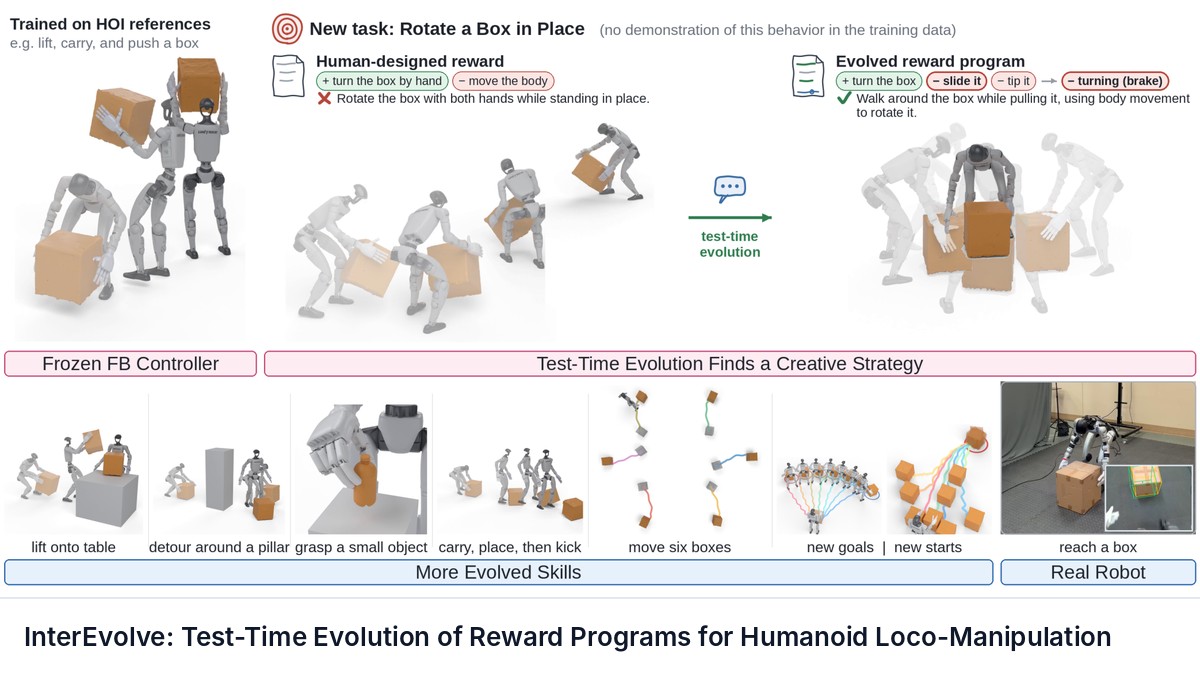
We study test-time evolution for humanoid loco-manipulation: solving tasks that a controller was never trained for by repurposing its existing skills, improving from its own attempts, and retaining what it learns, without retraining.
Abstract Summary
Key Points
- We study test-time evolution for humanoid loco-manipulation: solving tasks that a controller was never trained for by repurposing its existing skills, improving from its own attempts, and retaining what it learns, without retraining.
- Our key insight is that a broad controller already holds much of the competence a new task needs, and that this competence becomes accessible through an interface between planning and control that is expressive enough to specify contact-rich, multi-stage interactions, yet executable and measurable enough that execution feedback can guide planning from experience.
- InterEvolve realizes this interface with two components
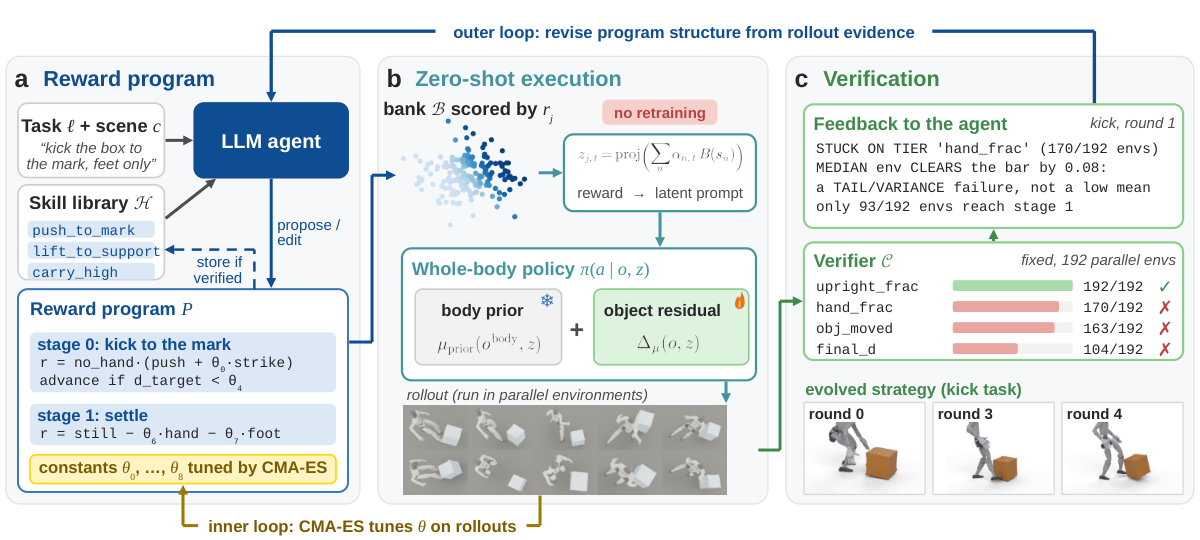
- First, we develop an object-aware forward-backward (FB) behavioral foundation model, whose object residuals on a frozen body prior turn a new reward about the body or objects into loco-manipulation behavior at test time.
- Second, we specify tasks as reward programs: staged rewards with completion conditions and tunable constants.
Method
InterEvolve adapts a fixed whole-body controller to new loco-manipulation tasks by evolving a reward programs at test time, and keeps verified programs in a skill library for later tasks to build on (Fig. 2 ). Sec. 3.1 formalizes this evolving problem and its budget. Sec. 3.2 defines reward programs, the editable task strategies that the evolve operates on. Sec.
3.3 shows how an object-aware forward-backward (FB) behavioral foundation model executes a reward program without retraining. Sec.
Experiments
This section verifies that our low-level controller already holds much of the competence a new task needs, and that test-time scaling over reward programs makes it accessible, through three questions. ( i ) Competence: can object-aware motor model provide reusable whole-body interaction, and does better reward improve tracking (Sec. 4.2 )?
( ii ) Access: without reference motion, does execution-guided evolution reach behaviors fixed programs miss, and which evolution components produce the gain (Sec.
Sources and Demonstrations
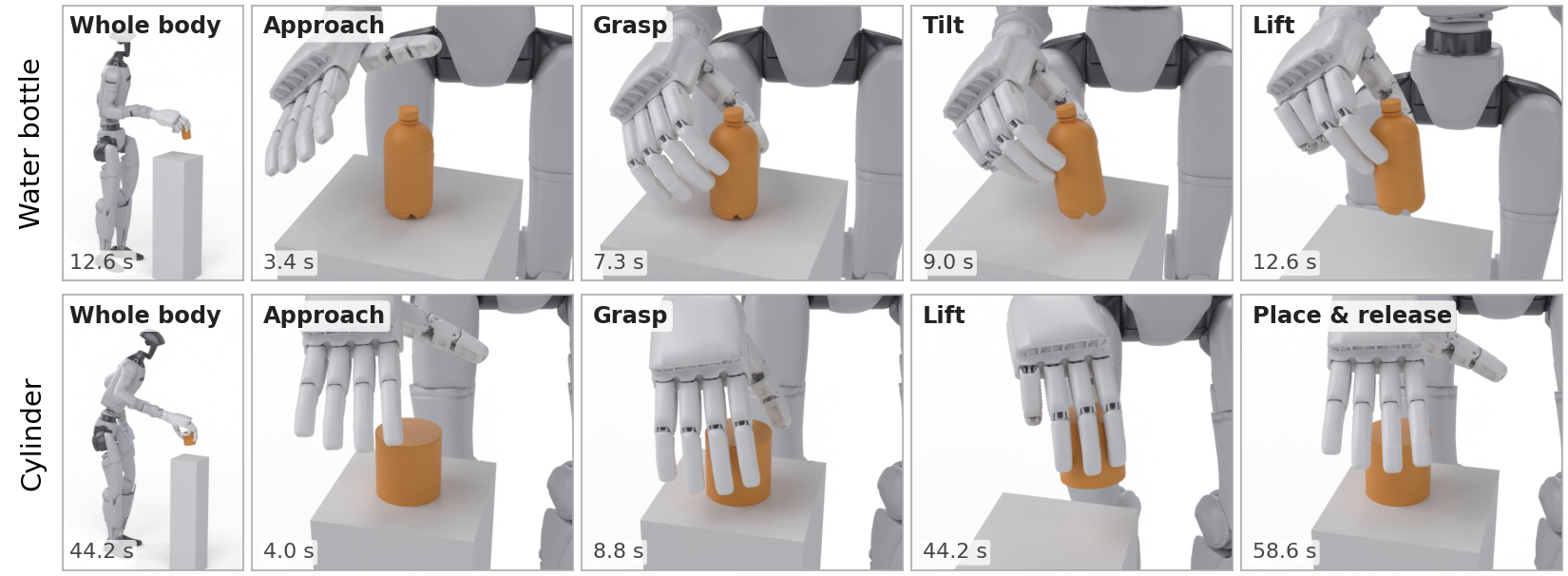
Figures are reproduced from Lin et al. See the full paper for experimental details and the project page, when the paper links one, for demonstrations and videos.
Related Papers
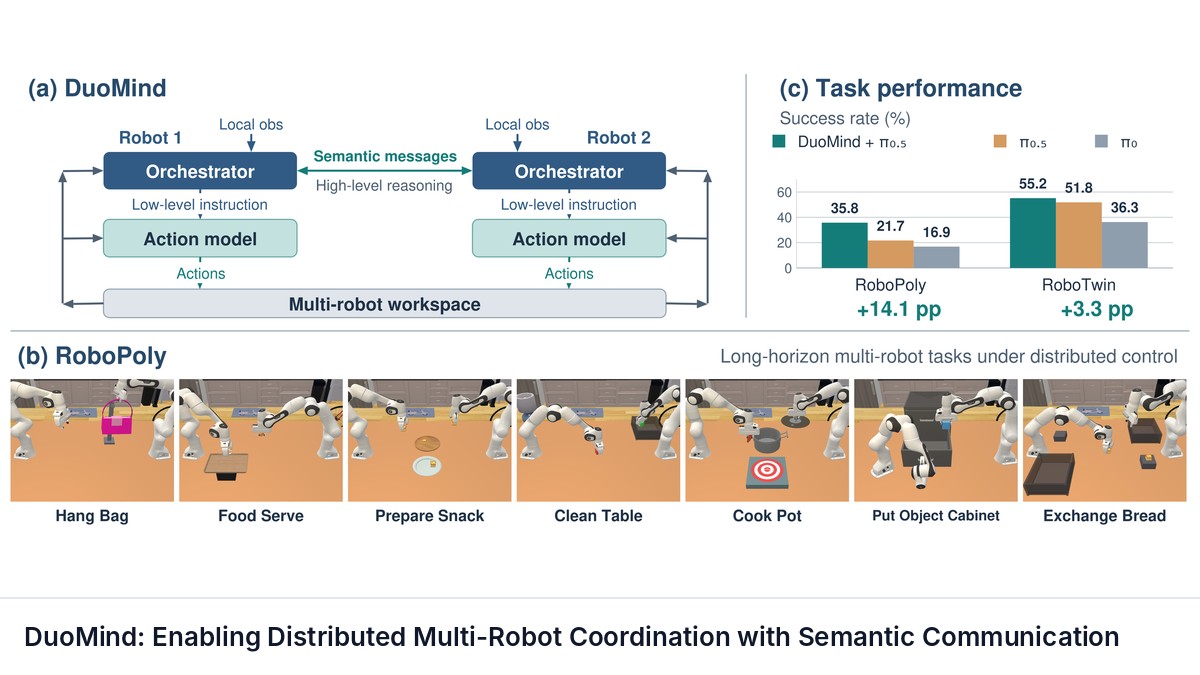
DuoMind: Enabling Distributed Multi-Robot Coordination with Semantic Communication
Hanchu Zhou, Dechen Gao, Hang Wang et al.
Vision-language models (VLMs) and vision-language-action models (VLAs) have recently driven rapid progress in general-purpose robots, yet most progress has focused on single-robot settings.
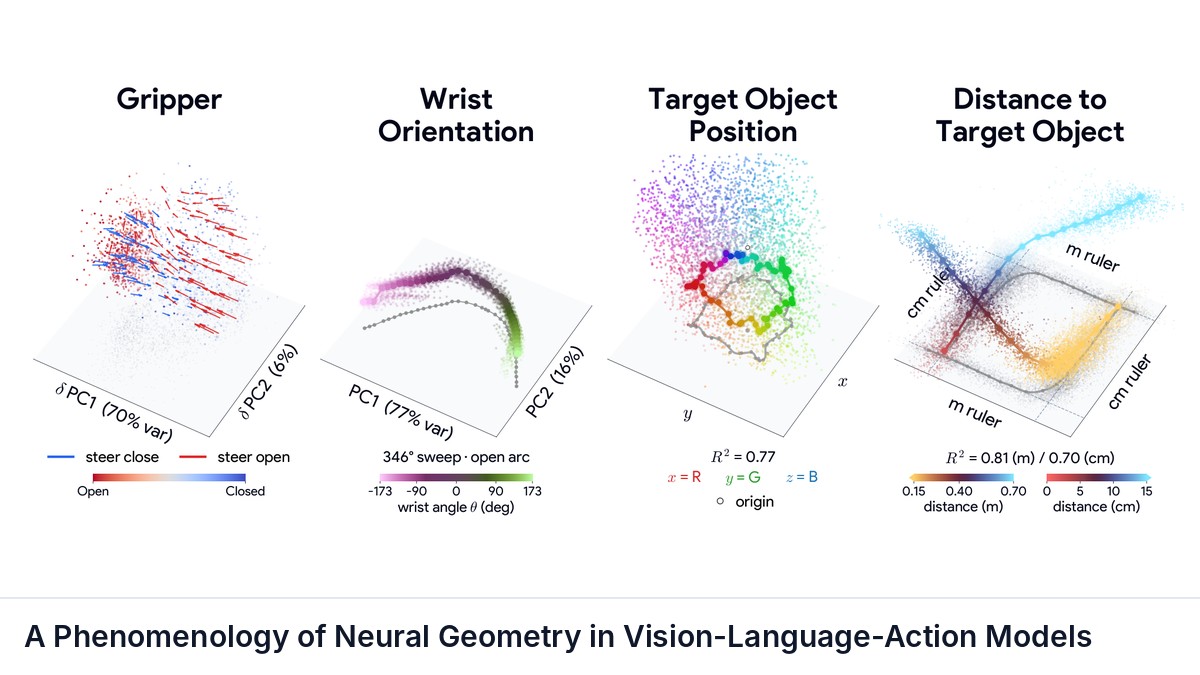
A Phenomenology of Neural Geometry in Vision-Language-Action Models
Mozes Jacobs, Aiden Swann, Mathilde Papillon et al.
Robotic manipulation is inherently geometric, but what shape does the world take inside the policy that performs it?

A Sim-to-Real Integration Pipeline for Training and Deployment of Chunk-Based VLA Manipulation Policies
Mathilde Kappel, Clémence Grislain, Mohamed Chetouani et al.
Vision-Language-Action (VLA) models have become a prominent paradigm for mapping multimodal inputs, including semantic instructions, visual observations of the scene, and proprioceptive observations, to robot actions.
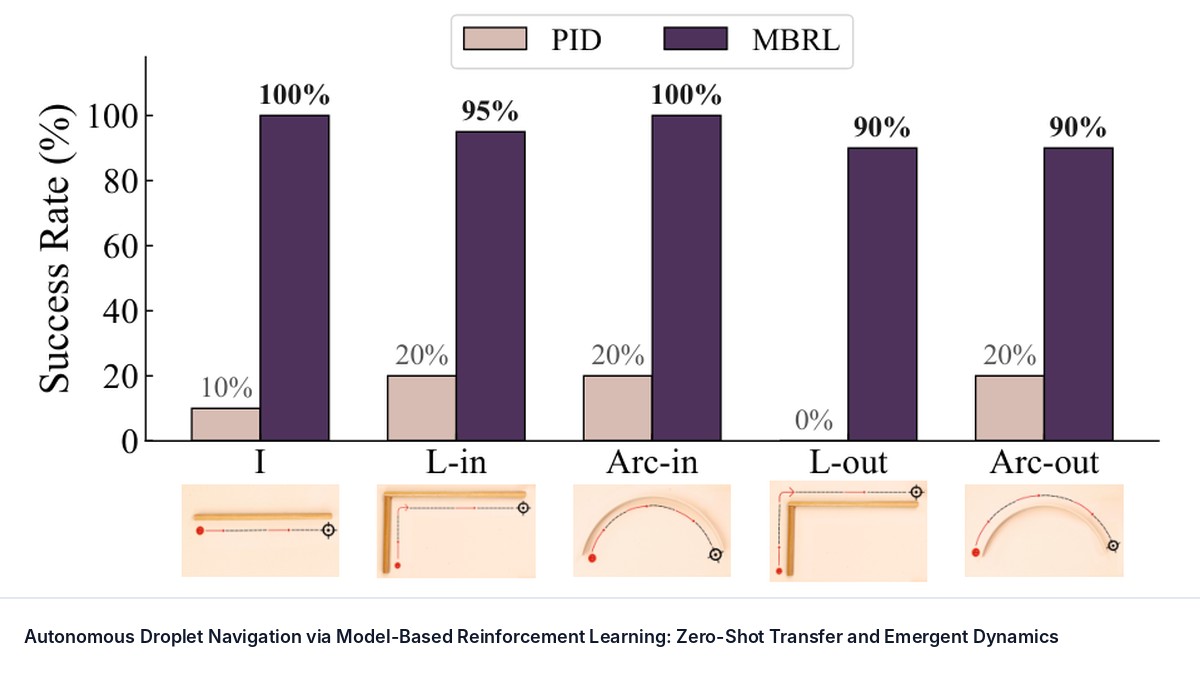
Autonomous Droplet Navigation via Model-Based Reinforcement Learning: Zero-Shot Transfer and Emergent Dynamics
Rajneesh Anand, Mayuresh V. Kothare
Self-driving laboratories (SDLs) are transforming chemical and materials discovery through closed-loop automation, yet automated infrastructure for physical manipulation of soft, deformable matter remains beyond current robotic platforms.