
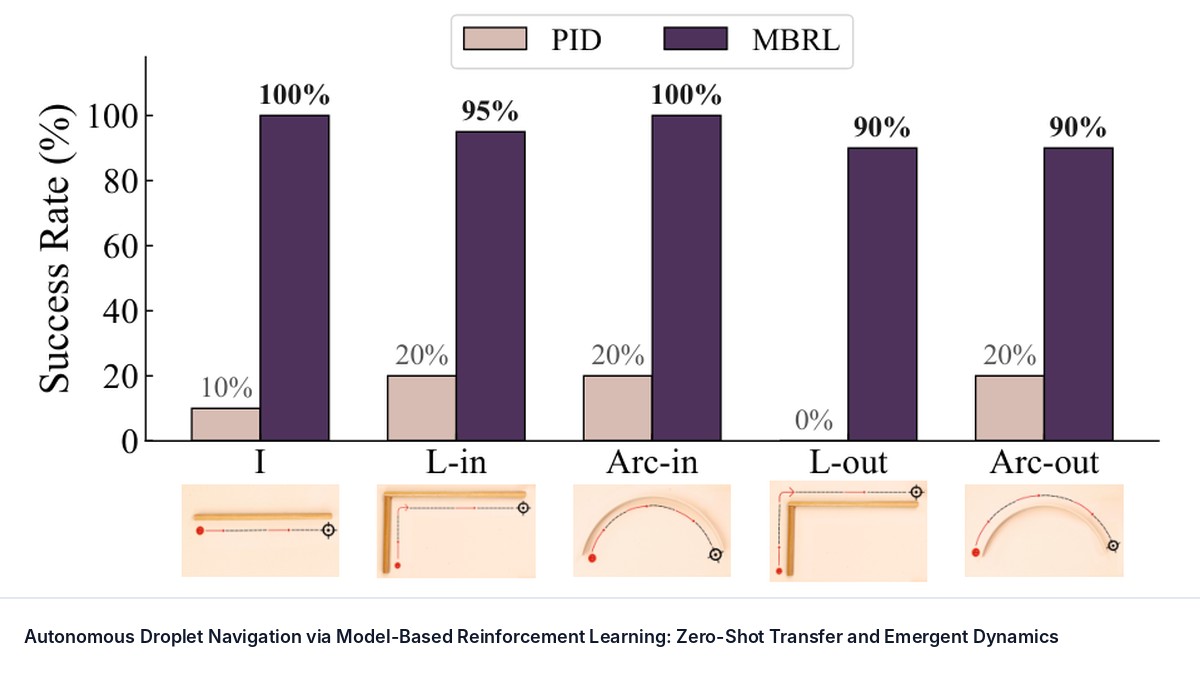
Autonomous Droplet Navigation via Model-Based Reinforcement Learning: Zero-Shot Transfer and Emergent Dynamics
Rajneesh Anand, Mayuresh V. Kothare · N/A · 2026
Framework
N/A
License
N/A
Stars
N/A
Summary
Self-driving laboratories (SDLs) are transforming chemical and materials discovery through closed-loop automation, yet automated infrastructure for physical manipulation of soft, deformable matter remains beyond current robotic platforms.
Abstract Summary
Key Points
- Self-driving laboratories (SDLs) are transforming chemical and materials discovery through closed-loop automation, yet automated infrastructure for physical manipulation of soft, deformable matter remains beyond current robotic platforms.
- A critical instance is autonomous droplet transport on an open surface, where contact-angle hysteresis, capillary pinning, and surface heterogeneity produce partially observable dynamics that pose significant challenges for classical model-based controllers.
- We introduce the first robotic platform for closed-loop autonomous liquid droplet navigation on an open, unconfined surface using model-based reinforcement learning.
- A two-axis tilting board coated with a thin silicone oil film drives the droplet, while an overhead camera provides real-time feedback.
- A learned policy was trained on just 50 to 150 physical episodes depending on geometric complexity, without simulation or analytical models.
Methods
The robotic (DropletRunner) platform (Fig. 1 ) consists of five parts including a BRIO Labyrinth board modified with custom 3D-printed PLA channel geometries coated with a thin silicone oil film to mitigate surface problem [ 4 ] , two motors that control the inclination of the board, an overhead camera provides visual feedback, a control unit that runs all the algorithms, and finally a red-dyed water droplet.
Results
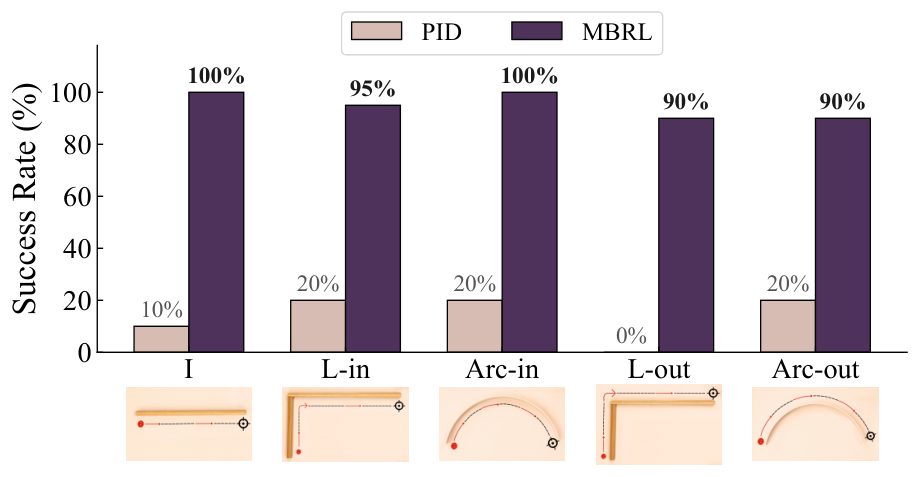
We present DropletRunner 1 1 1 The source code for autonomous droplet naviagtion is available at https://github.com/rajneeshanand/DropletRunner. [ 6 ] , to our knowledge the first robotic platform for closed-loop autonomous liquid droplet navigation on an open, unconfined surface, enabled by model-based reinforcement learning (MBRL). The platform (Fig.
Sources and Demonstrations
Figures are reproduced from Anand et al. See the full paper for experimental details and the project page, when the paper links one, for demonstrations and videos.
Related Papers
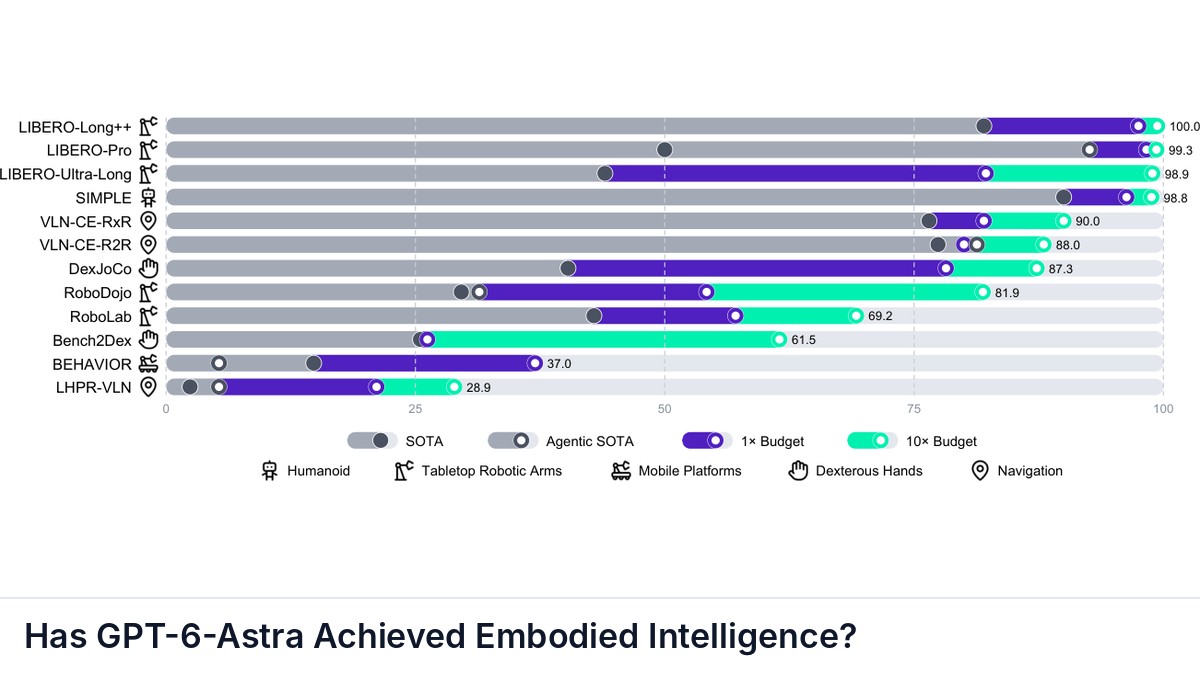
Has GPT-6-Astra Achieved Embodied Intelligence?
SenseNova, Joint Research Team, : et al.
GPT-6-Astra demonstrates a level of competence in robotic manipulation and navigation that challenges the conventional paradigm of building specialized models for individual tasks and embodiments.
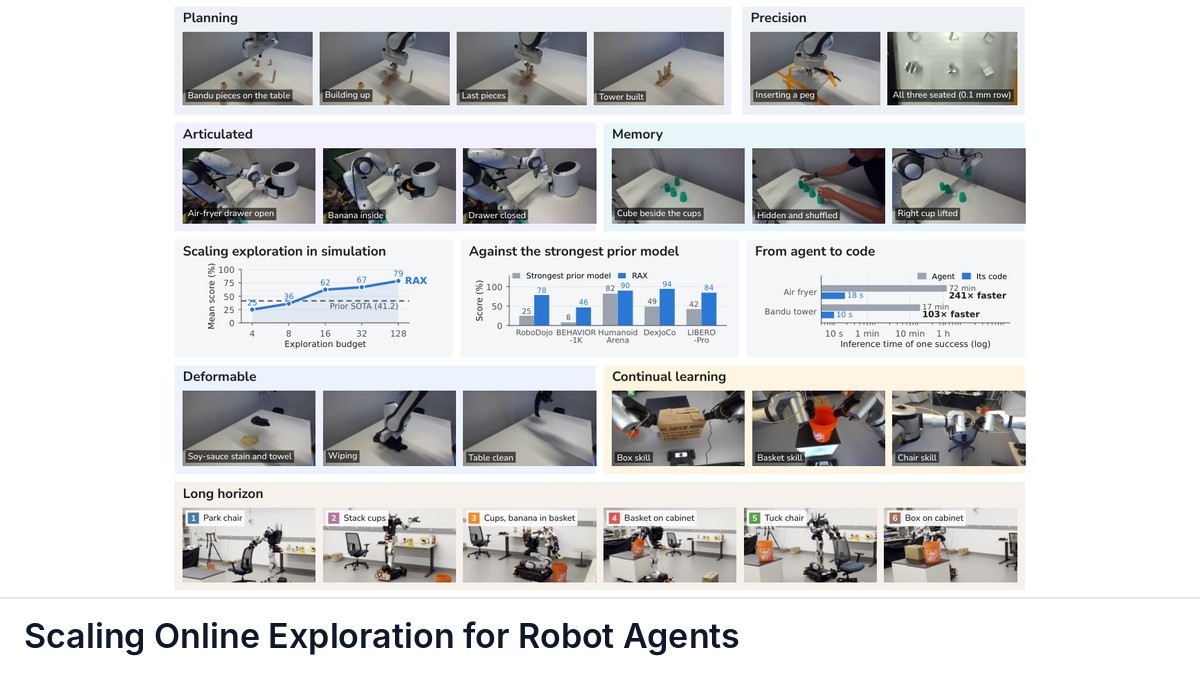
Scaling Online Exploration for Robot Agents
Runhan Huang, Xiangcheng Zhang, Haoyu Chen et al.
Robot learning has advanced by scaling demonstration datasets and model capacity; however, deploying a new robot embodiment or task typically necessitates a dedicated teleoperation corpus.
A Low-Cost, Open Platform for End-to-End Autonomous Driving on a Miniature Ackermann Vehicle
Gustavo Claudio Karl Couto, Eric Aislan Antonelo, Gabriel George Zipperer
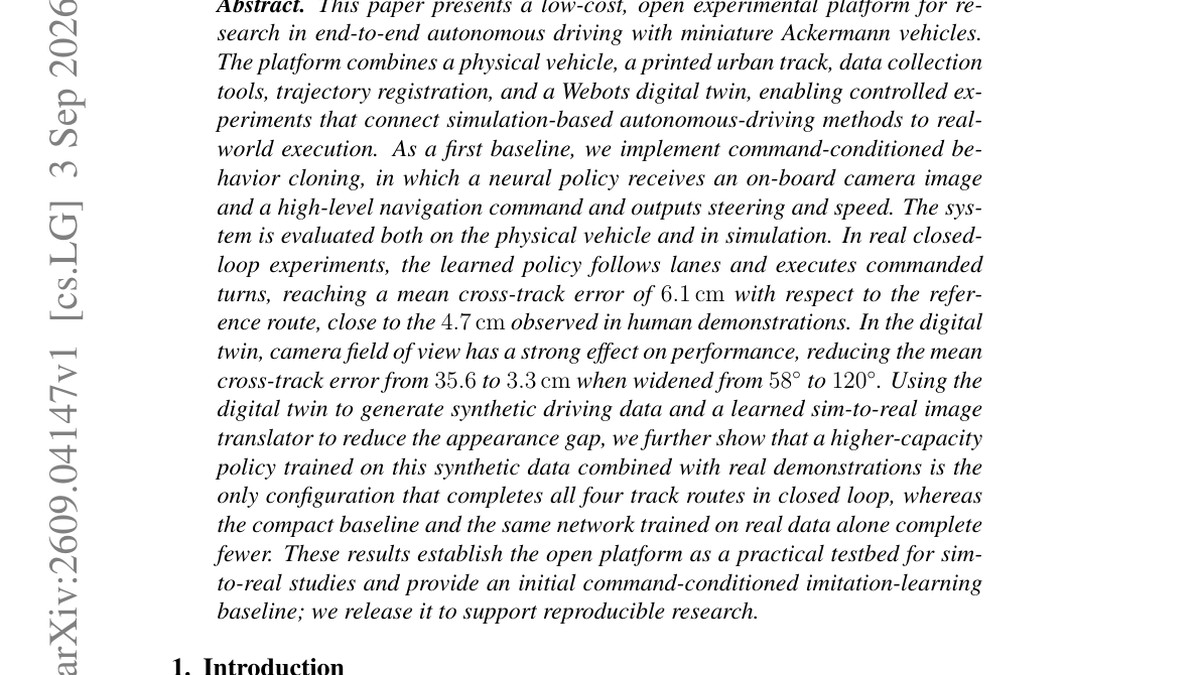
This paper presents a low-cost, open experimental platform for research in end-to-end autonomous driving with miniature Ackermann vehicles.
A Phenomenology of Neural Geometry in Vision-Language-Action Models
Mozes Jacobs, Aiden Swann, Mathilde Papillon et al.
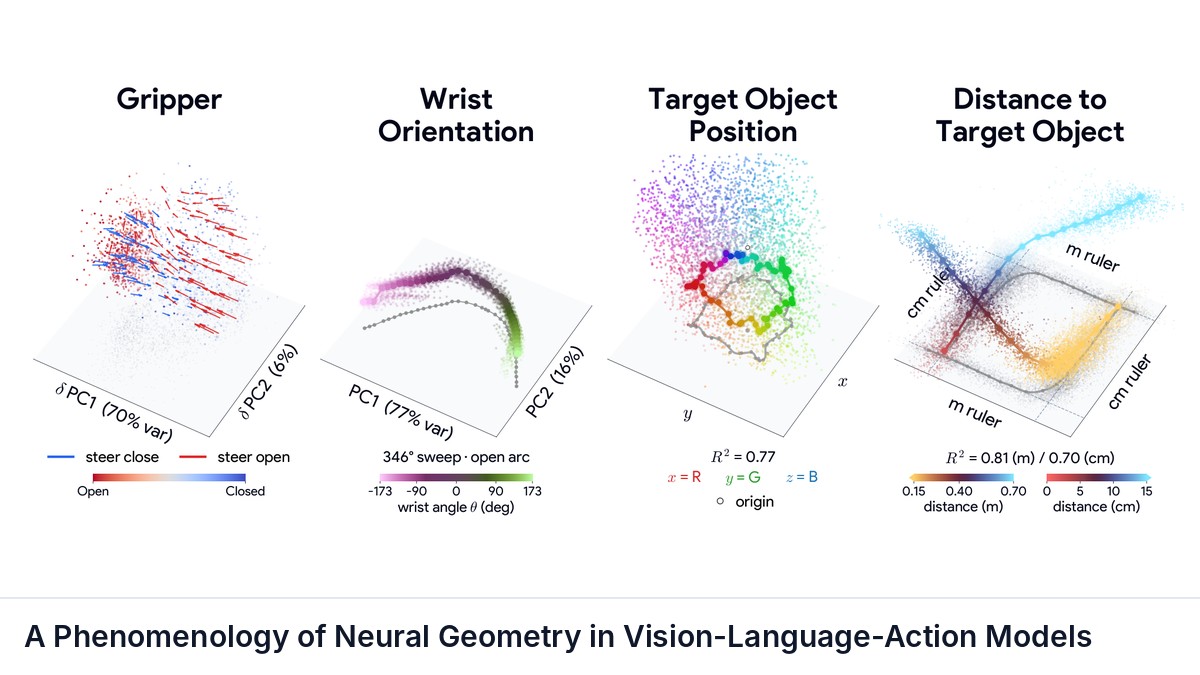
Robotic manipulation is inherently geometric, but what shape does the world take inside the policy that performs it?