
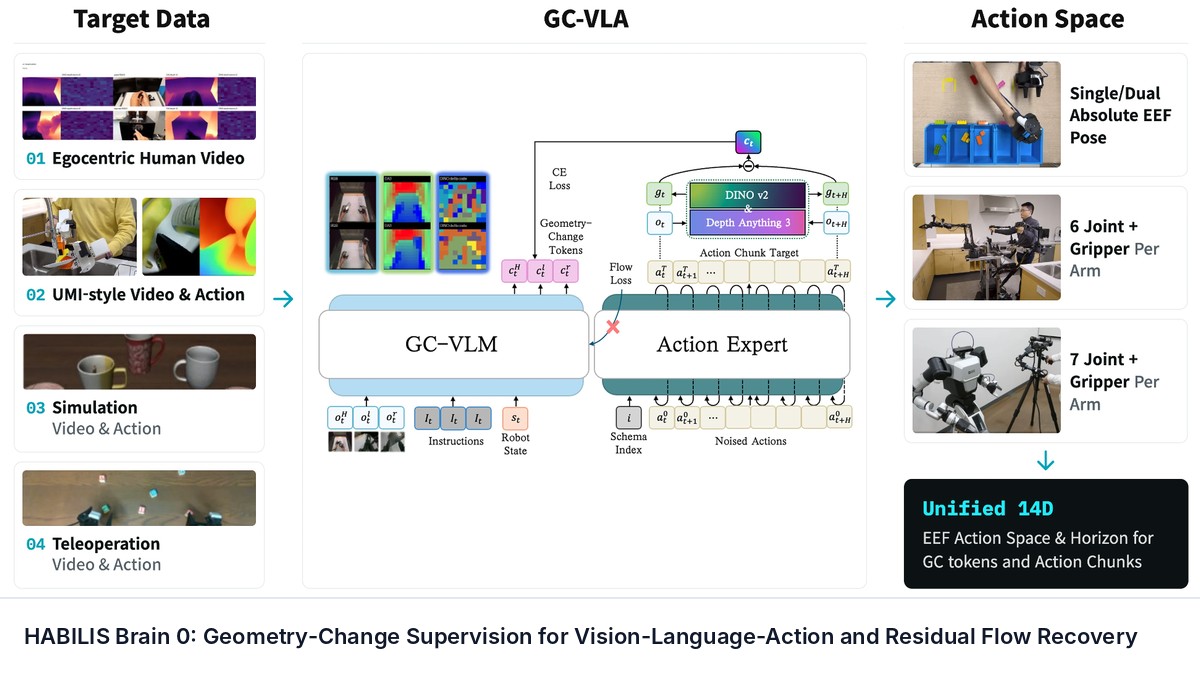
HABILIS Brain 0: Geometry-Change Supervision for Vision-Language-Action and Residual Flow Recovery
Jinu Pahk, Jesoon Kang, Taegeon Park, Jisu An, Soo Min Kimm, Jaejoon Kim, Byoung-Tak Zhang · N/A · 2026
Framework
N/A
License
N/A
Stars
N/A
Summary
Vision-language-action policies benefit from geometric supervision, but current-frame geometry alone does not explicitly describe the changes associated with manipulation.
Abstract Summary
Key Points
- Vision-language-action policies benefit from geometric supervision, but current-frame geometry alone does not explicitly describe the changes associated with manipulation.
- This design is motivated by the goal of learning an embodiment-agnostic visual interface that can be pretrained across robot and egocentric video before robot-specific action alignment.
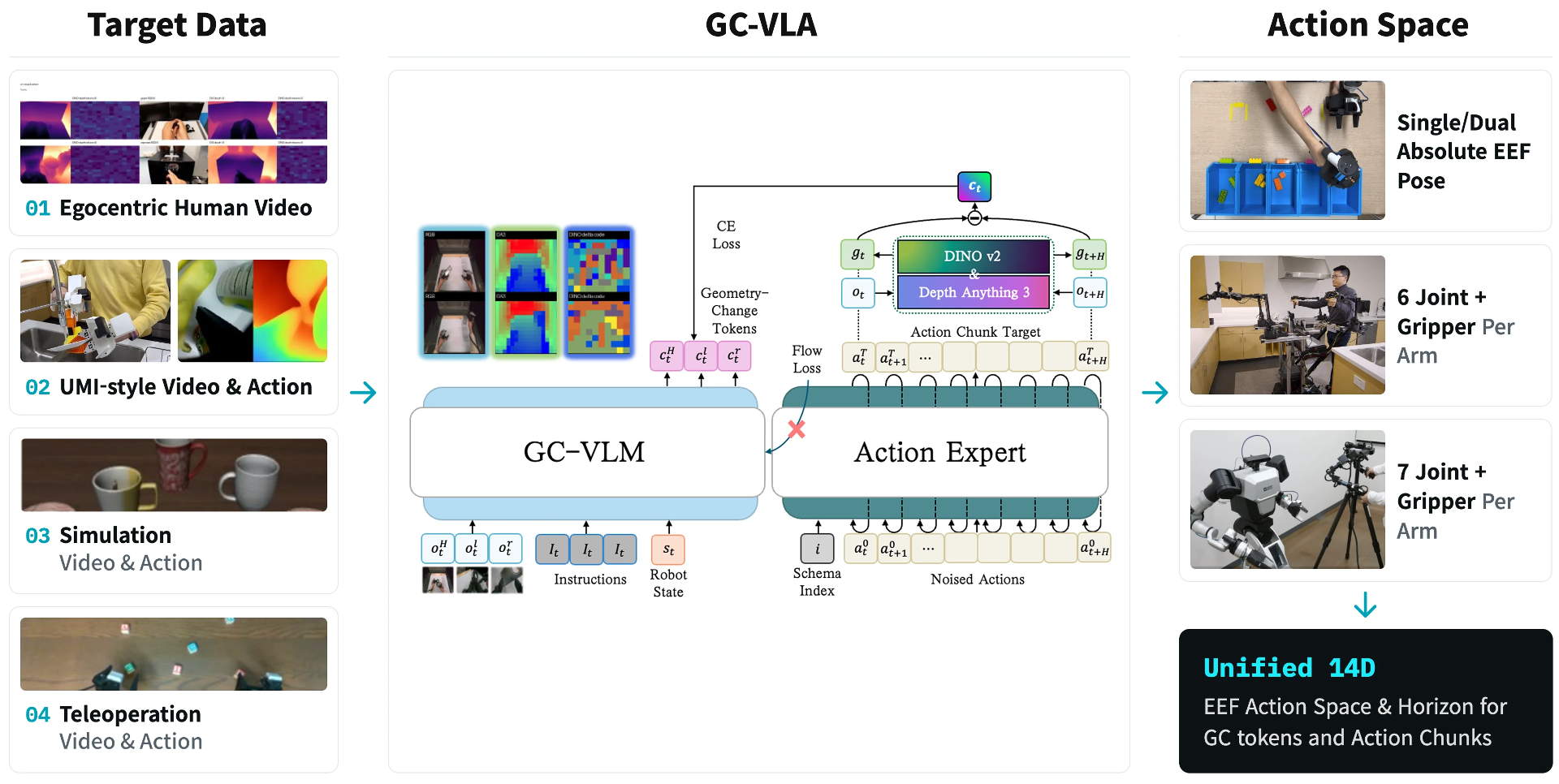
- We introduce Geometry-Change VLA (GC-VLA), which learns to predict multiview future-current geometry-change tokens from current observations.
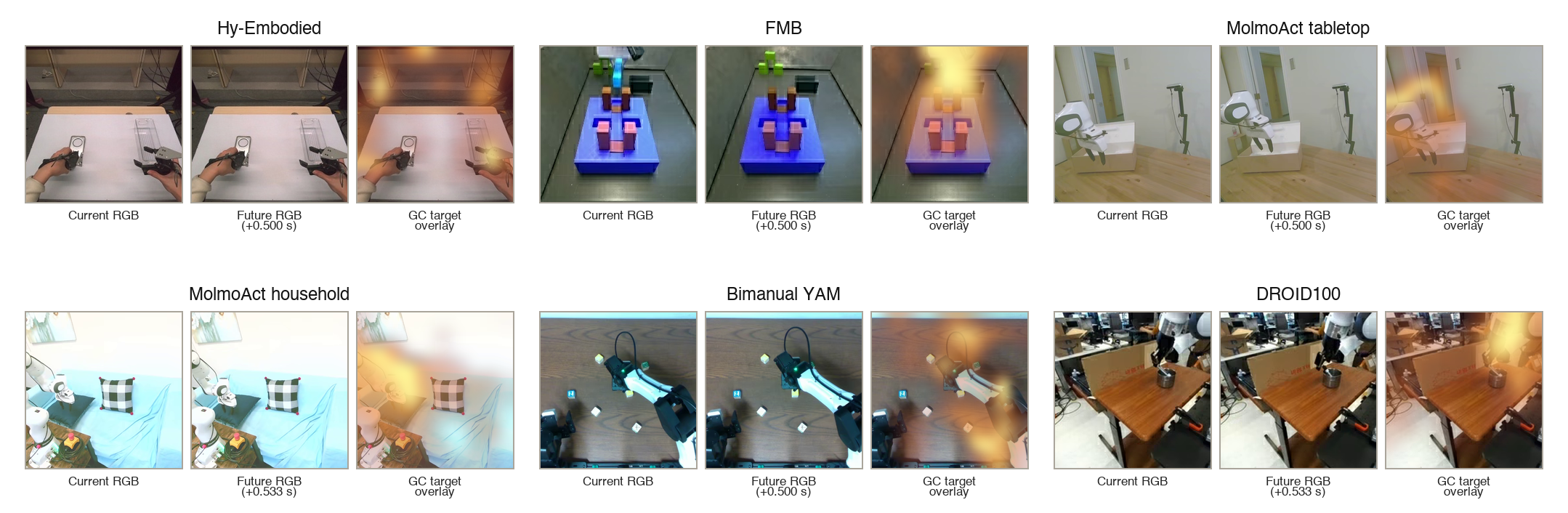
- Offline frame pairs define a nominal 0.5-second prediction horizon; future observations are used only to construct training targets.
- Stage 1 trains a geometry-change vision-language model (GC-VLM)
Method
Let the online input be where $\ell$ is the language instruction, $I_{t}^{(v)}$ is an available RGB view, and $q_{t}$ is the robot state.
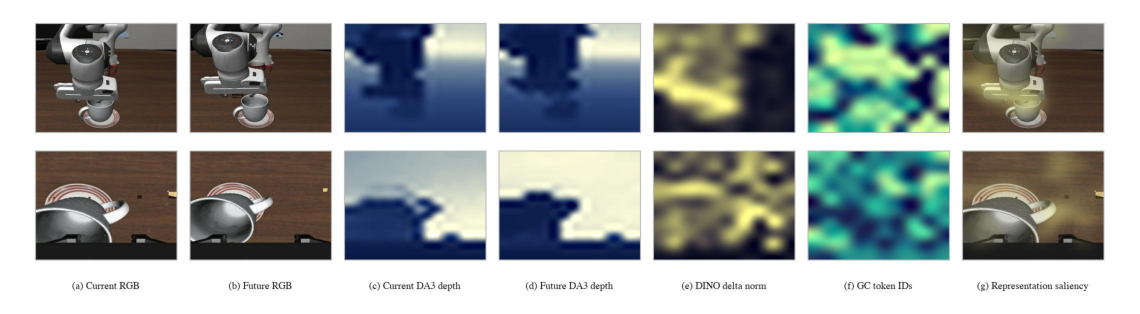
An offline geometry encoder $\phi$ maps a camera observation and its pseudo-depth estimate to a compact spatial representation: The training label is the geometry change over the prediction horizon The $10\times 10$ spatial grid is quantized into 100 token positions per view, $y_{t,H_{\mathrm{GC}}}^{(v)}\in\{1,\ldots,K\}^{100}$ .
Experimental Setup
We use two frozen pretrained models only during offline target generation. For pseudo-depth estimation, we use depth-anything/DA3-BASE , a 0.12B-parameter checkpoint from Depth Anything 3 [ 17 ] . For geometry representation extraction, we use facebook/dinov2-small , corresponding to the 21M-parameter distilled DINOv2 ViT-S/14 model [ 25 ] .
Both checkpoints are used as preprocessing models and are not executed during GC-VLA inference. For each camera view, Depth Anything 3 first predicts a pseudo-depth map from the current RGB observation.
Results
We evaluate whether geometry-change representations encode action-relevant information using matched action-chunk and manipulation-phase probes. Table 3 compares target representations under a common split and state baseline. Table 4 evaluates information retained in frozen learned representations. Action-chunk gain: 95% CI $[+0.004,+0.037]$, one-sided sign-flip $p=0.027$.
Phase gain: positive in 9/10 folds, Holm-adjusted $p=0.0195$.
Sources and Demonstrations
Figures are reproduced from Pahk et al. See the full paper for experimental details and the project page, when the paper links one, for demonstrations and videos.
Related Papers
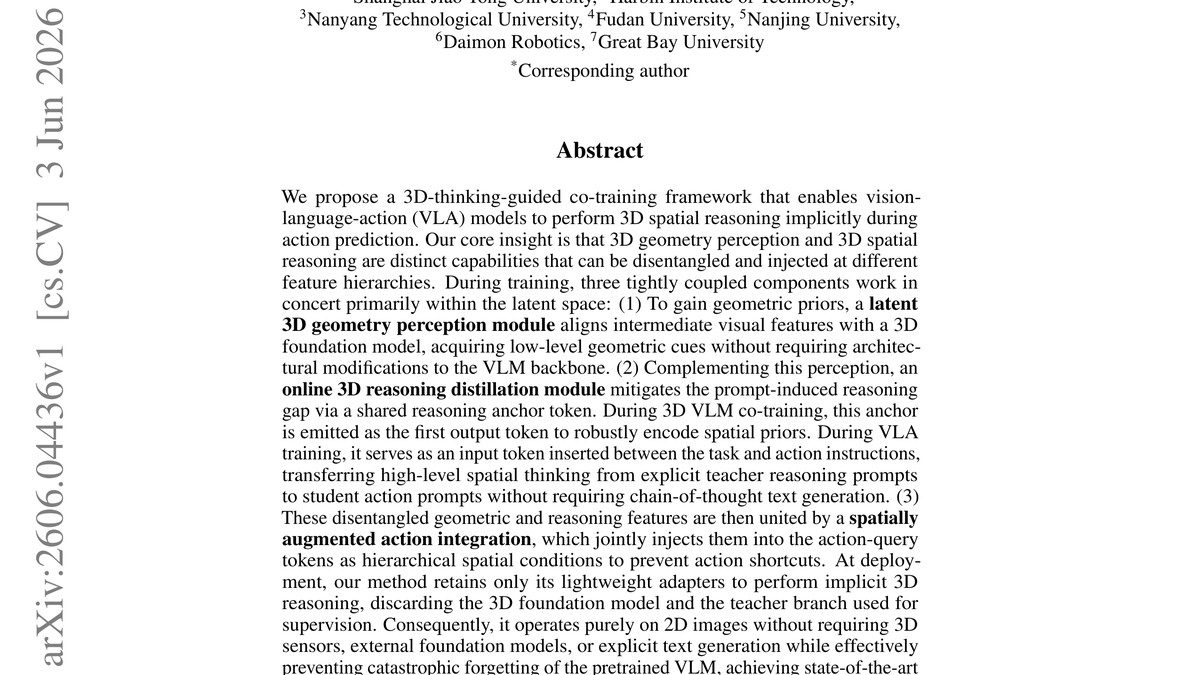
3DThinkVLA: Endowing Vision-Language-Action Models with Latent 3D Priors via 3D-Thinking-Guided Co-training
Jiaxin Shi, Xidong Zhang, Fucai Zhu et al.
We propose a 3D-thinking-guided co-training framework that enables vision-language-action (VLA) models to perform 3D spatial reasoning implicitly during action prediction.
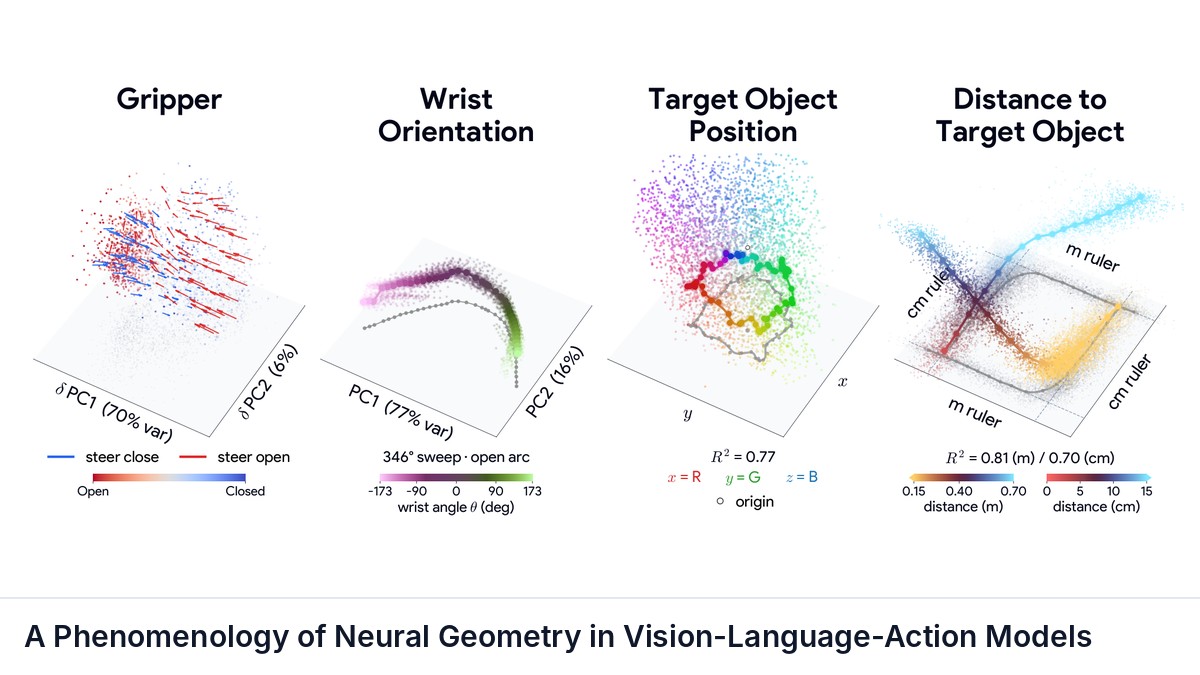
A Phenomenology of Neural Geometry in Vision-Language-Action Models
Mozes Jacobs, Aiden Swann, Mathilde Papillon et al.
Robotic manipulation is inherently geometric, but what shape does the world take inside the policy that performs it?

A Sim-to-Real Integration Pipeline for Training and Deployment of Chunk-Based VLA Manipulation Policies
Mathilde Kappel, Clémence Grislain, Mohamed Chetouani et al.
Vision-Language-Action (VLA) models have become a prominent paradigm for mapping multimodal inputs, including semantic instructions, visual observations of the scene, and proprioceptive observations, to robot actions.
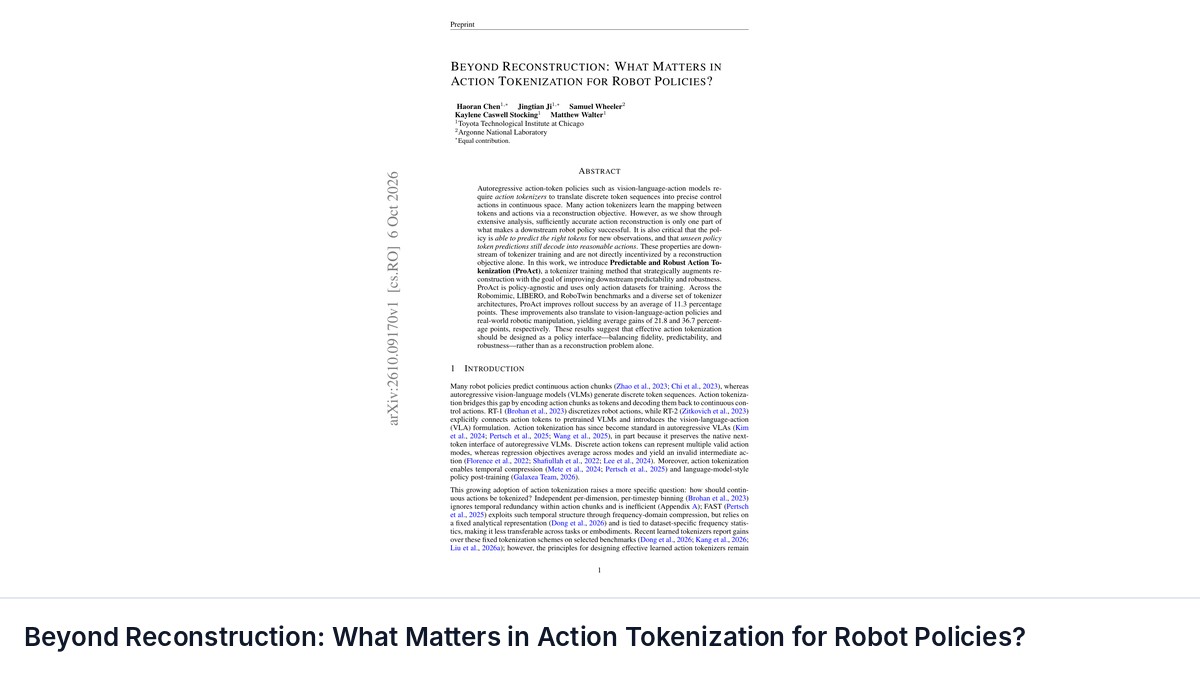
Beyond Reconstruction: What Matters in Action Tokenization for Robot Policies?
Haoran Chen, Jingtian Ji, Samuel Wheeler et al.
Autoregressive action-token policies such as vision-language-action models require action tokenizers to translate discrete token sequences into precise control actions in continuous space. Many action tokenizers learn the mapping between tokens and actions via a reconstruction objective.