
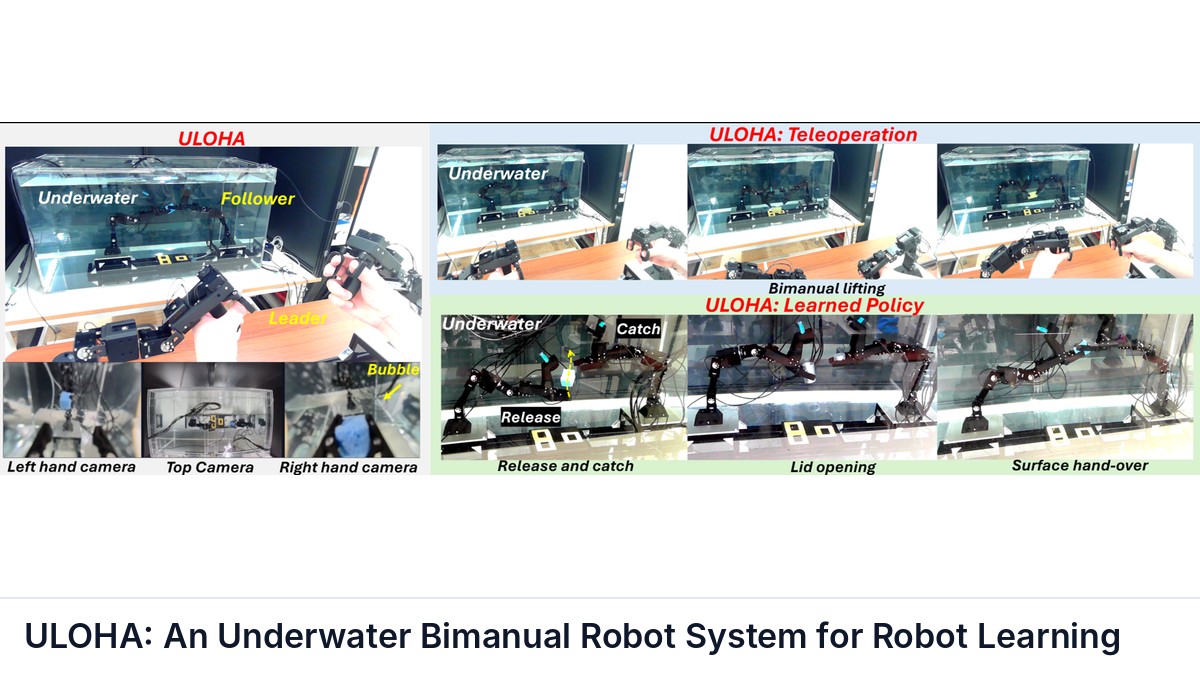
ULOHA: An Underwater Bimanual Robot System for Robot Learning
Masato Kobayashi, Takeru Tsunoori · N/A · 2026
Framework
N/A
License
N/A
Stars
N/A
Summary
Underwater visuomotor policy learning has focused primarily on single manipulators, while bimanual imitation learning has been studied largely in air.
Abstract Summary
Key Points
- Underwater visuomotor policy learning has focused primarily on single manipulators, while bimanual imitation learning has been studied largely in air.
- We present ULOHA, an underwater bimanual robot learning platform that combines custom-designed leader--follower hardware with software extensions to LeRobot, integrating teleoperation, multi-view sensing, demonstration collection, policy training, and autonomous deployment.
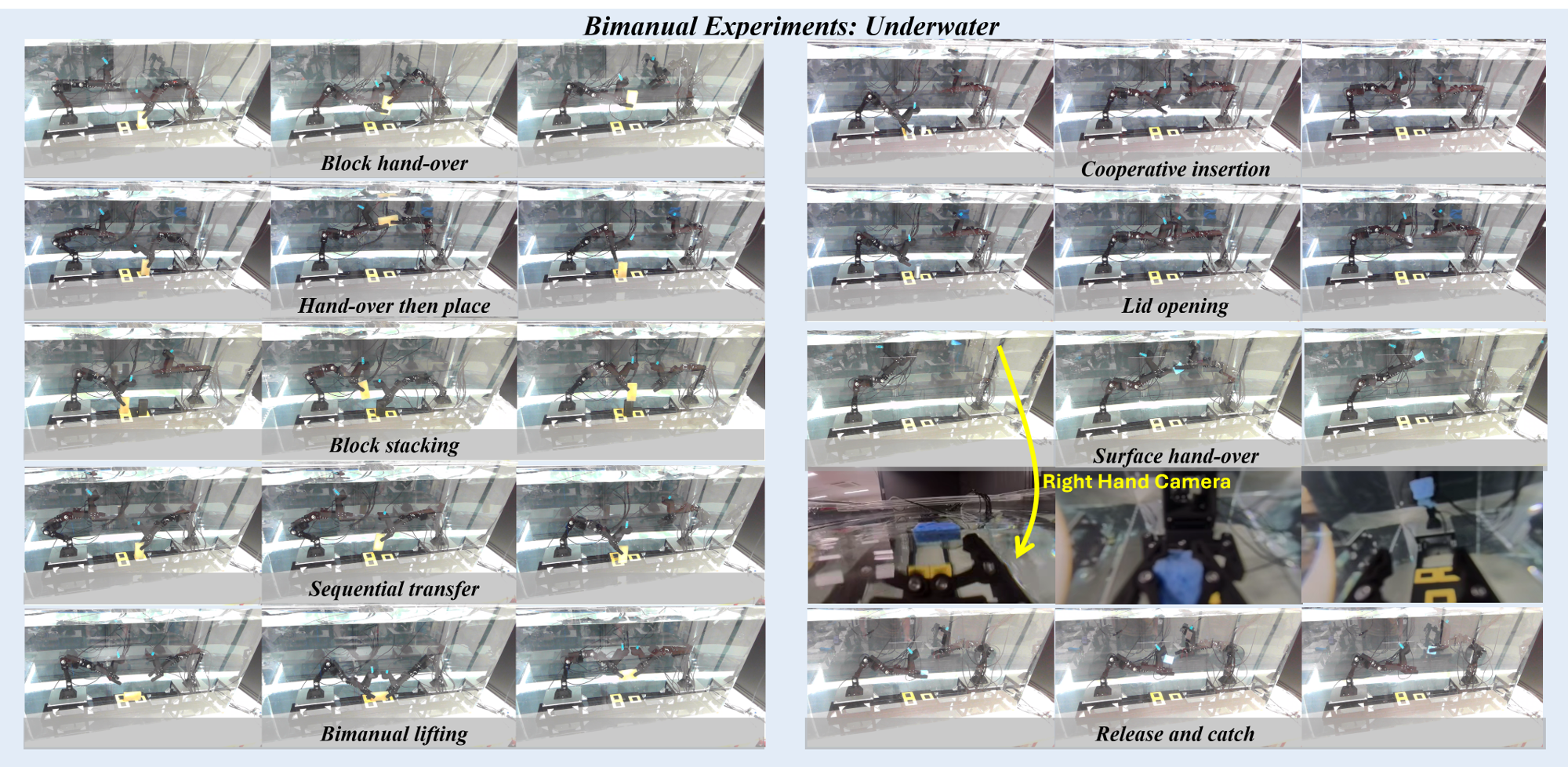
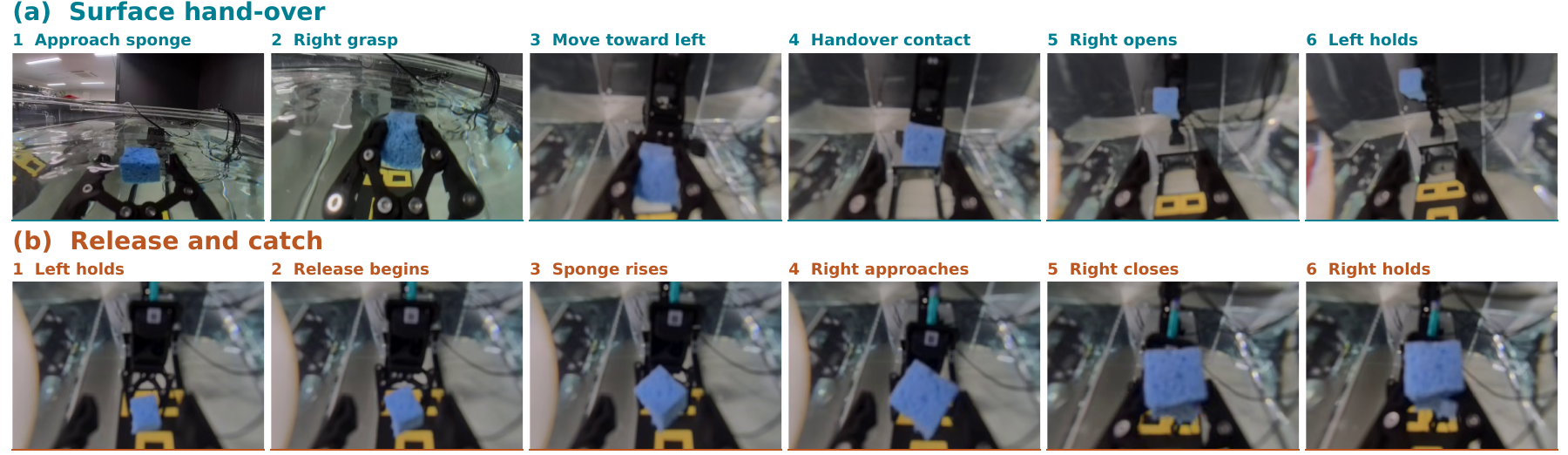
- Real-robot experiments demonstrate a range of coordinated underwater bimanual behaviors, including inter-arm transfer, shared-object manipulation, and buoyancy-driven interception.
- We evaluate ACT, Diffusion Policy, and the vision--language--action model SmolVLA on the platform
- We investigate how learning methods and execution strategies developed for manipulation in air perform underwater, examining bubble disturbances, buoyancy-driven object motion, action-execution horizons, and real-time chunking.
ULOHA SYSTEM
ULOHA combines hardware designed by the authors with a software stack that extends LeRobot [ 11 ] through ULOHA-specific hardware adapters and recording, training, and deployment configurations. The hardware comprises two dry leader arms and two kinematically matched underwater followers, with custom arm structures and grippers.
EXPERIMENTAL EVALUATION
The evaluation addresses four questions: which coordinated underwater tasks can be learned from demonstrations; whether ACT, Diffusion Policy, and SmolVLA can be deployed on the platform; how bubbles and action-execution strategies affect deployment; and whether policies transfer between air and water.
We first evaluate bimanual learning and deployment, then use a separate single-arm ACT study to examine training-medium coverage.
Sources and Demonstrations
Figures are reproduced from Kobayashi et al. See the full paper for experimental details and the project page, when the paper links one, for demonstrations and videos.
Related Papers

A Sim-to-Real Integration Pipeline for Training and Deployment of Chunk-Based VLA Manipulation Policies
Mathilde Kappel, Clémence Grislain, Mohamed Chetouani et al.
Vision-Language-Action (VLA) models have become a prominent paradigm for mapping multimodal inputs, including semantic instructions, visual observations of the scene, and proprioceptive observations, to robot actions.

Capability-Aware Arbitration for Semantic Intent-Based Shared Control
Zhaoda Du, Michael Bowman, Xiaoli Zhang
Shared control often allocates robot authority based on confidence in inferred human intent, assuming reliable autonomous execution. When this assumption fails, high intent confidence can cause over-helping.
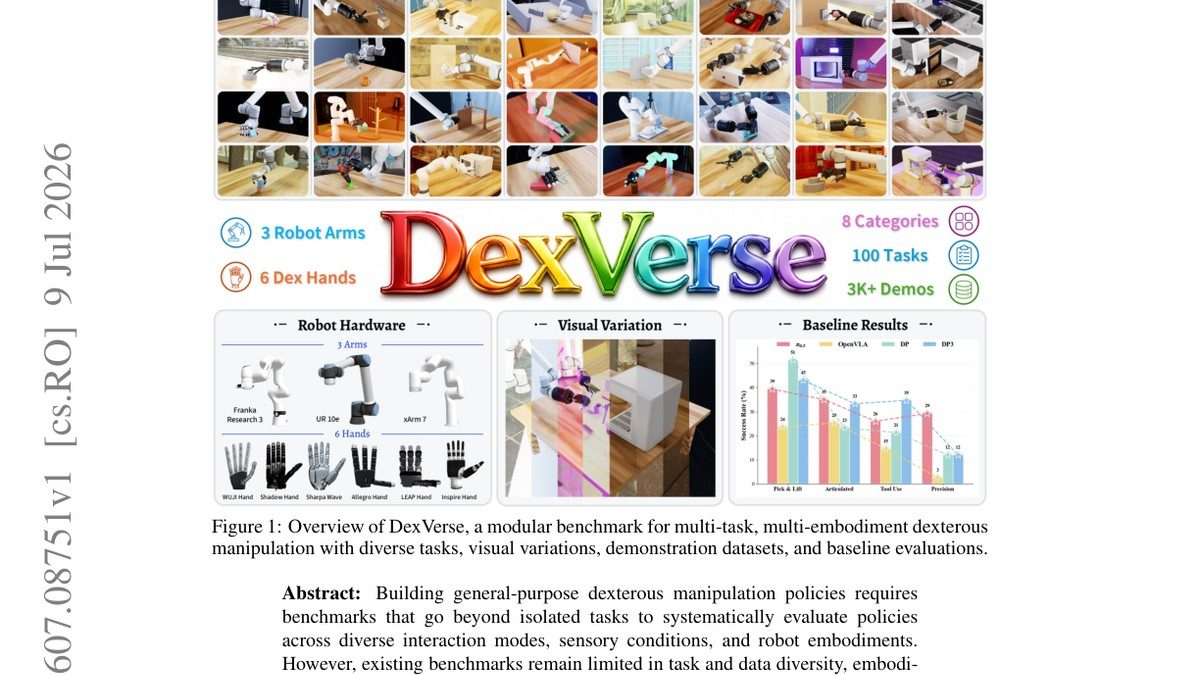
DexVerse: A Modular Benchmark for Multi-Task, Multi-Embodiment Dexterous Manipulation
Yunchao Yao, Zhuxiu Xu, Tianqi Zhang et al.
Building general-purpose dexterous manipulation policies requires benchmarks that go beyond isolated tasks to systematically evaluate policies across diverse interaction modes, sensory conditions, and robot embodiments.
DriftOPD: Sequence-Level Reverse-KL Distillation for One-Step VLA Policies
Youngjun Jun, Kyumin Choi, Youngmin Kim et al.
Vision-Language-Action (VLA) models increasingly rely on action experts that generate short action chunks under receding-horizon control.