

FabriVLA: A Lightweight Vision-Language-Action Model for Precise Multi-Task Manipulation
Shiyuan Yang, Borong Zhang, Jizheng Zhang, Zhijia Tao, Junfei Guo, Donglai Ran, Xu Bian, Qingbiao Li · N/A · 2026
Framework
N/A
License
N/A
Stars
N/A
Summary
We present FabriVLA, a lightweight Vision-Language-Action model for Precise Multi-Task Manipulation.
Abstract Summary
Key Points
- We present FabriVLA, a lightweight Vision-Language-Action model for Precise Multi-Task Manipulation
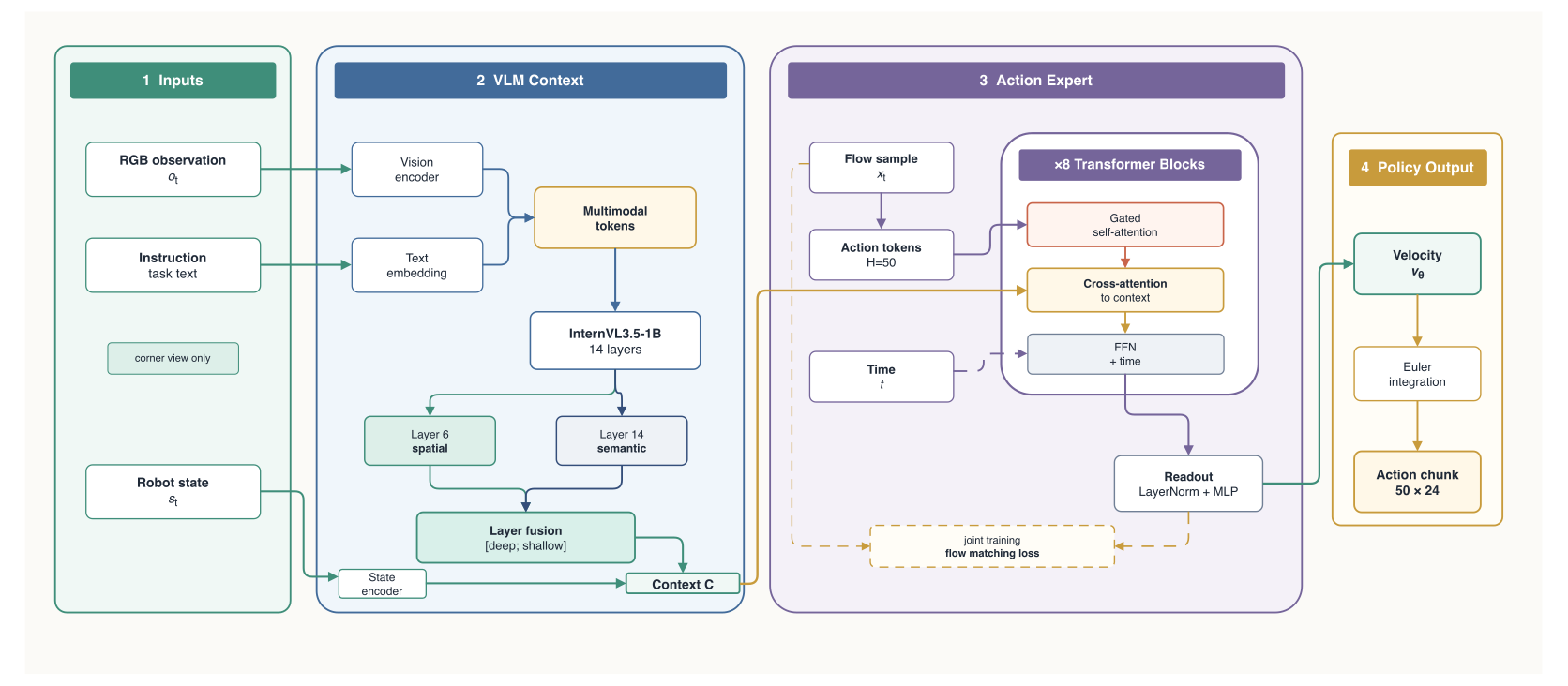
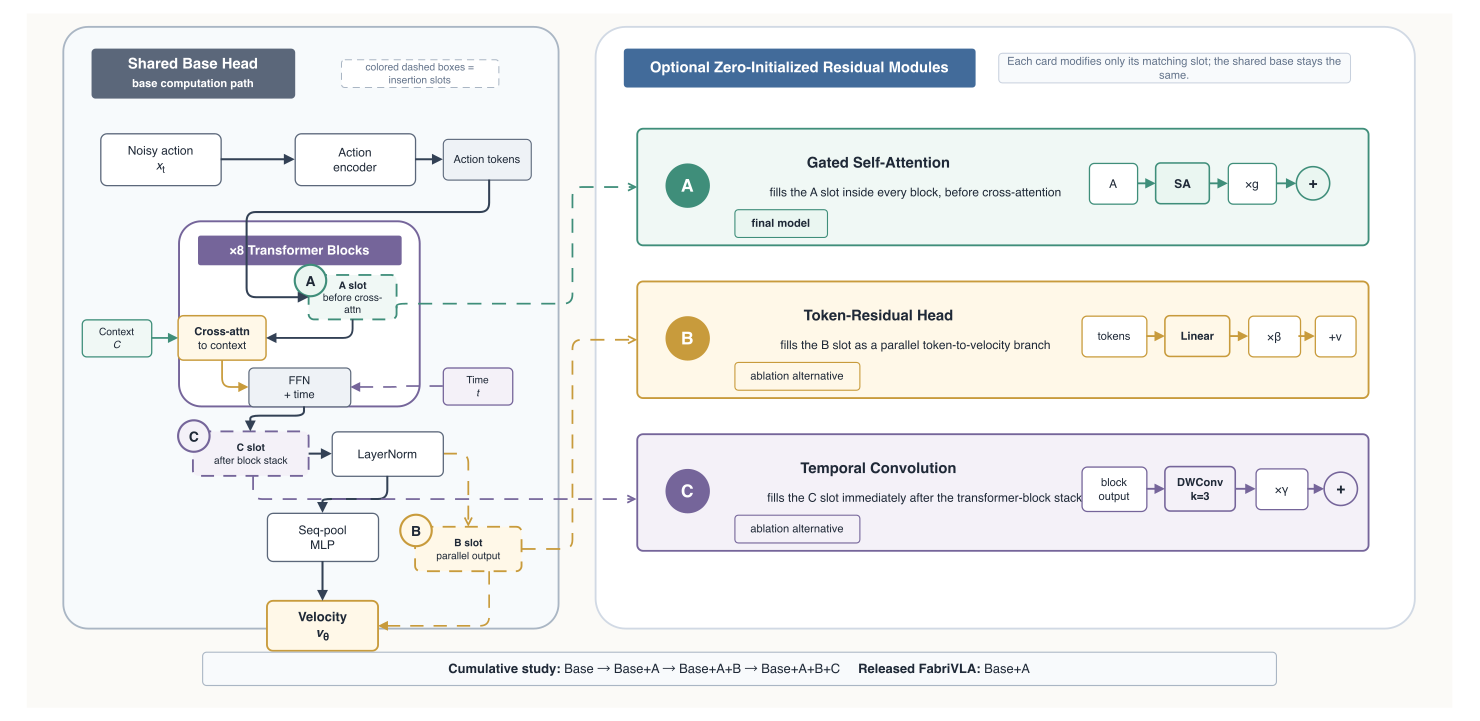
- FabriVLA combines an InternVL3.5 vision-language backbone with a flow-matching action head featuring gated self-attention across action tokens and shallow VLM layer fusion for enriched spatial context.
- The model is trained via single stage joint optimization from a pretrained VLM and randomly initialized action head.
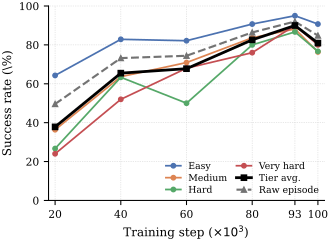
- On the Meta-World MT50 benchmark spanning 50 diverse manipulation tasks, FabriVLA achieves a tier-average success rate of 90.0%, demonstrating that a compact VLA built on a 1B scale VLM can achieve strong performance without relying on multi billion parameter VLA backbones.
Model Architecture
FabriVLA consists of three components: (1) an InternVL3.5 vision-language backbone, (2) state and action encoders, and (3) a flow-matching action head. Figure 2 illustrates the overall architecture. We adopt InternVL3.5-1B ( Wang et al. 2025 ) as the VLM backbone. Input images are resized to $448\times 448$ and processed through the vision encoder, which produces a sequence of visual tokens.
A task prompt (e.g., “Dunk the basketball into the basket”) is tokenized via the language tokenizer and concatenated with the visual tokens.
Training Procedure
FabriVLA is trained in a single stage on the openly released Evo-1 Meta-World demonstration dataset ( Lin et al. 2026c ) , which contains 50 trajectories per MT50 task and 2,500 trajectories in total. The action head is randomly initialized; the InternVL3.5 backbone is loaded from the publicly released pretrained checkpoint.
The entire model, both the VLM backbone and the action head is jointly optimized from the start, with all parameters unfrozen throughout training.
Experiments
We evaluate FabriVLA on the Meta-World MT50 benchmark ( Yu et al. 2020 ) , which comprises 50 distinct robotic manipulation tasks grouped into four difficulty tiers: easy, medium, hard, and very hard. Tasks range from simple reaching and pushing to complex articulated object manipulation (e.g., door opening, peg insertion, nut assembly).
Each task is evaluated over 10 episodes with randomized initial states using environment seed 4042. An episode is considered successful if the task goal is achieved within a 400 step horizon.
Sources and Demonstrations
Figures are reproduced from Yang et al. See the full paper for experimental details and the project page, when the paper links one, for demonstrations and videos.
Related Papers

A Sim-to-Real Integration Pipeline for Training and Deployment of Chunk-Based VLA Manipulation Policies
Mathilde Kappel, Clémence Grislain, Mohamed Chetouani et al.
Vision-Language-Action (VLA) models have become a prominent paradigm for mapping multimodal inputs, including semantic instructions, visual observations of the scene, and proprioceptive observations, to robot actions.
Beyond Reconstruction: What Matters in Action Tokenization for Robot Policies?
Haoran Chen, Jingtian Ji, Samuel Wheeler et al.
Autoregressive action-token policies such as vision-language-action models require action tokenizers to translate discrete token sequences into precise control actions in continuous space. Many action tokenizers learn the mapping between tokens and actions via a reconstruction objective.

Capability-Aware Arbitration for Semantic Intent-Based Shared Control
Zhaoda Du, Michael Bowman, Xiaoli Zhang
Shared control often allocates robot authority based on confidence in inferred human intent, assuming reliable autonomous execution. When this assumption fails, high intent confidence can cause over-helping.
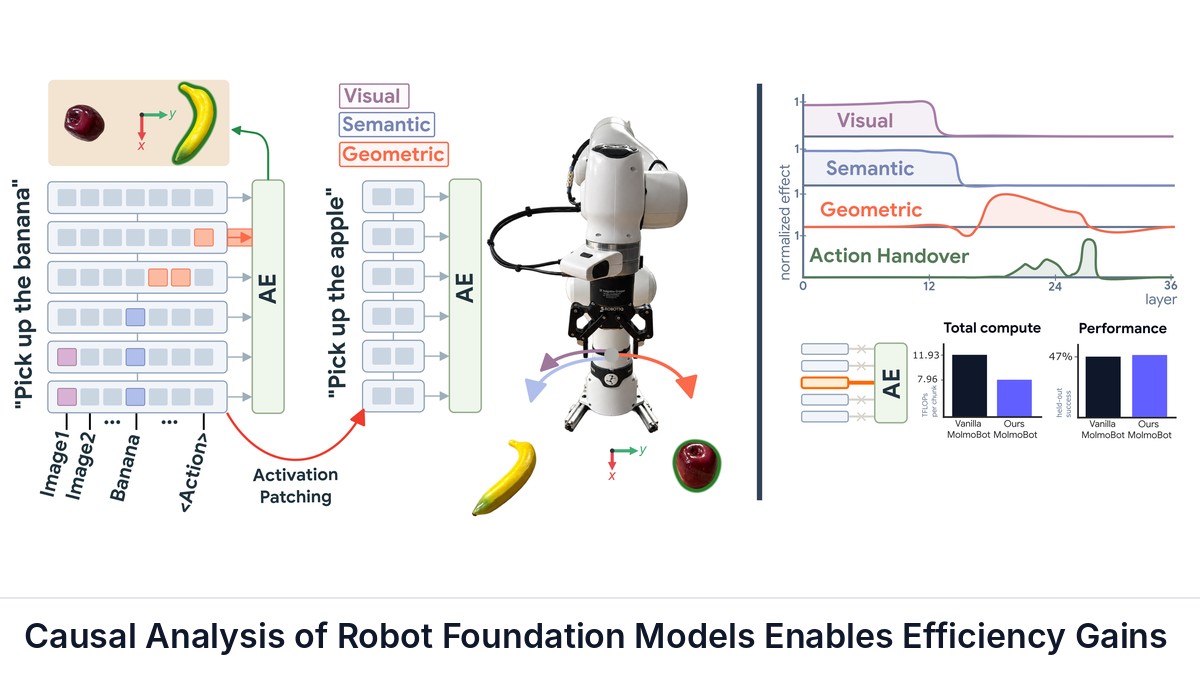
Causal Analysis of Robot Foundation Models Enables Efficiency Gains
Aiden Swann, Mathilde Papillon, Mozes Jacobs et al.
Vision-language-action (VLA) models are a promising approach to general purpose robot manipulation.