
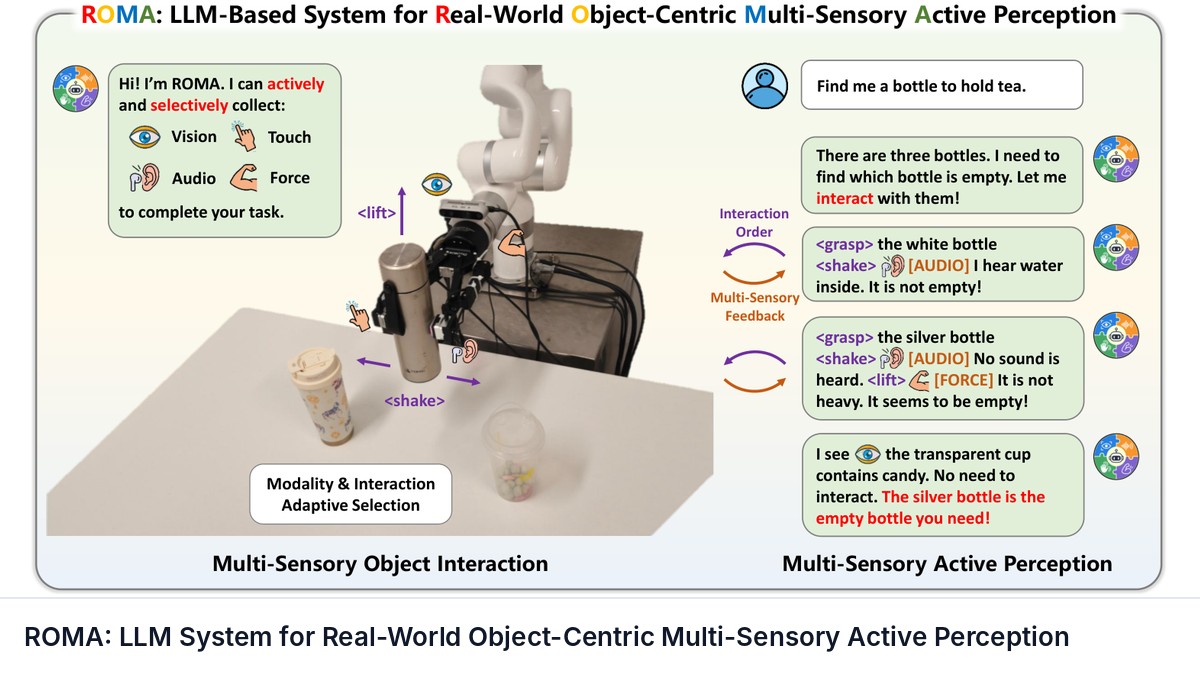
ROMA: LLM System for Real-World Object-Centric Multi-Sensory Active Perception
Ruoxuan Feng, Yutong Chen, Ruihua Song, Huan Yang, Zhongyuan Wang, Guocai Yao, Di Hu · N/A · 2026
Framework
N/A
License
N/A
Stars
N/A
Summary
Humans inherently understand the physical world through an active process. When sensory evidence is insufficient to infer physical properties, we naturally interact with the environment by deciding what information is missing, how to acquire it, and when sufficient evidence has been obtained. In ...
Abstract Summary
Key Points
- Humans inherently understand the physical world through an active process
- When sensory evidence is insufficient to infer physical properties, we naturally interact with th...
- In stark contrast, existing multi-sensory robot systems mainly integrate sensory inputs rather th...
- In this work, we introduce ROMA, an LLM-based system for Real-World Object-Centric Multi-Sensory ...
- ROMA integrates vision, audio, tactile, and force sensing into a reasoning-interaction-feedback loop
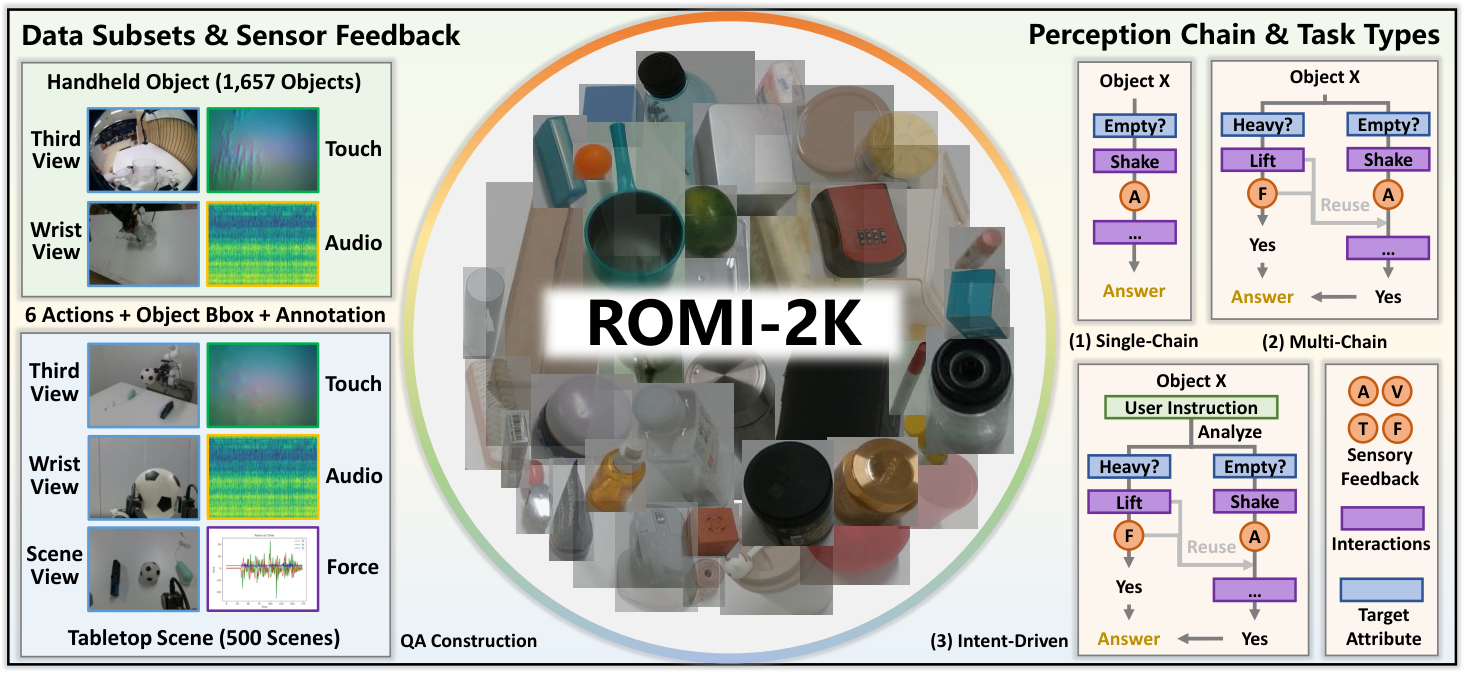
ROMI-2K: Object-Centric Multi-Sensory Interaction Dataset
Existing multi-sensory interaction datasets face a fundamental trade-off between object diversity and interaction diversity . Interaction-centric datasets collect diverse trajectories over a limited set of objects ( e.g. , 381 objects in Hoi! [ 39 ] ). In contrast, object-centric datasets cover numerous objects with simple interactions like hitting [ 28 ] .
Consequently, existing resources provide limited coverage of how diverse objects respond to different physical interactions and their multi-sensory feedback.
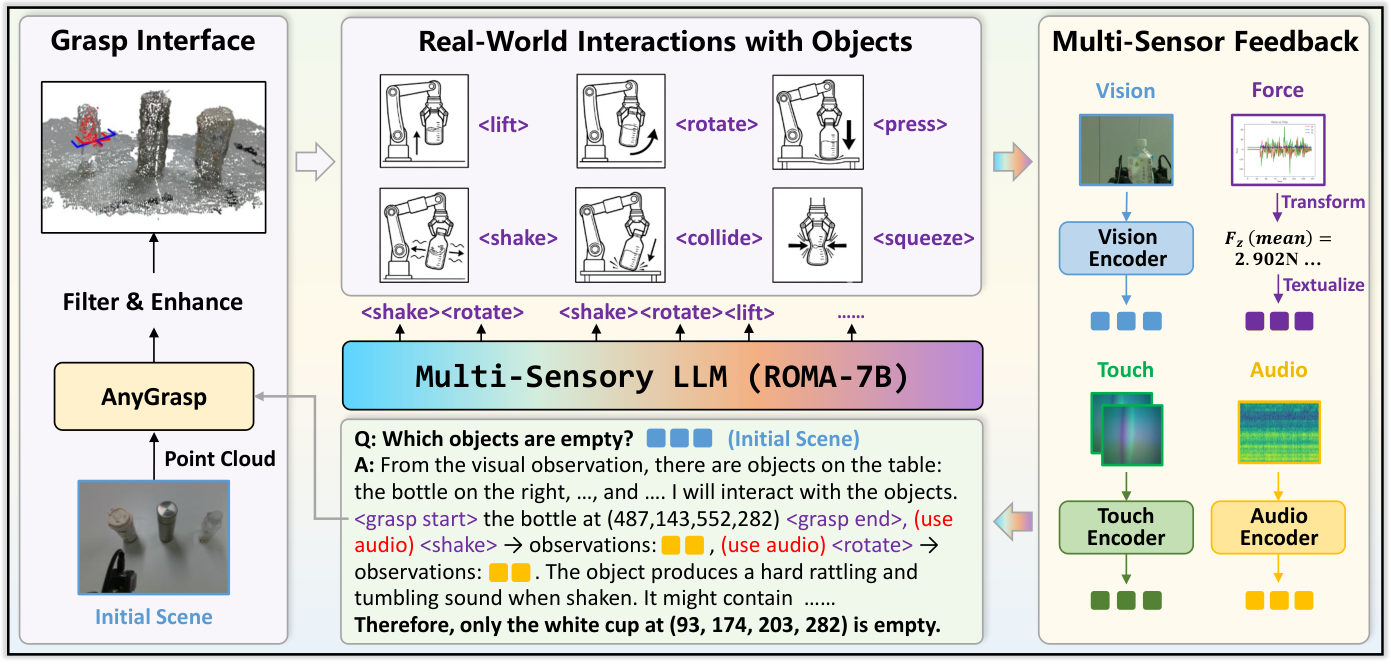
REAL-WORLD Object Multi-Sensory Active Perception System
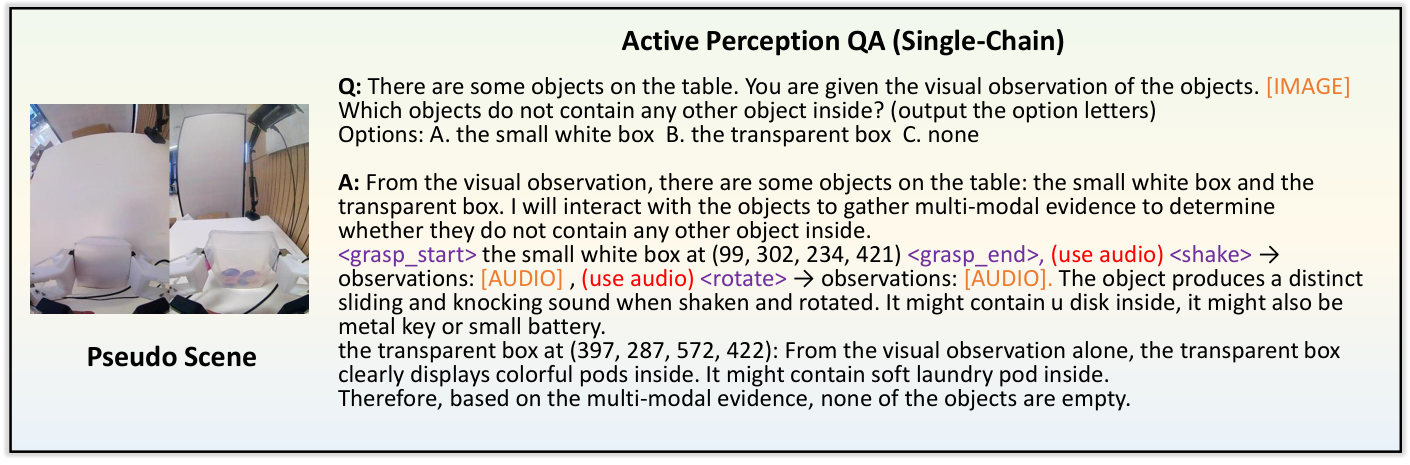
Building on the rich object and scene interaction data provided by ROMI-2K, we introduce ROMA , an LLM-Based System for Real-World Object-Centric Multi-Sensory Active Perception, as shown in Fig. 3 . We describe its physical interface for executing interactions and collecting multi-sensory feedback (Sec. 4.1 ) and its multi-sensory LLM for active perception (Sec. 4.2 ) in this section.
Experiments
In this section, we first introduce ROMA Bench and the evaluation protocol for multi-sensory active perception (Sec. 5.1 ). We then evaluate ROMA against existing MLLMs on both the offline benchmark and real-world tabletop scenes (Sec. 5.2 ), and analyze how different methods allocate interaction effort for evidence acquisition (Sec. 5.3 ). More details are shown in Appendix 14 .
We construct ROMA Bench from the test split of the tabletop subset in ROMI-2K, comprising 2,100 scene-level active perception tasks.
Handheld Data Collection
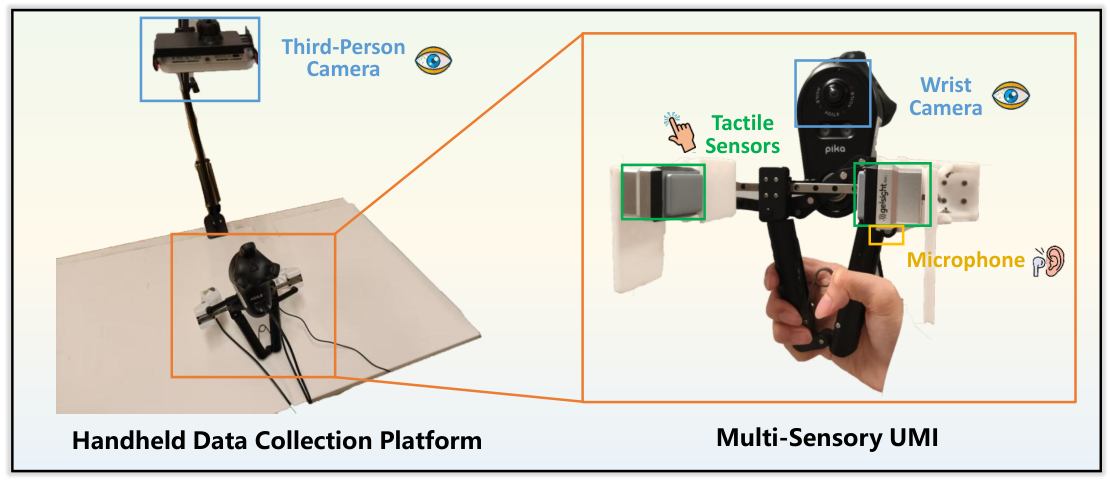
Before collecting structured tabletop scenes with the robotic arm, we first build a handheld data collection platform to efficiently acquire large-scale object-interaction trajectories. The handheld platform allows us to rapidly explore a diverse set of everyday objects under different grasping and interaction configurations.
These data provide broad coverage of object-level physical interactions and serve as an important component of ROMI-2K for training ROMA’s active perception capabilities.
Tabletop Scene Collection and Robotic System Details
In this section, we describe the robotic system developed for ROMA. The system is designed for large-scale, multi-sensory data acquisition through physical object interaction.
Given the name of an object and a corresponding visual prompt, the system autonomously detects the target from multi-view RGB-D observations, estimates its 3D geometry, plans and executes a feasible 6-DoF grasp, and performs a sequence of pre-defined physical interactions while synchronously recording visual, audio, tactile, and force feedback.
Dataset Statistics
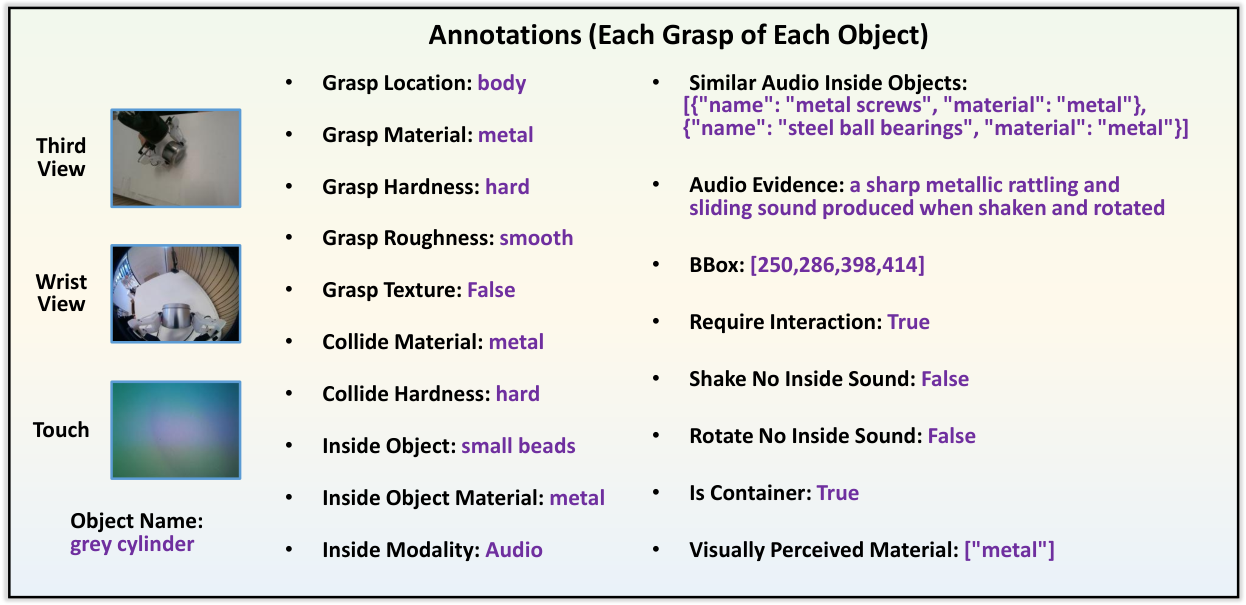
In this section, we first provide a detailed statistical analysis of tabletop scene subset (including both the training set and ROMA Bench) of ROMI-2K. We provide statistics on the object materials, the presence of contents within objects, and the task statistics of ROMA Bench for the training set and ROMA Bench of the tabletop scene subset, as shown in Fig. 16 , 17 , and 18 , respectively.
Implementation Details
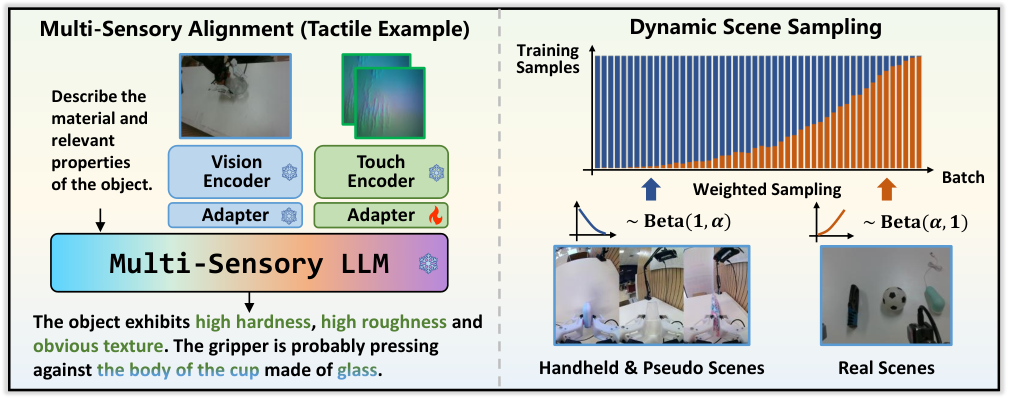
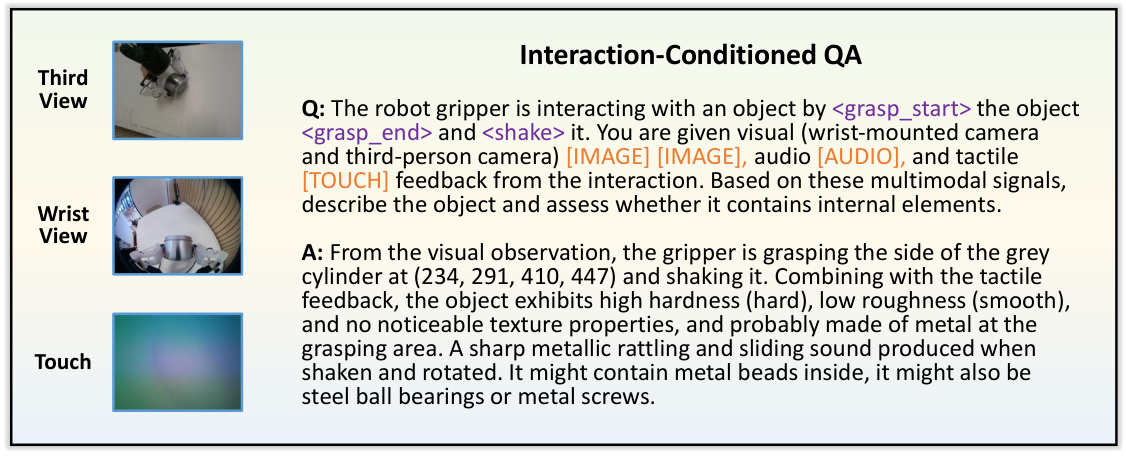
We initialize the ROMA-7B LLM from the weights of Qwen 2.5-Omni 7B [ 42 ] and incorporate the 2-frame version of the AnyTouch 2 [ 48 ] tactile encoder. For stage 1 alignment, we construct modality-specific QA pairs from publicly available datasets and combine them with the handheld object subset of ROMI-2K. For audio alignment, we use AudioCaps [ 49 ] and AudioSet [ 50 ] .
Specifically, we use AudioCaps and select AudioSet samples that contain object-related sounds to construct audio QA pairs.
Interaction and Ablation Study
In this section, we first analyze the interaction patterns of different models on completed active perception tasks, followed by component-level ablations and missing-modality experiments.
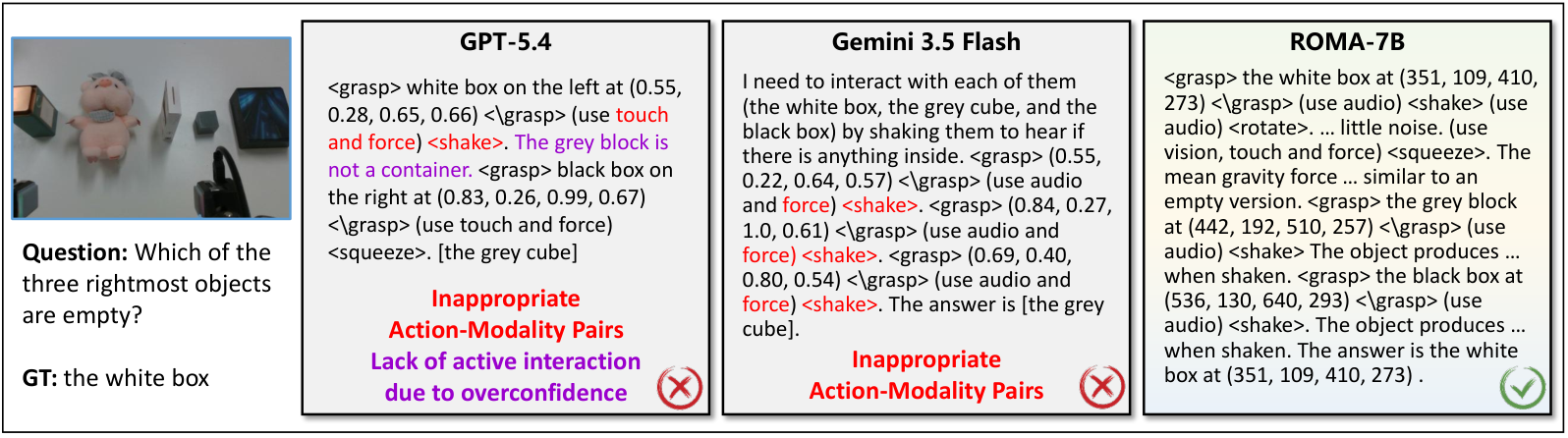
To analyze how different models explore the physical world and select interactions to acquire additional sensory evidence, we compare the relative distributions of the six interaction primitives performed by GPT-5.4, Gemini 3.5 Flash, and ROMA-7B on ROMA Bench, as shown in Fig. 23 . The results reveal clear differences in their interaction preferences.
Sources and Demonstrations
Figures are reproduced from Feng et al. See the full paper for experimental details and the project page, when the paper links one, for demonstrations and videos.
Related Papers
DUET: Decoupled Upper- and Lower-Body Execution for Task-Agnostic Humanoid Loco-Manipulation
Kapalik Khanal, Biswash Khatiwada, Stephen Afrifa et al.
Changing a humanoid robot's manipulation policy should not require retraining the controller that maintains the robot's balance. This study introduces DUET, a decoupled execution framework that enables locomotion and manipulation controllers to operate simultaneously by combining their commands o...

A Sim-to-Real Integration Pipeline for Training and Deployment of Chunk-Based VLA Manipulation Policies
Mathilde Kappel, Clémence Grislain, Mohamed Chetouani et al.
Vision-Language-Action (VLA) models have become a prominent paradigm for mapping multimodal inputs, including semantic instructions, visual observations of the scene, and proprioceptive observations, to robot actions. Most state-of-the-art models predict actions in the end-effector pose space as ...
Beyond Reconstruction: What Matters in Action Tokenization for Robot Policies?
Haoran Chen, Jingtian Ji, Samuel Wheeler et al.
Autoregressive action-token policies such as vision-language-action models require action tokenizers to translate discrete token sequences into precise control actions in continuous space. Many action tokenizers learn the mapping between tokens and actions via a reconstruction objective. However,...
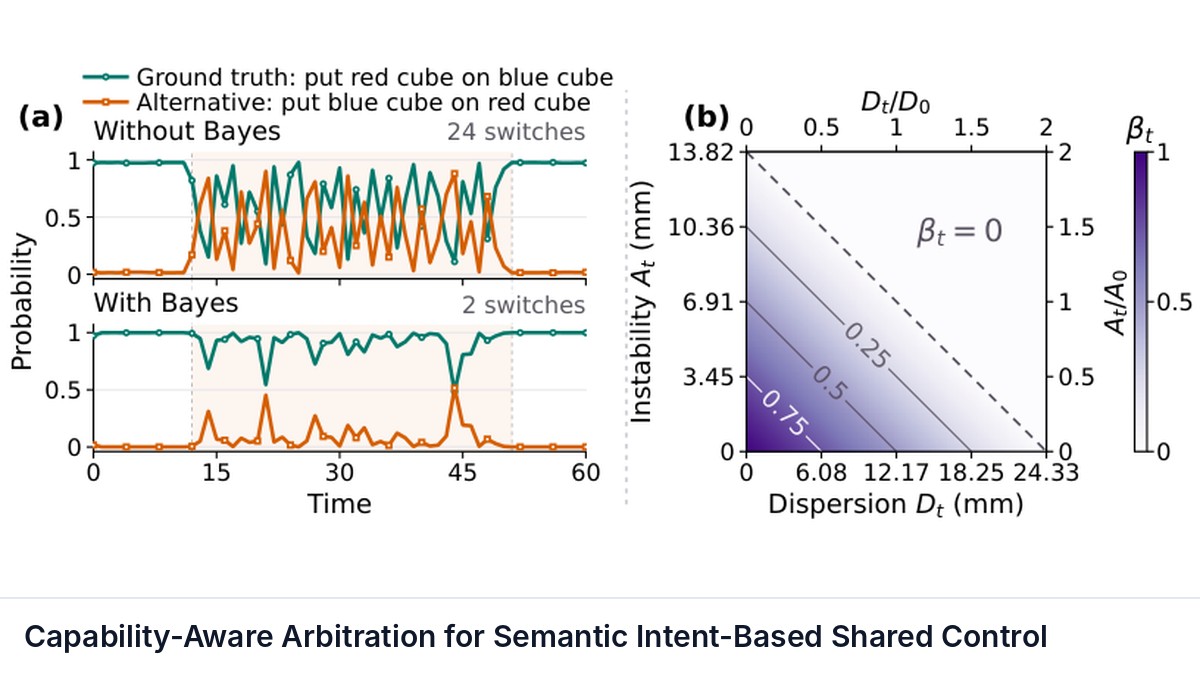
Capability-Aware Arbitration for Semantic Intent-Based Shared Control
Zhaoda Du, Michael Bowman, Xiaoli Zhang
Shared control often allocates robot authority based on confidence in inferred human intent, assuming reliable autonomous execution. When this assumption fails, high intent confidence can cause over-helping. We present a capability-aware shared-control framework in which a vision-language model (...