
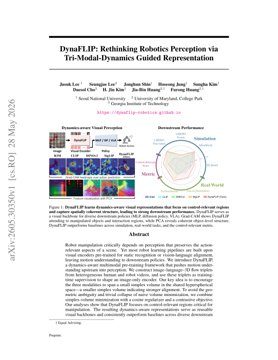
DynaFLIP: Rethinking Robotics Perception via Tri-Modal-Dynamics Guided Representation
FeaturedJusuk Lee, Seungjae Lee, Jonghun Shin, Hoseong Jung, Sungha Kim, Daesol Cho, H. Jin Kim, Jia-Bin Huang, Furong Huang · · 2026
Framework
N/A
License
N/A
Stars
0
Summary
Robot manipulation critically depends on perception that preserves the action-relevant aspects of a scene. Yet most robot learning pipelines are built upon visual encoders pre-trained for static recog
Abstract Summary
Key Points
- Dynamics-aware multimodal pre-training framework for robotics perception.
- Uses image-language-3D flow triplets for training-time supervision.
- Simplex volume minimization in hyperspherical space aligns tri-modal representations.
- Works as reusable visual backbone for VLAs and downstream policies.
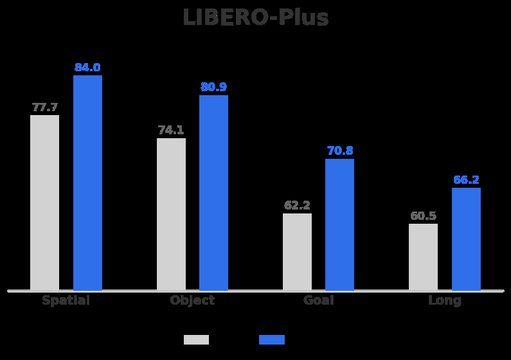
- +22.5% gains under OOD scenarios across diverse simulation and real-world setups.
Method
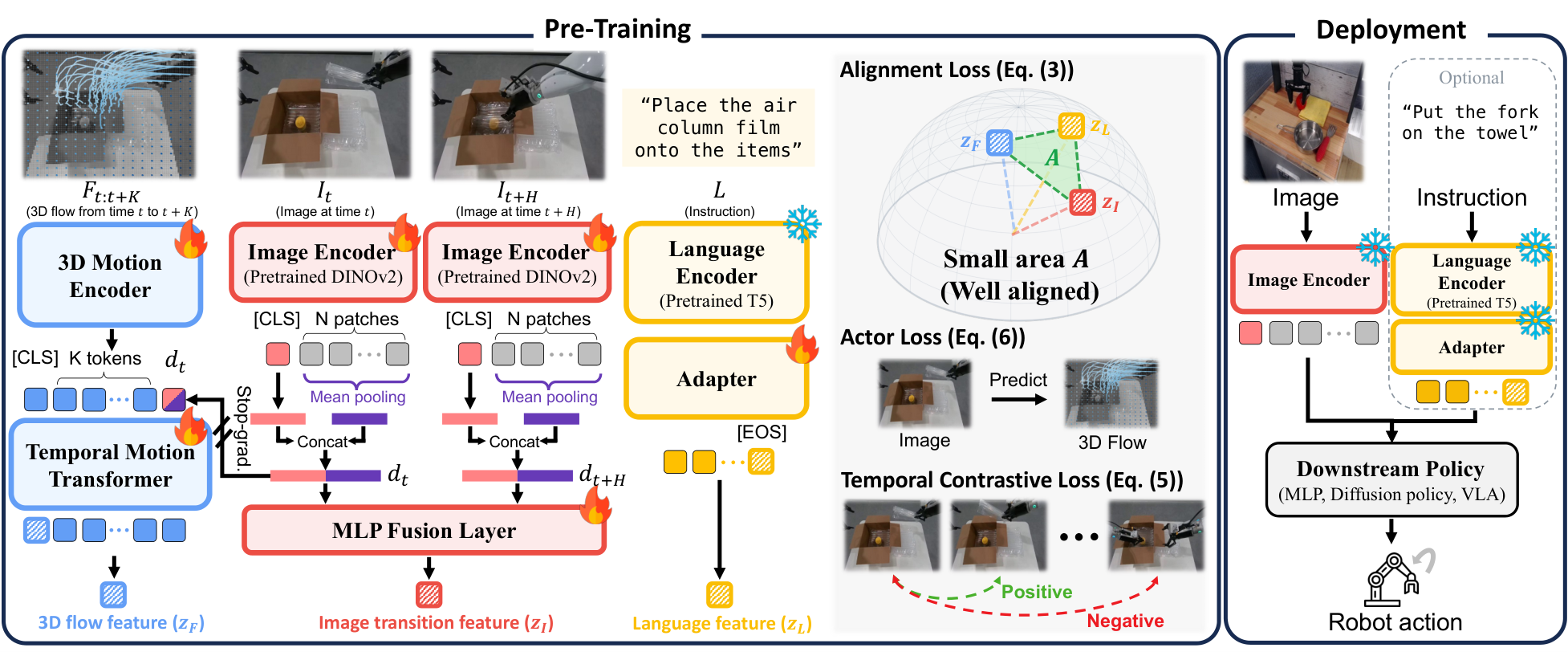
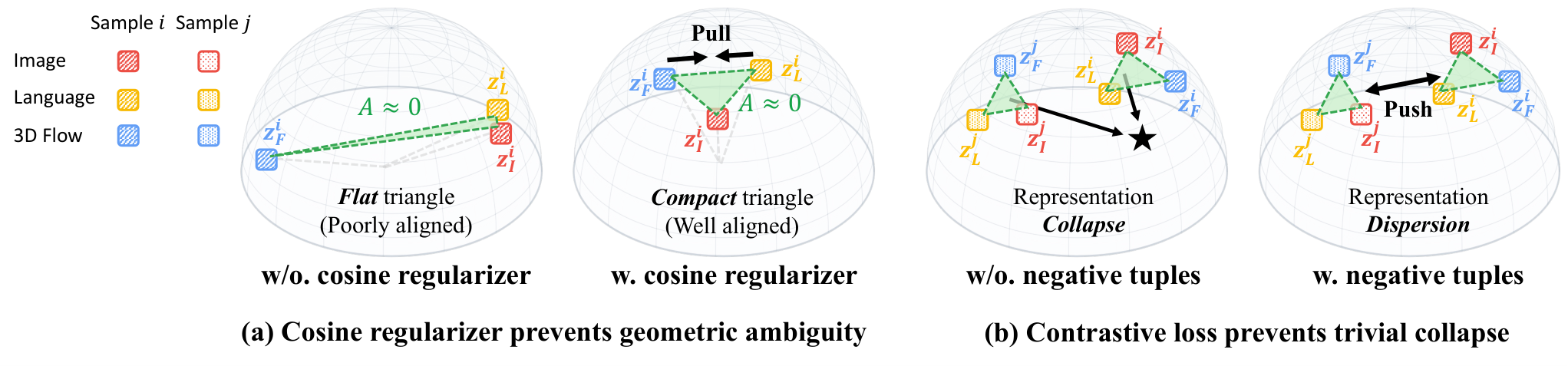
DynaFLIP shifts visual pre-training from static scene understanding to motion-induced state transitions. Section 2.1 introduces a simplex-guided multimodal alignment objective that aligns image transitions, language, and 3D flow into a shared embedding space while resolving two optimization pitfalls: geometric ambiguity and trivial collapse.
Section 2.2 then presents the auxiliary objectives—temporal contrastive and actor losses—that further strengthen dynamics-aware visual representations.
Experiments
In this section, we evaluate DynaFLIP through extensive experiments in both simulation and the real world. Through these experiments, we aim to answer the following questions: Does DynaFLIP learn dynamics-aware representations that preserve control-relevant information for manipulation? Do dynamics-aware representations improve downstream policy learning compared to strong baselines?
Can DynaFLIP improve real-world manipulation under both in-distribution and out-of-distribution settings? Which design choices in DynaFLIP are most critical to its...
Sources and Demonstrations
Figures are reproduced from Lee et al. See the full paper for experimental details and the project page, when the paper links one, for demonstrations and videos.
Related Papers
GuidedVLA: Specifying Task-Relevant Factors via Plug-and-Play Action Attention Specialization
Xiaosong Jia, Bowen Yang, Zuhao Ge et al.
Vision-Language-Action (VLA) models aim for general robot learning by aligning action as a modality within powerful Vision-Language Models (VLMs). Existing VLAs rely on end-to-end supervision to implicitly enable the action decoding process to learn task-relevant features.
From Imagined Futures to Executable Actions: Mixture of Latent Actions for Robot Manipulation
Yajie Li, Bozhou Zhang, Chun Gu et al.
Video foundation-models models offer a promising imagination mechanism for robot manipulation by predicting long-horizon future observations, but effectively exploiting these imagined futures for action execution remains challenging.
Qwen-VLA: Unifying Vision-Language-Action Modeling across Tasks, Environments, and Robot Embodiments
Qiuyue Wang, Mingsheng Li, Jian Guan et al.
Embodied intelligence is often studied through specialized models for individual tasks such as manipulation or navigation, resulting in fragmented capabilities and limited generalization across tasks,
Spatial Memory for Out-of-Vision Manipulation in Vision-Language-Action
Pengteng Li, Weiyu Guo, He Zhang et al.
SOMA introduces an explicit spatial memory framework that enables VLA models to track and manipulate objects even after they leave the camera's field of view.