
Reconstruct, Practice, Go Real: Guided Self-Improvement for Embodied Agents
Yen-Jen Wang, Haozhe Jiang, Shuying Deng, Haoru Xue, Weirui Ye, Rocky Duan, Nika Haghtalab, S. Shankar Sastry, Pieter Abbeel, Haozhi Qi · N/A · 2026
Framework
N/A
License
N/A
Stars
N/A
Summary
Building reliable robot capabilities across diverse tasks requires substantial human effort to develop and maintain skills, design rewards, and integrate perception with control.
Abstract Summary
Key Points
- Building reliable robot capabilities across diverse tasks requires substantial human effort to develop and maintain skills, design rewards, and integrate perception with control.
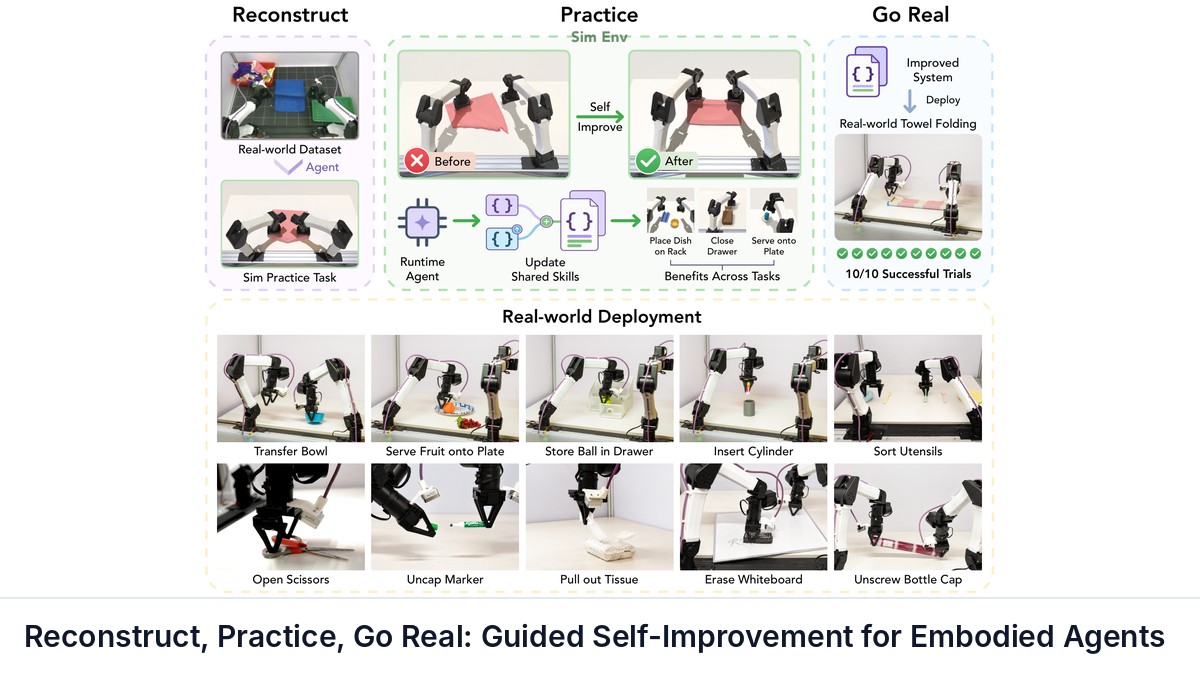
- We present Reconstruct, Practice, Go Real (RPG), a framework for autonomous improvement of robot execution systems without updating model weights.
- RPG identifies manipulation capabilities in an offline dataset and constructs related practice tasks in simulation.
- During practice, RPG uses execution feedback, privileged simulator state, and available dataset videos to diagnose failures.
- It develops new reusable symbolic skills, refines existing skills, and revises the system prompt based on these diagnoses.
Reconstruct, Practice, Go Real
RPG coordinates six specialized agents across its three stages: Constructor, Runtime Agent, Privileged Agent, Video Analyzer, Implementor, and Merger (Fig. 2 ). It first constructs simulation practice tasks from an offline dataset, improves a shared robot execution system by practicing these tasks, and ultimately deploys the resulting system on a physical robot.
Evaluation
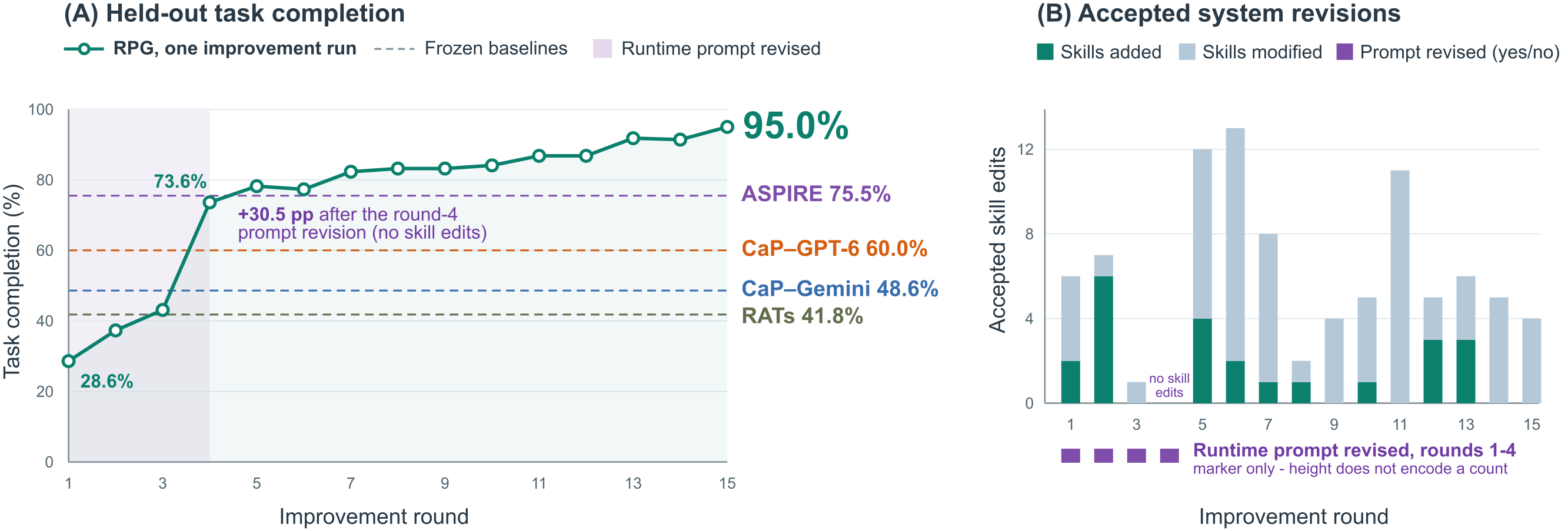
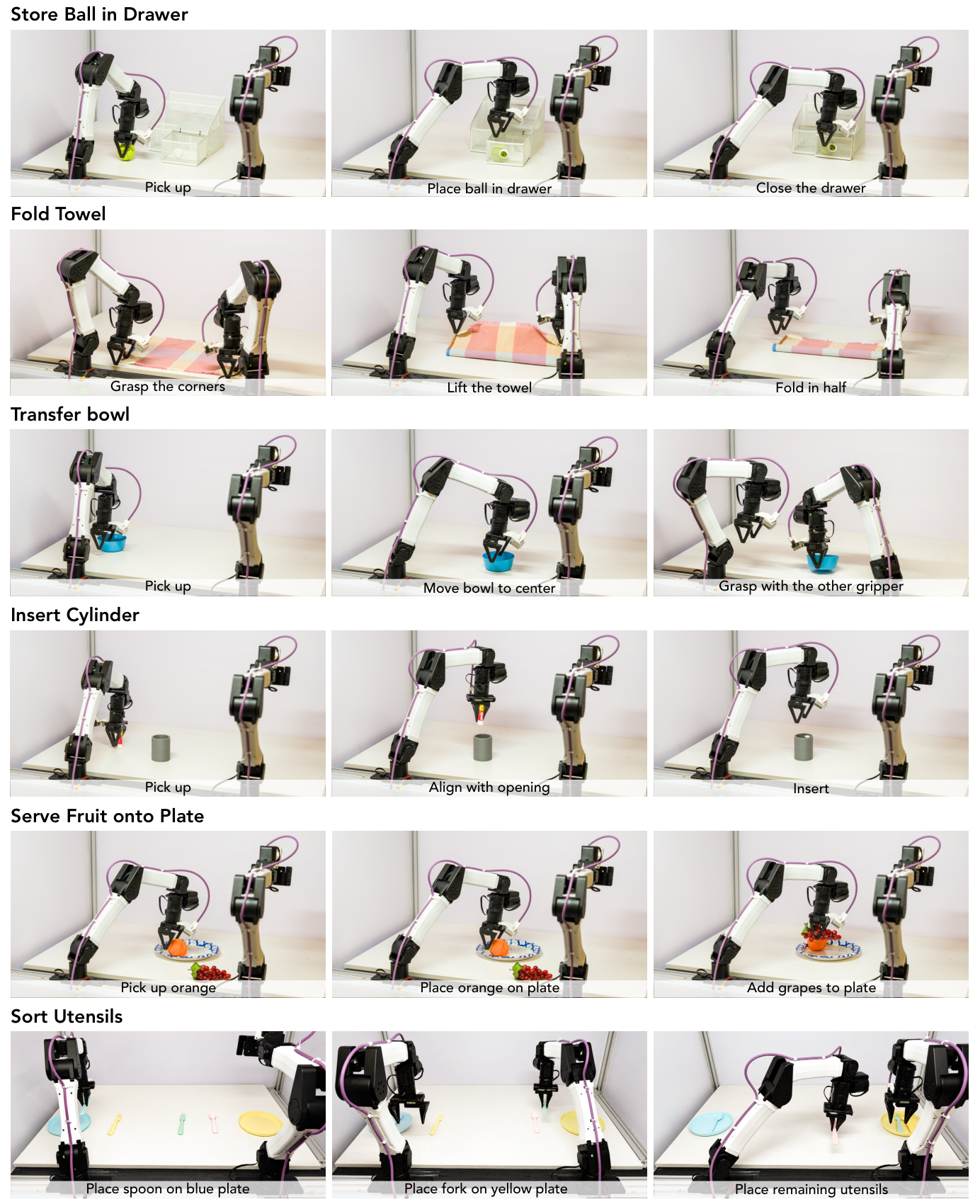
Q1 , how does task success change with practice, and how does RPG compare with existing agents? Q2 , how do the diagnostic inputs affect improvement? Q3 , can library changes improve task completion with the surrounding runtime fixed? Q4 , does the resulting system complete physical tasks after common adaptation? The simulated YAM robot has two 6-DoF arms and two grippers, and receives RGB-D observations.
It accepts 14-dimensional commands specifying absolute joint-position targets.
Sources and Demonstrations
Figures are reproduced from Wang et al. See the full paper for experimental details and the project page, when the paper links one, for demonstrations and videos.
Related Papers

A Sim-to-Real Integration Pipeline for Training and Deployment of Chunk-Based VLA Manipulation Policies
Mathilde Kappel, Clémence Grislain, Mohamed Chetouani et al.
Vision-Language-Action (VLA) models have become a prominent paradigm for mapping multimodal inputs, including semantic instructions, visual observations of the scene, and proprioceptive observations, to robot actions.
Beyond Reconstruction: What Matters in Action Tokenization for Robot Policies?
Haoran Chen, Jingtian Ji, Samuel Wheeler et al.
Autoregressive action-token policies such as vision-language-action models require action tokenizers to translate discrete token sequences into precise control actions in continuous space. Many action tokenizers learn the mapping between tokens and actions via a reconstruction objective.

Capability-Aware Arbitration for Semantic Intent-Based Shared Control
Zhaoda Du, Michael Bowman, Xiaoli Zhang
Shared control often allocates robot authority based on confidence in inferred human intent, assuming reliable autonomous execution. When this assumption fails, high intent confidence can cause over-helping.
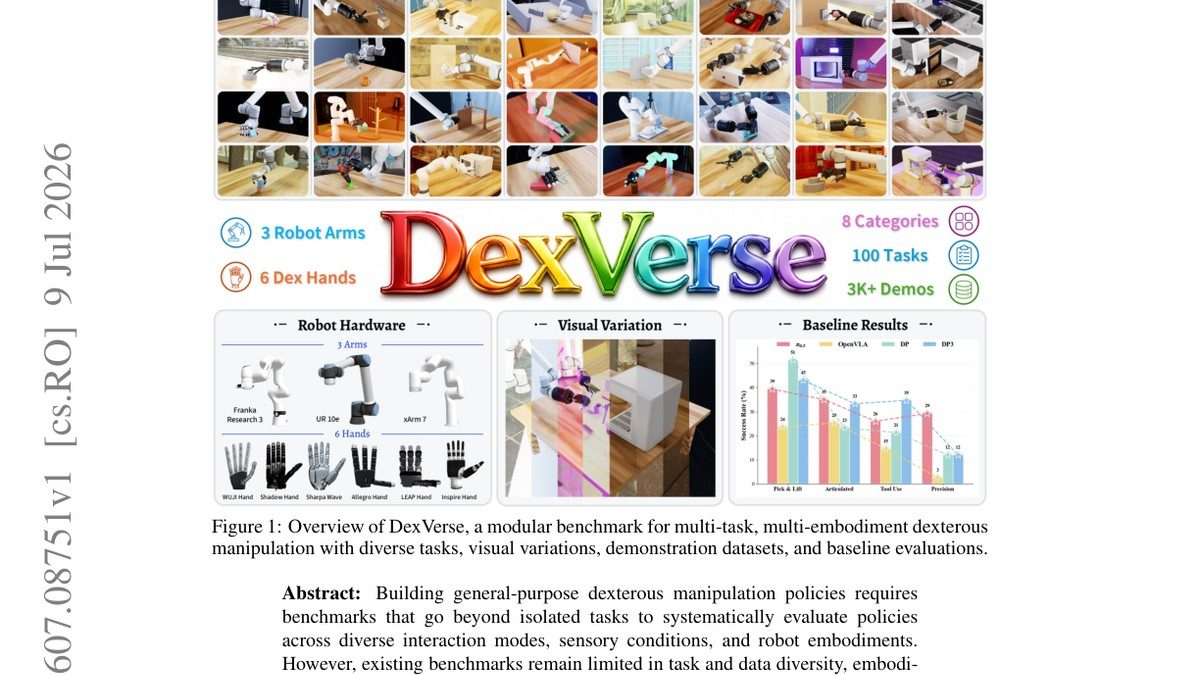
DexVerse: A Modular Benchmark for Multi-Task, Multi-Embodiment Dexterous Manipulation
Yunchao Yao, Zhuxiu Xu, Tianqi Zhang et al.
Building general-purpose dexterous manipulation policies requires benchmarks that go beyond isolated tasks to systematically evaluate policies across diverse interaction modes, sensory conditions, and robot embodiments.