
Human-Centric Grasp State Assessment: Toward Transferring Subjective Evaluation to Robots
Ryohei Kobayashi, Kosei Isomoto, Yuga Yano, Yuichiro Tanaka, Hakaru Tamukoh · N/A · 2026
Framework
N/A
License
N/A
Stars
N/A
Summary
We propose a framework that transfers tacit human subjective criteria to robotic systems for the appropriate grasping of deformable objects. Achieving such behavior is challenging because a semantic gap exists between qualitative human expectations and quantitative robotic measurements.
Abstract Summary
Key Points
- We propose a framework that transfers tacit human subjective criteria to robotic systems for the appropriate grasping of deformable objects.
- Achieving such behavior is challenging because a semantic gap exists between qualitative human expectations and quantitative robotic measurements.
- Conventional deep learning approaches for bridging this gap also require prohibitive amounts of manually annotated data for each newly encountered object.
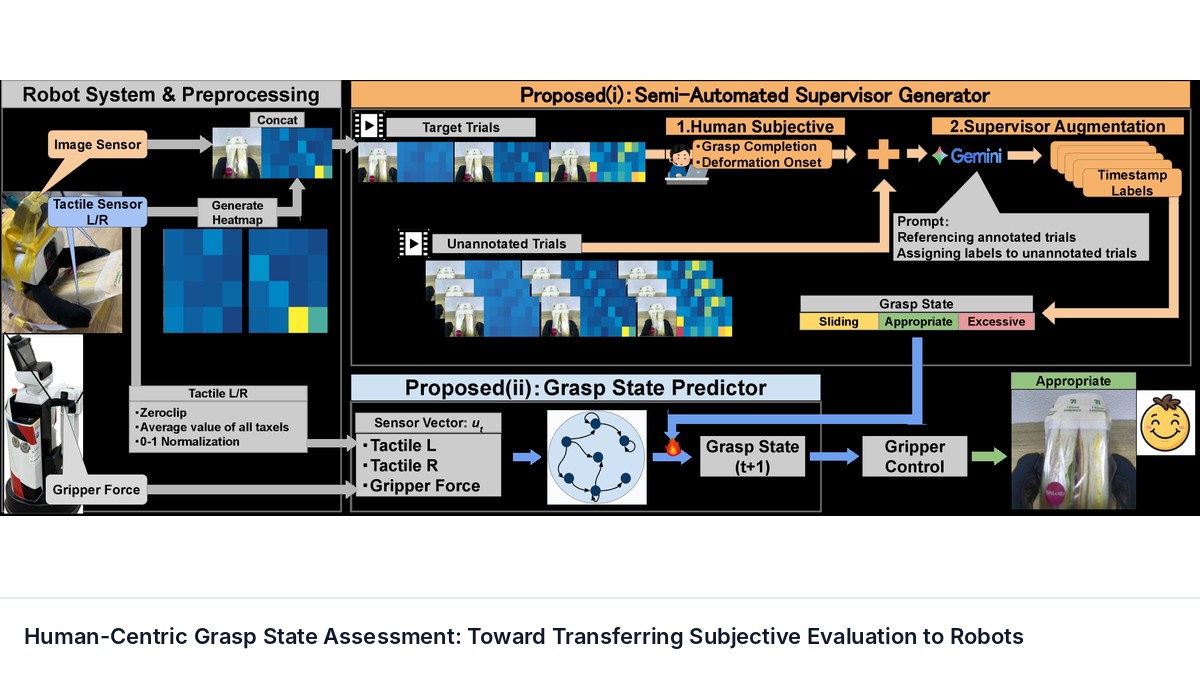
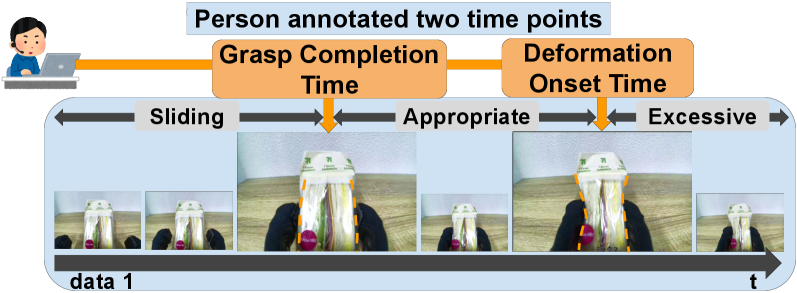
- To address these challenges, our framework integrates a Vision-Language Model (VLM)-based semi-automated supervisor generator with a lightweight grasp state predictor, using a minimal set of human-annotated trials as contextual anchors to propagate subjective criteria to unannotated data.
- The prediction model then enables rapid online adaptation by sequentially estimating the grasp state from time-series tactile and grasping force measurements.
PROPOSED FRAMEWORK
Figure 2 illustrates the proposed framework. To support object-wise adaptation with limited annotation, the framework integrates two main modules: Supervisor Generator (SG) that generates training data starting from a limited number of human subjective annotations.
Grasp State Predictor (GSP) that predicts one-step-ahead the grasp state of sliding, appropriate, and excessive from time-series tactile and grasping force data. Rather than replacing human annotation, the SG reduces labeling costs.
Experiments
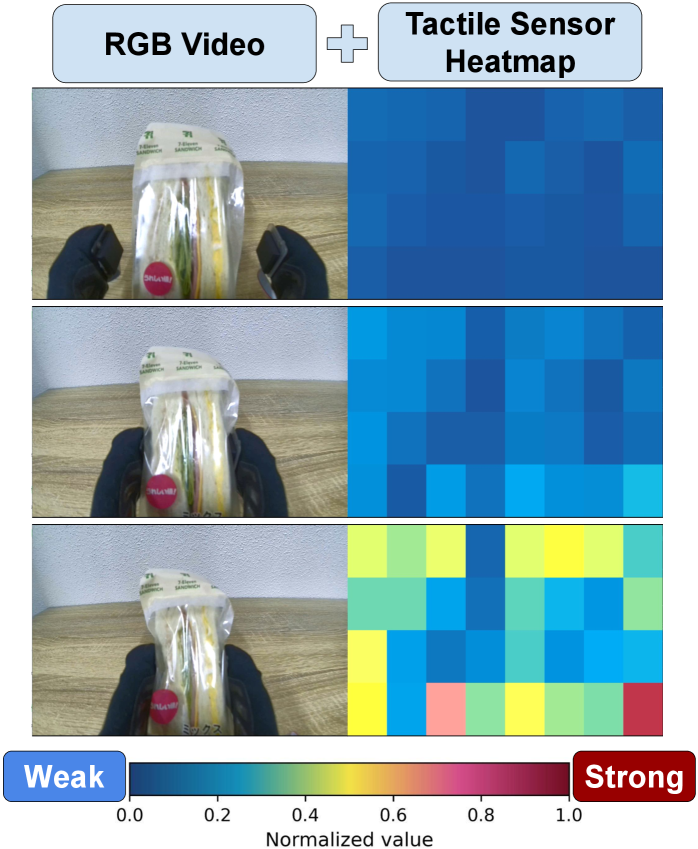
To verify the effectiveness of the proposed framework in bridging the semantic gap and achieving rapid adaptation, we conduct evaluations structured as follows: A. Dataset and Setup: Details of multimodal data collection and ground truth definitions for three distinct objects to establish the experimental baseline. B.
SG Reliability: Evaluation of label accuracy versus example count to demonstrate the mitigation of manual data collection bottlenecks. C.
Sources and Demonstrations
Figures are reproduced from Kobayashi et al. See the full paper for experimental details and the project page, when the paper links one, for demonstrations and videos.
Related Papers
DUET: Decoupled Upper- and Lower-Body Execution for Task-Agnostic Humanoid Loco-Manipulation
Kapalik Khanal, Biswash Khatiwada, Stephen Afrifa et al.
Changing a humanoid robot's manipulation policy should not require retraining the controller that maintains the robot's balance.

A Sim-to-Real Integration Pipeline for Training and Deployment of Chunk-Based VLA Manipulation Policies
Mathilde Kappel, Clémence Grislain, Mohamed Chetouani et al.
Vision-Language-Action (VLA) models have become a prominent paradigm for mapping multimodal inputs, including semantic instructions, visual observations of the scene, and proprioceptive observations, to robot actions.
Beyond Reconstruction: What Matters in Action Tokenization for Robot Policies?
Haoran Chen, Jingtian Ji, Samuel Wheeler et al.
Autoregressive action-token policies such as vision-language-action models require action tokenizers to translate discrete token sequences into precise control actions in continuous space. Many action tokenizers learn the mapping between tokens and actions via a reconstruction objective.

Capability-Aware Arbitration for Semantic Intent-Based Shared Control
Zhaoda Du, Michael Bowman, Xiaoli Zhang
Shared control often allocates robot authority based on confidence in inferred human intent, assuming reliable autonomous execution. When this assumption fails, high intent confidence can cause over-helping.