
ForeTac-VLA: A Forecasting-Based Tactile-Vision-Language-Action Model for Contact-Rich Robotic Manipulation
Zhengyu Tao, Xin Li, Xin Wang · N/A · 2026
Framework
N/A
License
N/A
Stars
N/A
Summary
Vision-language-action (VLA) models have demonstrated strong capabilities in robotic manipulation, yet their reliance on visual perception limits robustness in contact-rich environments, where critical physical interaction states may not be visually observable.
Abstract Summary
Key Points
- Vision-language-action (VLA) models have demonstrated strong capabilities in robotic manipulation, yet their reliance on visual perception limits robustness in contact-rich environments, where critical physical interaction states may not be visually observable.
- Existing tactile-enhanced VLA methods improve physical grounding using observed tactile feedback, but most remain largely reactive rather than explicitly modeling how contact may evolve.
- Therefore, we propose ForeTac-VLA, a forecasting-based tactile-vision-language fusion model that predicts future tactile states to guide action generation.
- Specifically, ForeTac-VLA encodes recent tactile observations into temporal representations and integrates them with vision-language features through bidirectional cross-attention.
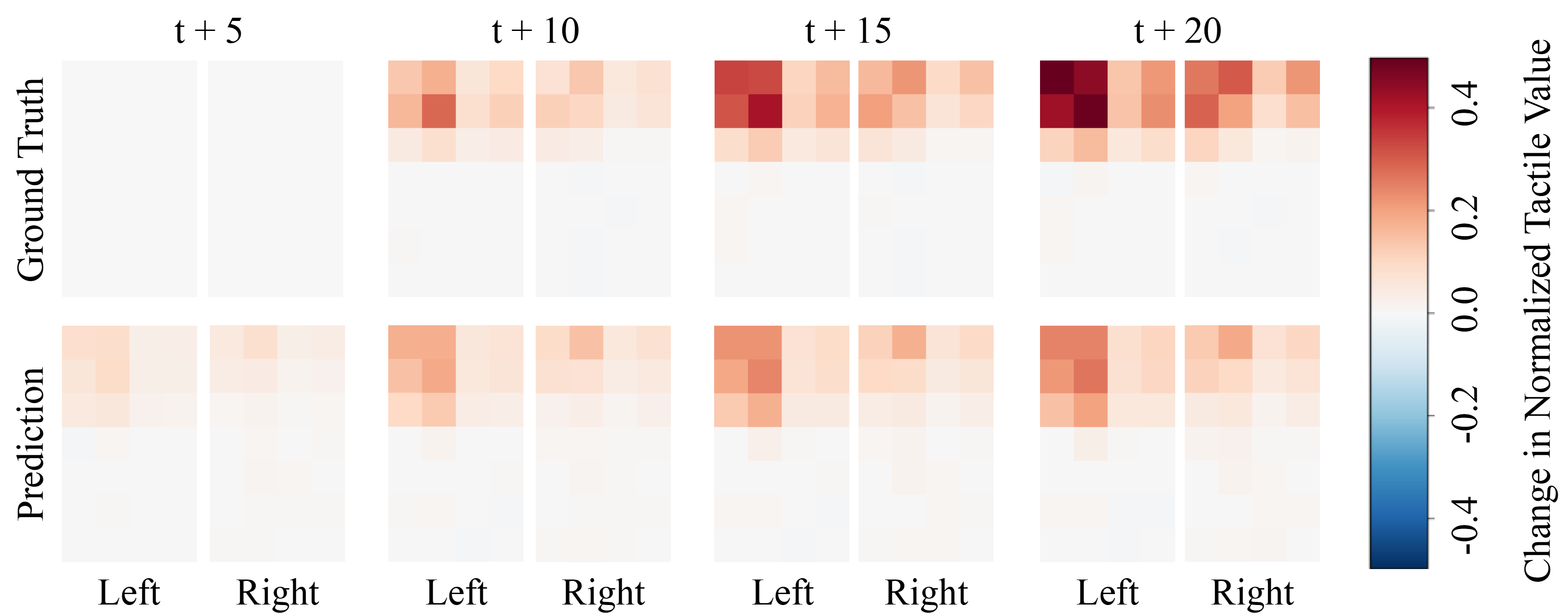
- Further, a transformer-based forecasting module predicts multi-step future tactile states, enabling the model to reason jointly over observed and anticipated contact.
Method
In this section, we first introduce the overall architecture of ForeTac-VLA (Sec. III-A), followed by the bidirectional cross-attention module for multimodal fusion (Sec. III-B). We then present the transformer-based multi-step future tactile forecasting module (Sec. III-C). Finally, we describe the training procedure in Sec. III-D. As illustrated in Fig.
, ForeTac-VLA is built upon the pretrained $\pi_{0.5}$ VLA model and extends it with temporal tactile encoding, bidirectional cross-attention, and multi-step future tactile forecasting.
Experiments
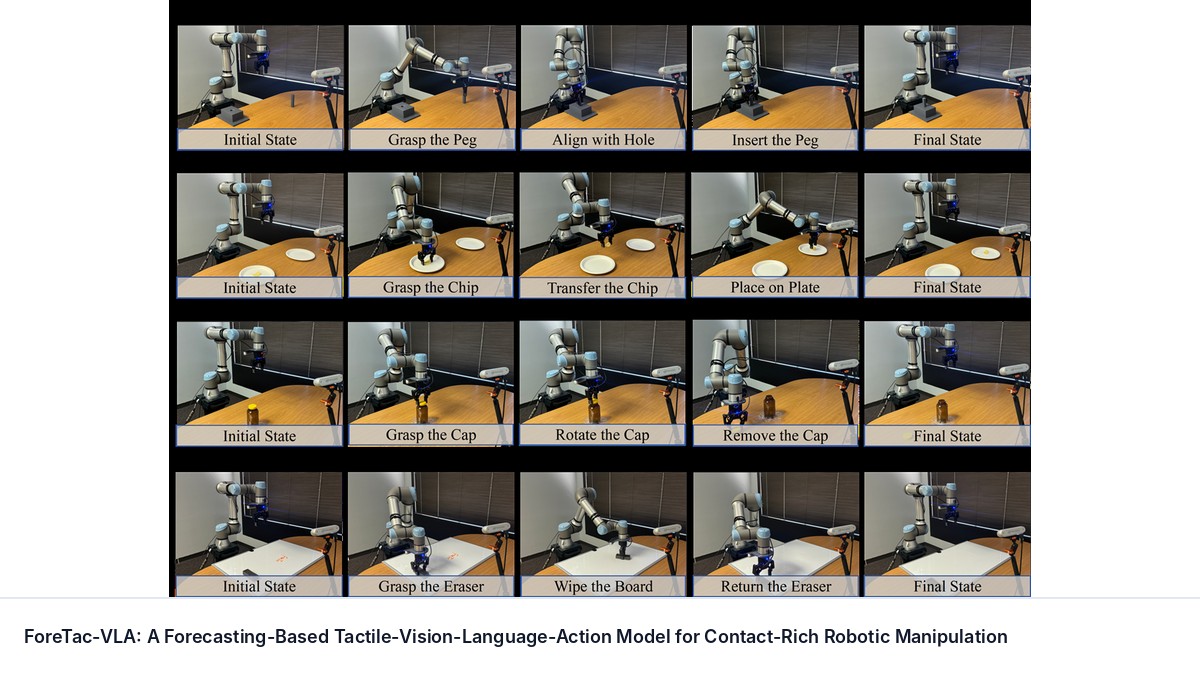
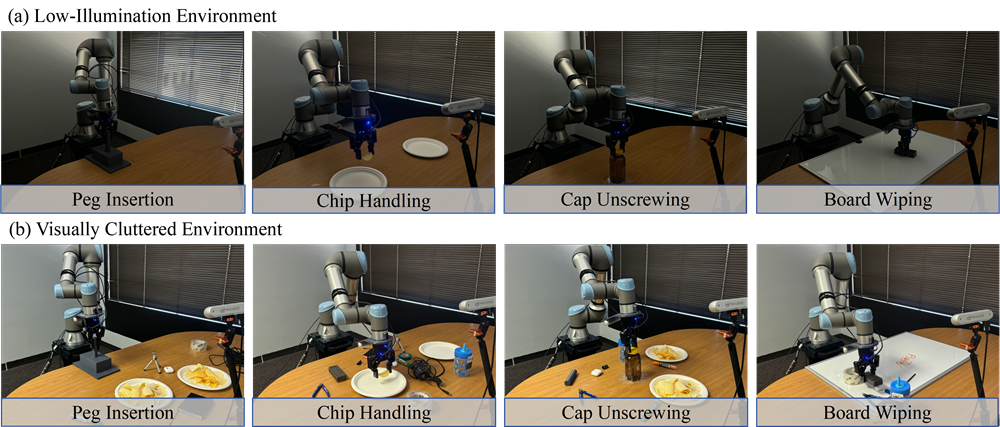
In this section, the experiments are presented across five aspects: (1) Experimental Setup : the real-robot platform, manipulation tasks, data collection and training procedures, and evaluation approach and metrics; (2) Experimental Results : comparisons with the fine-tuned VLA model and state-of-the-art tactile-enhanced VLA models; (3) Ablation Study : the contributions of tactile input, future tactile forecasting, and multimodal fusion; (4) Robustness and Generalization : performance under challenging visual conditions, including low-illumina...
Sources and Demonstrations
Figures are reproduced from Tao et al. See the full paper for experimental details and the project page, when the paper links one, for demonstrations and videos.
Related Papers

A Sim-to-Real Integration Pipeline for Training and Deployment of Chunk-Based VLA Manipulation Policies
Mathilde Kappel, Clémence Grislain, Mohamed Chetouani et al.
Vision-Language-Action (VLA) models have become a prominent paradigm for mapping multimodal inputs, including semantic instructions, visual observations of the scene, and proprioceptive observations, to robot actions.

Capability-Aware Arbitration for Semantic Intent-Based Shared Control
Zhaoda Du, Michael Bowman, Xiaoli Zhang
Shared control often allocates robot authority based on confidence in inferred human intent, assuming reliable autonomous execution. When this assumption fails, high intent confidence can cause over-helping.
Design and Evaluation of a Touchscreen-Based Teleoperation Interface for Robotic Manipulators
Juan José García Cárdenas, Alperen Kenan, Hamidreza Raei et al.
Intuitive teleoperation interfaces are crucial for the safe and effective operation of robotic manipulators in challenging environments.
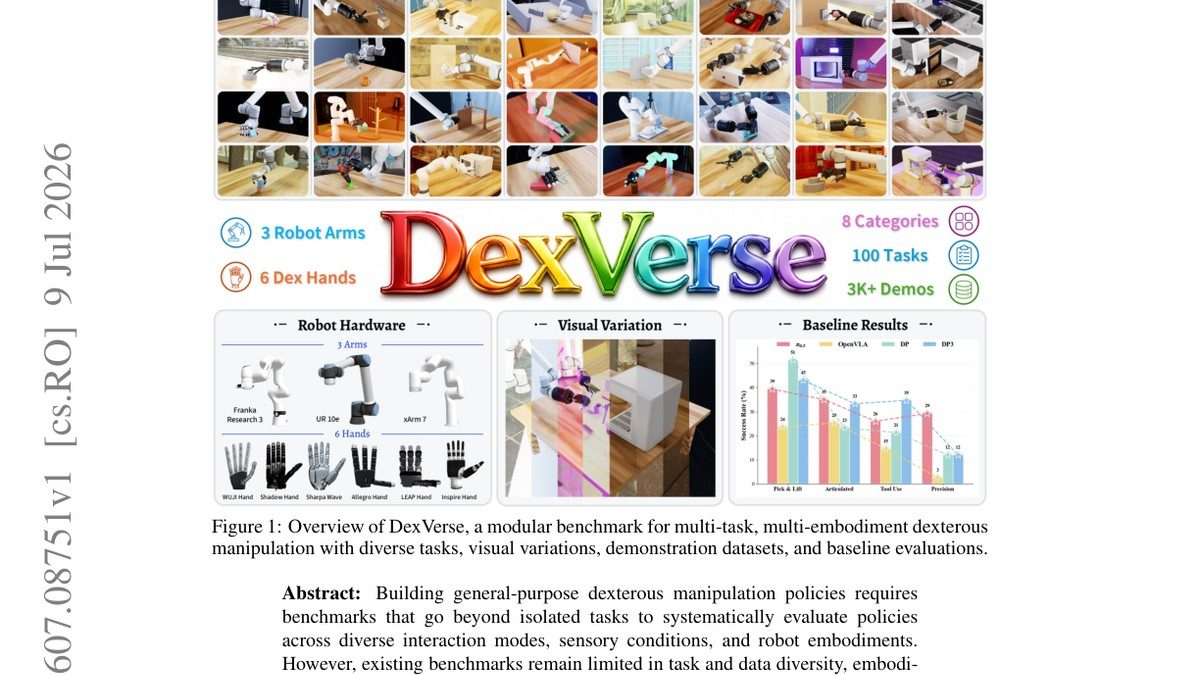
DexVerse: A Modular Benchmark for Multi-Task, Multi-Embodiment Dexterous Manipulation
Yunchao Yao, Zhuxiu Xu, Tianqi Zhang et al.
Building general-purpose dexterous manipulation policies requires benchmarks that go beyond isolated tasks to systematically evaluate policies across diverse interaction modes, sensory conditions, and robot embodiments.