
SUAVE: Unified Video-Action Models via Masked Diffusion
Rhythm Syed, Jean Mercat, Sedrick Keh, Kushal Arora, Paarth Shah, Aykut Onol, Mengchao Zhang, Tony Dear · N/A · 2026
Framework
N/A
License
N/A
Stars
N/A
Summary
Vision-language-action models (VLAs) inherit strong semantic grounding from pretrained vision-language backbones but are typically optimized for predicting actions rather than future observations. They can see and act, but they do not imagine the future before acting.
Abstract Summary
Key Points
- Vision-language-action models (VLAs) inherit strong semantic grounding from pretrained vision-language backbones but are typically optimized for predicting actions rather than future observations.
- They can see and act, but they do not imagine the future before acting
- World action models (WAMs) built on video diffusion backbones can imagine but treat language as frozen conditioning on a continuous latent space.
- Unified models bring these modalities into one architecture, but they either decode autoregressively, one token at a time, or keep video continuous with an auxiliary action head.
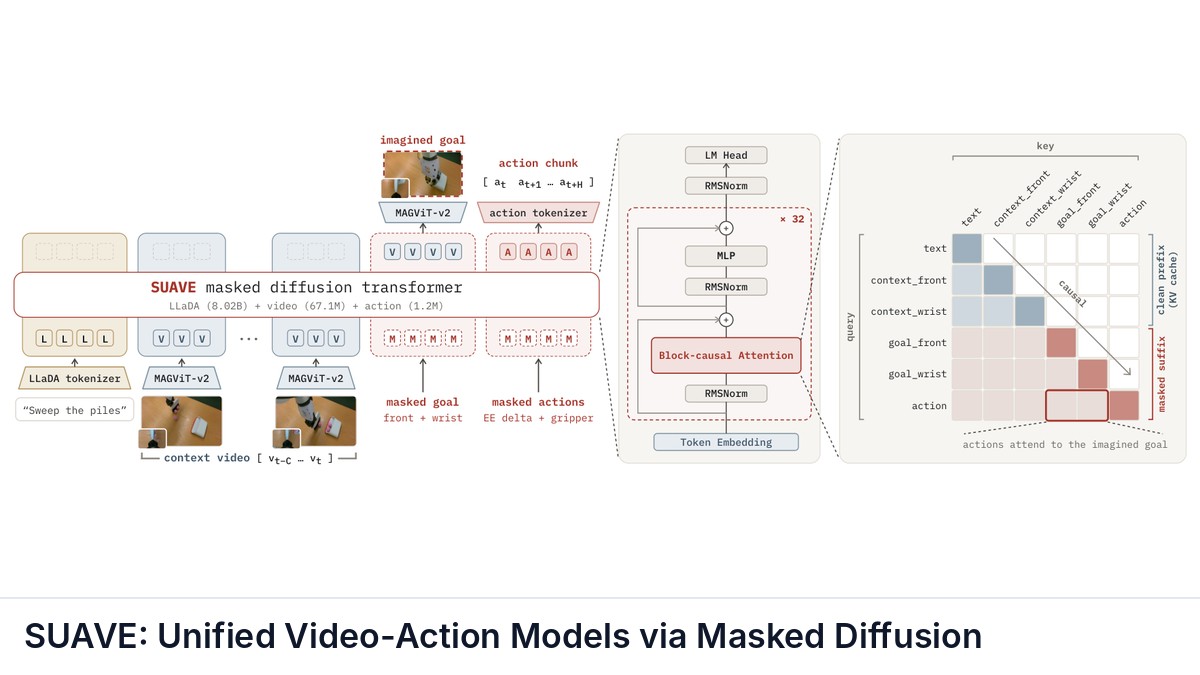
- In this work, we present SUAVE, a Single vocabulary Unified Action-Video modEl in which a masked diffusion transformer generates video and actions conditioned on language, with all three modalities represented as discrete tokens in a shared sequence.
Method
SUAVE is a single transformer that models language, video, and robot actions as one sequence of discrete tokens, as shown in Figure 2 . Attention is bidirectional within each block of the sequence and causal across blocks, and the model is trained with a masked diffusion objective [ 21 , 22 , 23 ] .
Experiments
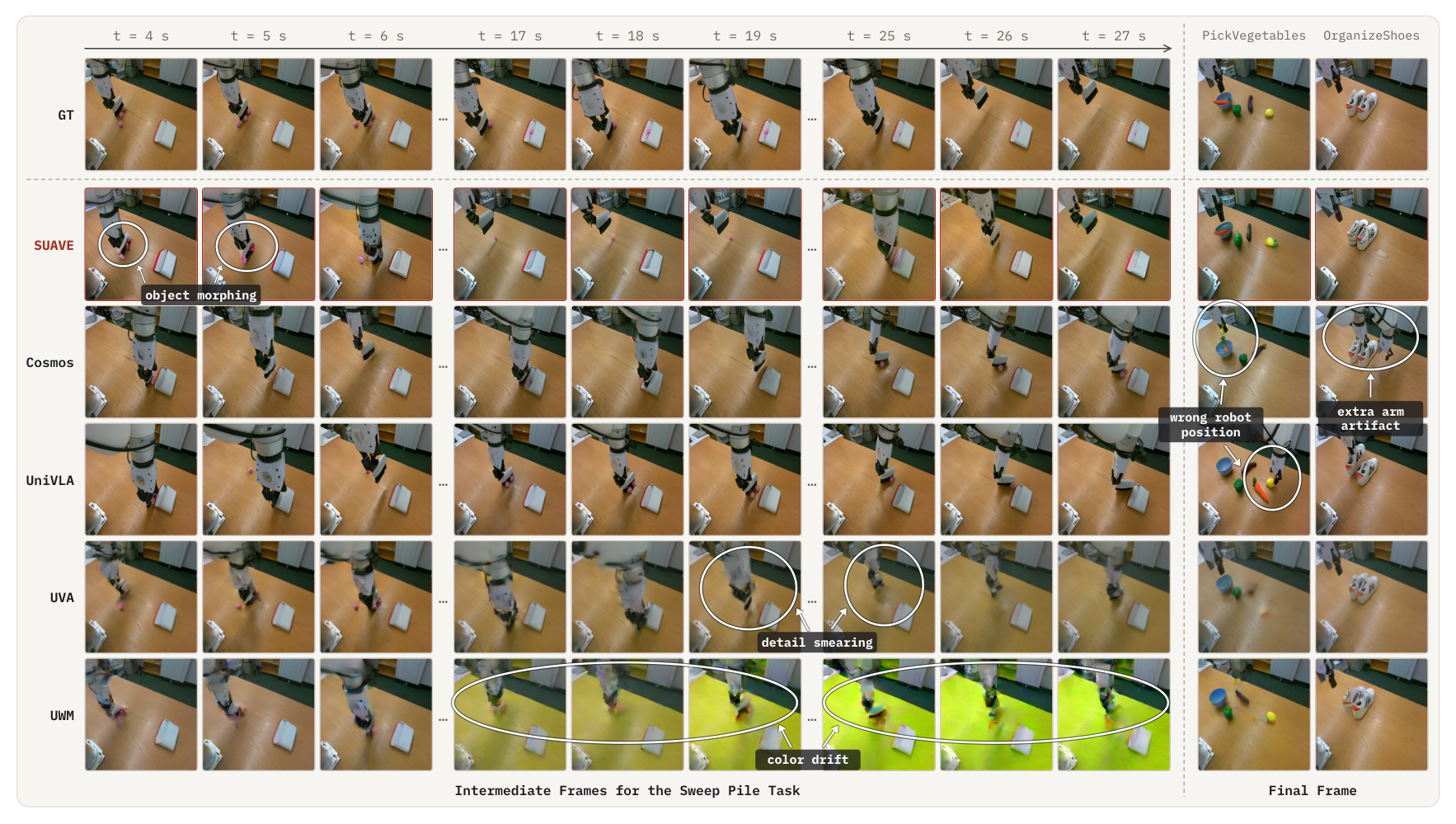
Our experiments investigate three questions. (Q1) Is SUAVE competitive with specialized action policies in various static and dynamic manipulation scenes? (Q2) How does SUAVE’s video prediction compare with dedicated world models trained on the same data?
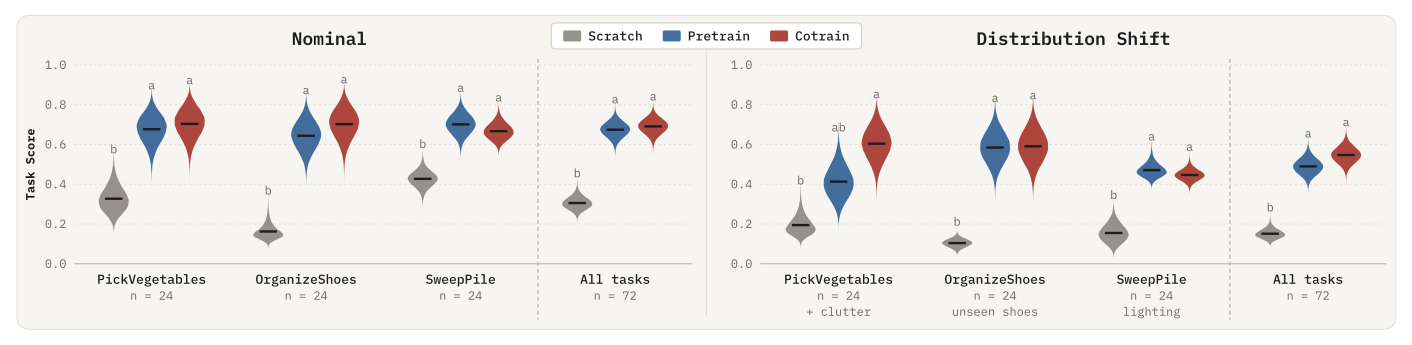
(Q3) What do pretraining on robot video and co-training on action-free human video each contribute in the discrete space formulation under nominal conditions and distribution shift? We evaluate on a 7-DoF xArm7 robot for real tasks and on the LIBERO, LIBERO-Plus, and DOMINO benchmarks for simu...
Sources and Demonstrations
Figures are reproduced from Syed et al. See the full paper for experimental details and the project page, when the paper links one, for demonstrations and videos.
Related Papers
A Phenomenology of Neural Geometry in Vision-Language-Action Models
Mozes Jacobs, Aiden Swann, Mathilde Papillon et al.
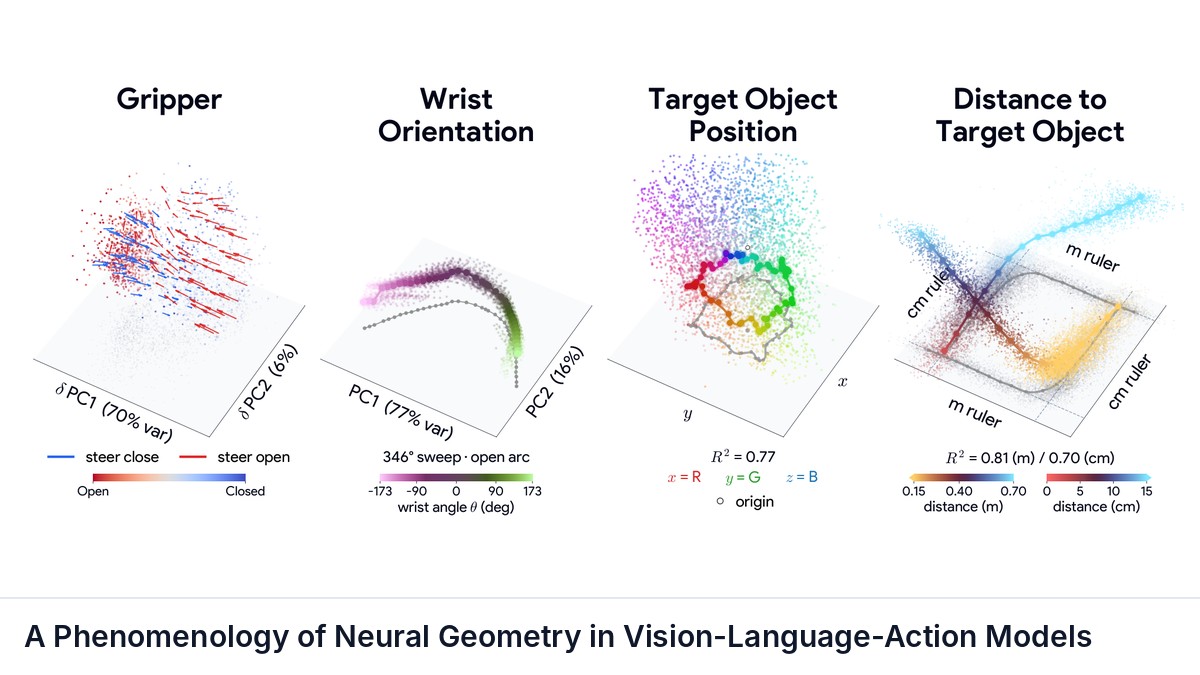
Robotic manipulation is inherently geometric, but what shape does the world take inside the policy that performs it?

A Sim-to-Real Integration Pipeline for Training and Deployment of Chunk-Based VLA Manipulation Policies
Mathilde Kappel, Clémence Grislain, Mohamed Chetouani et al.
Vision-Language-Action (VLA) models have become a prominent paradigm for mapping multimodal inputs, including semantic instructions, visual observations of the scene, and proprioceptive observations, to robot actions.
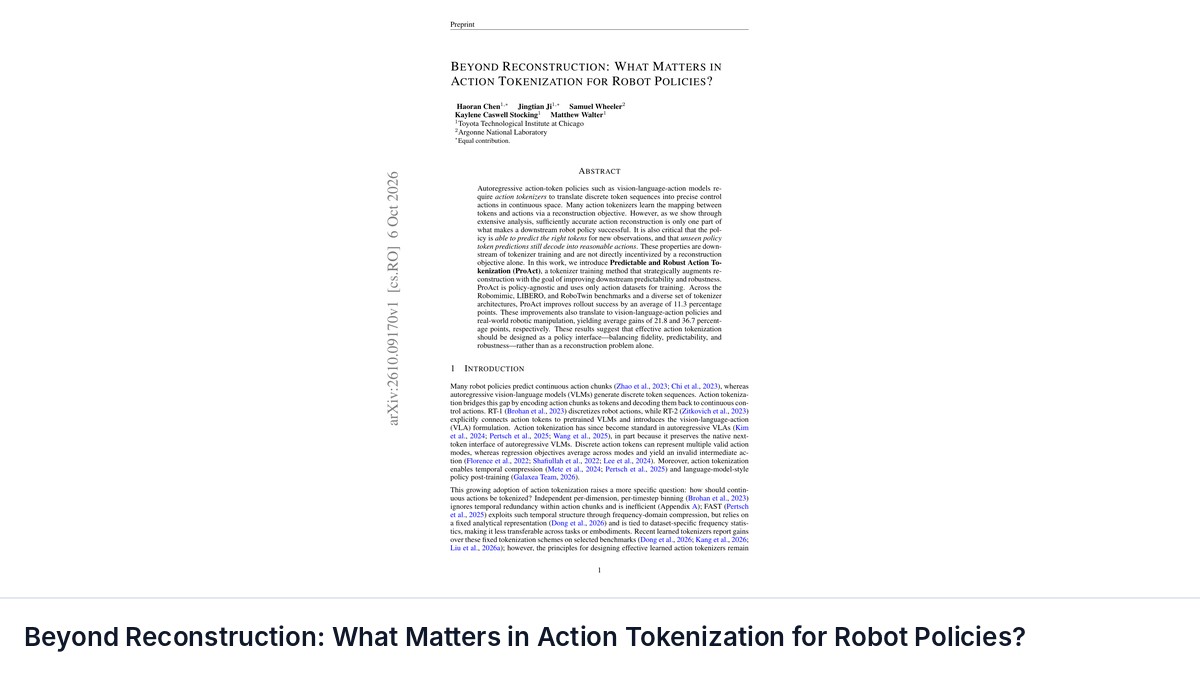
Beyond Reconstruction: What Matters in Action Tokenization for Robot Policies?
Haoran Chen, Jingtian Ji, Samuel Wheeler et al.
Autoregressive action-token policies such as vision-language-action models require action tokenizers to translate discrete token sequences into precise control actions in continuous space. Many action tokenizers learn the mapping between tokens and actions via a reconstruction objective.

Capability-Aware Arbitration for Semantic Intent-Based Shared Control
Zhaoda Du, Michael Bowman, Xiaoli Zhang
Shared control often allocates robot authority based on confidence in inferred human intent, assuming reliable autonomous execution. When this assumption fails, high intent confidence can cause over-helping.