
Embodied Turing Machines: Stateful Code for Robot Recursive Self-Improvement
Kairui Hu, Siyuan Hu, Fangzhou Hong, Zhaoxi Chen, Ziwei Liu · N/A · 2026
Framework
N/A
License
N/A
Stars
N/A
Summary
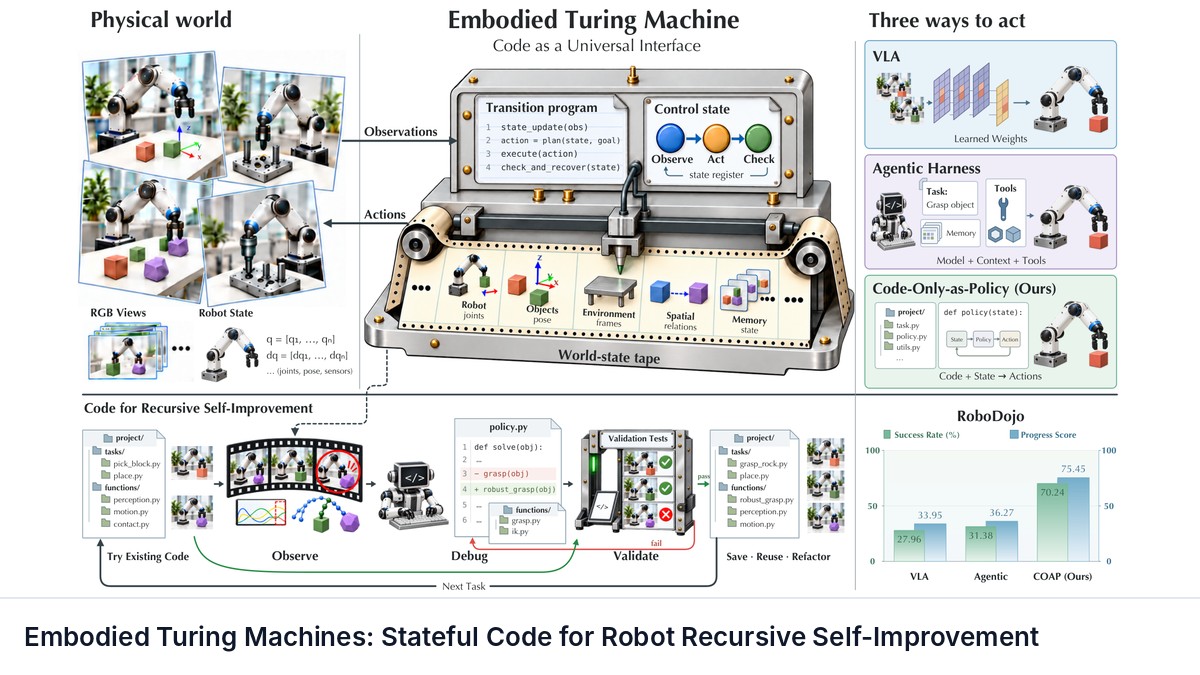
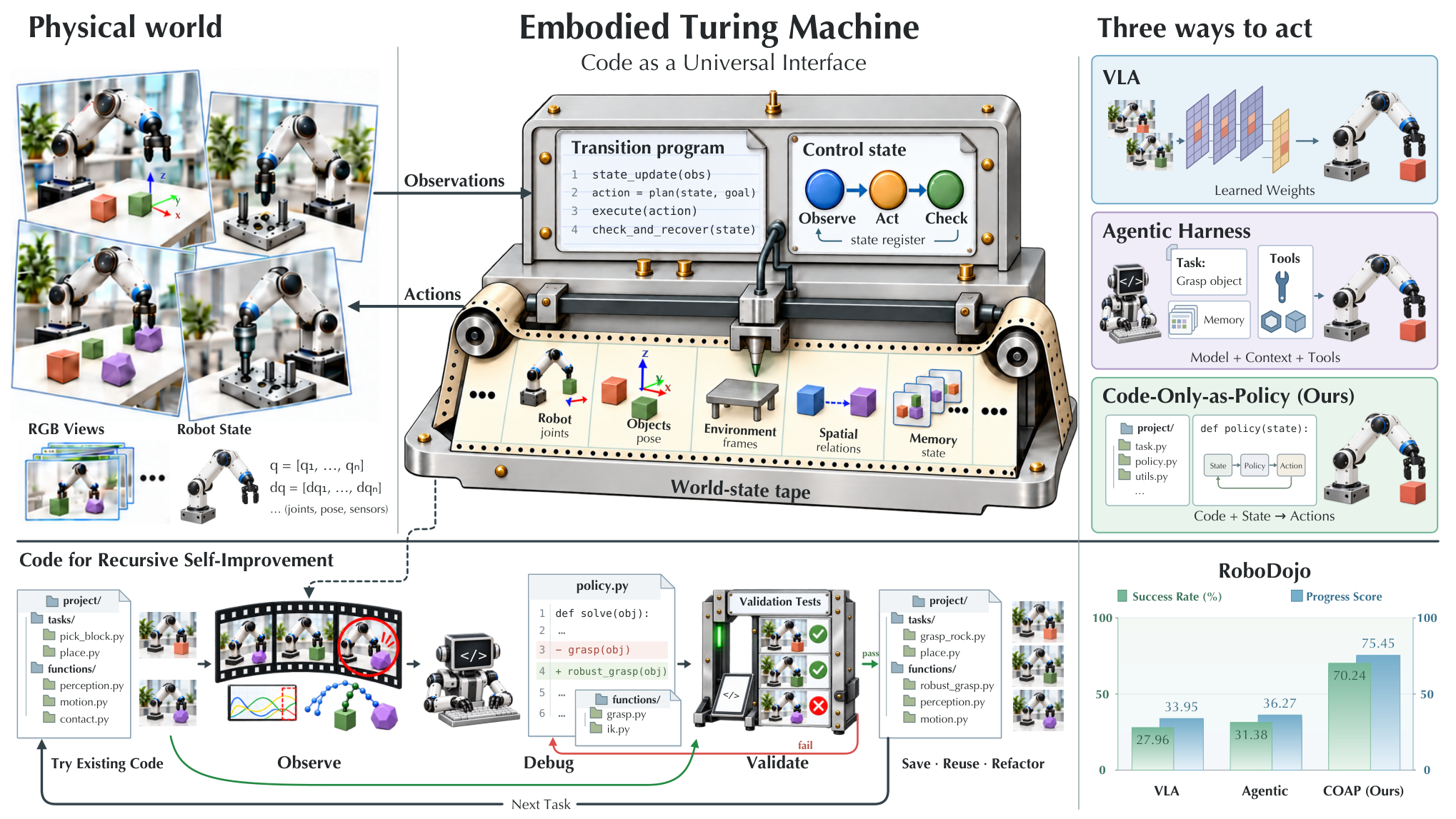
Most robot policies keep a model in the control loop: a VLA maps observations to actions, and an Agent Harness, such as Agent-as-Policy or Harness VLA queries a VLM for decision making at run time.
Abstract Summary
Key Points
- Most robot policies keep a model in the control loop: a VLA maps observations to actions, and an Agent Harness, such as Agent-as-Policy or Harness VLA queries a VLM for decision making at run time.
- We propose a different view: the embodied world is an Embodied Turing Machine, whose tape is the robot and environment state and rules are the policy.
- If this state can be represented accurately, the decision making can be written entirely in code
- We therefore propose Code-Only-as-Policy (COAP): code measures and tracks the robot, environment, and task state from camera images and proprioception, and makes every decision from it.
- The same code applies across episodes, and different tasks share one library without a VLM or VLA in the loop.
Embodied Turing Machine: Code-Only-as-Policy
Code-Only-as-Policy implements the Embodied Turing Machine (§ 1 ) as a shared code library, in which code variables hold the state and the source code constitutes the rules. Beyond storing the state, the perception code measures the environment from camera images, and the code updates these measurements as the robot acts. The code is frozen at runtime and improved offline by coding agents (Figure 3 ).
Experiments
This section answers three questions: (1) How well does Code-Only-as-Policy (COAP) perform on a hard benchmark (§ 4.1 –§ 4.2 )? (2) What does COAP offer that a VLA or an Agent Harness lacks (§ 4.3 )? (3) Why does COAP suit RSI (§ 4.4 )? RoboDojo [ 7 ] contains 42 bimanual tasks that span five dimensions: Memory, Precision, Open instruction following, Generalization, and Long-Horizon manipulation.
Sources and Demonstrations
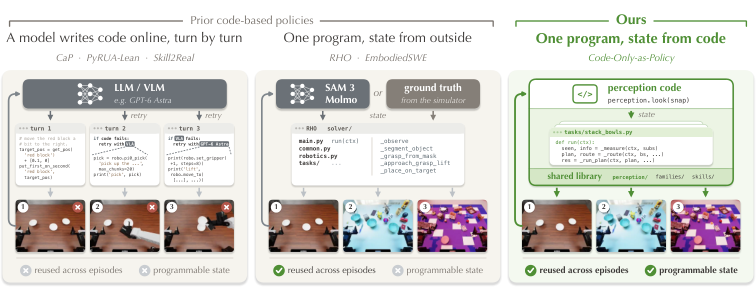
Figures are reproduced from Hu et al. See the full paper for experimental details and the project page, when the paper links one, for demonstrations and videos.
Related Papers
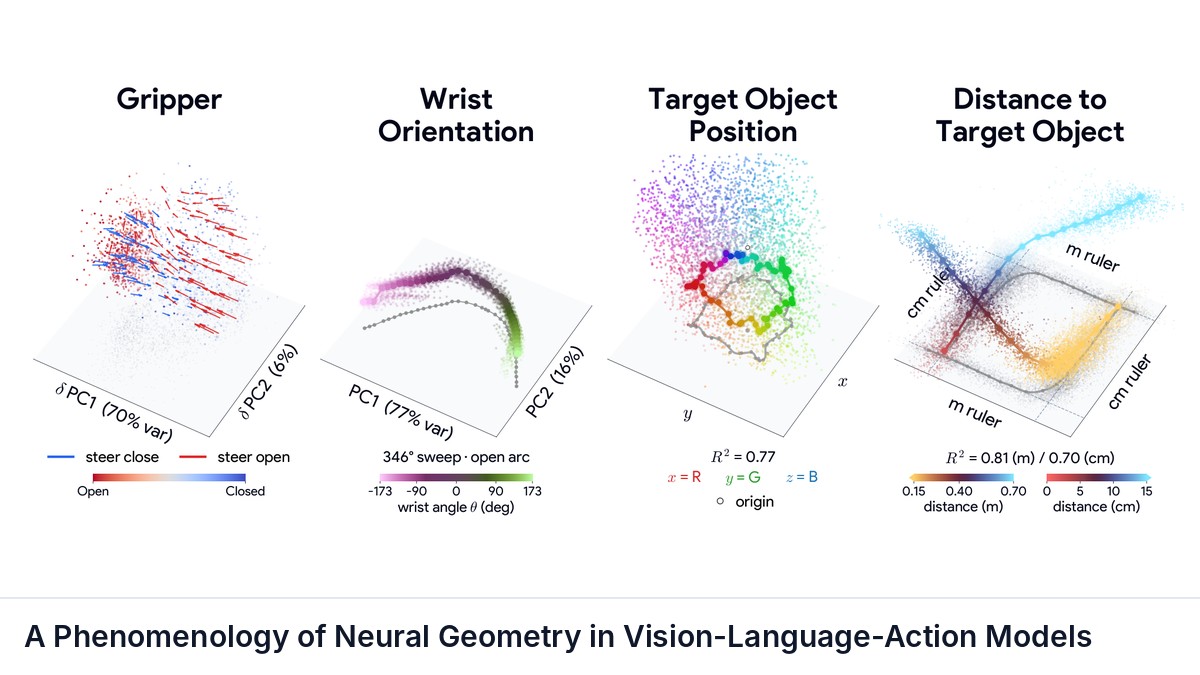
A Phenomenology of Neural Geometry in Vision-Language-Action Models
Mozes Jacobs, Aiden Swann, Mathilde Papillon et al.
Robotic manipulation is inherently geometric, but what shape does the world take inside the policy that performs it?

A Sim-to-Real Integration Pipeline for Training and Deployment of Chunk-Based VLA Manipulation Policies
Mathilde Kappel, Clémence Grislain, Mohamed Chetouani et al.
Vision-Language-Action (VLA) models have become a prominent paradigm for mapping multimodal inputs, including semantic instructions, visual observations of the scene, and proprioceptive observations, to robot actions.
Beyond Reconstruction: What Matters in Action Tokenization for Robot Policies?
Haoran Chen, Jingtian Ji, Samuel Wheeler et al.
Autoregressive action-token policies such as vision-language-action models require action tokenizers to translate discrete token sequences into precise control actions in continuous space. Many action tokenizers learn the mapping between tokens and actions via a reconstruction objective.

Capability-Aware Arbitration for Semantic Intent-Based Shared Control
Zhaoda Du, Michael Bowman, Xiaoli Zhang
Shared control often allocates robot authority based on confidence in inferred human intent, assuming reliable autonomous execution. When this assumption fails, high intent confidence can cause over-helping.