
SocialVLA: A Social Perception Gateway for Human-Reaction-Based Failure Detection and Recovery in VLA Manipulation
Sofya Konstantinova, Miguel Altamirano Cabrera, Artem Lykov, Dzmitry Tsetserukou · N/A · 2026
Framework
N/A
License
N/A
Stars
N/A
Summary
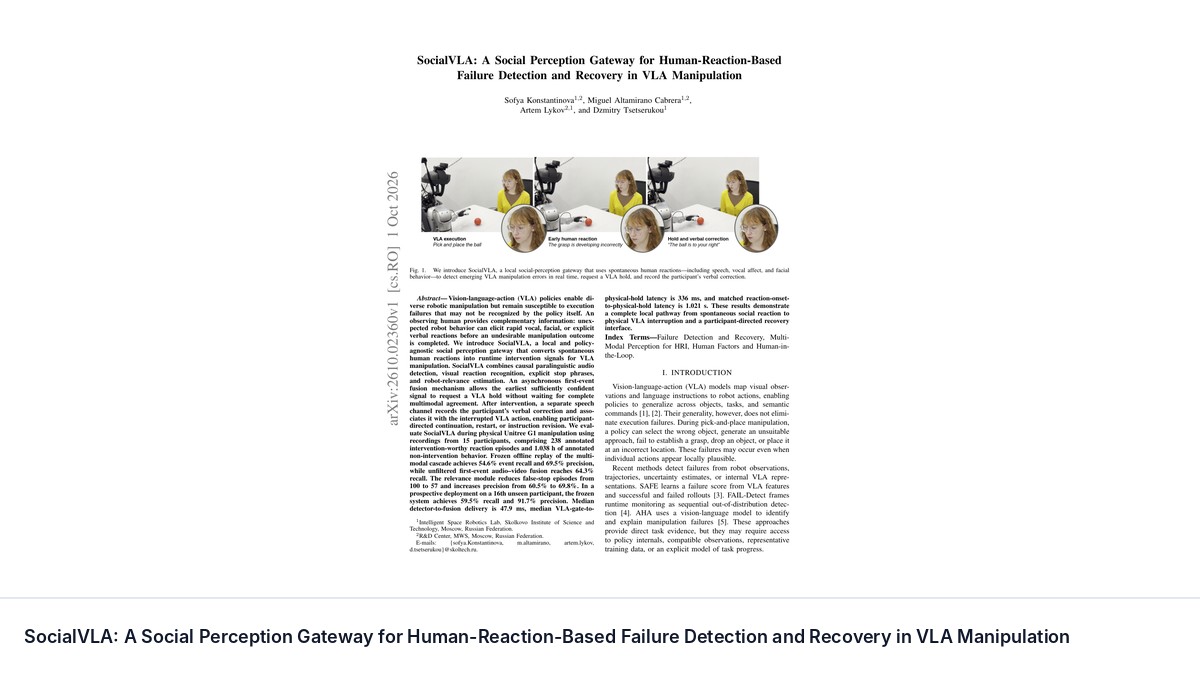
Vision-language-action (VLA) policies enable diverse robotic manipulation but can fail during execution without recognizing their own errors. Human observers provide complementary signals, as unexpected robot behavior can trigger rapid vocal, facial, or verbal reactions before failure is completed.
Abstract Summary
Key Points
- Vision-language-action (VLA) policies enable diverse robotic manipulation but can fail during execution without recognizing their own errors.
- Human observers provide complementary signals, as unexpected robot behavior can trigger rapid vocal, facial, or verbal reactions before failure is completed.
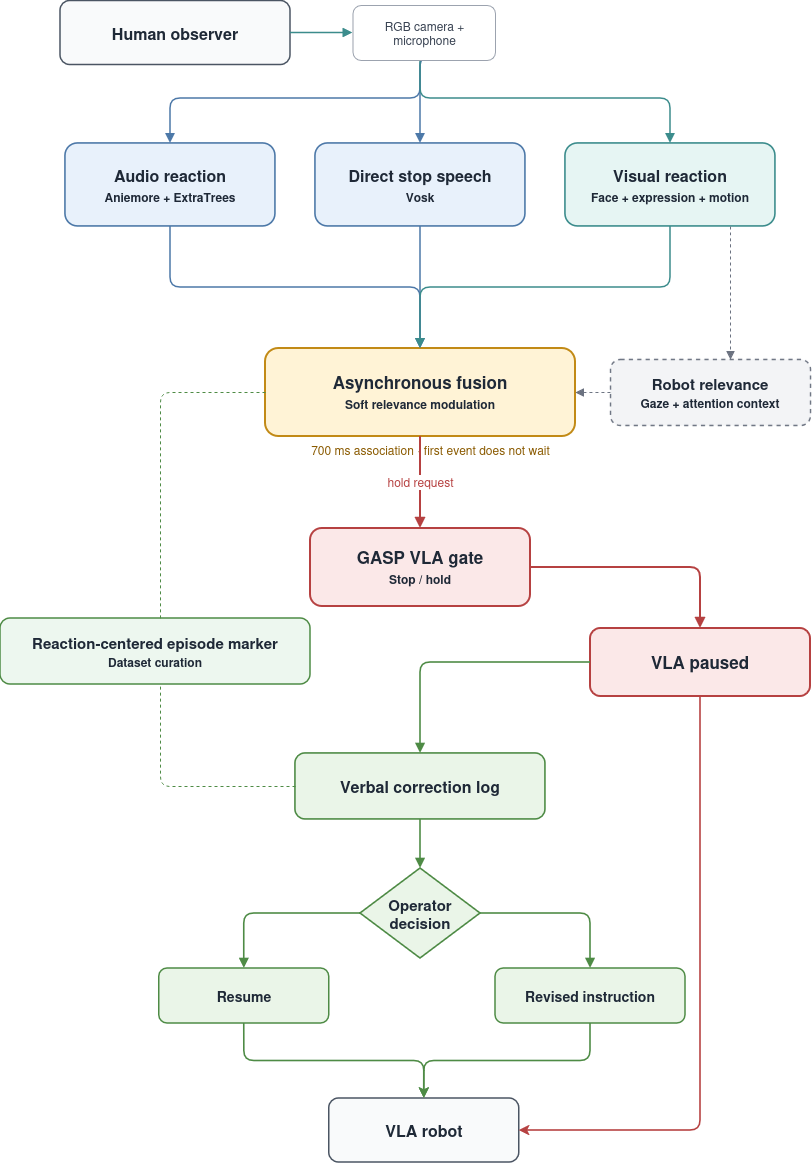
- We introduce SocialVLA, a local, policy-agnostic social perception gateway that converts spontaneous human reactions into runtime intervention signals for VLA manipulation.
- SocialVLA combines causal paralinguistic audio detection, visual reaction recognition, explicit stop phrases, and robot-relevance estimation.
- An asynchronous first-event fusion mechanism triggers a VLA hold from the earliest sufficiently confident signal, while a separate speech channel captures verbal corrections for participant-directed continuation, restart, or instruction revision.
SYSTEM ARCHITECTURE
Let $x_{a}(t)$ and $x_{v}(t)$ denote participant-facing audio and video streams. A detector produces: where $m_{i}$ is the modality, $c_{i}$ the event class, $s_{i}$ the score, $[t_{i}^{0},t_{i}^{1}]$ the source interval supporting the decision, and $t_{i}^{e}$ the publication time. The system distinguishes fast reaction events, extended-context reaction events, and direct lexical events.
Attention-target estimates are diagnostic; only the binary robot-relevance probability enters the candidate fusion rule. Audio is recorded at 16 kHz in mono.
EXPERIMENTAL METHODOLOGY
Experiments use a physical Unitree G1 humanoid controlled by GR00T-WholeBodyControl and a GR00T policy trained for a pick-and-place task. The robot must grasp a ball and place it in a specified target region. Participants observed both successful executions and naturally occurring VLA failures. Failure occurrence was not announced, and participants were not instructed to produce specific reactions.
The prediction target in this study is the observer’s intervention-worthy response rather than a predefined taxonomy of physical failure modes.
EVALUATION RESULTS
Table I reports the complete frozen multimodal cascade replayed over all annotated sessions. The evaluation contains 238 manually annotated robot-related intervention episodes and 1.038 h of explicitly annotated non-intervention or robot-unrelated behavior. All audio, video, relevance, lexical, and temporal-fusion components use the deployed weights, thresholds, and 700-ms cross-modal association window.
The complete cascade detects 130 of 238 intervention episodes, corresponding to 54.6% event recall and 69.5% precision.
Sources and Demonstrations
Figures are reproduced from Konstantinova et al. See the full paper for experimental details and the project page, when the paper links one, for demonstrations and videos.
Related Papers
A Phenomenology of Neural Geometry in Vision-Language-Action Models
Mozes Jacobs, Aiden Swann, Mathilde Papillon et al.
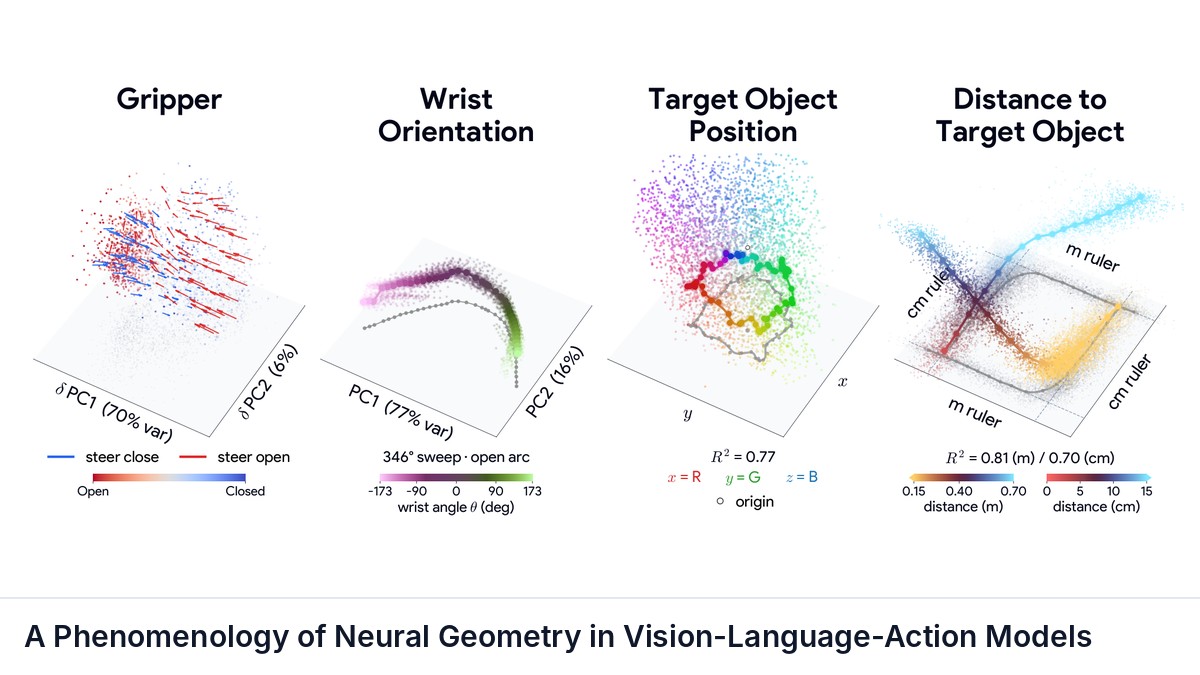
Robotic manipulation is inherently geometric, but what shape does the world take inside the policy that performs it?

A Sim-to-Real Integration Pipeline for Training and Deployment of Chunk-Based VLA Manipulation Policies
Mathilde Kappel, Clémence Grislain, Mohamed Chetouani et al.
Vision-Language-Action (VLA) models have become a prominent paradigm for mapping multimodal inputs, including semantic instructions, visual observations of the scene, and proprioceptive observations, to robot actions.
Beyond Reconstruction: What Matters in Action Tokenization for Robot Policies?
Haoran Chen, Jingtian Ji, Samuel Wheeler et al.
Autoregressive action-token policies such as vision-language-action models require action tokenizers to translate discrete token sequences into precise control actions in continuous space. Many action tokenizers learn the mapping between tokens and actions via a reconstruction objective.
Capability-Aware Arbitration for Semantic Intent-Based Shared Control
Zhaoda Du, Michael Bowman, Xiaoli Zhang
Shared control often allocates robot authority based on confidence in inferred human intent, assuming reliable autonomous execution. When this assumption fails, high intent confidence can cause over-helping.