
VersaCamVLA: Camera-Configurable VLA Policies for Robotic Manipulation
Boyao Han, Chen Shi, Jingjing Qian, ZhuoTan Tian, Li Jiang · N/A · 2026
Framework
N/A
License
N/A
Stars
N/A
Summary
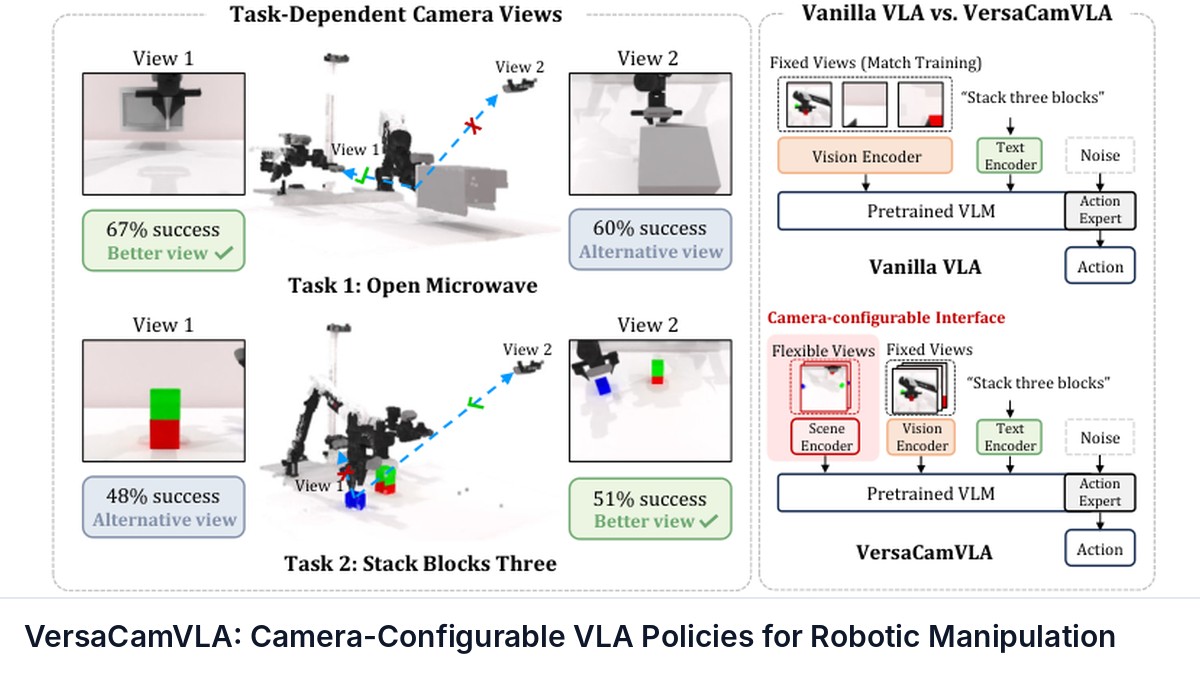
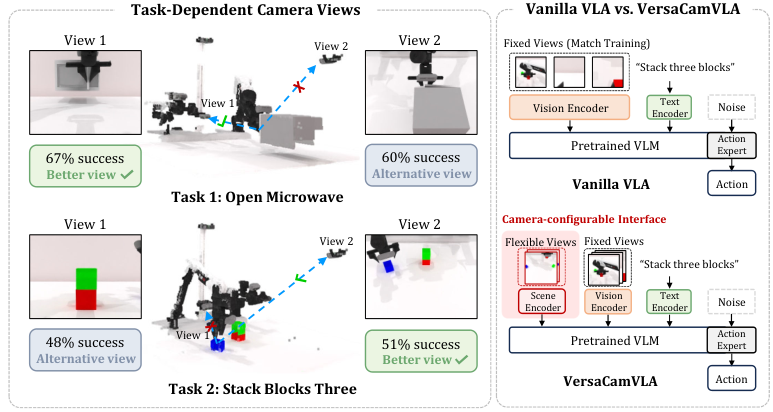
Vision-Language-Action (VLA) models have emerged as powerful foundations for robotic manipulation, but their reliance on fixed camera configurations during training makes them brittle to changes in camera count or pose during deployment.
Abstract Summary
Key Points
- Vision-Language-Action (VLA) models have emerged as powerful foundations for robotic manipulation, but their reliance on fixed camera configurations during training makes them brittle to changes in camera count or pose during deployment.
- To overcome these limitations, we propose VersaCamVLA, a camera-configurable framework that decouples camera-set representation from action learning.
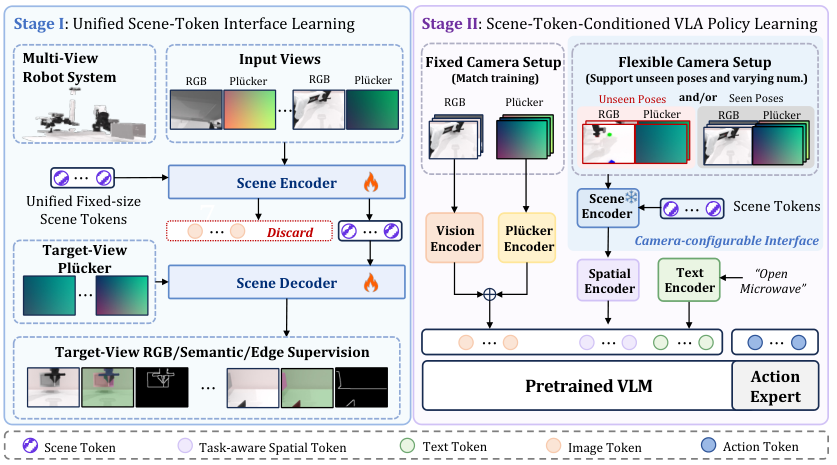
- VersaCamVLA learns a unified scene-token interface that maps an arbitrary, variable set of posed RGB views into fixed-size latent scene tokens.
- This is achieved via multi-signal target-view prediction and Wrist-Augmented Pose Sampling (WAPS), which leverages natural wrist-camera motion for free pose diversity.
- At deployment, a lightweight spatial encoder injects these compact scene tokens into a pretrained base VLA as a supplementary visual condition, requiring no explicit 3D sensing or novel-view rendering.
Methodology
We present VersaCamVLA , a camera-configurable VLA framework that decouples camera-set representation learning from action learning, as illustrated in Fig. 2 . In Stage I, VersaCamVLA learns a unified scene-token interface between raw observations and the policy.
A scene encoder maps any non-empty set of posed RGB views to fixed-size latent scene tokens, supervised by target-view prediction, which encourages the scene tokens to preserve view-consistent spatial information across camera poses.
Experiments
Simulation Setup. We evaluate on two standard robotic manipulation benchmarks, RoboTwin 2.0 [ 24 ] for bimanual manipulation under canonical ( Clean ) and domain-randomized ( DR ) settings, and LIBERO [ 25 ] for single-arm manipulation across four suites. Embodiments, task selection, demonstration counts, and training protocols are described in Appendix A . Camera-Configuration Setup.
Beyond the official benchmark settings, we design additional evaluations to test robustness to changing camera configurations. Camera-Pose Perturbation.
Sources and Demonstrations
Figures are reproduced from Han et al. See the full paper for experimental details and the project page, when the paper links one, for demonstrations and videos.
Related Papers
3DThinkVLA: Endowing Vision-Language-Action Models with Latent 3D Priors via 3D-Thinking-Guided Co-training
Jiaxin Shi, Xidong Zhang, Fucai Zhu et al.
We propose a 3D-thinking-guided co-training framework that enables vision-language-action (VLA) models to perform 3D spatial reasoning implicitly during action prediction.
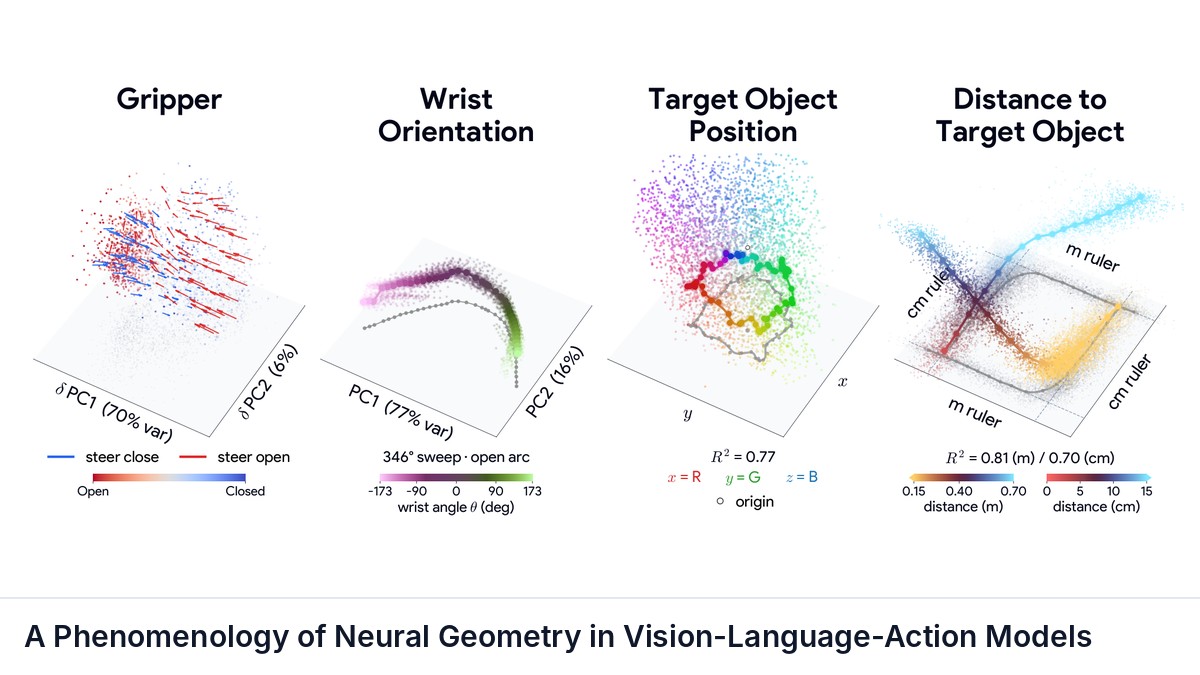
A Phenomenology of Neural Geometry in Vision-Language-Action Models
Mozes Jacobs, Aiden Swann, Mathilde Papillon et al.
Robotic manipulation is inherently geometric, but what shape does the world take inside the policy that performs it?

A Sim-to-Real Integration Pipeline for Training and Deployment of Chunk-Based VLA Manipulation Policies
Mathilde Kappel, Clémence Grislain, Mohamed Chetouani et al.
Vision-Language-Action (VLA) models have become a prominent paradigm for mapping multimodal inputs, including semantic instructions, visual observations of the scene, and proprioceptive observations, to robot actions.
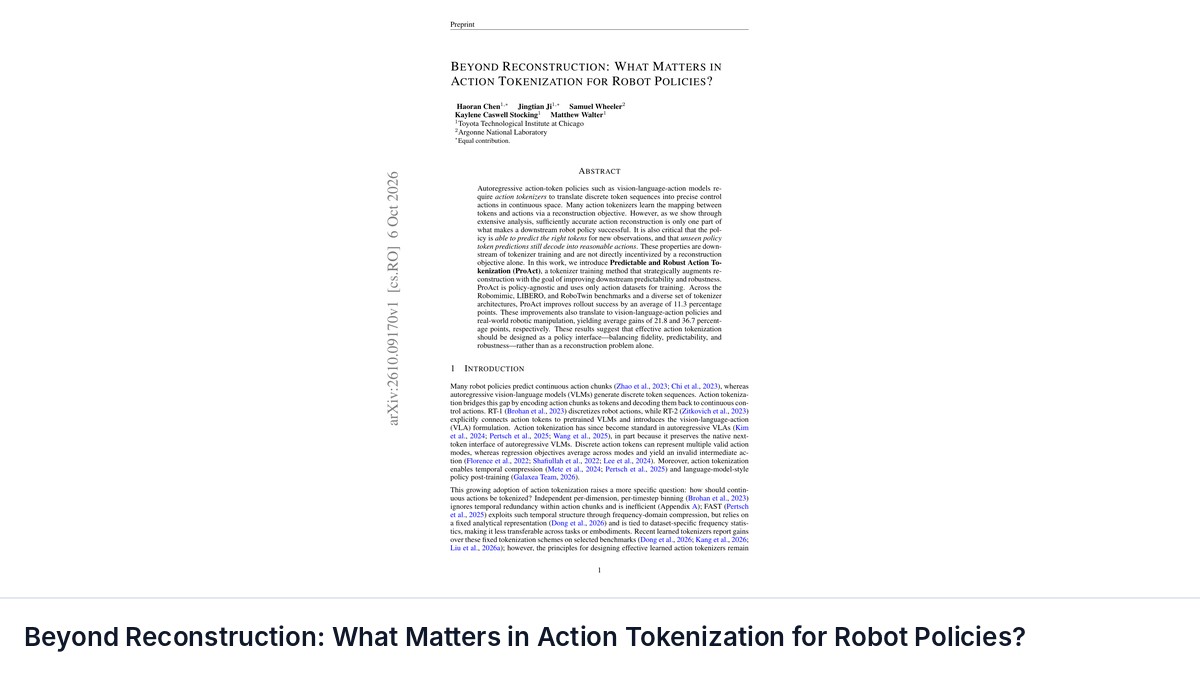
Beyond Reconstruction: What Matters in Action Tokenization for Robot Policies?
Haoran Chen, Jingtian Ji, Samuel Wheeler et al.
Autoregressive action-token policies such as vision-language-action models require action tokenizers to translate discrete token sequences into precise control actions in continuous space. Many action tokenizers learn the mapping between tokens and actions via a reconstruction objective.