
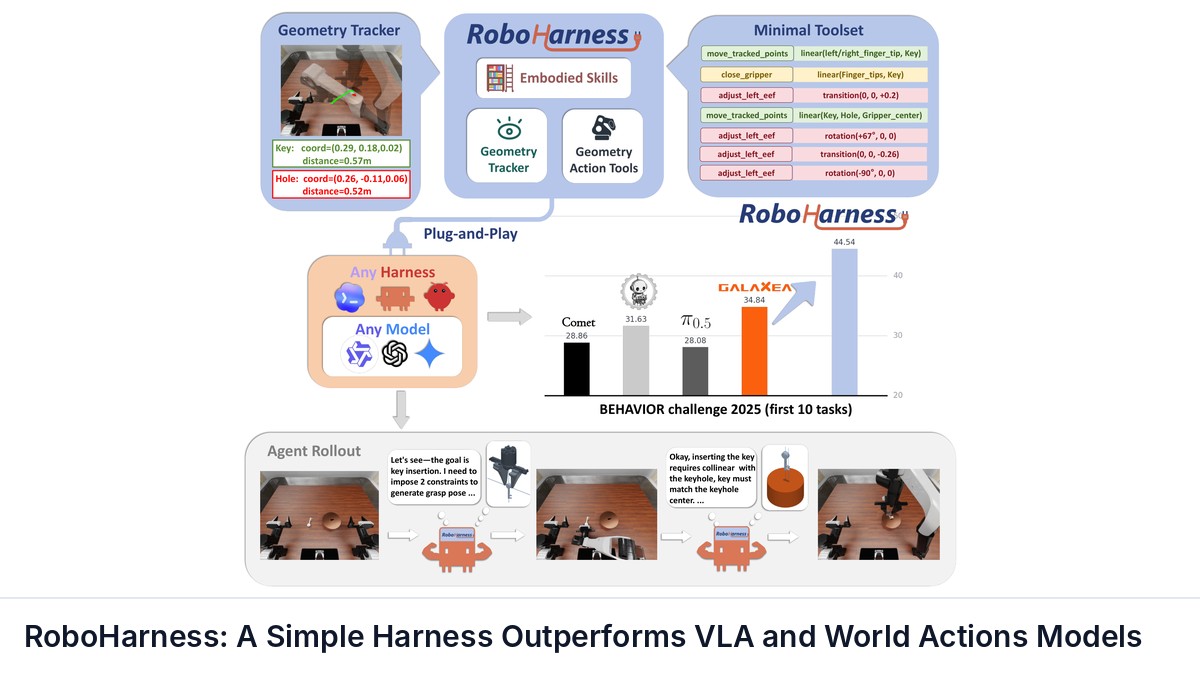
RoboHarness: A Simple Harness Outperforms VLA and World Actions Models
Bince Qu, Wei Chen, Bo Zhang · N/A · 2026
Framework
N/A
License
N/A
Stars
N/A
Summary
The rise of large language models (LLMs) has opened a path toward generalist embodied AI, raising the question of how LLMs can act in the physical world.
Abstract Summary
Key Points
- The rise of large language models (LLMs) has opened a path toward generalist embodied AI, raising the question of how LLMs can act in the physical world.
- One straightforward approach is training the model to generate actions: collect robot-action data and video demonstration, refine LLM architecture with an action head, and train a vision-language-action (VLA) model at scale.
- However, we argue that coding agents have the potential to realize generalist embodied manipulation
- All they need is a simple yet effective robot harness
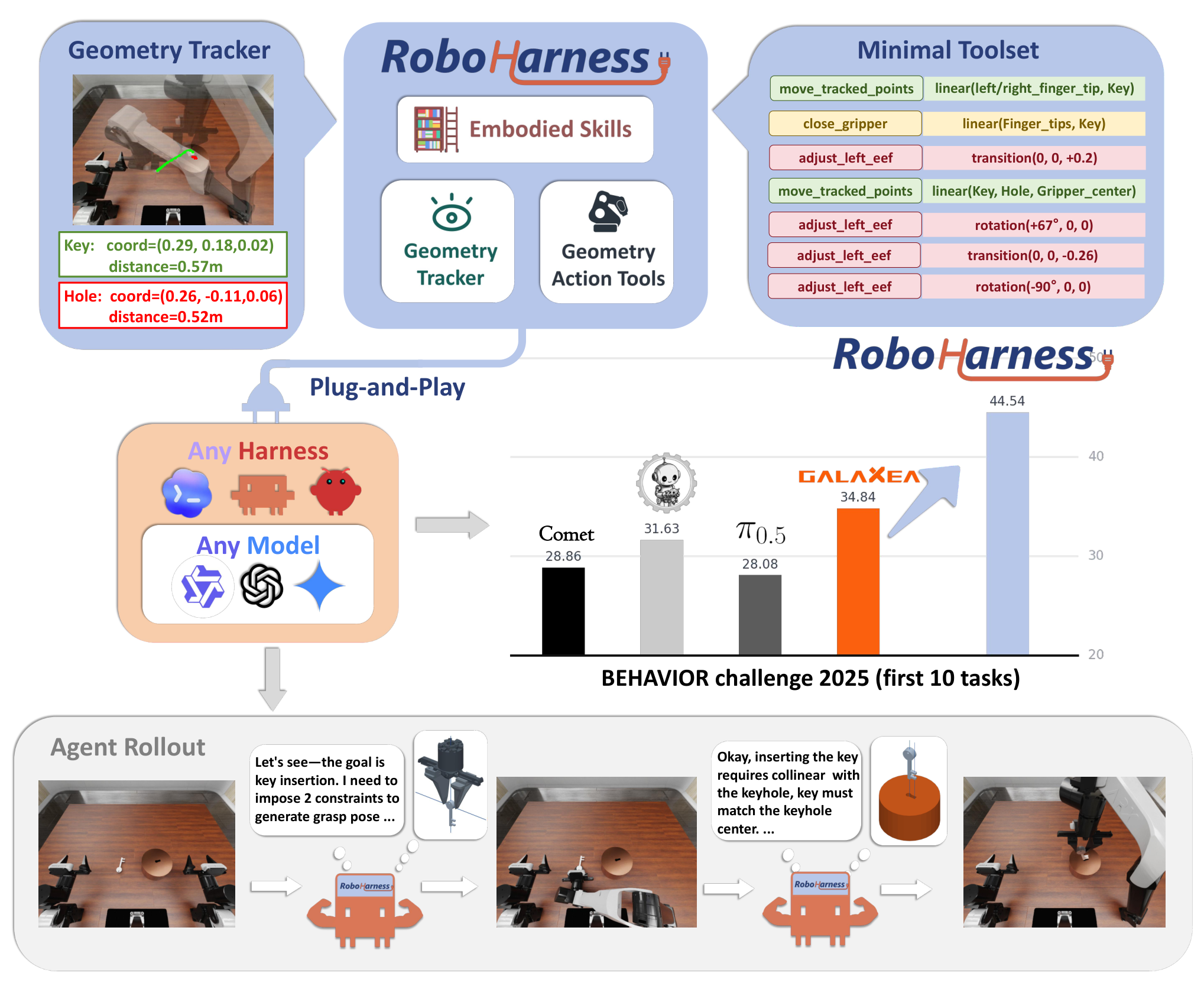
- We present RoboHarness: a robotic harness that gives LLM agents a visual-geometric control panel so that they can directly understand and invoke embodied tasks.
Method
Lessons from coding agents show that: a minimal set of simple, orthogonal primitive tools outperforms a collection of predefined features and heavy scaffolding. Inspired by this principle, we argue that an LLM’s potential on embodied tasks is best unlocked by giving it the minimal primitive action tools rather than layers of engineered features.
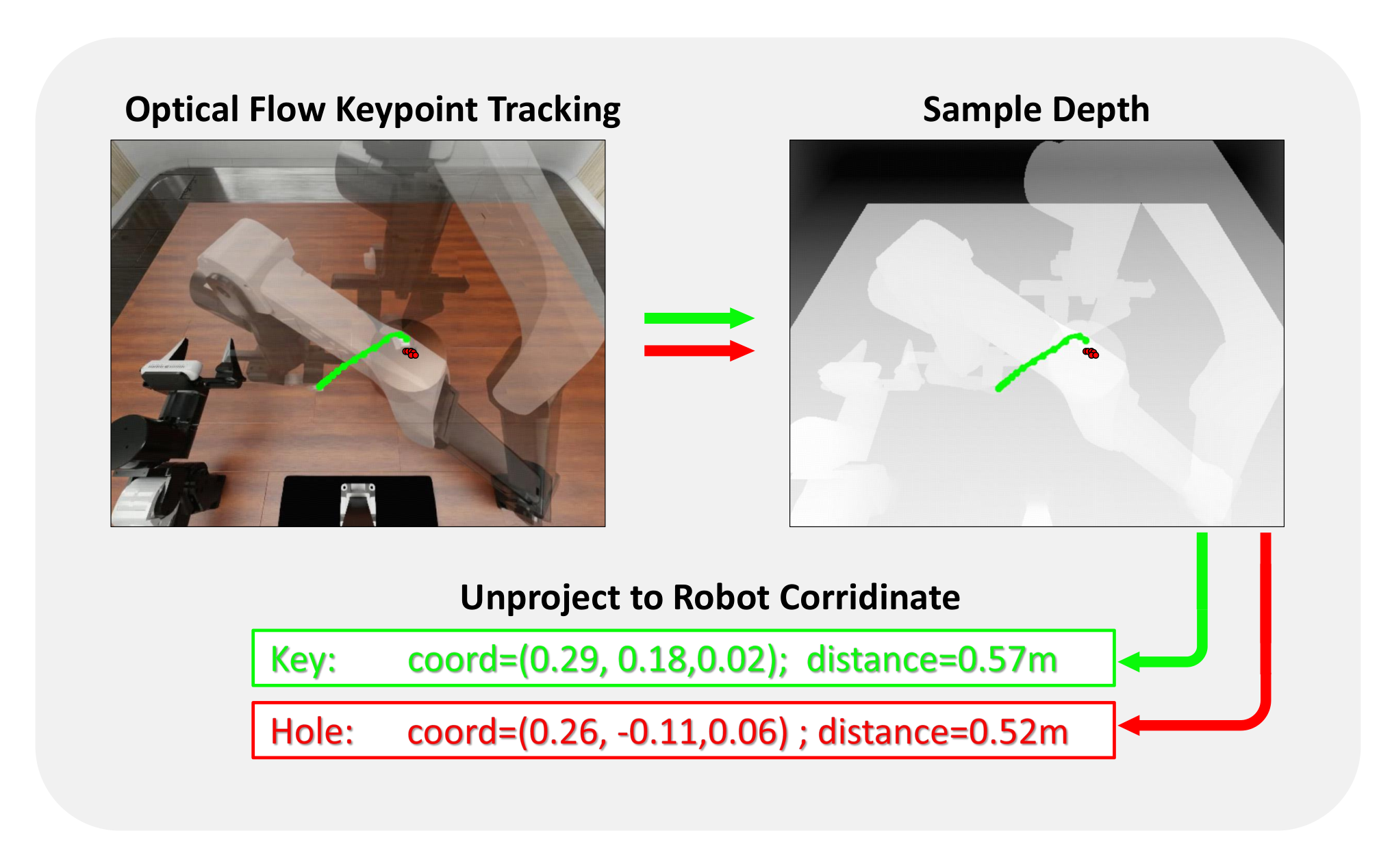
We start from studying spatial relations between a gripper and objects it interacts with, therefore constructing the most elementary primitive action tools.
Proof: Completeness of the Keypoint-Constraint Representation
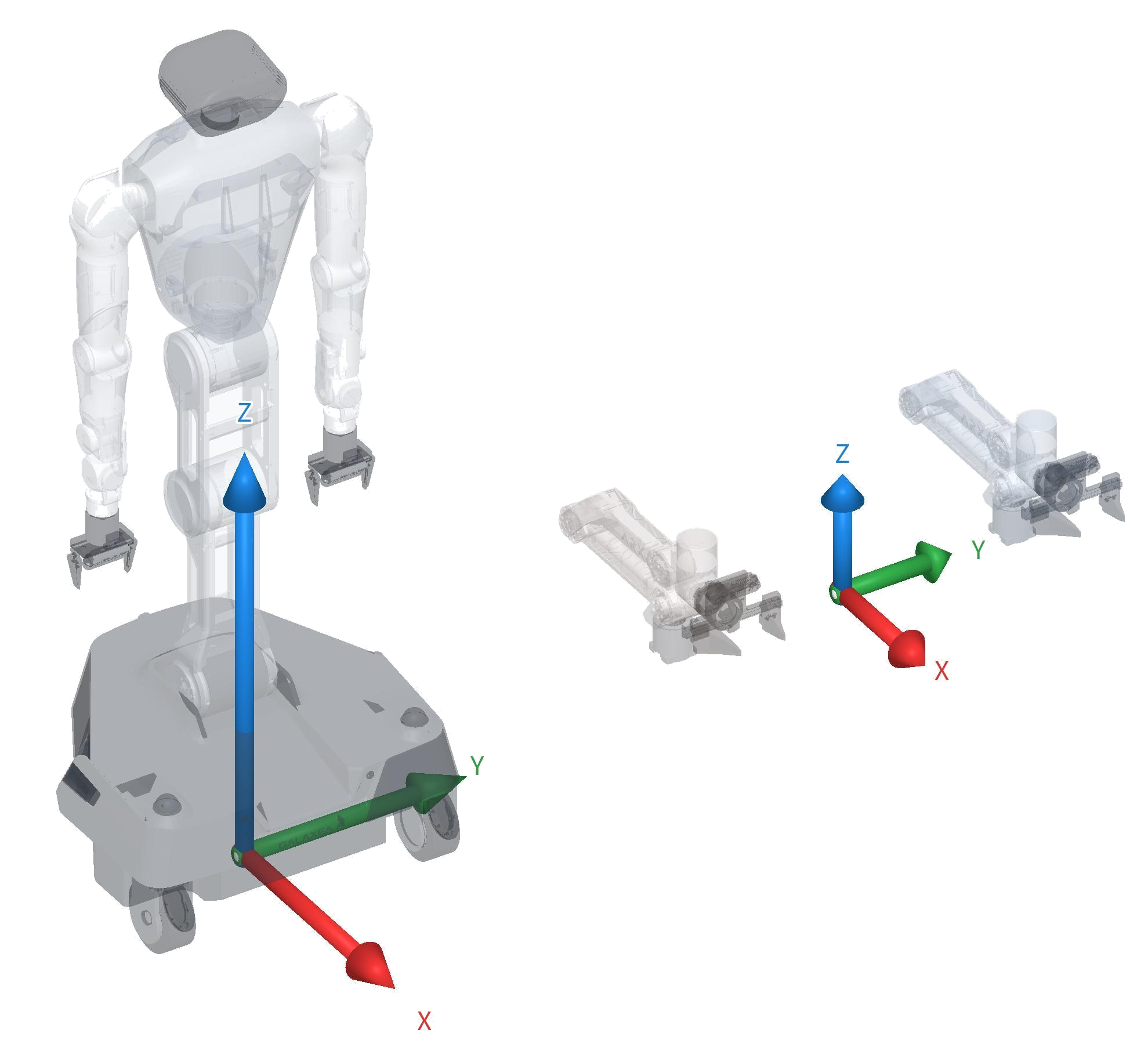
The three points on the robot gripper, namely the left fingertip, right fingertip, and gripper center, are intrinsic points that remain tracked throughout execution (Figure 4.1 ). The following results show that constraining their geometric relationships can represent arbitrary motion trajectories and interaction poses.
The elementary correspondence between a contact pose and a keypoint triple is given in Section 4.1 .
Experiments
We compare against state-of-the-art VLAs such as Galaxea G0.5 and $\pi_{0.5}$, evaluating both success rate and subgoal completion rate ( Liu et al., 2026 ; Black et al., 2025a ) . We additionally include the first- and second-place winners of the BEHAVIOR Challenge 2025 (RLC and Comet, respectively) ( Larchenko et al., 2025 ; Bai et al., 2025 ) , whose $q$-scores are reported on the official leaderboard.
The RoboHarness column is Qwen3.8-Flash-Next. Each entry is the mean $q$-score over five instances per task.
Sources and Demonstrations
Figures are reproduced from Qu et al. See the full paper for experimental details and the project page, when the paper links one, for demonstrations and videos.
Related Papers

A Sim-to-Real Integration Pipeline for Training and Deployment of Chunk-Based VLA Manipulation Policies
Mathilde Kappel, Clémence Grislain, Mohamed Chetouani et al.
Vision-Language-Action (VLA) models have become a prominent paradigm for mapping multimodal inputs, including semantic instructions, visual observations of the scene, and proprioceptive observations, to robot actions.

Capability-Aware Arbitration for Semantic Intent-Based Shared Control
Zhaoda Du, Michael Bowman, Xiaoli Zhang
Shared control often allocates robot authority based on confidence in inferred human intent, assuming reliable autonomous execution. When this assumption fails, high intent confidence can cause over-helping.
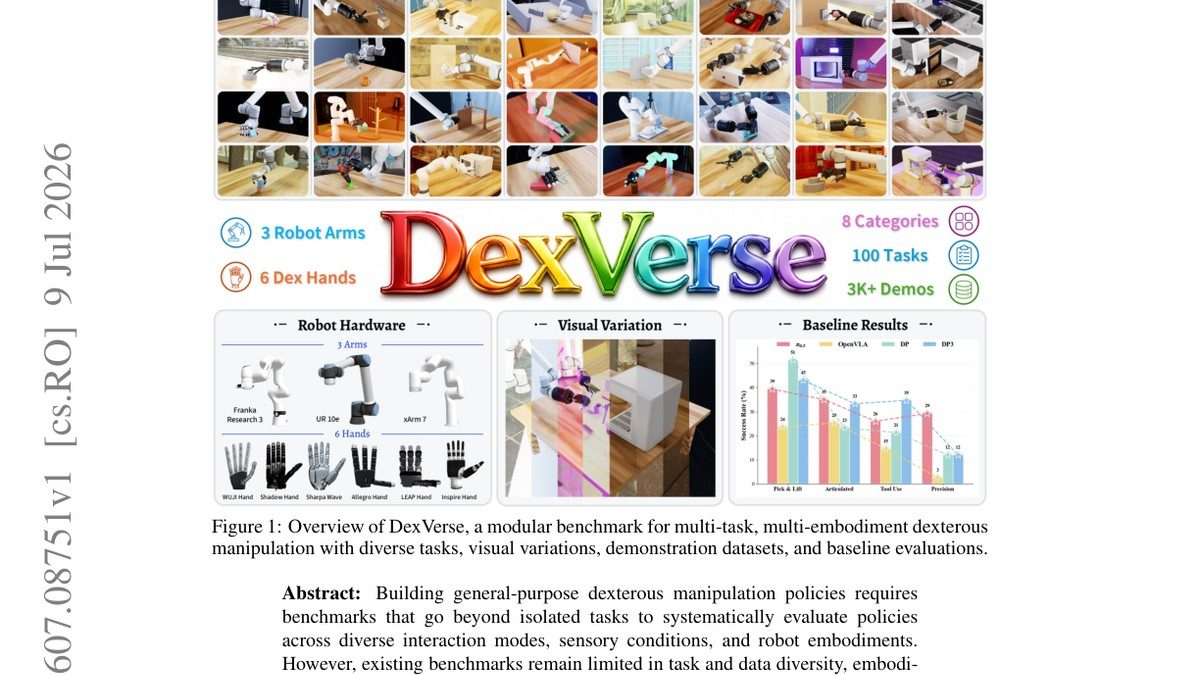
DexVerse: A Modular Benchmark for Multi-Task, Multi-Embodiment Dexterous Manipulation
Yunchao Yao, Zhuxiu Xu, Tianqi Zhang et al.
Building general-purpose dexterous manipulation policies requires benchmarks that go beyond isolated tasks to systematically evaluate policies across diverse interaction modes, sensory conditions, and robot embodiments.
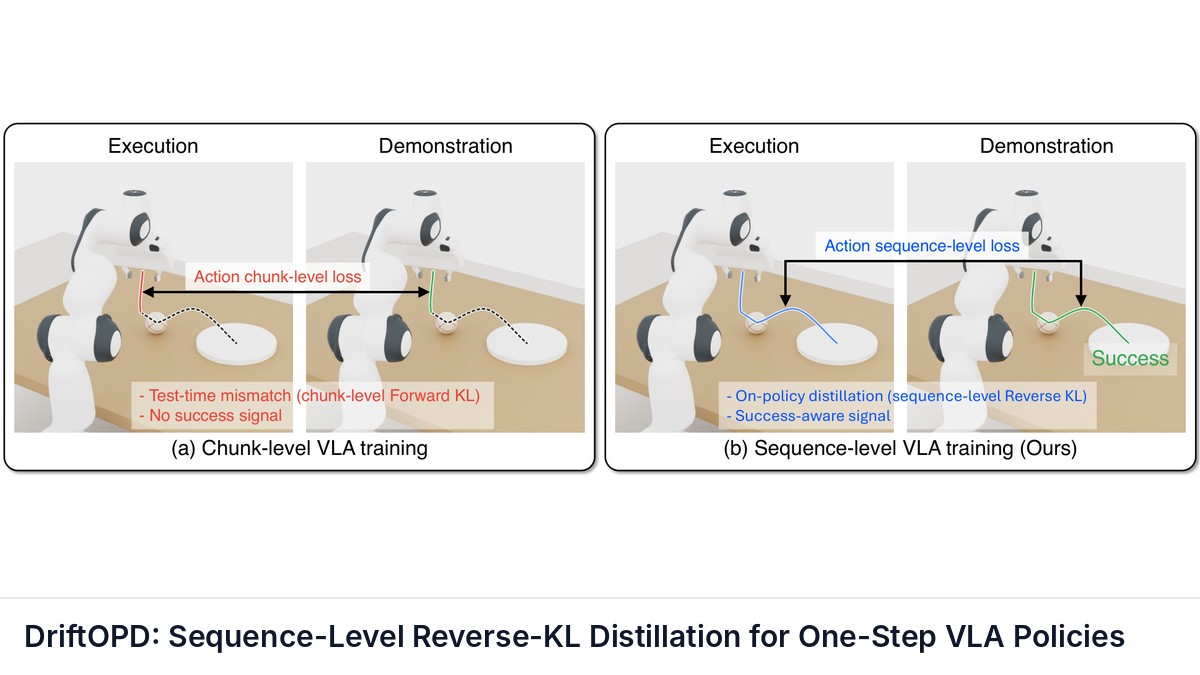
DriftOPD: Sequence-Level Reverse-KL Distillation for One-Step VLA Policies
Youngjun Jun, Kyumin Choi, Youngmin Kim et al.
Vision-Language-Action (VLA) models increasingly rely on action experts that generate short action chunks under receding-horizon control.