
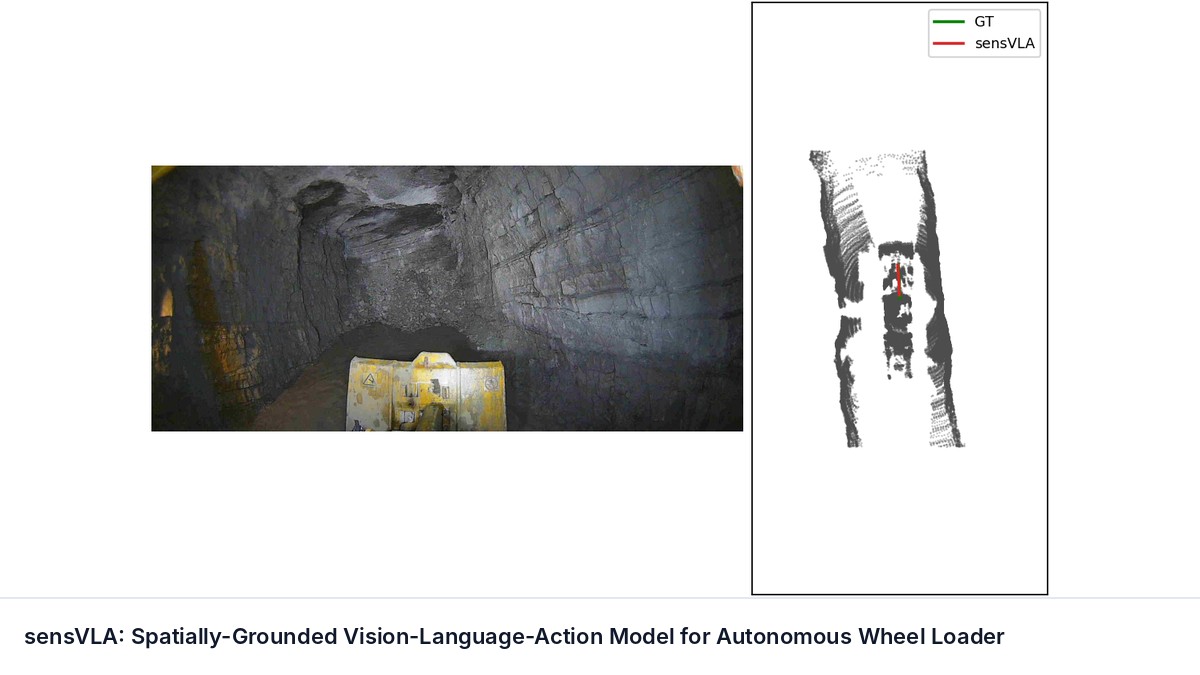
sensVLA: Spatially-Grounded Vision-Language-Action Model for Autonomous Wheel Loader
Gopi Krishna Erabati, Bjarne Johannsen, Angus Stewart, Vardeep Singh Sandhu · N/A · 2026
Framework
N/A
License
N/A
Stars
N/A
Summary
Autonomous wheel-loader control requires joint reasoning over task semantics, egocentric vision, proprioception, and 3D scene geometry.
Abstract Summary
Key Points
- Autonomous wheel-loader control requires joint reasoning over task semantics, egocentric vision, proprioception, and 3D scene geometry.
- We present sensVLA, a Vision-Language-Action (VLA) architecture that combines a Qwen3-2B Vision-Language Model (VLM) with a fully trainable transformer action expert trained by flow-matching velocity regression.
- sensVLA routes Bird's-Eye-View (BEV) features, extracted from fused front and rear lidar, directly to the action expert through a dedicated cross-attention pathway, while the VLM consumes front and rear RGB views to provide task-conditioned semantic context.
- This design decouples spatial grounding from linguistic reasoning while preserving interaction between both streams at decision time.
- The expert predicts six action dimensions: longitudinal velocity, steering, body-frame displacement, arm rate, and bucket rate.
System Overview and Data Pipeline
The proprietary dataset consists of lidars, RGB cameras, and IMU sensors. Each sensor is stored asynchronously and during training, temporally synchronized to the control timestamps. Each sample consists of the RGB images, a short natural-language task prompt, 0.5s of accumulated lidar data, the proprioceptive state, and the action targets.
The proprioceptive state consists of forward velocity, steering angle, imu data. The action targets are forward velocity, steering, body-frame displacement, arm rate and bucket rate.
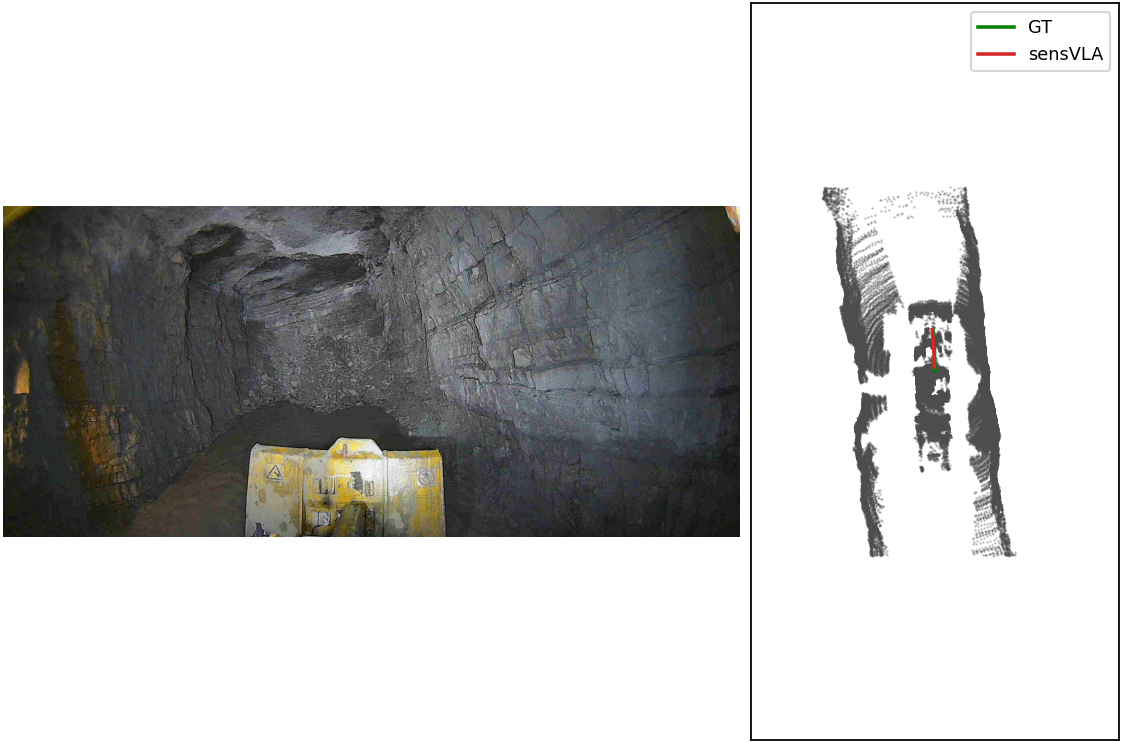
sensVLA Architecture
The sensVLA model ingests four modalities: an RGB image, a short text prompt, proprioceptive state including a ten-step history, and a temporally-accumulated lidar point cloud, and produces a chunk of ten future 6-DoF actions as shown in fig. 1 .
The RGB image and text prompt are processed by a LoRA-adapted [ 14 ] Qwen3-2B VLM [ 20 ] to produce task-conditioned contextual representations, while the lidar cloud is encoded into a BEV feature grid by a frozen PointPillars backbone.
Experiments
We collect data onboard a wheel loader and curate a dataset comprising 200K training chunks and 40K validation chunks. Each sample contains RGB images, LiDAR and IMU measurements. Our policy is built upon Qwen3-2B-VL [ 20 ] , where the language decoder is truncated to 14 transformer blocks. LoRA adapters ($r=16$, $\alpha=16$, dropout $0.05$) are inserted into the final 8 decoder layers.
The PointPillars encoder, pretrained on a separate in-house end-to-end task, is kept frozen throughout training.
Sources and Demonstrations
Figures are reproduced from Erabati et al. See the full paper for experimental details and the project page, when the paper links one, for demonstrations and videos.
Related Papers

A Sim-to-Real Integration Pipeline for Training and Deployment of Chunk-Based VLA Manipulation Policies
Mathilde Kappel, Clémence Grislain, Mohamed Chetouani et al.
Vision-Language-Action (VLA) models have become a prominent paradigm for mapping multimodal inputs, including semantic instructions, visual observations of the scene, and proprioceptive observations, to robot actions.
Beyond Reconstruction: What Matters in Action Tokenization for Robot Policies?
Haoran Chen, Jingtian Ji, Samuel Wheeler et al.
Autoregressive action-token policies such as vision-language-action models require action tokenizers to translate discrete token sequences into precise control actions in continuous space. Many action tokenizers learn the mapping between tokens and actions via a reconstruction objective.

Capability-Aware Arbitration for Semantic Intent-Based Shared Control
Zhaoda Du, Michael Bowman, Xiaoli Zhang
Shared control often allocates robot authority based on confidence in inferred human intent, assuming reliable autonomous execution. When this assumption fails, high intent confidence can cause over-helping.
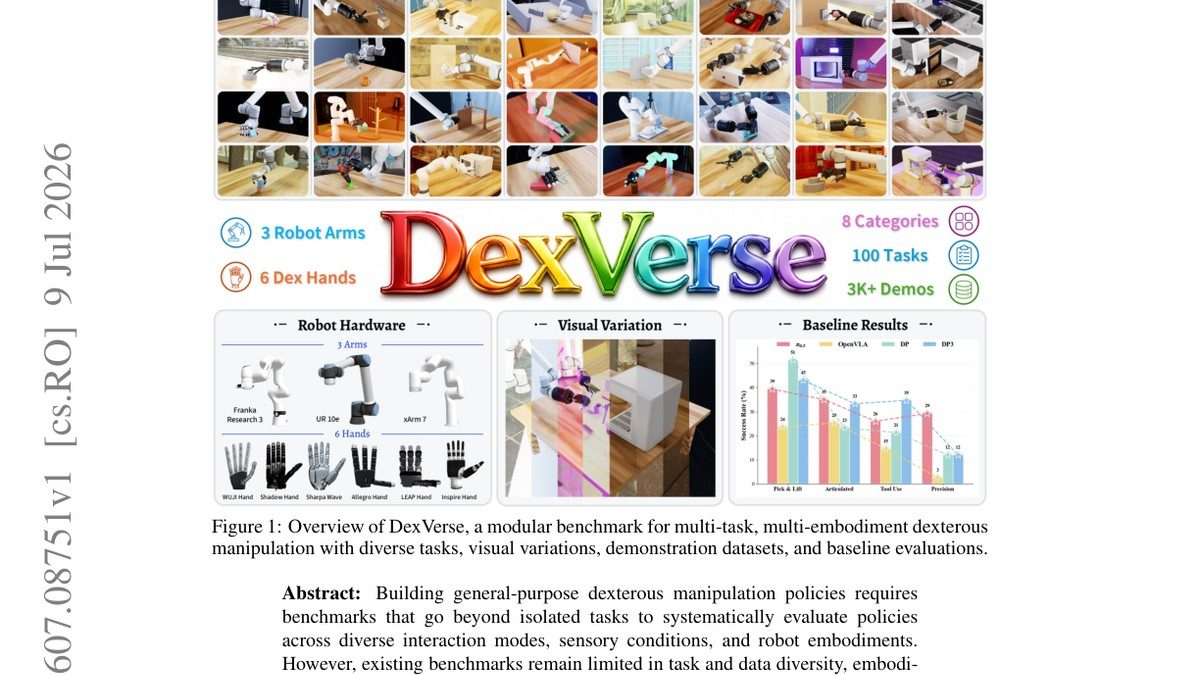
DexVerse: A Modular Benchmark for Multi-Task, Multi-Embodiment Dexterous Manipulation
Yunchao Yao, Zhuxiu Xu, Tianqi Zhang et al.
Building general-purpose dexterous manipulation policies requires benchmarks that go beyond isolated tasks to systematically evaluate policies across diverse interaction modes, sensory conditions, and robot embodiments.