
Skill-SLM: Agent Skill-driven Small Language Models for Reliable Robot Operation
Wenhao Wang, Yanyan Li, Jiawei Yuan · N/A · 2026
Framework
N/A
License
N/A
Stars
N/A
Summary
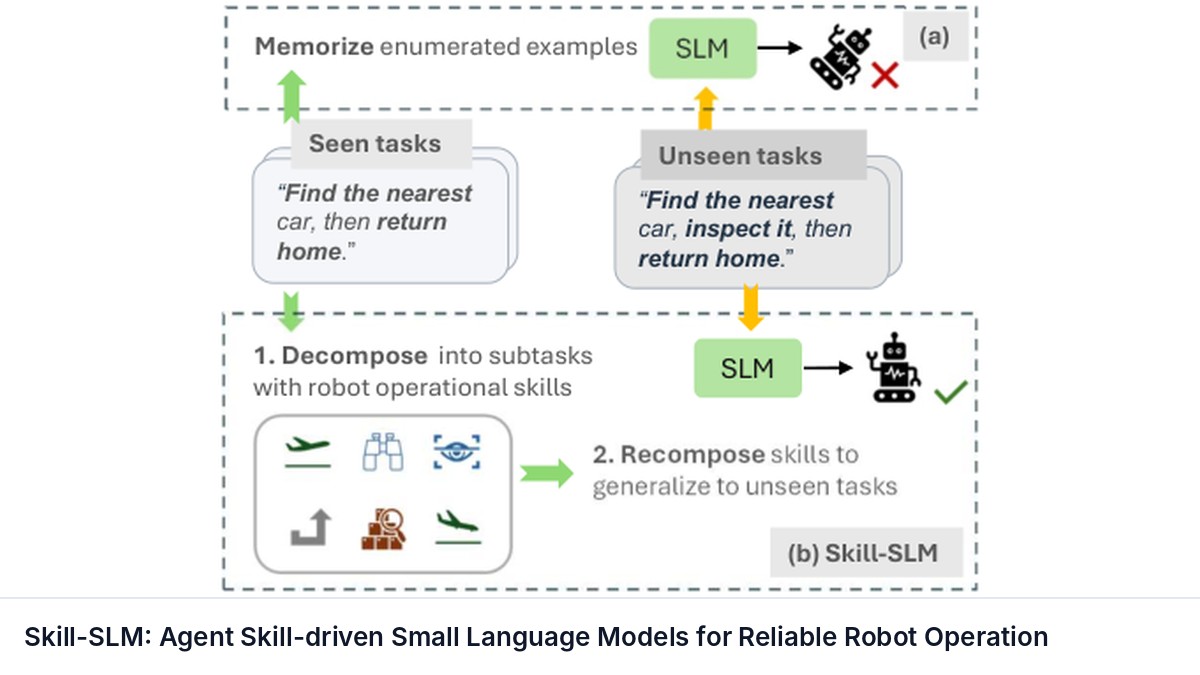
Small language models (SLMs) have been increasingly adopted for onboard robot operation because they enable intelligent decision-making. However, existing approaches are mainly distillation-oriented and rely on enumerating representative task-solution pairs.
Abstract Summary
Key Points
- Small language models (SLMs) have been increasingly adopted for onboard robot operation because they enable intelligent decision-making.
- However, existing approaches are mainly distillation-oriented and rely on enumerating representative task-solution pairs.
- This makes dataset construction difficult and limits generalization to diverse robot tasks whose possible forms grow rapidly.
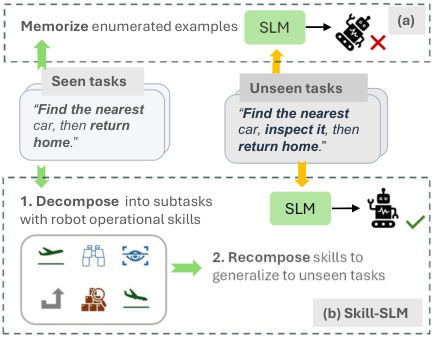
- This paper proposes Skill-SLM, a framework that reformulates SLM-driven robot operation as a task-decomposition and skill-composition problem.
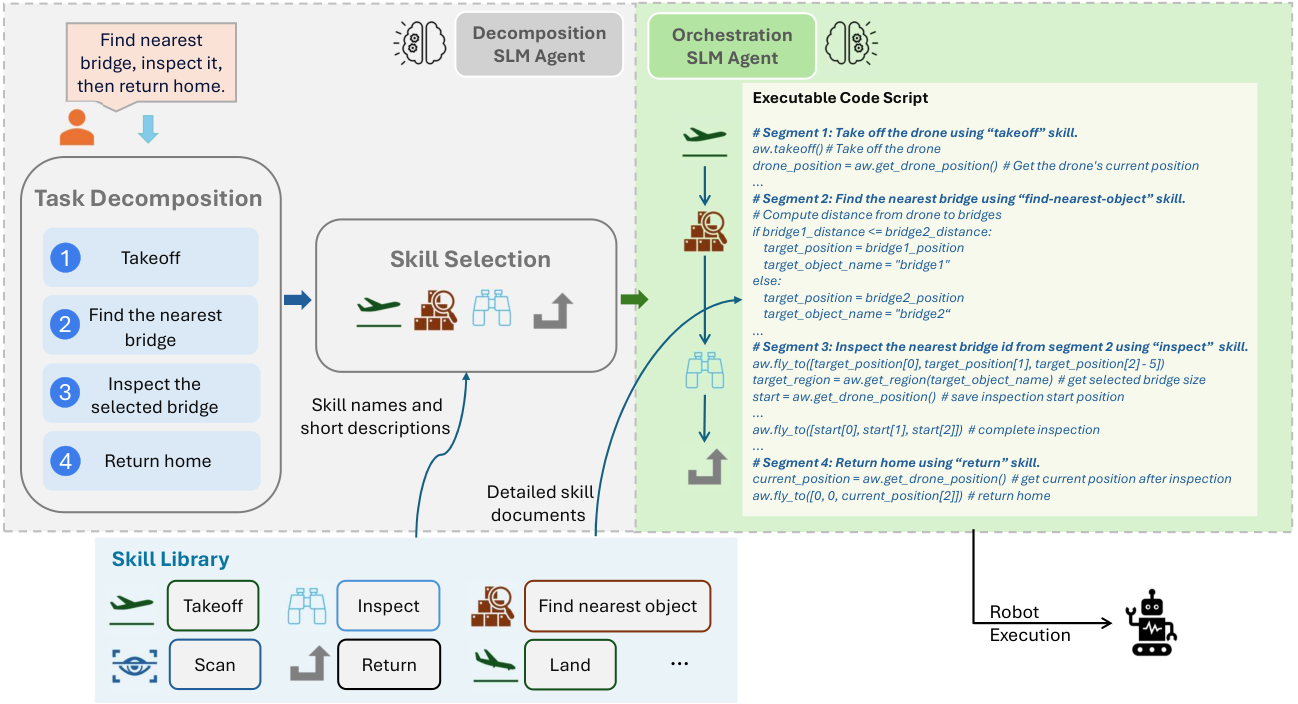
- Given a natural language task instruction, Skill-SLM decomposes the task into subtasks, selects appropriate skills from the skill library, and orchestrates the selected skills into executable robot operations.
Method
Fig. 2 presents the workflow of our Skill-SLM framework. Given a task $T$, the goal of Skill-SLM deployed on the robot is to analyze the task and generate the corresponding robot operation code $C$ for the robot to complete the task.
Experiments
The robots used in our experiment include a Holybro X500 V2 UAV with a Pixhawk 6X flight controller and a ROSMASTER X3 ground vehicle with ROS, as presented in Fig. 4 . Both robots are equipped with Jetson Orin NX (16 GB) for the deployment of Skill-SLM. We evaluate four SLMs: Llama-3.2-3B-Instruct, Llama-3.1-8B-Instruct, Qwen3-4B, and Qwen3-8B [ 29 , 16 ] .
Model LoRA [ 27 ] training is conducted on a server equipped with four NVIDIA H200 GPUs.
Sources and Demonstrations
Figures are reproduced from Wang et al. See the full paper for experimental details and the project page, when the paper links one, for demonstrations and videos.
Related Papers

A Sim-to-Real Integration Pipeline for Training and Deployment of Chunk-Based VLA Manipulation Policies
Mathilde Kappel, Clémence Grislain, Mohamed Chetouani et al.
Vision-Language-Action (VLA) models have become a prominent paradigm for mapping multimodal inputs, including semantic instructions, visual observations of the scene, and proprioceptive observations, to robot actions.
Beyond Reconstruction: What Matters in Action Tokenization for Robot Policies?
Haoran Chen, Jingtian Ji, Samuel Wheeler et al.
Autoregressive action-token policies such as vision-language-action models require action tokenizers to translate discrete token sequences into precise control actions in continuous space. Many action tokenizers learn the mapping between tokens and actions via a reconstruction objective.

Capability-Aware Arbitration for Semantic Intent-Based Shared Control
Zhaoda Du, Michael Bowman, Xiaoli Zhang
Shared control often allocates robot authority based on confidence in inferred human intent, assuming reliable autonomous execution. When this assumption fails, high intent confidence can cause over-helping.
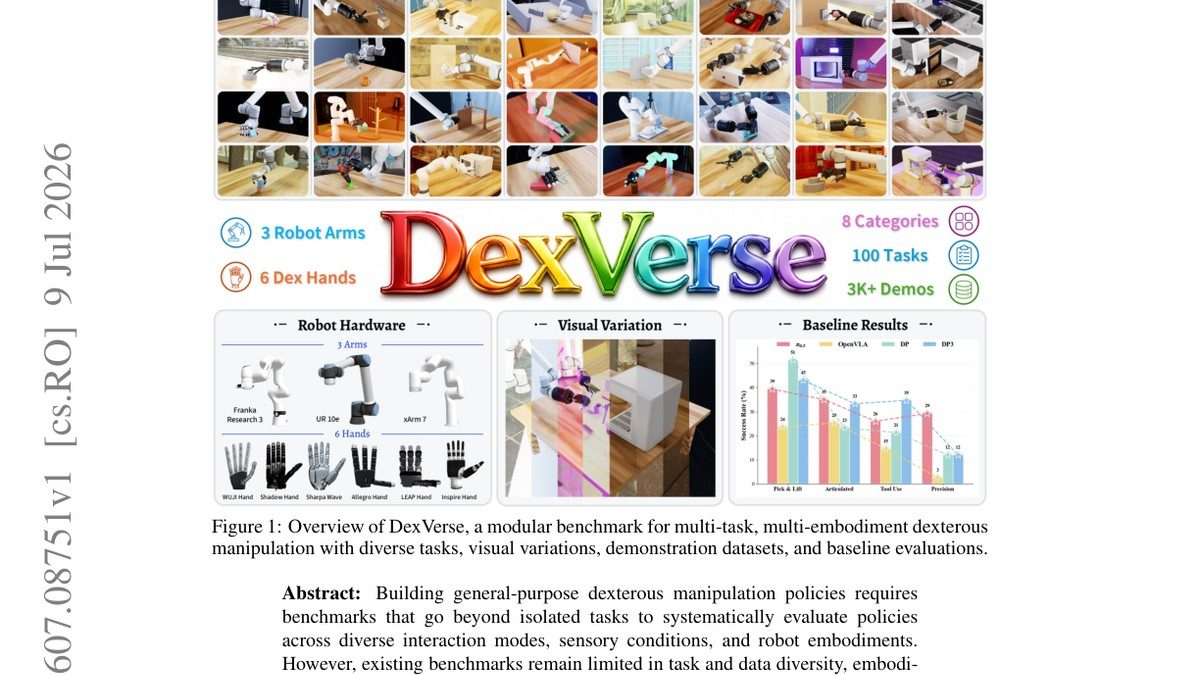
DexVerse: A Modular Benchmark for Multi-Task, Multi-Embodiment Dexterous Manipulation
Yunchao Yao, Zhuxiu Xu, Tianqi Zhang et al.
Building general-purpose dexterous manipulation policies requires benchmarks that go beyond isolated tasks to systematically evaluate policies across diverse interaction modes, sensory conditions, and robot embodiments.