
Intrinsic Robot Rewarding: Reusing VLA Representations for Autonomous Evaluation and Policy Improvement
Tobias Schaffer, Mohab Elkhayat, Daniela Nicklas, Mustafa Almohamad, Elham Al-Fuqara · N/A · 2026
Framework
N/A
License
N/A
Stars
N/A
Summary
Vision-language-action (VLA) systems already bring together two valuable resources for robot learning: rich visual representations and demonstrations of successful task execution.
Abstract Summary
Key Points
- Vision-language-action (VLA) systems already bring together two valuable resources for robot learning: rich visual representations and demonstrations of successful task execution.
- Intrinsic Robot Rewarding (IRR) proposes to use these resources for a second, complementary purpose: evaluating the robot's own outcomes and providing feedback for policy improvement.
- Successful demonstration endpoints define task-specific references, and the policy's frozen visual encoder provides the feature space in which new outcomes are assessed.
- The core reward mechanism adds a reference bank and a scoring operation to the existing pipeline, without requiring a separate learned evaluator or an additional perception backbone.
- Our position is that this reuse offers a promising route to lower integration effort, efficient reward computation, and reduced recurring human outcome scoring.
Position and motivation
Vision–language–action models connect visual observations and language instructions to robot actions. RT-2 demonstrated the transfer of web-derived semantic knowledge into robotic control, while OpenVLA made a broadly pretrained VLA available for downstream adaptation [ 1 , 2 ] . These developments provide an increasingly capable foundation for manipulation.
Adapting such a policy to an industrial task also produces a valuable local resource with demonstrations that show both, how the task is performed and what successful execution looks like.
Related research and proposed contribution
OpenVLA combines DINOv2 and SigLIP visual features with a language backbone and action prediction [ 2 , 5 , 6 ] . Its optimized fine-tuning recipe, OpenVLA-OFT, uses parallel decoding, action chunking, continuous actions, and an L1 regression objective [ 7 ] . This provides a practical base policy for studying internal outcome evaluation.
A residual RL controller can build on its regression-based action interface while supplying the stochastic learning mechanism for subsequent improvement.
Available TRL 4 demonstrator and experimental foundation
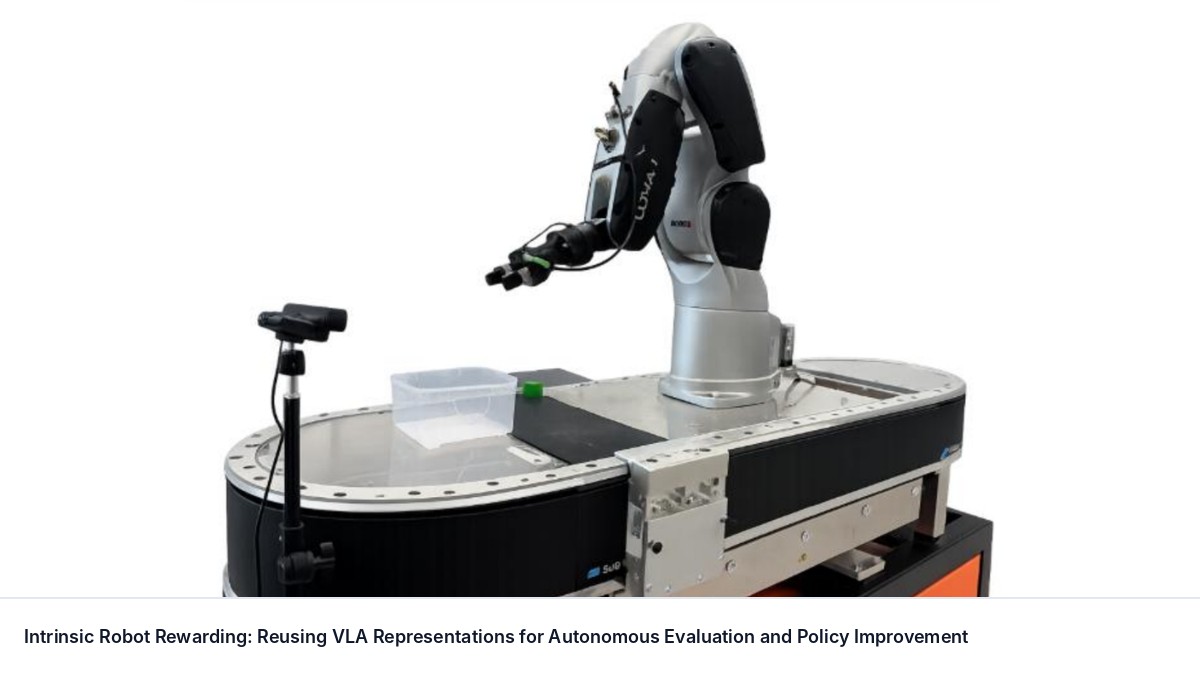
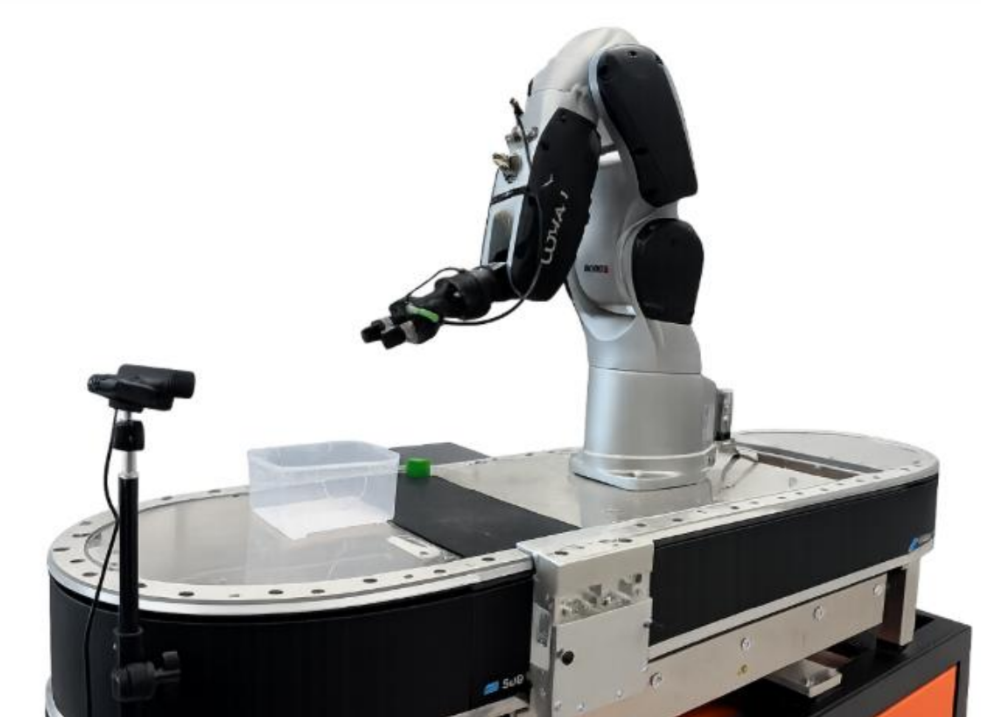
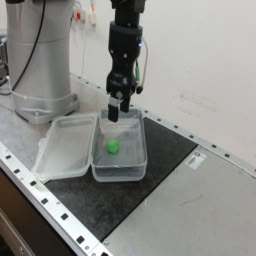
An operational VLA demonstrator is available at TRL 4, providing a laboratory-validated experimental foundation for IRR. The demonstrator comprises a COMAU Racer 3 six-axis industrial arm with a Robotiq Hand-E gripper, a third-person USB camera, VR teleoperation, and a ROS control stack [ 4 ] . The baseline study uses 245 demonstrations of placing a small green cube into a container.
Images, proprioceptive observations, and end-effector delta commands were recorded at a nominal 5 Hz.
Proposed IRR formulation
Let $g$ be a task with a written success specification, $o_{t}$ denote its camera observation, $p_{t}$ the robot’s proprioceptive state, and $\pi_{0}$ the imitation-trained VLA policy. Let $\phi$ be a frozen checkpoint of its visual encoder and $P$ a documented feature extraction and pooling operation.
For a single image, define The encoder layer, image preprocessing, token pooling, and normalization are part of the method and must be fixed before evaluation. DINOv2 features, SigLIP features, and their fusion will be compared.
Research questions and decisive experiments
RQ1 – How effectively do existing policy representations support task evaluation? We hypothesize that a task-conditioned reference bank can distinguish successful endpoints from realistic near misses with a low false-positive rate. The evaluation will include correct placement, objects beside the container, objects still held above it, wrong-object placement, premature release, and partial occlusion.
Evaluation design and evidence standards
The first task reproduces the documented cube-to-container experiment. Two planned extensions introduce target-container placement with separation and placement into a fixture with visible pose constraints. These are laboratory tasks motivated by industrial handling.
Natural-product sorting and precision assembly provide subsequent application directions, with additional acceptance measurements wherever appearance alone is inadequate.
Scientific value and industrial relevance
IRR advances a practical research position, that representations and demonstrations used to establish robot behavior can also support its evaluation and improvement. Reuse can extend the function of an existing VLA deployment while keeping the reward mechanism compact. The core design introduces task references and a scoring operation, with no separate learned evaluator or additional perception backbone.
This makes the approach straightforward to relate to the robot’s existing data and model configuration.
Sources and Demonstrations
Figures are reproduced from Schaffer et al. See the full paper for experimental details and the project page, when the paper links one, for demonstrations and videos.
Related Papers

A Sim-to-Real Integration Pipeline for Training and Deployment of Chunk-Based VLA Manipulation Policies
Mathilde Kappel, Clémence Grislain, Mohamed Chetouani et al.
Vision-Language-Action (VLA) models have become a prominent paradigm for mapping multimodal inputs, including semantic instructions, visual observations of the scene, and proprioceptive observations, to robot actions.
Capability-Aware Arbitration for Semantic Intent-Based Shared Control
Zhaoda Du, Michael Bowman, Xiaoli Zhang
Shared control often allocates robot authority based on confidence in inferred human intent, assuming reliable autonomous execution. When this assumption fails, high intent confidence can cause over-helping.
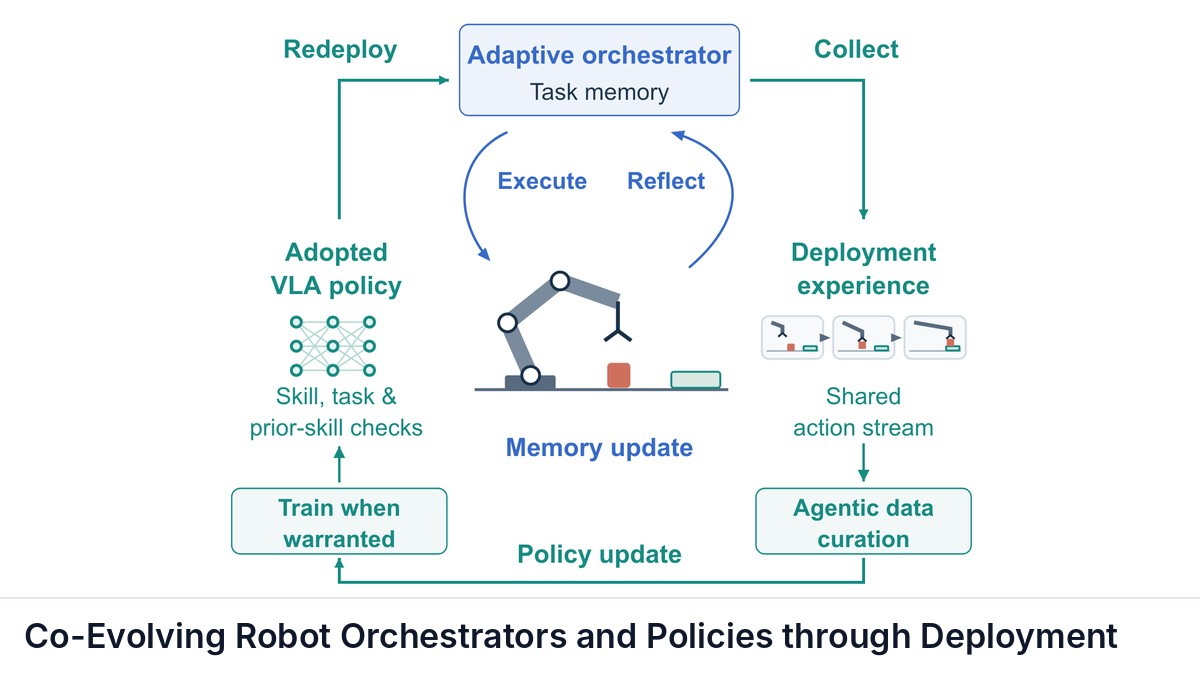
Co-Evolving Robot Orchestrators and Policies through Deployment
Xilun Zhang, Maggie Wang, Erik Bauer et al.
Vision-language-action (VLA) policies trained on large datasets are capable within their training domains, yet they still fail to generalize to the variety of situations a robot meets in real-world deployment.
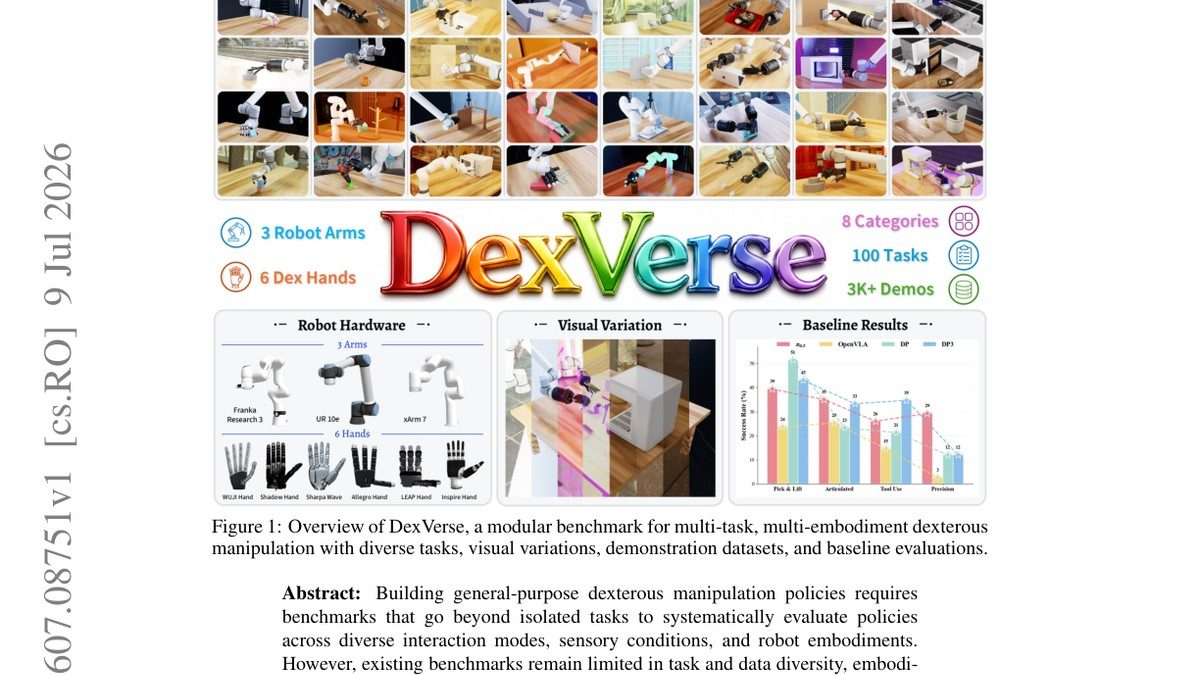
DexVerse: A Modular Benchmark for Multi-Task, Multi-Embodiment Dexterous Manipulation
Yunchao Yao, Zhuxiu Xu, Tianqi Zhang et al.
Building general-purpose dexterous manipulation policies requires benchmarks that go beyond isolated tasks to systematically evaluate policies across diverse interaction modes, sensory conditions, and robot embodiments.