
GesVLA: Gesture-Aware Vision-Language-Action Model
FeaturedWenxuan Guo, Ziyuan Li, Meng Zhang, Yichen Liu, Yimeng Dong, Chuxi Xu, Yunfei Wei, Ze Chen, Erjin Zhou, Jianjiang Feng · Tsinghua University · 2026
Framework
N/A
License
N/A
Stars
18
Summary
GesVLA augments standard VLA models with gesture awareness, enabling robots to interpret verbal instructions alongside human hand gestures for disambiguated manipulation.
Abstract Summary
Key Points
- First VLA model to explicitly integrate hand-gesture awareness.
- Gesture-Aware Embedding (GAE) fuses 2D hand poses with language tokens.
- Disambiguates object references in cluttered, multi-object scenes.
- Evaluated on Franka robot with real-world and simulated tasks.
- Supports gesture-only commands for noise-sensitive environments.
PROBLEM FORMULATION
We study a gesture-augmented vision-language-action (VLA) problem, where a robot is required to execute manipulation tasks based on multimodal human instructions. In standard VLA settings, the robot receives visual observations $\mathcal{O}$ and a language instruction $\mathcal{T}$, and aims to predict a sequence of actions that accomplish the task.
However, in many real-world scenarios, language alone is insufficient to uniquely specify the target due to spatial ambiguity (e.g., multiple similar objects).
Method
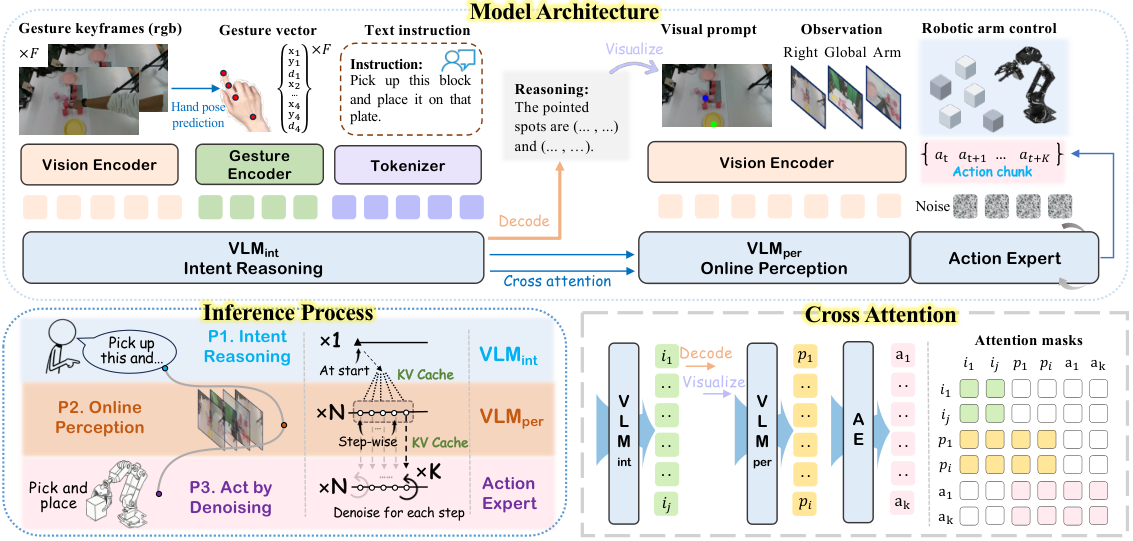
As shown in Fig. 2 , we propose a gesture-aware dual-VLM architecture that separates intent reasoning from action generation while enabling tight interaction between them. The model consists of a VLM for intent reasoning ($\text{VLM}_{\text{int}}$), a VLM for online perception ($\text{VLM}_{\text{per}}$), and an action expert ($\mathcal{F}_{\theta}$).
Experiments
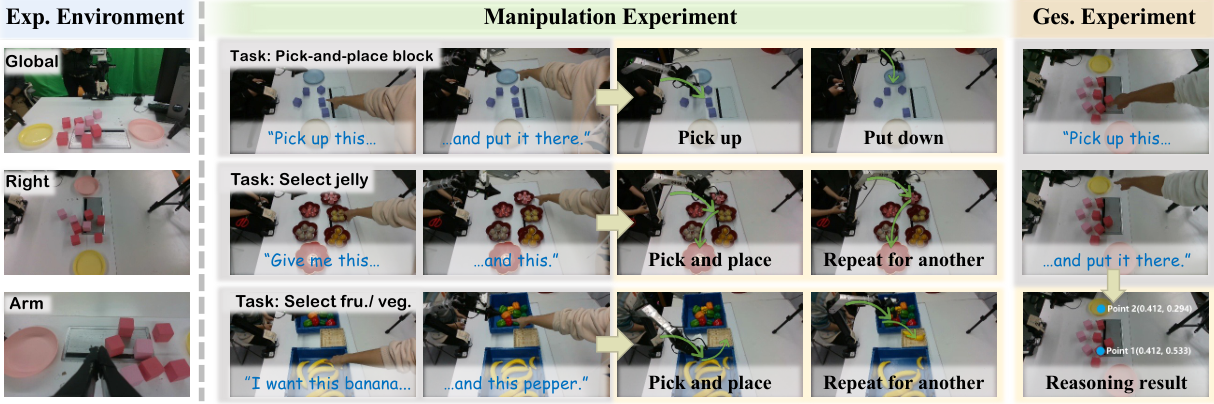
The experimental setup is shown in Fig. 4 . We conduct both intent reasoning and robot manipulation experiments. Three cameras with a frame rate of 30 fps are deployed on a fixed table: two provide a global view and a right-side view, respectively, and the third is mounted on the robotic gripper. Intent Reasoning Experiment.
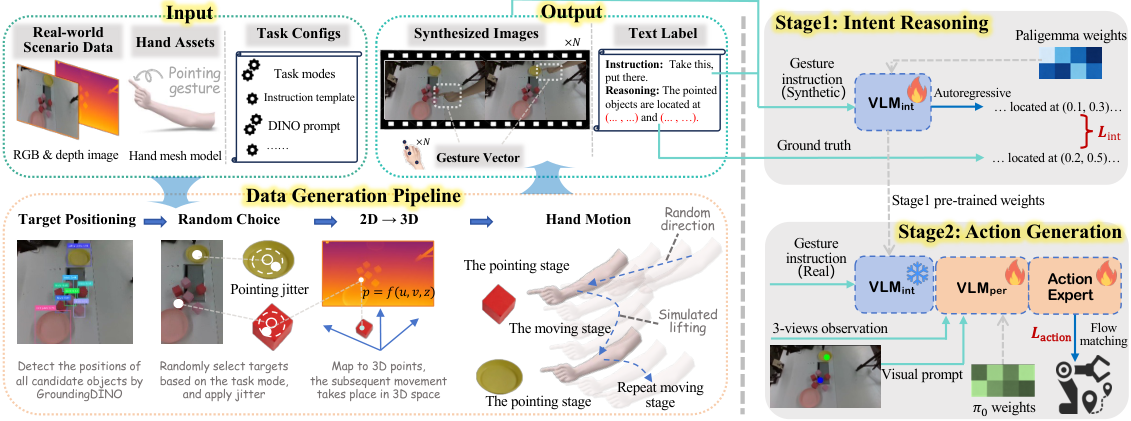
To validate sim-to-real transfer of gesture-conditioned intent reasoning, $\text{VLM}_{\text{int}}$ is trained on semi-synthetic data and directly evaluated in real-world scenarios.
Sources and Demonstrations
Figures are reproduced from Guo et al. See the full paper for experimental details and the project page, when the paper links one, for demonstrations and videos.
Related Papers
3DThinkVLA: Endowing Vision-Language-Action Models with Latent 3D Priors via 3D-Thinking-Guided Co-training
Jiaxin Shi, Xidong Zhang, Fucai Zhu et al.
We propose a 3D-thinking-guided co-training framework that enables vision-language-action (VLA) models to perform 3D spatial reasoning implicitly during action prediction.
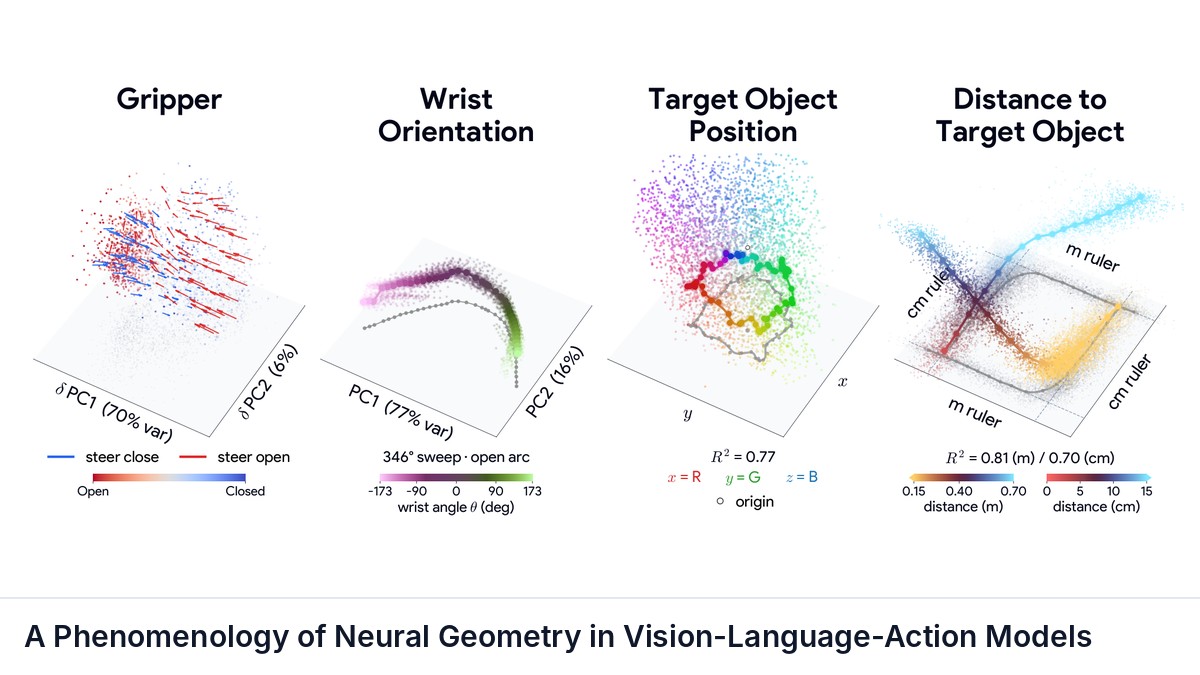
A Phenomenology of Neural Geometry in Vision-Language-Action Models
Mozes Jacobs, Aiden Swann, Mathilde Papillon et al.
Robotic manipulation is inherently geometric, but what shape does the world take inside the policy that performs it?

A Sim-to-Real Integration Pipeline for Training and Deployment of Chunk-Based VLA Manipulation Policies
Mathilde Kappel, Clémence Grislain, Mohamed Chetouani et al.
Vision-Language-Action (VLA) models have become a prominent paradigm for mapping multimodal inputs, including semantic instructions, visual observations of the scene, and proprioceptive observations, to robot actions.
AIR-VLA+: Decoupling Movement and Manipulation via Cascaded Dual-Action Decoders with Asymmetric MoE for Aerial Robots
Jianli Sun, Bin Tian, Qiyao Zhang et al.
Aerial manipulation systems have long suffered from representation coupling in end-to-end control, as platform-level Unmanned Aerial Vehicle (UAV) movement and end-effector-level arm manipulation differ substantially in action scale, dynamics, and control objectives.