
AD-WM: Action-Discriminative World Models for Counterfactual Model Predictive Control
Jiabin Qiu, Zixuan Chen, Hongye Cao, Jieqi Shi, Jing Huo, Yang Gao · N/A · 2026
Framework
N/A
License
N/A
Stars
N/A
Summary
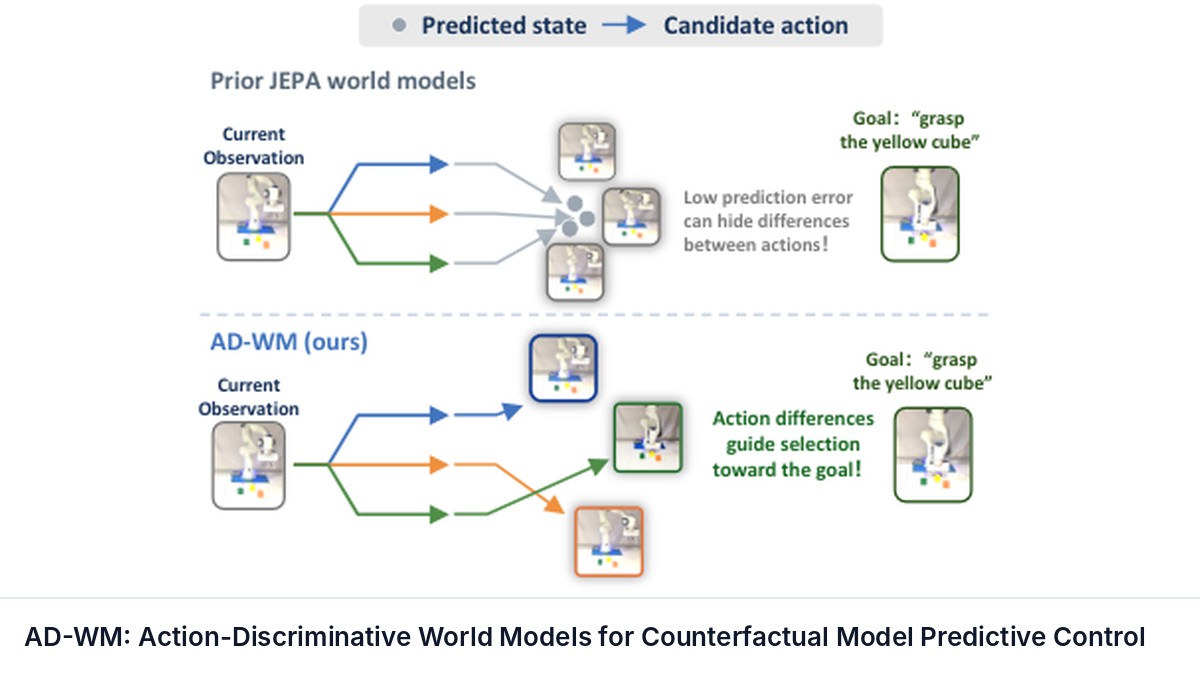
Latent world models are typically trained to predict factual transitions, whereas model predictive control (MPC) must compare alternative actions from the same state. A model can therefore achieve low factual prediction error yet poorly distinguish candidate actions.
Abstract Summary
Key Points
- Latent world models are typically trained to predict factual transitions, whereas model predictive control (MPC) must compare alternative actions from the same state.
- A model can therefore achieve low factual prediction error yet poorly distinguish candidate actions
- We introduce AD-WM, an action-discriminative joint-embedding world model for counterfactual MPC
- AD-WM combines residual latent dynamics with predictor-level action-recovery regularization, using inverse dynamics and a normalized recovery objective motivated by conditional mutual information.
- Both objectives encourage planning transitions to preserve action information; their auxiliary heads are discarded at test time, leaving MPC unchanged.
Method
Fig. 2 illustrates the training and planning pipeline of AD-WM . During training, residual latent prediction and action-recovery objectives jointly shape action-discriminative transitions. At test time, MPC uses the learned dynamics to compare candidate action sequences, with the auxiliary heads discarded. We first formulate the task, then detail the model, training objectives, and planning procedure.
Finally, we introduce diagnostics for evaluating candidate selection.
Experiments
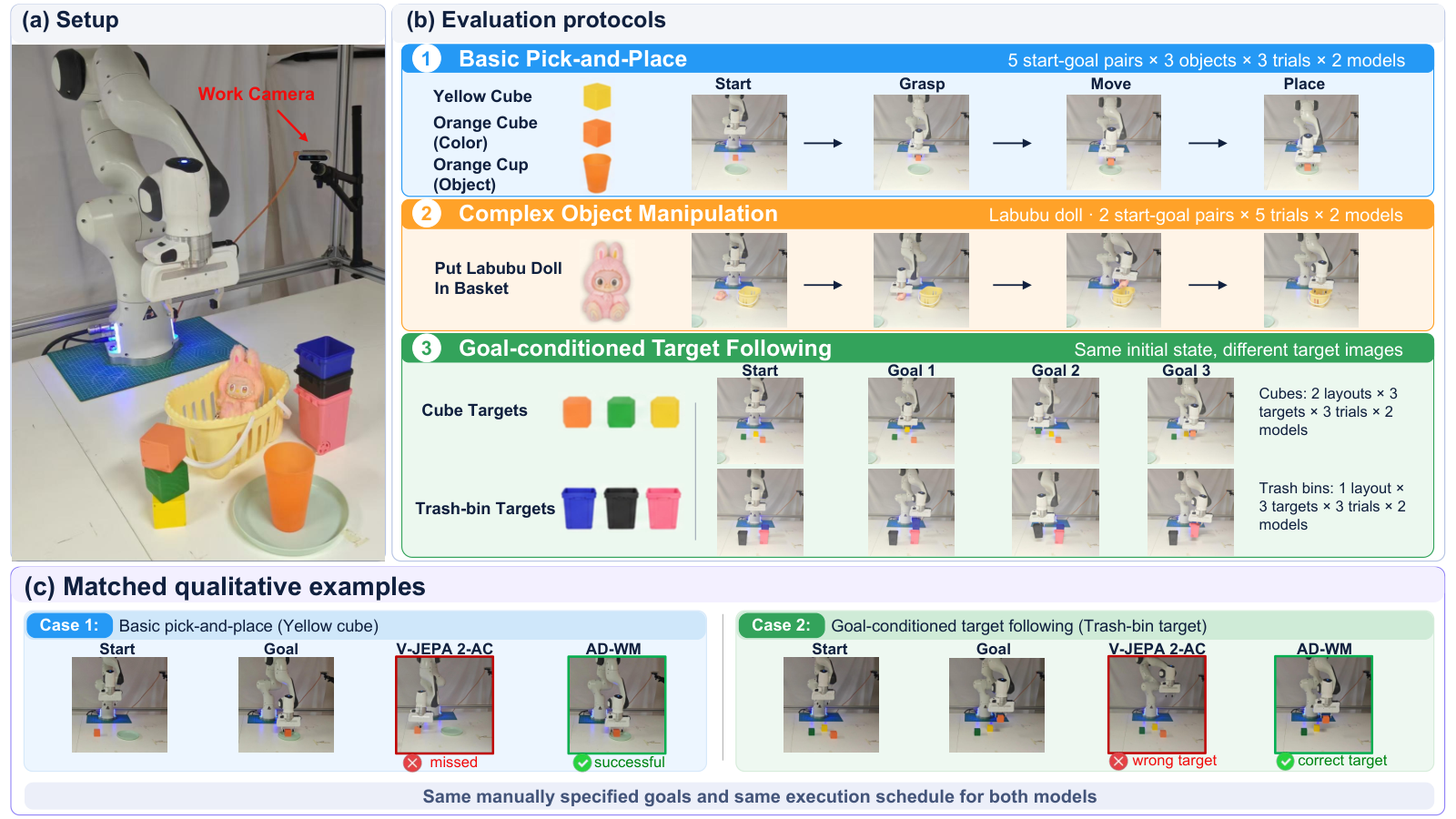
How well does AD-WM perform across simulation tasks and configuration shifts? Q2: How do residual prediction and action recovery contribute to control performance? Q3: Which prediction and selection metrics best reflect closed-loop success? Q4: Can AD-WM transfer to a real robot without lab-specific adaptation? Benchmarks and Baselines.
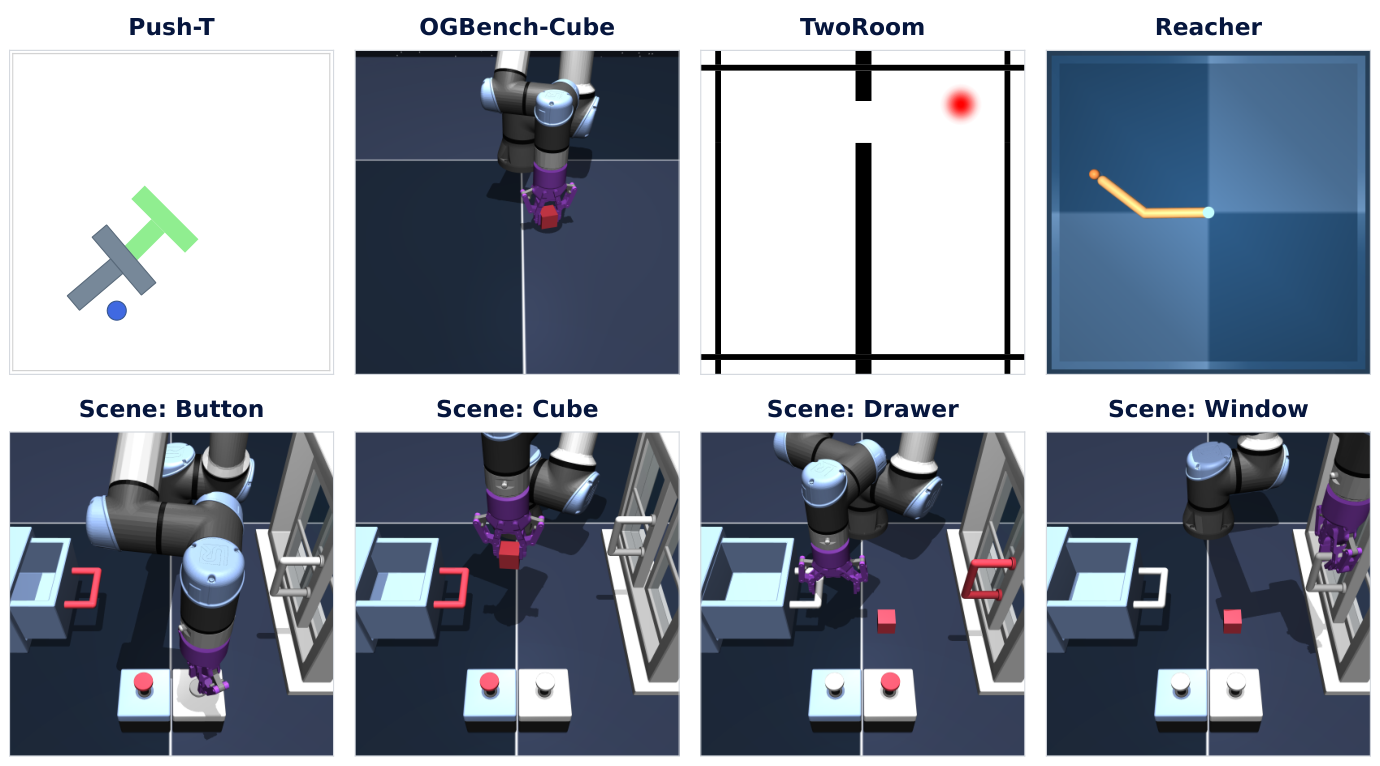
We follow LeWM’s simulation environment selection [ 11 ] , evaluating on Cube, Reacher, TwoRoom, and PushT, and additionally include Scene from OGBench [ 32 ] . As shown in Fig.
Sources and Demonstrations
Figures are reproduced from Qiu et al. See the full paper for experimental details and the project page, when the paper links one, for demonstrations and videos.
Related Papers
AHEAD: Anticipatory Hand-Driven Teleoperation via Human Intent Prediction
Seok Joon Kim, Junho Lee, Federica Spinola et al.
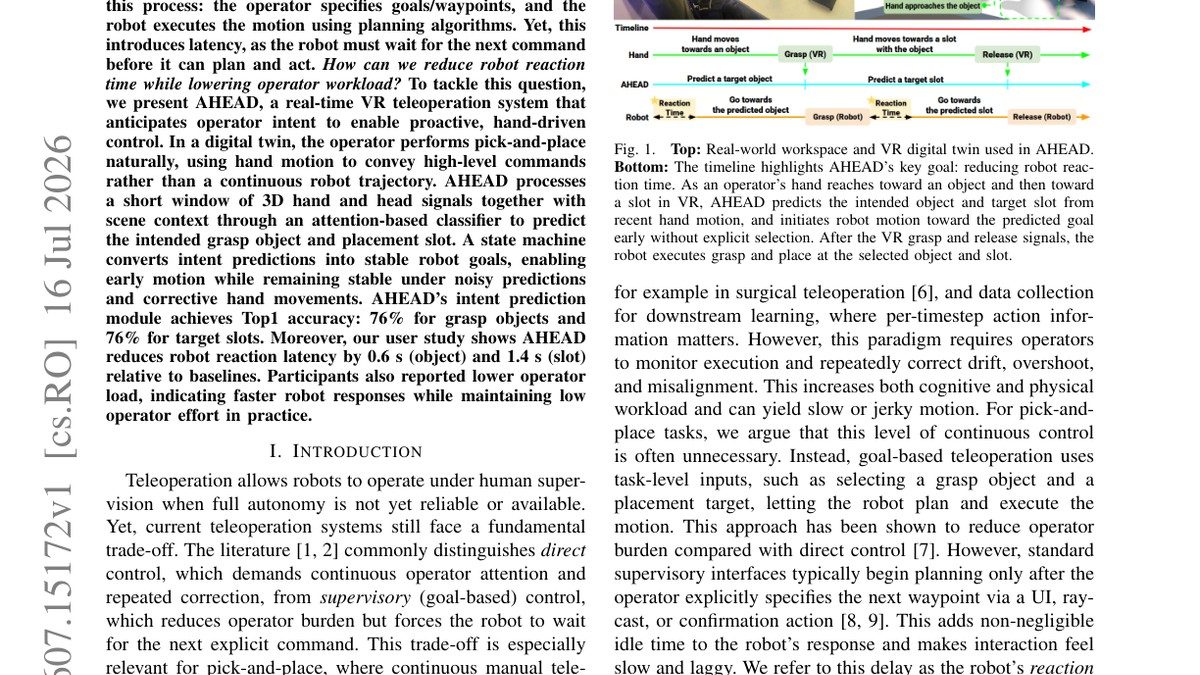
Direct hand-driven teleoperation maps an operator's hand motion to robot end-effector commands at every frame, enabling precise control, but it requires constant monitoring and correction during approach, grasp, and placement, which can be slow and fatiguing.
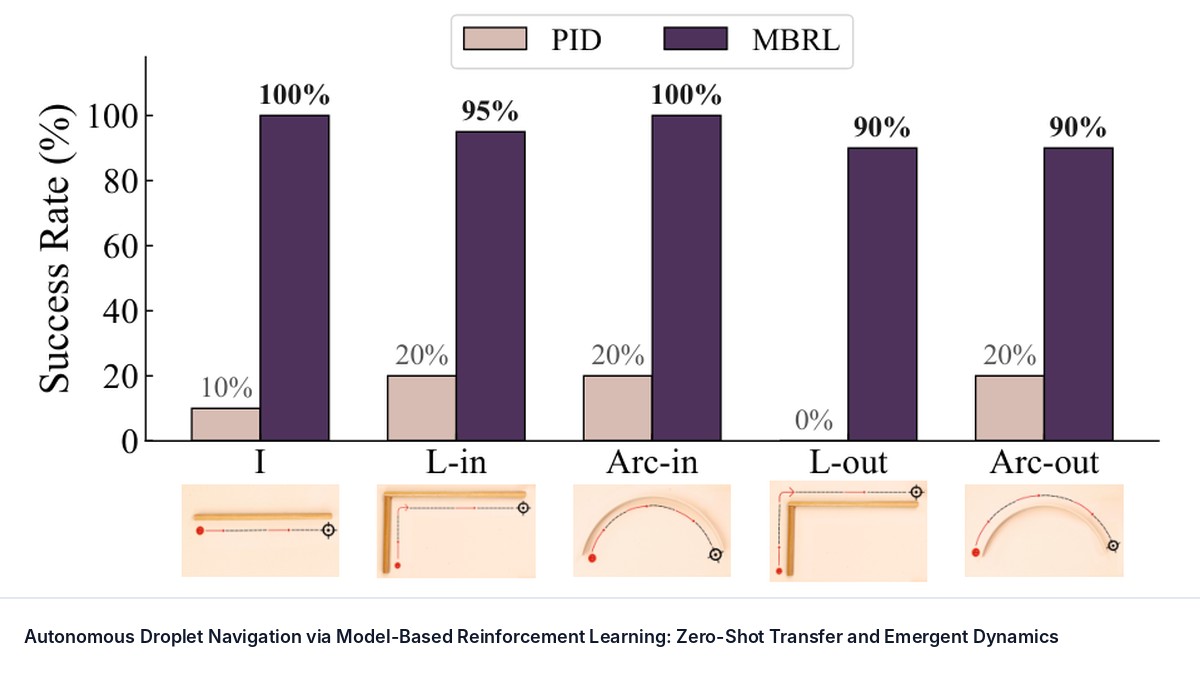
Autonomous Droplet Navigation via Model-Based Reinforcement Learning: Zero-Shot Transfer and Emergent Dynamics
Rajneesh Anand, Mayuresh V. Kothare
Self-driving laboratories (SDLs) are transforming chemical and materials discovery through closed-loop automation, yet automated infrastructure for physical manipulation of soft, deformable matter remains beyond current robotic platforms.
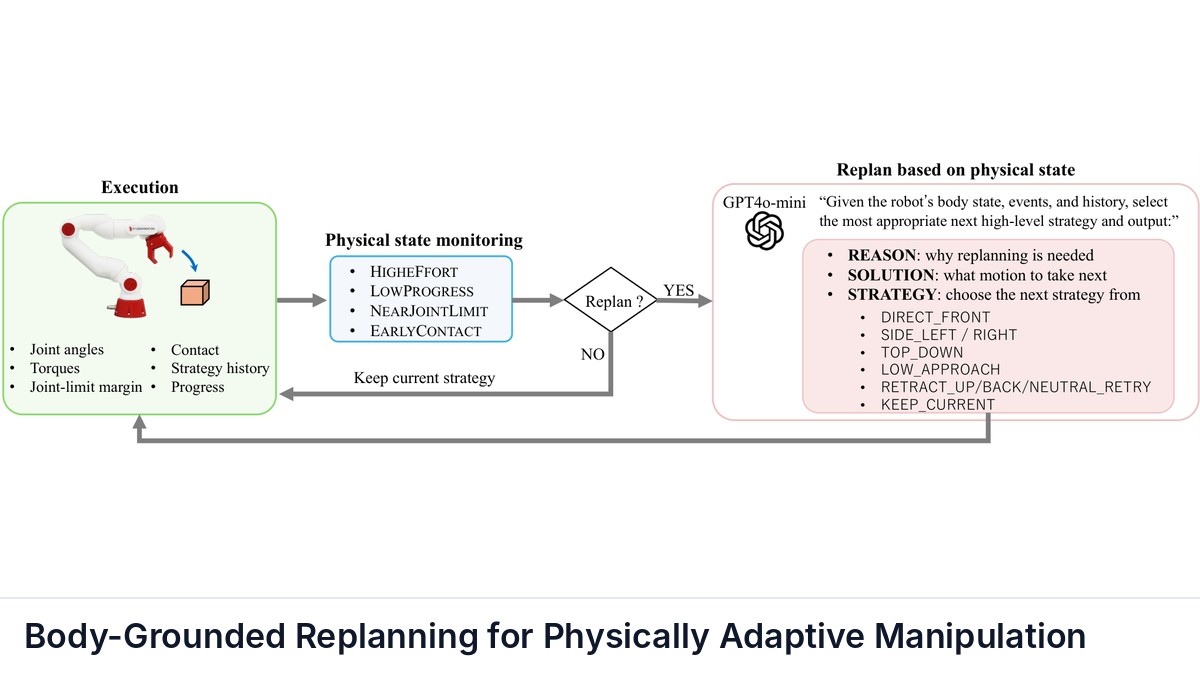
Body-Grounded Replanning for Physically Adaptive Manipulation
Namiko Saito, Hiroshi Kera
Manipulation requires not only reasoning about the external environment, but also about the robot's physical condition.
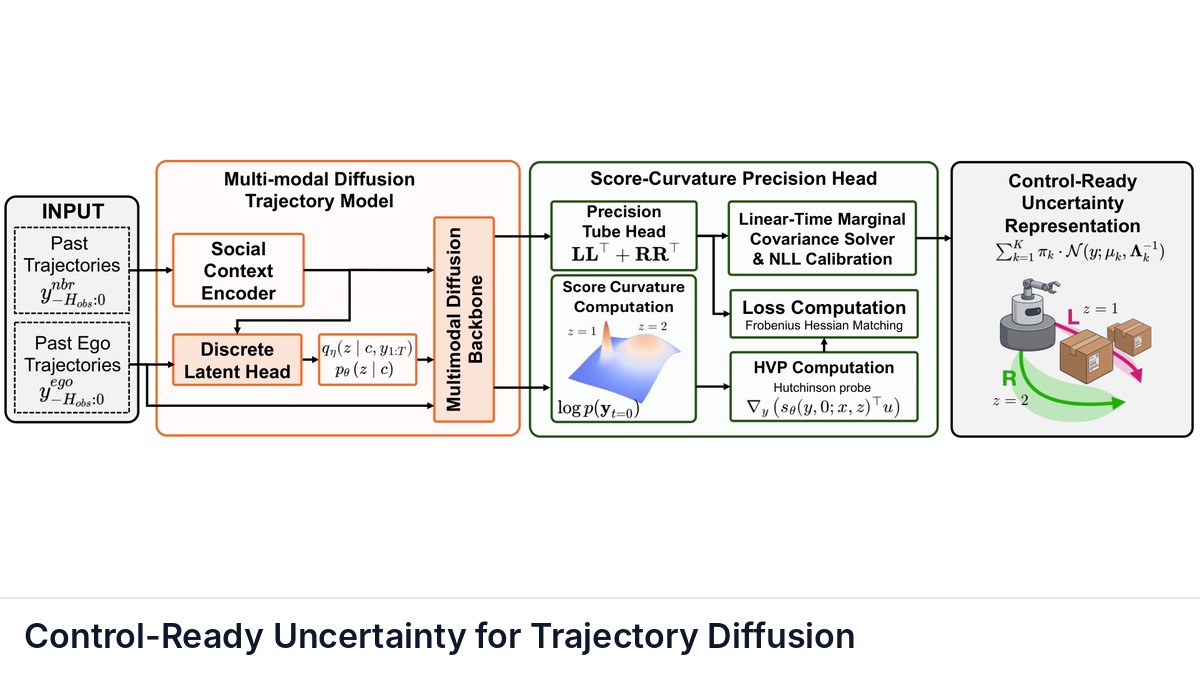
Control-Ready Uncertainty for Trajectory Diffusion
Zhiwei Xue, Jia Yue Kam, Jinhang Qiu et al.
Diffusion models can represent complex, multimodal trajectory distributions, but extracting uncertainty from them typically requires costly Monte Carlo sampling. This limits their use in real-time control, where robots must rapidly assess risk and maintain safety margins.