
Control-Ready Uncertainty for Trajectory Diffusion
Zhiwei Xue, Jia Yue Kam, Jinhang Qiu, Yifeng Cheng, Ege Gursoy, Jiaming Wang, Vincent Bonnet, Harold Soh · N/A · 2026
Framework
N/A
License
N/A
Stars
N/A
Summary
Diffusion models can represent complex, multimodal trajectory distributions, but extracting uncertainty from them typically requires costly Monte Carlo sampling. This limits their use in real-time control, where robots must rapidly assess risk and maintain safety margins.
Abstract Summary
Key Points
- Diffusion models can represent complex, multimodal trajectory distributions, but extracting uncertainty from them typically requires costly Monte Carlo sampling.
- This limits their use in real-time control, where robots must rapidly assess risk and maintain safety margins.
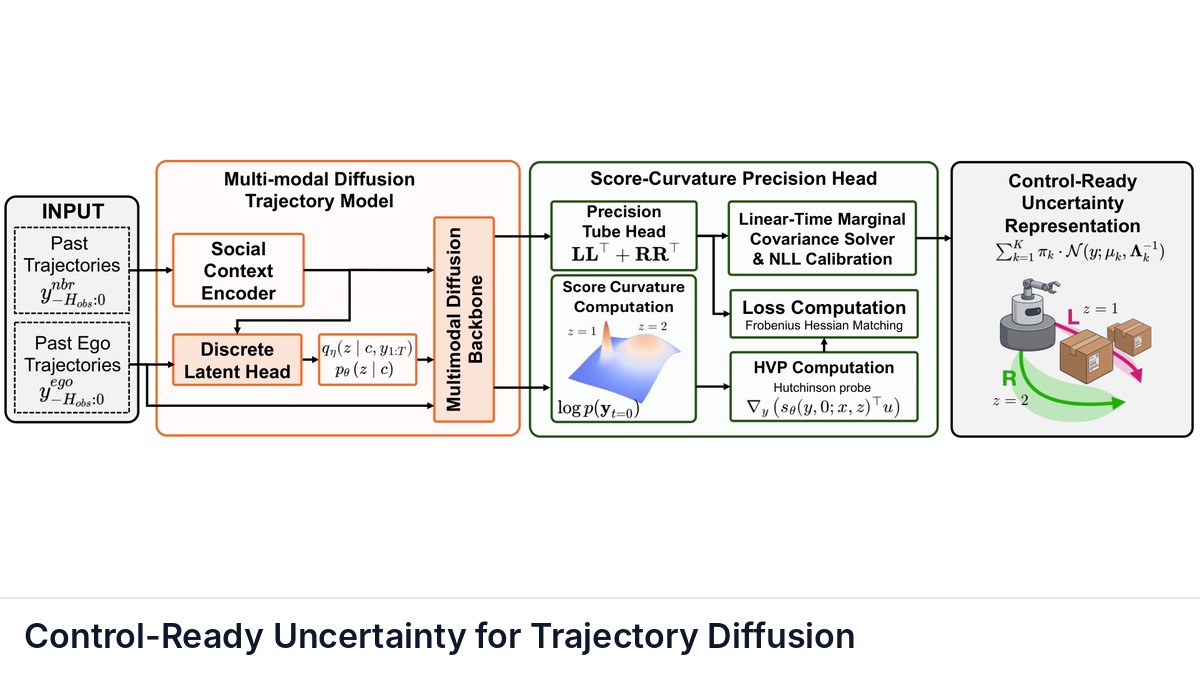
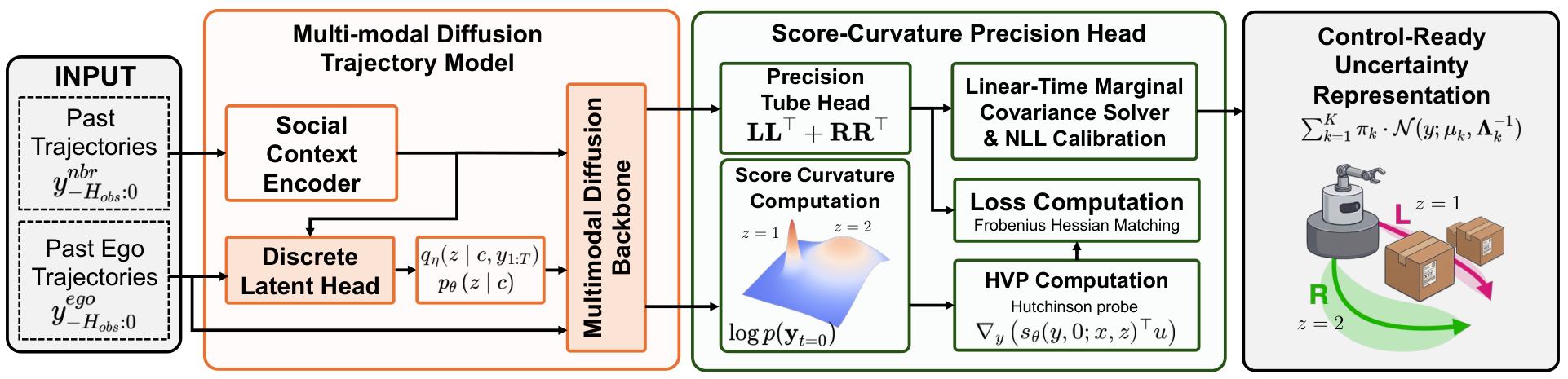
- We introduce Score-Curvature for Online Precision Estimation (SCOPE), a lightweight module that augments diffusion trajectory models with control-ready uncertainty.
- SCOPE learns a structured precision matrix around each nominal trajectory by distilling score-curvature information and producing calibrated Gaussian tubes with low overhead and without repeated Monte Carlo sampling.
- These tubes provide per-timestep covariance estimates that can be used both as predicted occupancy for moving agents and as adaptive exploration guides for robot control.
Preliminaries
Diffusion models as trajectory forecasters. Diffusion models generate trajectories by learning to reverse a gradual noising process.
The forward process progressively corrupts a clean trajectory $\mathbf{y}_{0}$ into Gaussian noise over $\mathsf{S}$ steps, with closed form $q(\mathbf{y}_{\mathsf{s}}/\mathbf{y}_{0})=\mathcal{N}\!\big(\sqrt{\bar{\alpha}_{\mathsf{s}}}\,\mathbf{y}_{0},\,(1-\bar{\alpha}_{\mathsf{s}})\mathbf{I}\big)$, where $\bar{\alpha}_{\mathsf{s}}=\prod_{j=1}^{\mathsf{s}}\alpha_{j}$ and $\alpha_{j}\in(0,1)$ is a noise schedule.
Score-Curvature for Online Precision Estimation (SCOPE)
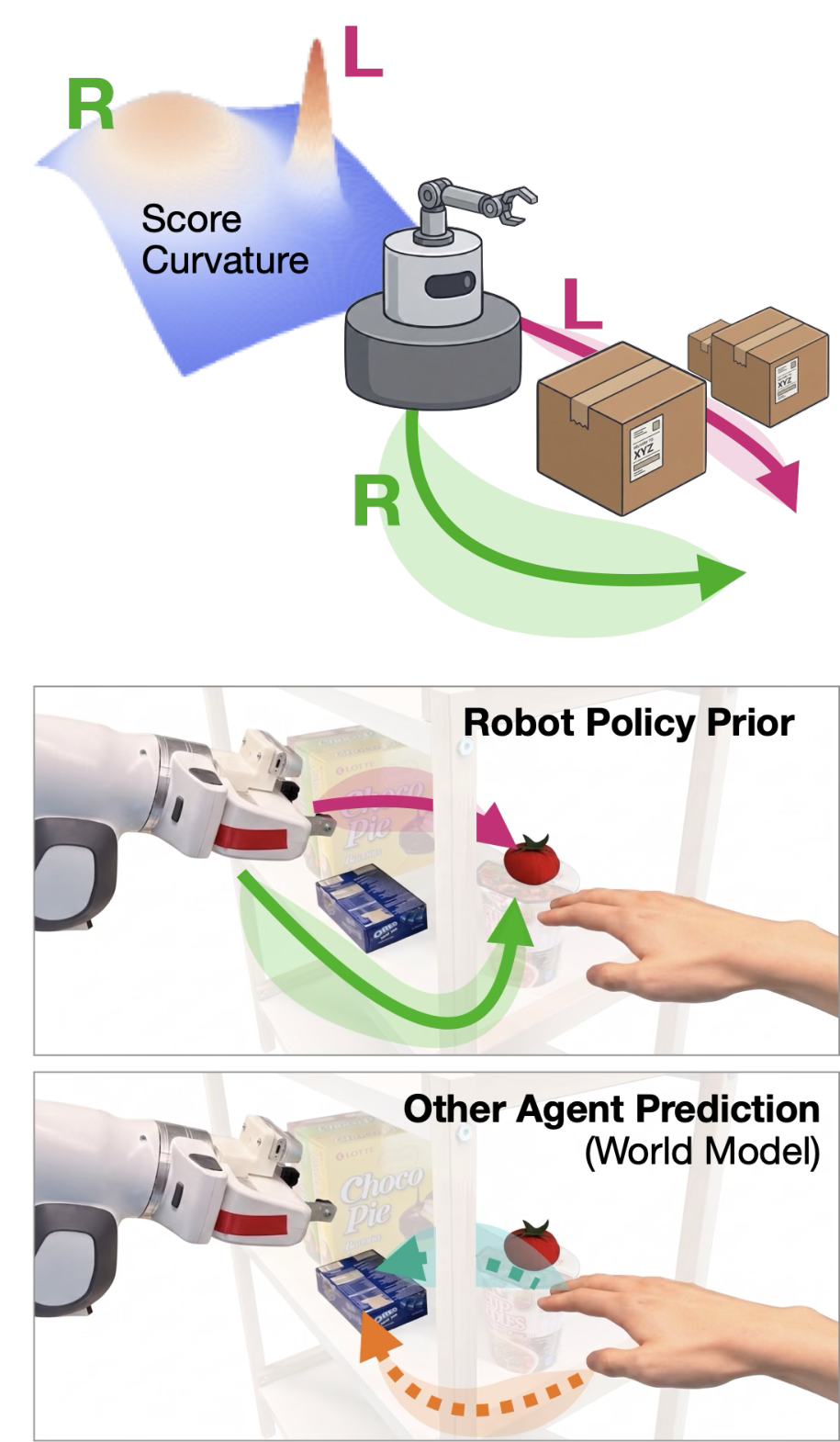
This section presents SCOPE, a lightweight module for extracting local, control-ready uncertainty from diffusion trajectory models. Given a conditioning context $\mathbf{c}$—such as agent histories, scene geometry, start and goal states, or task information—a diffusion model can produce one or more nominal future trajectories.
SCOPE augments each nominal trajectory with a structured precision matrix, whose inverse defines a local Gaussian tube around that prediction.
Experiments
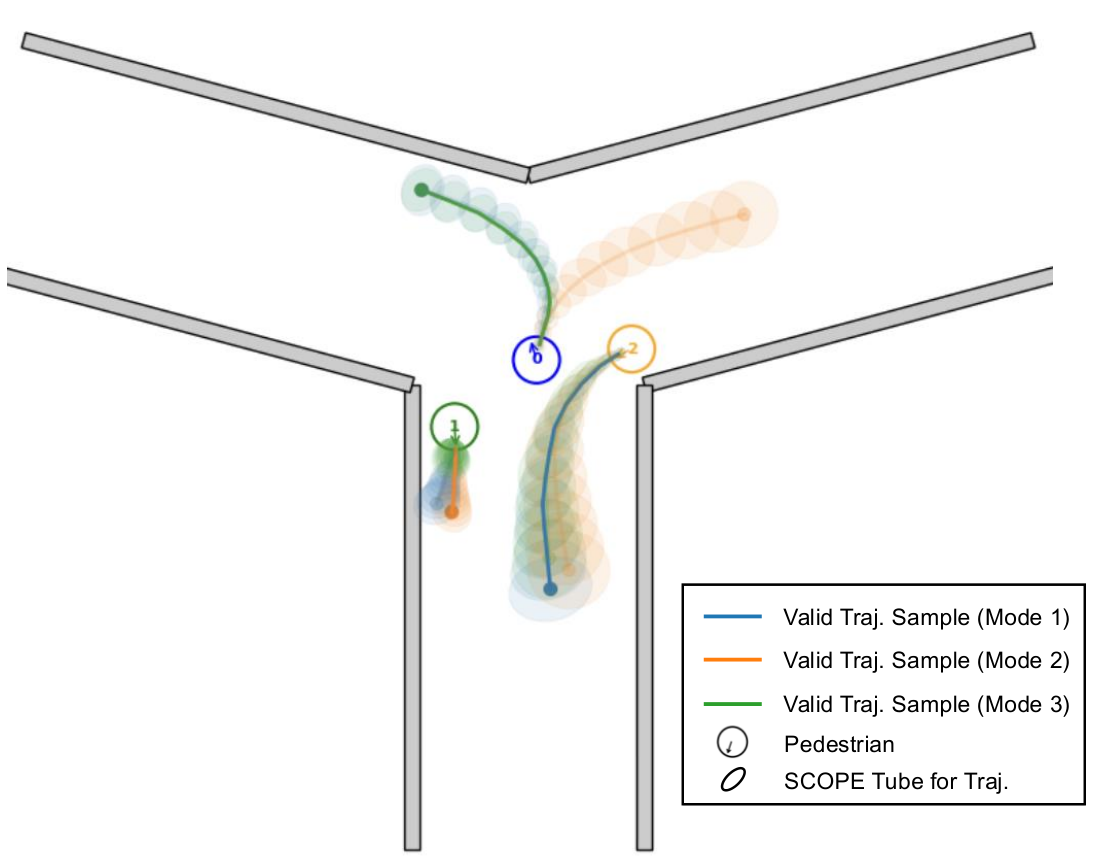
Our experiments are designed to answer three questions: (Q1) Does SCOPE produce accurate uncertainty tubes with fast inference, compared to sampling-based alternatives? (Q2) When used for policy, does SCOPE improve MPPI rollout efficiency and downstream control performance? (Q3) When used as a predictive world model, does SCOPE improve downstream control in interactive scenarios?
We evaluate SCOPE on pedestrian trajectory forecasting in an ORCA-simulated Y-corridor environment [ 41 ] (Fig.
Sources and Demonstrations
Figures are reproduced from Xue et al. See the full paper for experimental details and the project page, when the paper links one, for demonstrations and videos.
Related Papers
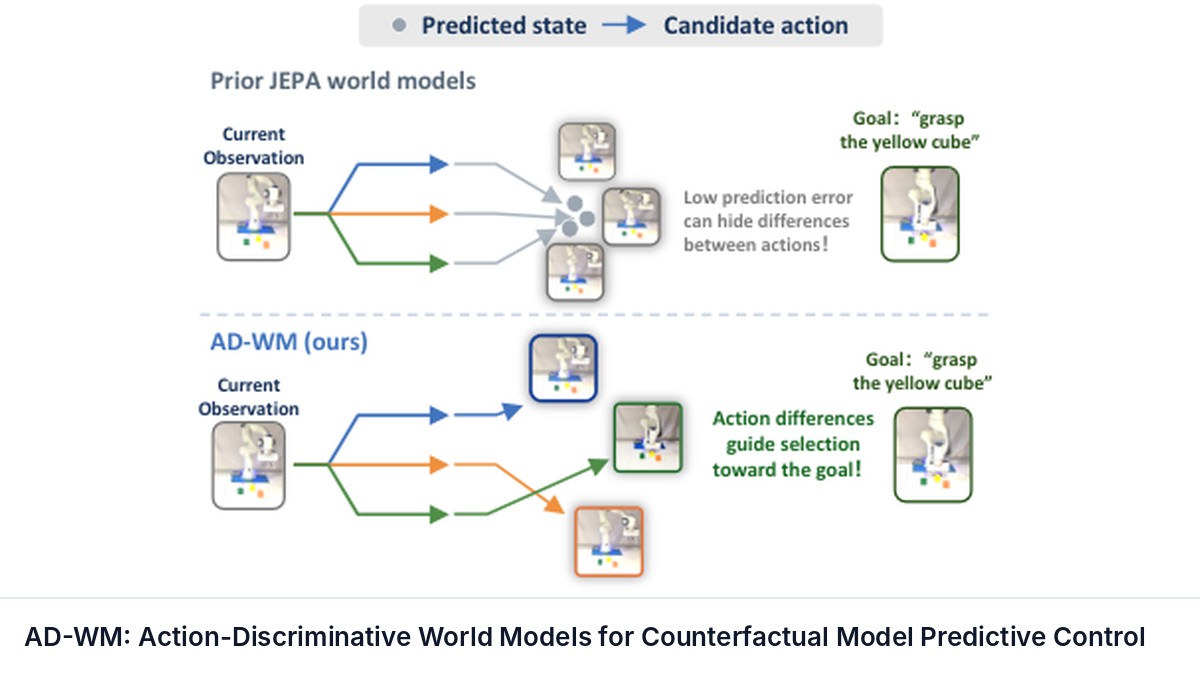
AD-WM: Action-Discriminative World Models for Counterfactual Model Predictive Control
Jiabin Qiu, Zixuan Chen, Hongye Cao et al.
Latent world models are typically trained to predict factual transitions, whereas model predictive control (MPC) must compare alternative actions from the same state. A model can therefore achieve low factual prediction error yet poorly distinguish candidate actions.
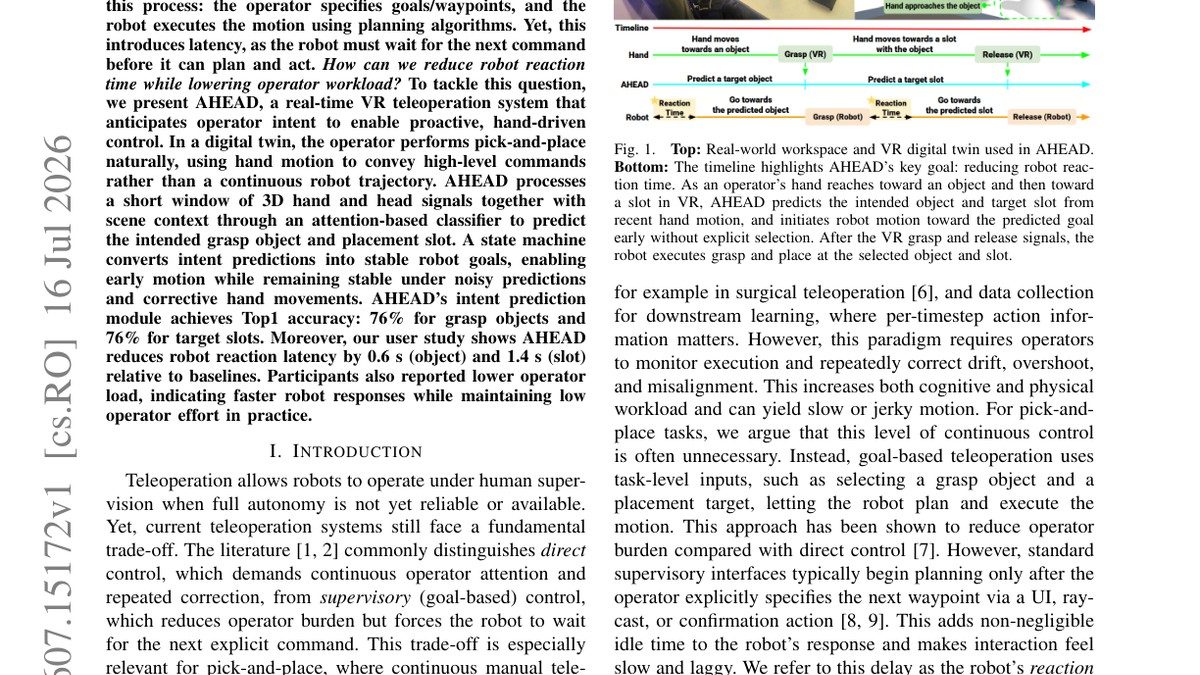
AHEAD: Anticipatory Hand-Driven Teleoperation via Human Intent Prediction
Seok Joon Kim, Junho Lee, Federica Spinola et al.
Direct hand-driven teleoperation maps an operator's hand motion to robot end-effector commands at every frame, enabling precise control, but it requires constant monitoring and correction during approach, grasp, and placement, which can be slow and fatiguing.
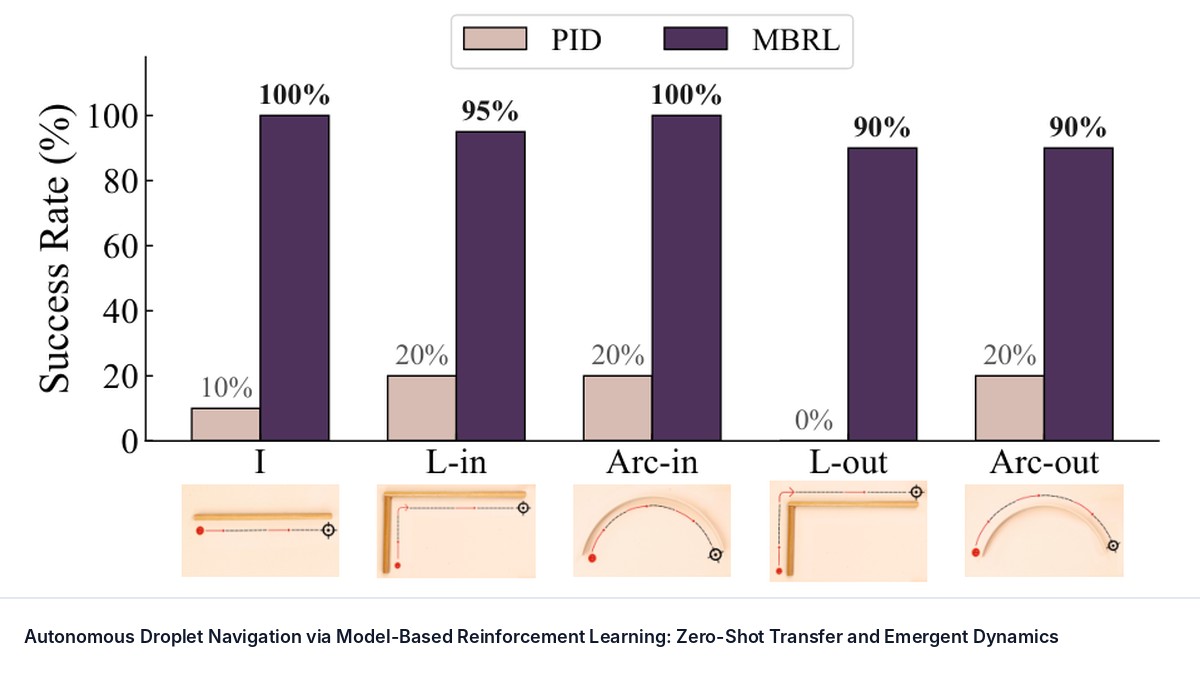
Autonomous Droplet Navigation via Model-Based Reinforcement Learning: Zero-Shot Transfer and Emergent Dynamics
Rajneesh Anand, Mayuresh V. Kothare
Self-driving laboratories (SDLs) are transforming chemical and materials discovery through closed-loop automation, yet automated infrastructure for physical manipulation of soft, deformable matter remains beyond current robotic platforms.
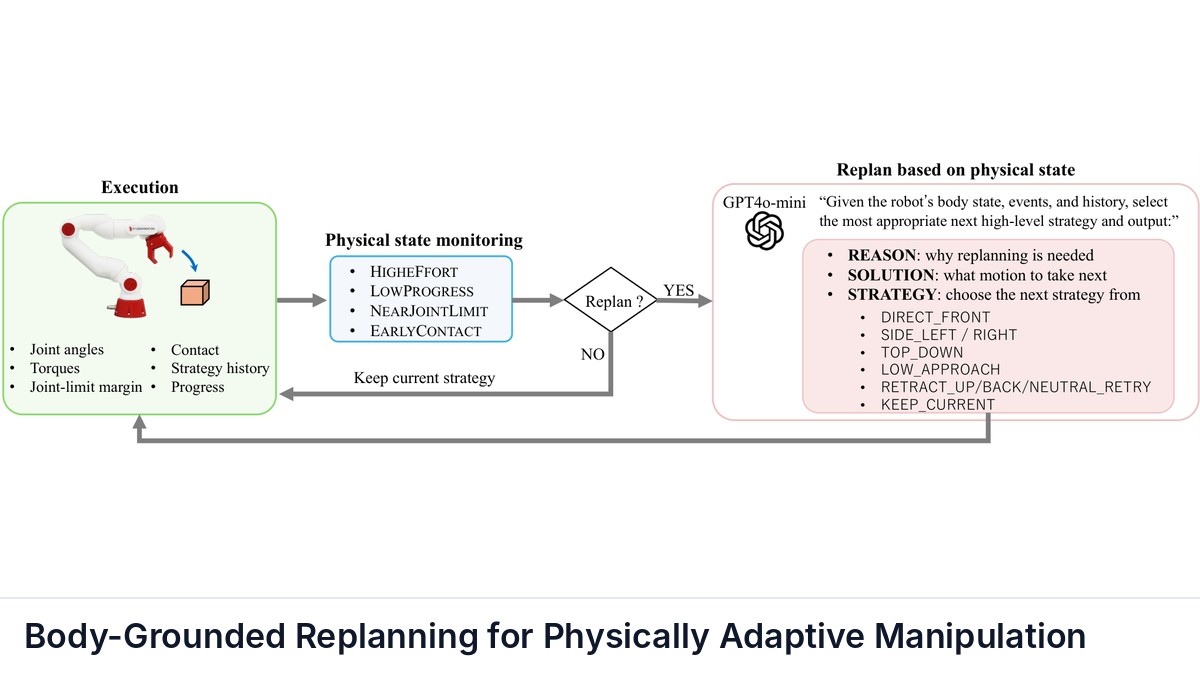
Body-Grounded Replanning for Physically Adaptive Manipulation
Namiko Saito, Hiroshi Kera
Manipulation requires not only reasoning about the external environment, but also about the robot's physical condition.