
What Stops Recursive Self-Improvement in Robotics? Lessons from 123 Rounds of Agentic Skill Discovery
Jiaming Wang (National University of Singapore) · N/A · 2026
Framework
N/A
License
N/A
Stars
N/A
Summary
Can a robot improve itself the way coding agents now improve software? We built an agentic system to find out.
Abstract Summary
Key Points
- Can a robot improve itself the way coding agents now improve software?
- We built an agentic system to find out
- It watches a robot fail, works out which capability is missing, writes new skills or finds and installs external models, tests every change in simulation, and repeats, with no human writing robot code.
- We ran it for 123 improvement rounds on household manipulation tasks
- This report describes what we learned
System Overview
1 Collect run task programs in simulation 2 Judge evaluator checks each declared step 3 Diagnose group first failures into gaps 4 Propose agent edits skills or requests a new model 5 Test & accept replay failure, fresh states, held-out task Research install, probe, register an external model code request next round starts from the improved robot Task program composes skills and declares step goals Routing chooses among a skill’s implementations Harness evaluators, tests, memory, robot interface description Models (providers) segmenters, VLMs, g...
What happened over 123 rounds
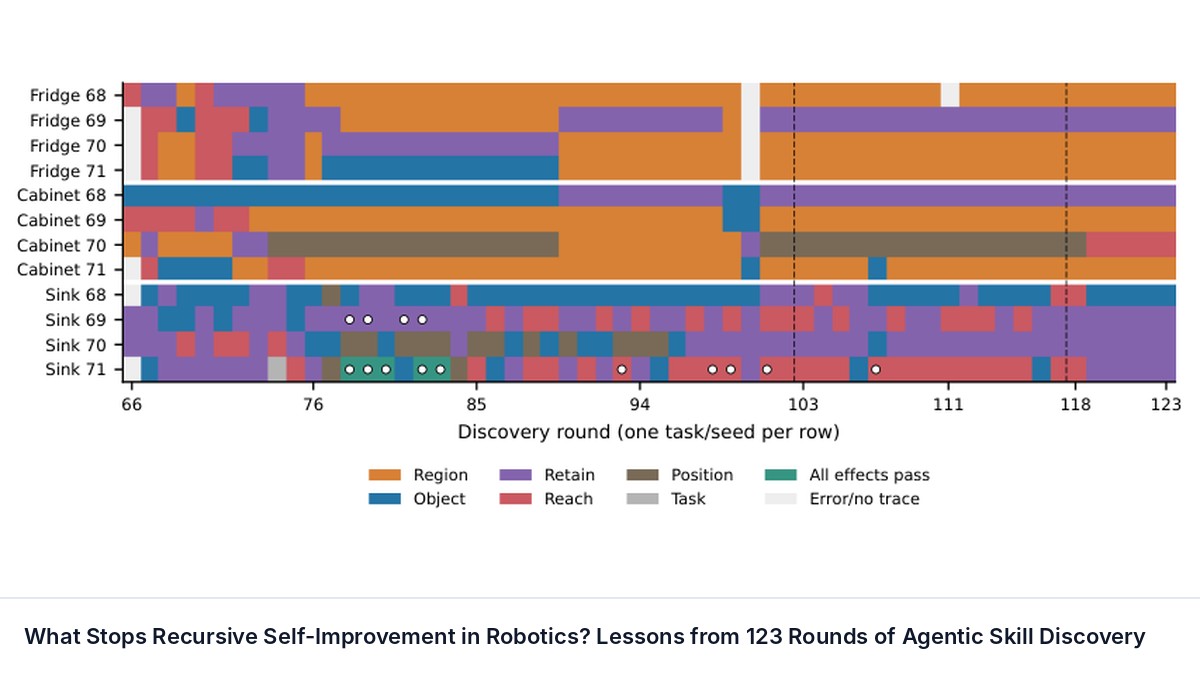
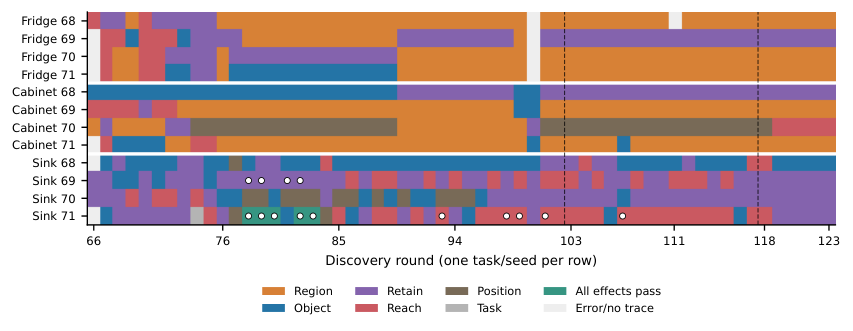
Figure 1 summarizes the whole run, and Figure 3 shows, round by round, where each task first failed. The story has three phases. Early on, the loop did what we hoped. The condiments in Fridge start out of view, and nothing in any prompt said so. At first the localizer returned confident points on visible look-alikes, and the agent tried to re-rank them.
Why improvements did not add up
Let $\Phi_{t}$ be the robot’s library after round $t$ and let a task be a chain of $m$ declared steps. Write $p_{j}(\Phi)$ for the probability that step $j$ succeeds given that steps $1,\dots,j-1$ did, and $\pi_{j}=\prod_{i reaches step $j$. Task success is $S(\Phi)=\prod_{j=1}^{m}p_{j}$, which requires no independence assumption.
Each round, the loop observes failures, a proposer produces a change $\delta$, and a gate $G$ accepts it, so that $\Phi_{t+1}=\Phi_{t}\oplus\delta$ when $G(\delta)=1$.
Lesson 1: chained perception modules do not understand relations
The fridge instruction reads: place the condiments on the top shelf; if items already occupy the top shelf, move them to other shelves. Every program the orchestrator wrote therefore asks perception for regions defined by relations: “the top shelf inside the fridge”, “the shelf immediately below the top shelf”, “a food item on the top shelf”.
This is exactly the kind of query household instructions are made of, and the loop never learned to answer it.
Lesson 2: skill chains lock learning onto the first step
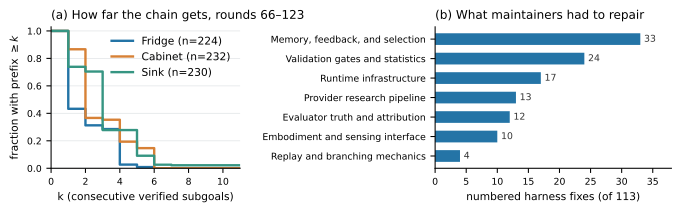
A household task is not a skill but a chain of them. The fridge task needs roughly fifteen declared steps: find the top shelf, clear it, then twice find a condiment, approach, grasp, carry, find the shelf again, place and release. This section argues that chaining does more than multiply small unreliabilities. It also shapes what the loop can learn , in a way that keeps it stuck at the front of the chain.
Consider a change that raises the reliability of step $j$ by $\Delta p_{j}$ and leaves everything else fixed.
Lesson 3: what the agent learns is decided by the harness
In a self-improvement loop the proposer supplies variation; everything else (the evaluators that say what went wrong, the gates that accept or reject, the memory that carries experience forward) supplies selection. In software the selection side is a test suite. In robotics it is a set of fallible models of physics and meaning, written by people and never complete.
This section argues that the selection side, not the proposer, determined what our loop learned. We identify four mechanisms by which it failed.
What we would do differently
If we started again, we would build the loop differently. Below are our recommendations, grouped by which of the three conditions each one restores. They come from this experiment but were not themselves tested in it, so Table 3 pairs each with an experiment that could prove it wrong. (D1) Attribute failures by capability, not by location.
An evaluator should ask whether a step could have succeeded from the state in which it began, and assign the failure to the step that made it impossible.
Sources and Demonstrations
Figures are reproduced from Singapore) See the full paper for experimental details and the project page, when the paper links one, for demonstrations and videos.
Related Papers
3DThinkVLA: Endowing Vision-Language-Action Models with Latent 3D Priors via 3D-Thinking-Guided Co-training
Jiaxin Shi, Xidong Zhang, Fucai Zhu et al.
We propose a 3D-thinking-guided co-training framework that enables vision-language-action (VLA) models to perform 3D spatial reasoning implicitly during action prediction.
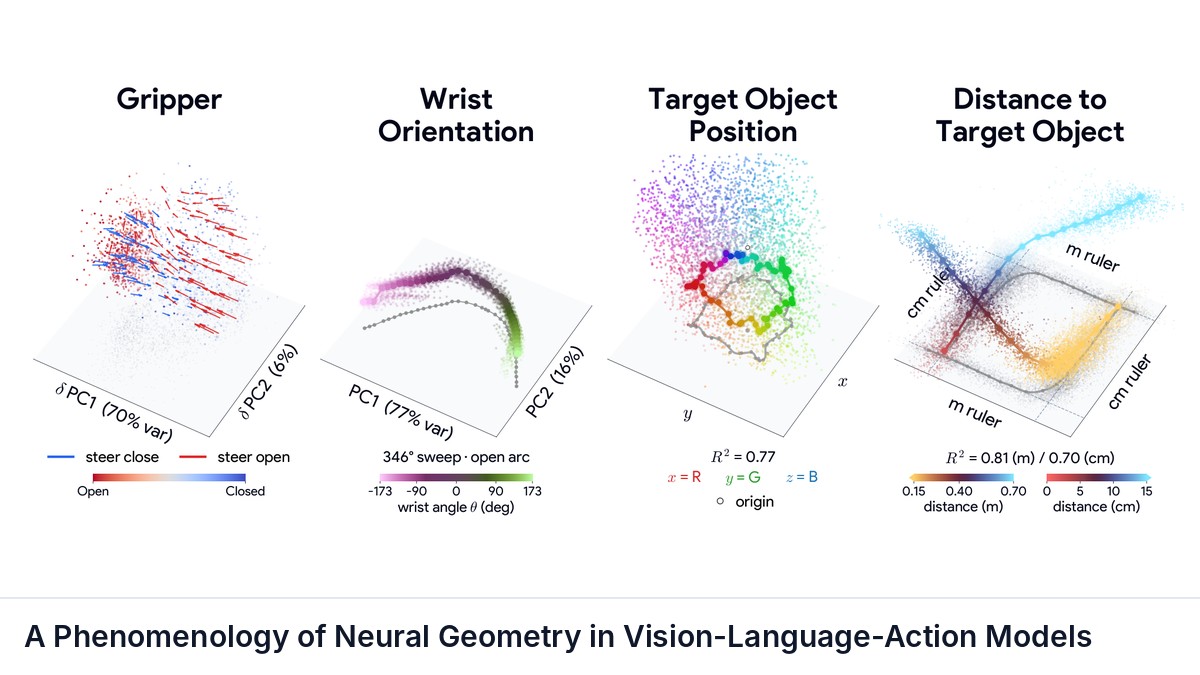
A Phenomenology of Neural Geometry in Vision-Language-Action Models
Mozes Jacobs, Aiden Swann, Mathilde Papillon et al.
Robotic manipulation is inherently geometric, but what shape does the world take inside the policy that performs it?

A Sim-to-Real Integration Pipeline for Training and Deployment of Chunk-Based VLA Manipulation Policies
Mathilde Kappel, Clémence Grislain, Mohamed Chetouani et al.
Vision-Language-Action (VLA) models have become a prominent paradigm for mapping multimodal inputs, including semantic instructions, visual observations of the scene, and proprioceptive observations, to robot actions.
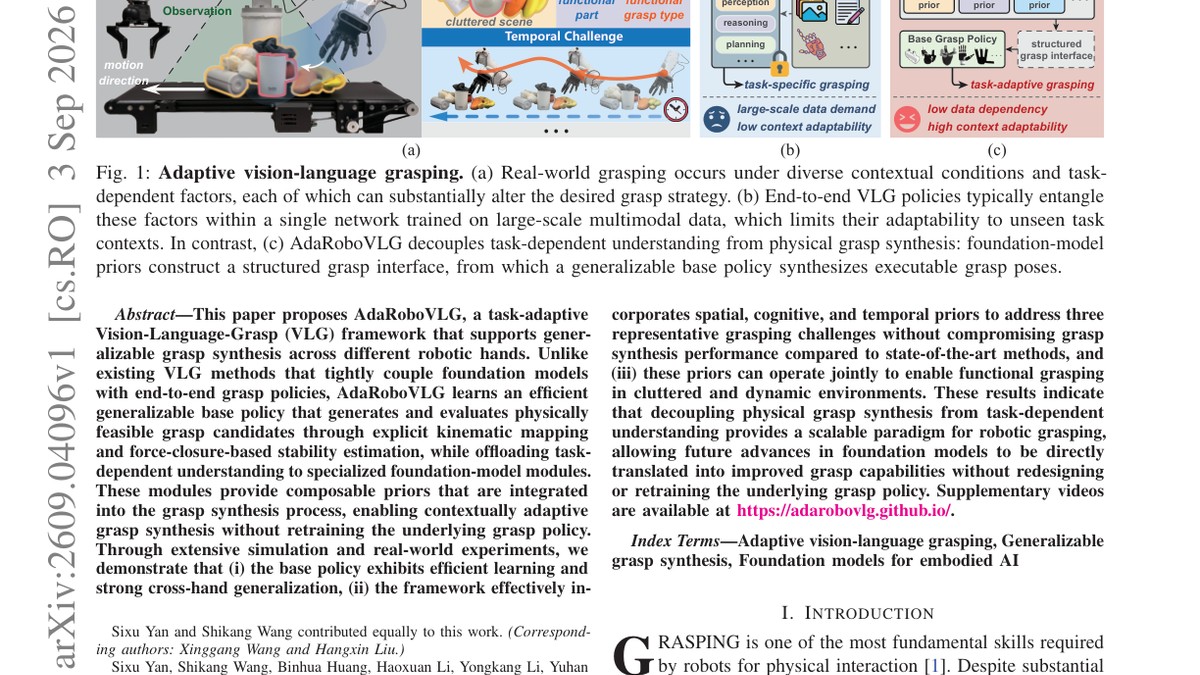
Adaptive Vision-Language Grasping via Composable Foundation Priors and Generalizable Grasp Synthesis
Sixu Yan, Shikang Wang, Binhua Huang et al.
This paper proposes AdaRoboVLG, a task-adaptive Vision-Language-Grasp (VLG) framework that supports generalizable grasp synthesis across different robotic hands.