
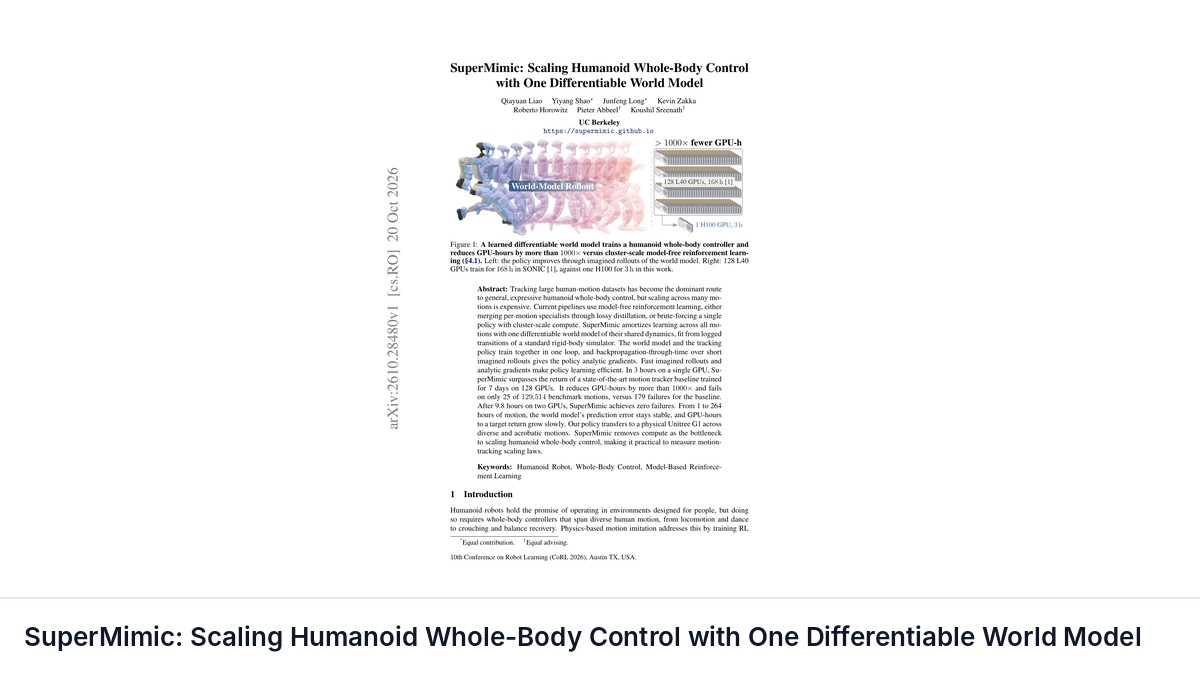
SuperMimic: Scaling Humanoid Whole-Body Control with One Differentiable World Model
Liao, Qiayuan, Shao, Yiyang, Long, Junfeng, Zakka, Kevin, Horowitz, Roberto, Abbeel, Pieter, Sreenath, Koushil · UC Berkeley · 2026
Framework
N/A
License
N/A
Stars
N/A
Summary
Tracking large human-motion datasets has become the dominant route to general, expressive humanoid whole-body control, but scaling across many motions is expensive.
Abstract Summary
Key Points
- Tracking large human-motion datasets has become the dominant route to general, expressive humanoid whole-body control, but scaling across many motions is expensive.
- Current pipelines use model-free reinforcement learning, either merging per-motion specialists through lossy distillation, or brute-forcing a single policy with cluster-scale compute.
- SuperMimic amortizes learning across all motions with one differentiable world model of their shared dynamics, fit from logged transitions of a standard rigid-body simulator.
- The world model and the tracking policy train together in one loop, and backpropagation-through-time over short imagined rollouts gives the policy analytic gradients.
- Fast imagined rollouts and analytic gradients make policy learning efficient
SuperMimic: Scaling Humanoid Whole-Body Control with One Differentiable World Model
|Authors: Liao, Qiayuan, Shao, Yiyang, Long, Junfeng, Zakka, Kevin, Horowitz, Roberto, Abbeel, Pieter, Sreenath, Koushil
|Venue: arXiv preprint | Year: 2026
|arXiv: 2610.28480
Abstract
Tracking large human-motion datasets has become the dominant route to general, expressive humanoid whole-body control, but scaling across many motions is expensive. Current pipelines use model-free reinforcement learning, either merging per-motion specialists through lossy distillation, or brute-forcing a single policy with cluster-scale compute. SuperMimic amortizes learning across all motions with one differentiable world model of their shared dynamics, fit from logged transitions of a standard rigid-body simulator. The world model and the tracking policy train together in one loop, and backpropagation-through-time over short imagined rollouts gives the policy analytic gradients. Fast imagined rollouts and analytic gradients make policy learning efficient. In 3 hours on a single GPU, SuperMimic surpasses the return of a state-of-the-art motion tracker baseline trained for 7 days on 128 GPUs. It reduces GPU-hours by more than and fails on only 25 of 129,514 benchmark motions, versus 179 failures for the baseline. After 9.8 hours on two GPUs, SuperMimic achieves zero failures. From 1 to 264 hours of motion, the world model’s prediction error stays stable, and GPU-hours to a target return grow slowly. Our policy transfers to a physical Unitree G1 across diverse and acrobatic motions. SuperMimic removes compute as the bottleneck to scaling humanoid whole-body control, making it practical to measure motion-tracking scaling laws.
Key Contributions
- Tracking large human-motion datasets has become the dominant route to general, expressive humanoi…
- Current pipelines use model-free reinforcement learning, either merging per-motion specialists th…
- SuperMimic amortizes learning across all motions with one differentiable world model of their sha…
- The world model and the tracking policy train together in one loop, and backpropagation-through-t…
- Fast imagined rollouts and analytic gradients make policy learning efficient
Topics
- reinforcement-learning
- control
- benchmark
Code & Data
No code repository linked in paper metadata.
BibTeX
@article{Qiayuan2026_261028480,
  title     = {SuperMimic: Scaling Humanoid Whole-Body Control with One Differentiable World Model},
  author    = {Liao, Qiayuan and Shao, Yiyang and Long, Junfeng and Zakka, Kevin and Horowitz, Roberto and Abbeel, Pieter and Sreenath, Koushil},
  year      = {2026},
  eprint    = {2610.28480},
  archivePrefix = {arXiv},
  primaryClass  = {cs.RO},
  url       = {https://arxiv.org/abs/2610.28480}
}
Related Papers
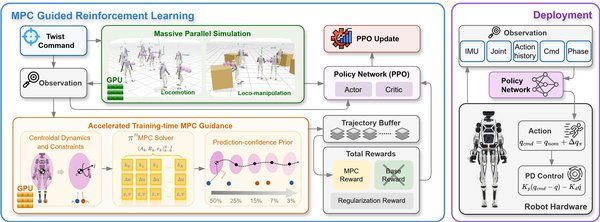
Accelerating and Scaling MPC-Guided Reinforcement Learning for Humanoid Locomotion and Manipulation
Junheng Li, Liang Wu, Sergio A. Esteban et al.
In humanoid motion control, model predictive control (MPC) offers physically grounded prediction and constraint handling, while reinforcement learning (RL) enables robust whole-body skills through large-scale simulation. However, using MPC inside RL often requires time-consuming problem construction or excessive training overhead, making such frameworks difficult to justify in practice. This work studies efficient training-time MPC guidance for humanoid locomotion and manipulation, termed MPC-RL. We introduce a centroidal-dynamics MPC reward formulation that leverages guidance from MPC trajectories in training time. To make this practical in massively parallel RL, we develop π^nMPC, a parallel-in-horizon and construction-free batched GPU MPC solver that operates directly on time-varying dynamics to avoid high memory usage and pre-compilation. Through a variety of comparative studies and hardware validations, we have found that MPC-RL achieves superior performance in locomotion and manipulation skills.
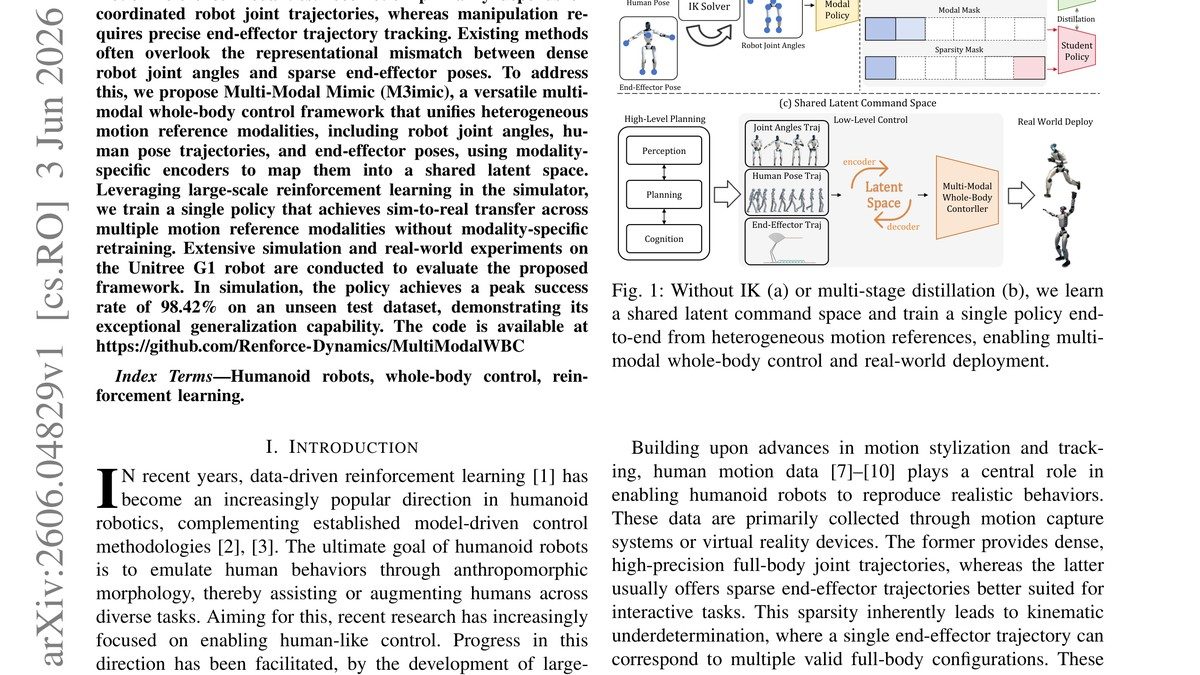
M3imic: Learning a Versatile Whole-Body Controller for Multimodal Motion Mimicking
Zuxing Lu, Ziang Zheng, Yao Lyu et al.
Building a general-purpose whole-body controller is essential for enabling diverse motion capabilities in humanoid robots across a wide range of downstream tasks, including locomotion and loco-manipulation.
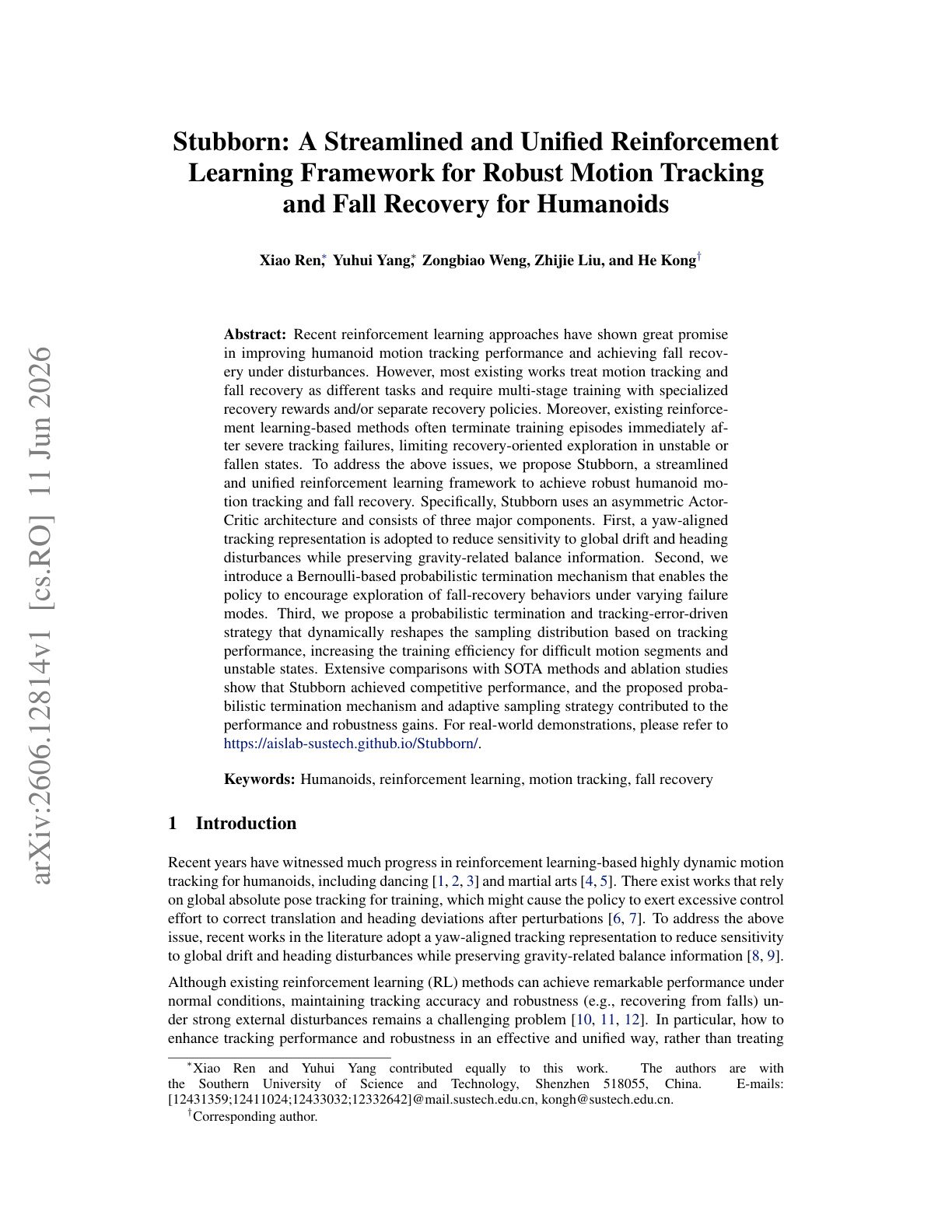
Stubborn: A Streamlined and Unified Reinforcement Learning Framework for Robust Motion Tracking and Fall Recovery for Humanoids
Xiao Ren, Yuhui Yang, Zongbiao Weng et al.
Recent reinforcement learning approaches have shown great promise in improving humanoid motion tracking performance and achieving fall recovery under disturbances.
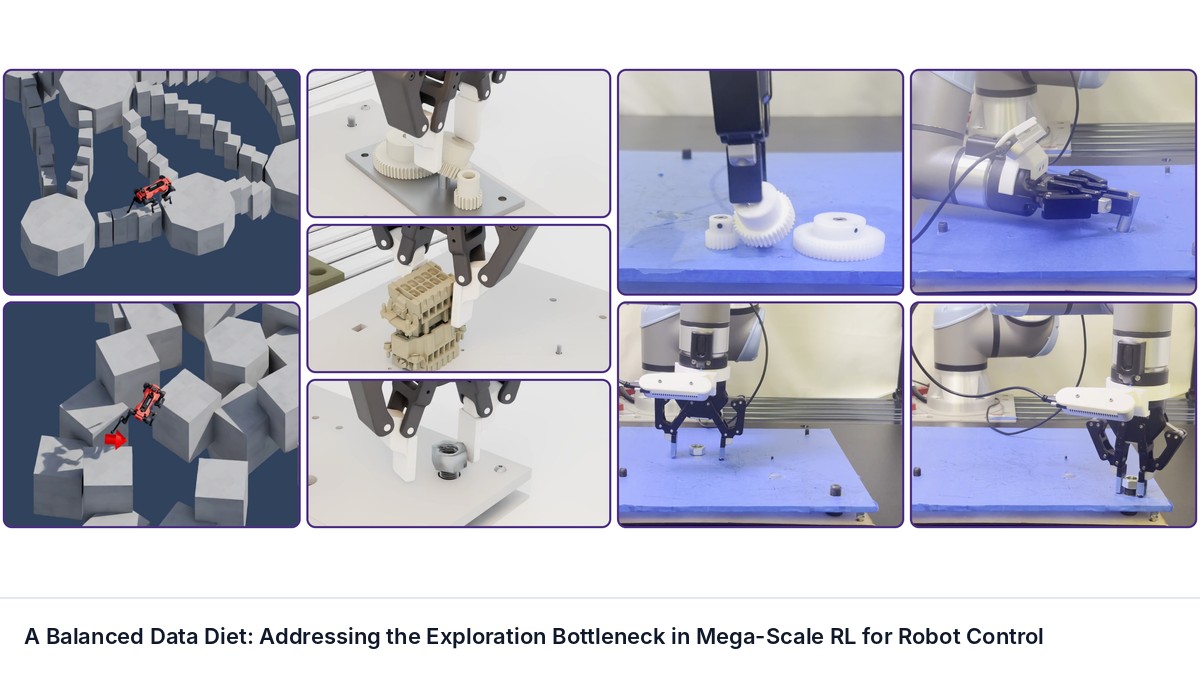
A Balanced Data Diet: Addressing the Exploration Bottleneck in Mega-Scale RL for Robot Control
Octi Zhang, Mateo Guaman Castro, Patrick Yin et al.
General-purpose robots must perform a wide range of tasks from agile locomotion to dexterous manipulation.