
A Balanced Data Diet: Addressing the Exploration Bottleneck in Mega-Scale RL for Robot Control
Octi Zhang, Mateo Guaman Castro, Patrick Yin, Ignacio Dagnino, Abhishek Gupta, Rosario Scalise, Byron Boots · N/A · 2026
Framework
N/A
License
N/A
Stars
N/A
Summary
General-purpose robots must perform a wide range of tasks from agile locomotion to dexterous manipulation.
Abstract Summary
Key Points
- General-purpose robots must perform a wide range of tasks from agile locomotion to dexterous manipulation.
- While sim-to-real reinforcement learning (RL) has proven to be a useful tool for this goal, current RL pipelines depend on engineering-heavy, per-task structural priors such as shaped rewards and demonstrations.
- Recent work has shown that diverse simulator resets, combined with massively parallel simulation, can alleviate much of this engineering burden on several manipulation problems.
- However, we find that naively scaling this paradigm to more precise or dynamic problems remains non-trivial.
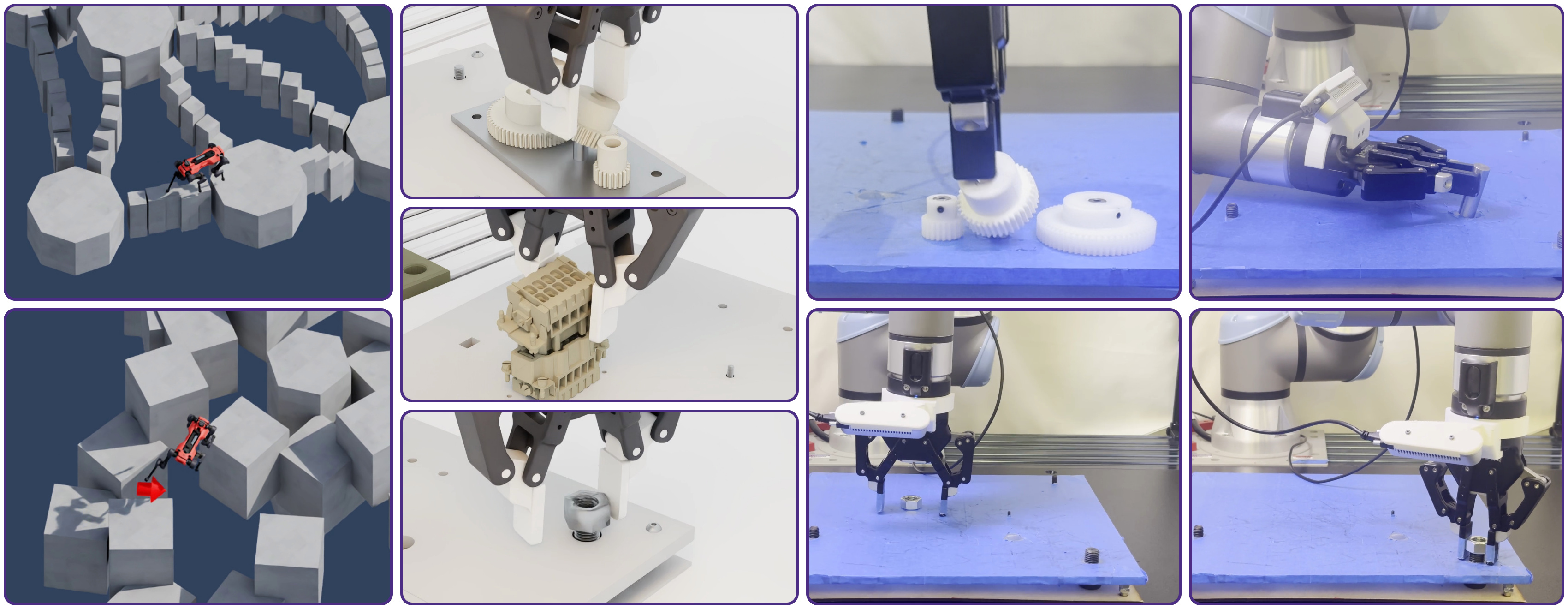
- While simulator resets can help with exploration, uniformly sampling over this distribution wastes a growing fraction of learning experience on task configurations the policy has already mastered or cannot yet attempt.
Method
We study the problem of learning goal-conditioned RL policies from scratch for challenging robotic control tasks.
We instantiate this problem as a goal-conditioned Markov Decision Process (MDP) $\mathcal{M}=(\mathcal{S},\mathcal{A},\mathcal{G},P,r,\gamma,\rho)$ where $s\in\mathcal{S}$ is the state, $a\in\mathcal{A}$ is the robot’s action, $g\in\mathcal{G}$ is the robot’s goal, $P$ is the transition dynamics, $r$ is the reward function, $\gamma$ is the discount factor, and $\rho$ is the distribution over initial state and goal pairs $(s_{0},g)\i...
Experimental Results
Through a series of large-scale scaling studies, we ask: (Q1) Scaling — does SGS scale better than uniform sampling and PLR [ 24 ] as parallel training environments grow? (Q2) Capability — does SGS unlock robotics tasks beyond what prior methods could solve, even at smaller scales? (Q3) Transfer — can dexterous manipulation behaviors learned with SGS transfer zero-shot to real hardware?
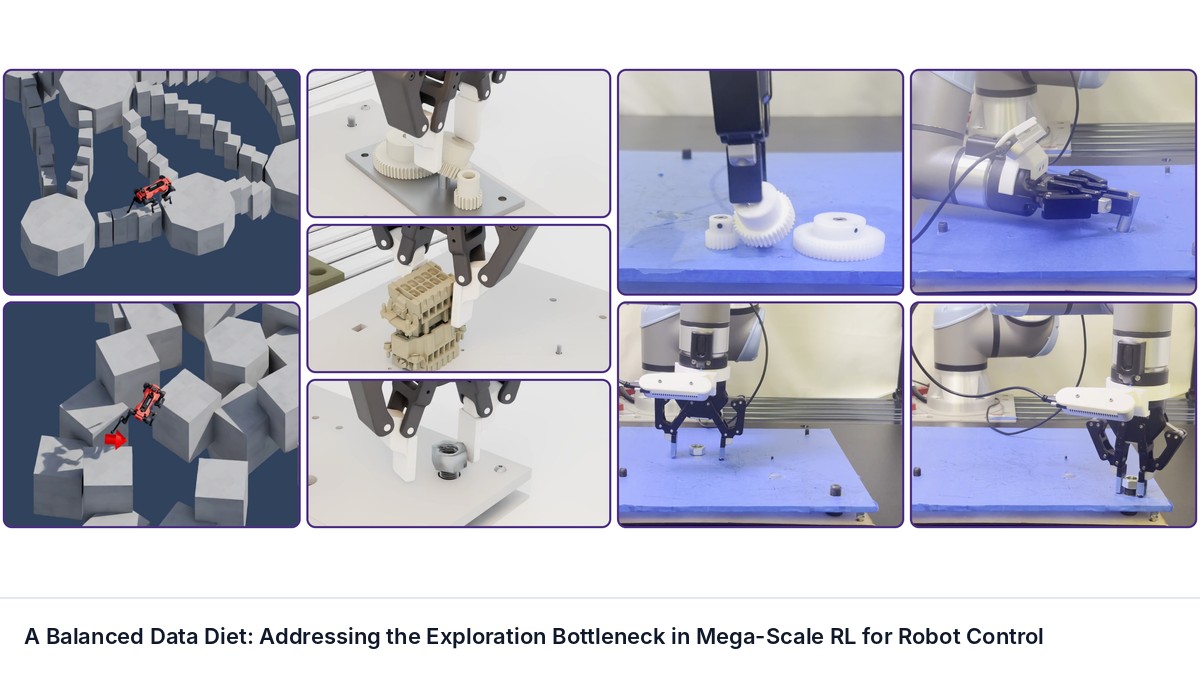
We study locomotion for a quadrupedal robot traversing a variety of different terrains, some of which can be seen in Figure 1 (See Appendix A.1 for a thorough d...
Sources and Demonstrations
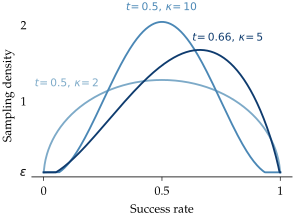
Figures are reproduced from Zhang et al. See the full paper for experimental details and the project page, when the paper links one, for demonstrations and videos.
Related Papers
OIL: An Object Interaction Layer for Humanoid Whole-Body Control
Pranay Dugar, Mohitvishnu S. Gadde, Rajesh Mangannavar et al.
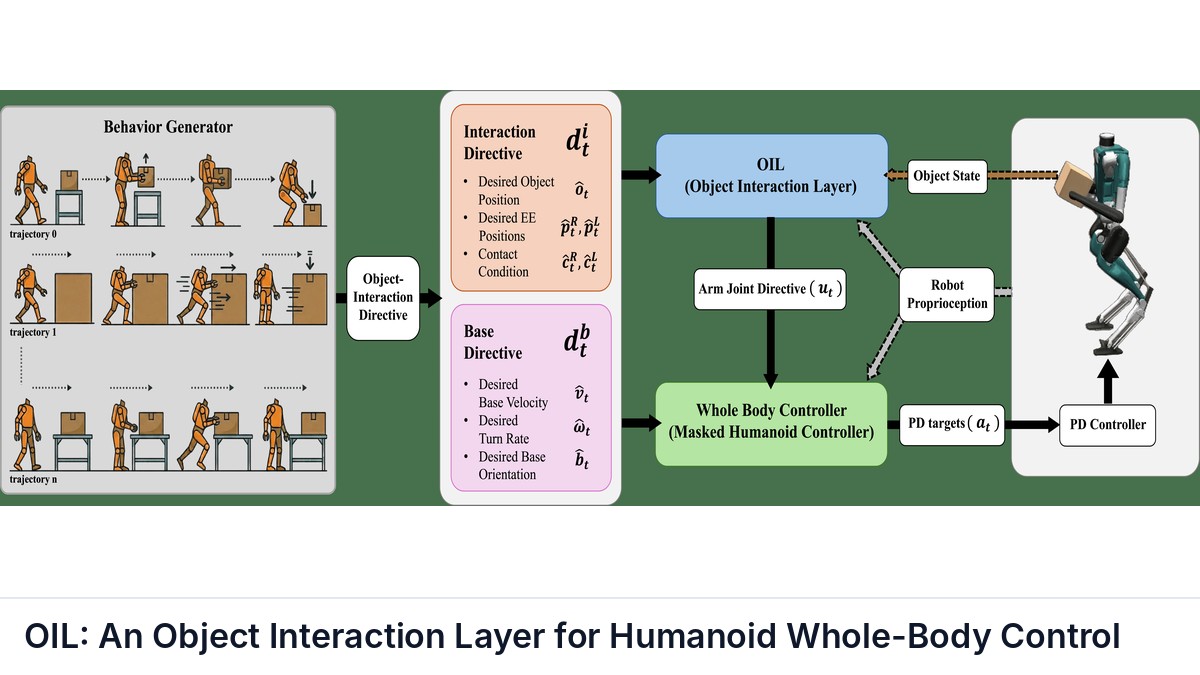
Recent progress in learned whole-body controllers for humanoid robots has enabled robust free-space motion by tracking kinematic targets such as joint or end-effector trajectories.
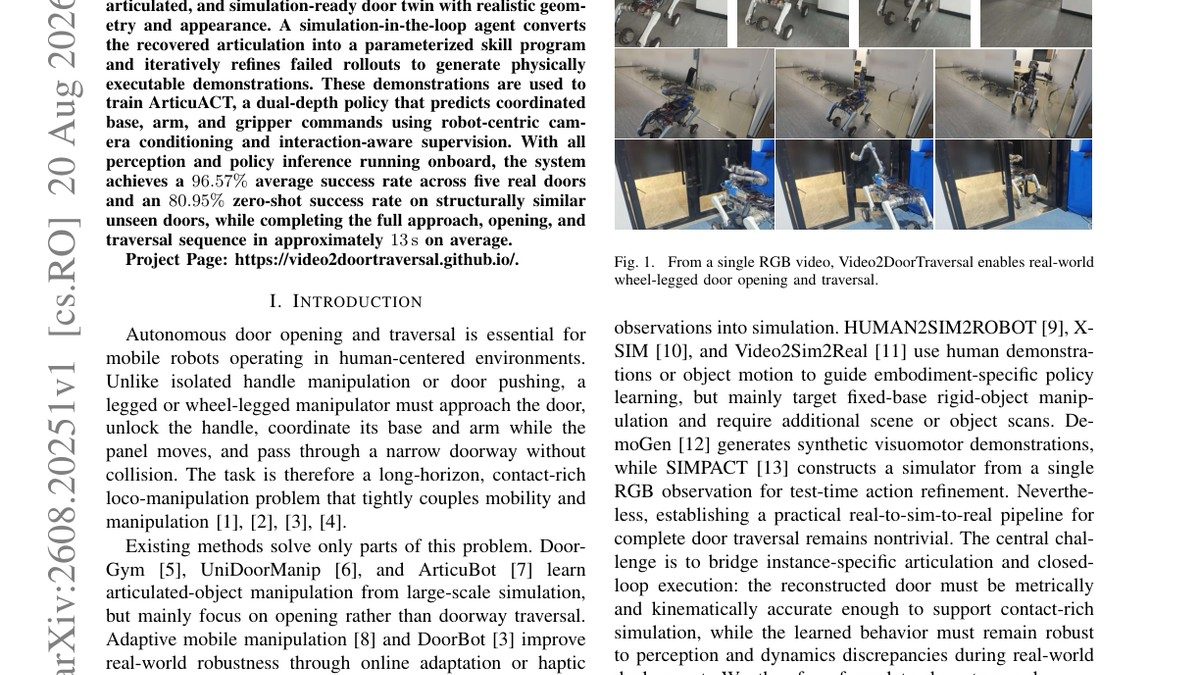
Video2DoorTraversal: Push Door Traversal via Simulated Door Twins
Xincheng Tang, Yiji Chen, Youhan Xie et al.
Door opening and traversal is a long-horizon loco-manipulation task that requires precise handle interaction and coordinated base-arm control. We present Video2DoorTraversal, a single-video real-to-sim-to-real framework for wheel-legged mobile manipulators.

A Sim-to-Real Integration Pipeline for Training and Deployment of Chunk-Based VLA Manipulation Policies
Mathilde Kappel, Clémence Grislain, Mohamed Chetouani et al.
Vision-Language-Action (VLA) models have become a prominent paradigm for mapping multimodal inputs, including semantic instructions, visual observations of the scene, and proprioceptive observations, to robot actions.
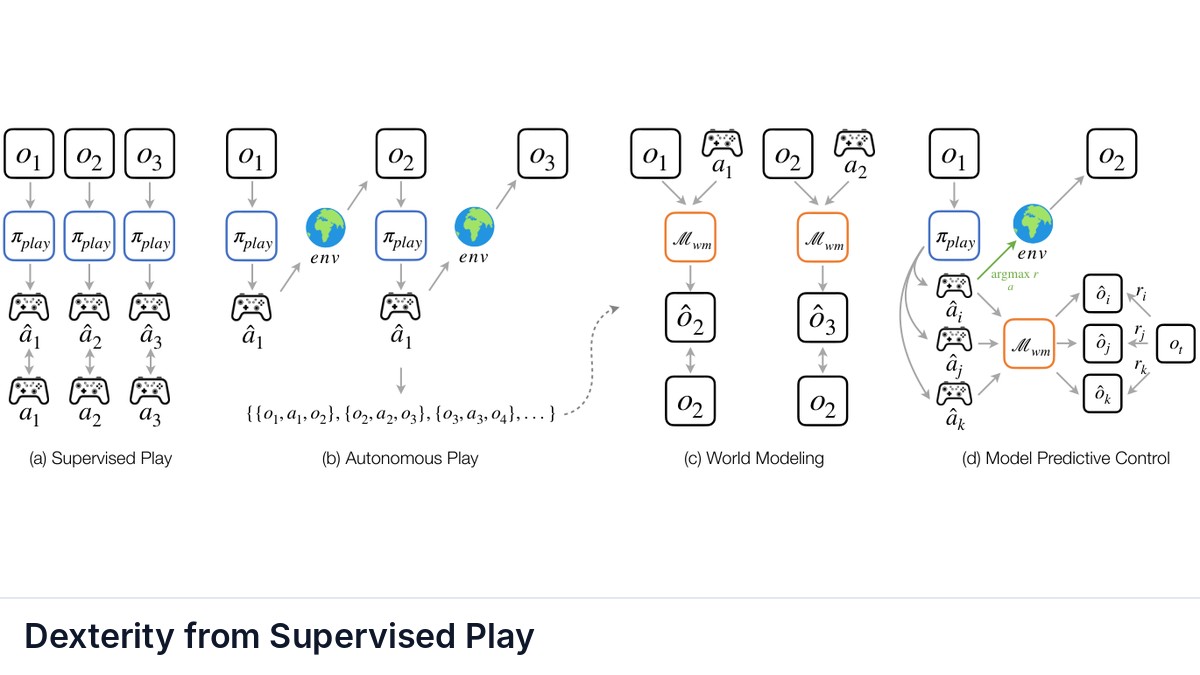
Dexterity from Supervised Play
Botao He, Yiming Dou, Yiannis Aloimonos et al.
How can robots autonomously collect the contact-rich experience needed to learn dexterous manipulation?