
Co-VLA: Coordination-Aware Structured Action Modeling for Dual-Arm Vision-Language-Action Systems
FeaturedYandong Wang, Jiaqian Yu, Xiongfeng Peng, Lu Xu, Yamin Mao, Weiming Li, Jaewook Yoo, Dongwook Lee, Daehyun Ji, Mingbo Zhao, Chao Zhang · · 2026
Framework
N/A
License
N/A
Stars
N/A
Summary
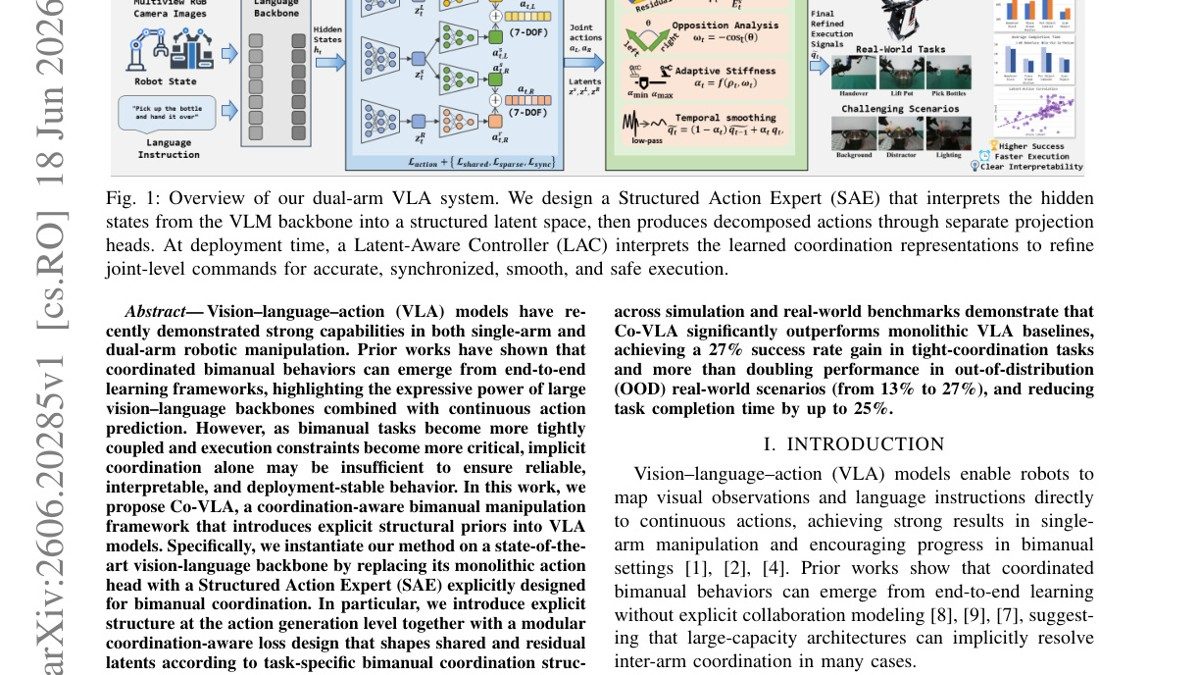
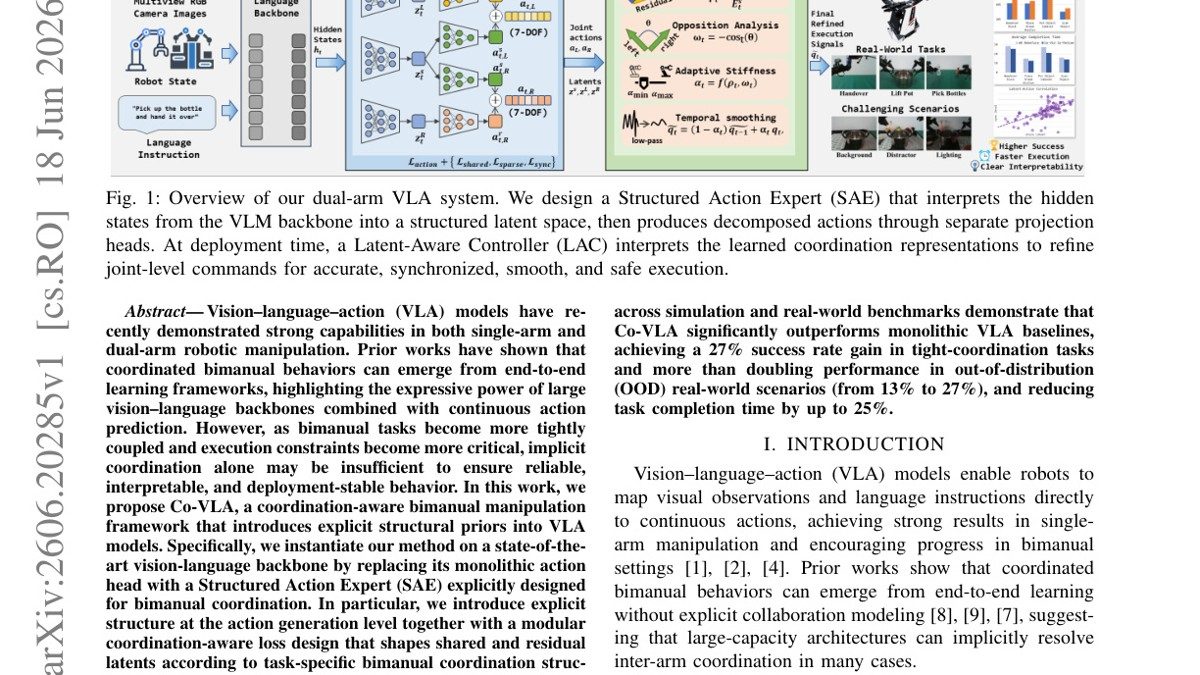
Vision-language-action (VLA) models show strong capabilities in single and dual-arm robotic manipulation. Prior works show coordinated bimanual behaviors can emerge from end-to-end learning, leveraging large vision-language backbones with continuous action prediction.
Abstract Summary
Key Points
- Proposes Co-VLA for robotics.
- Evaluated on real or simulated robotic tasks.
- Primary contribution in ar-vr.
Method
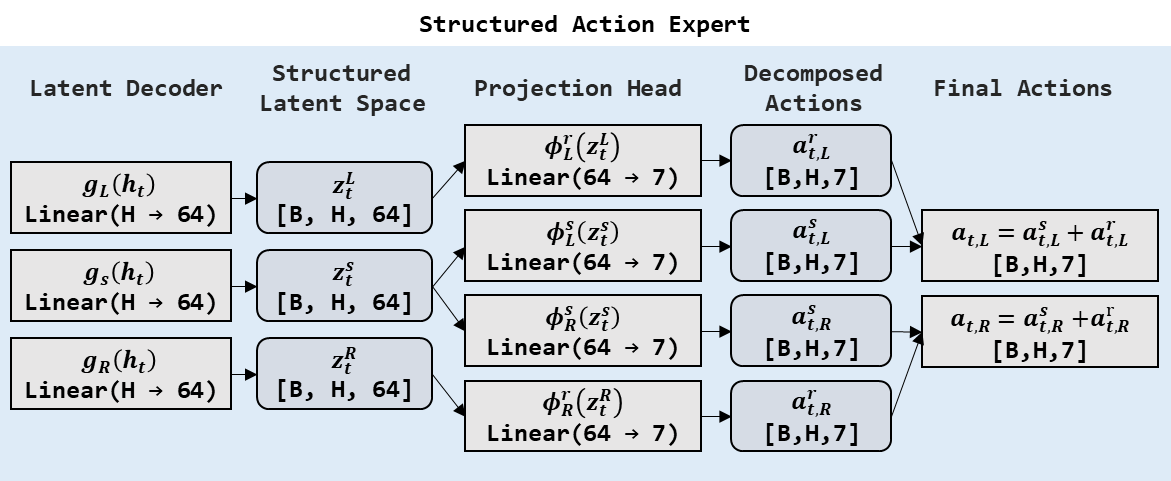
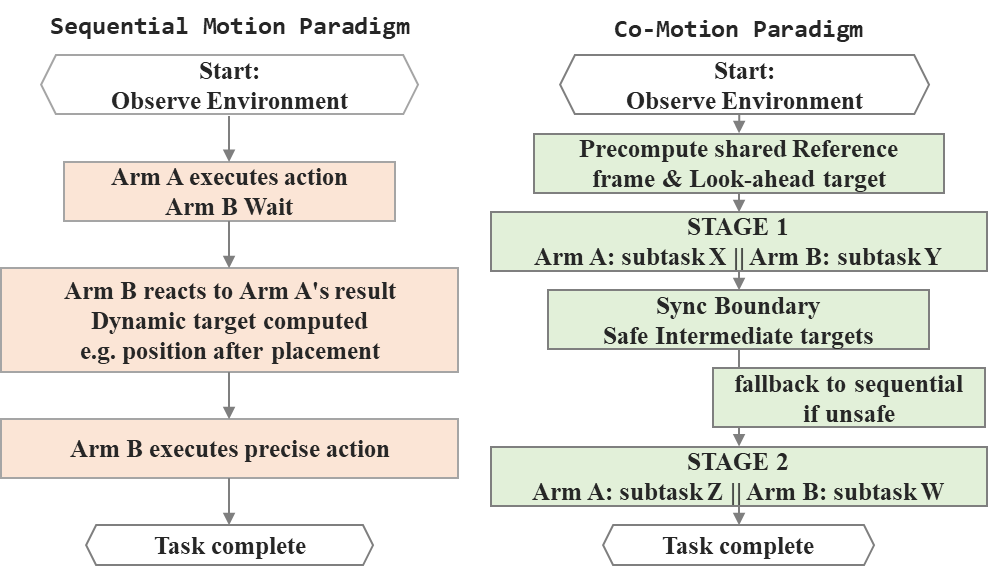
Our approach extends exisiting VLA framework by introducing structured action modeling and execution refinement for coordinated bimanual manipulation. As illustrated in Fig. , The system comprises three components: Structured Action Expert (SAE) a shared–residual decomposition that explicitly separates task-level coordination intent from arm-specific execution (Sec.
Experiment
RoboTwin tasks Real-World tasks At training stage, we adopt a two-phase strategy. In Phase 1 (warm-up), we freeze the pretrained backbone and train only the newly introduced SAE layers, including the shared and residual action projections as well as the share-to-arm routing modules, for 1,000 steps with a peak learning rate of $5\times 10^{-5}$.
This allows the new parameters to reach a reasonable initialization without disrupting the pretrained representations.
Sources and Demonstrations
Figures are reproduced from Wang et al. See the full paper for experimental details and the project page, when the paper links one, for demonstrations and videos.
Related Papers
Co-VLA: Coordination-Aware Structured Action Modeling for Dual-Arm Vision-Language-Action Systems
Yandong Wang, Jiaqian Yu, Xiongfeng Peng et al.
Vision-language-action (VLA) models show strong capabilities in single and dual-arm robotic manipulation. Prior works show coordinated bimanual behaviors can emerge from end-to-end learning, leveraging large vision-language backbones with continuous action prediction.
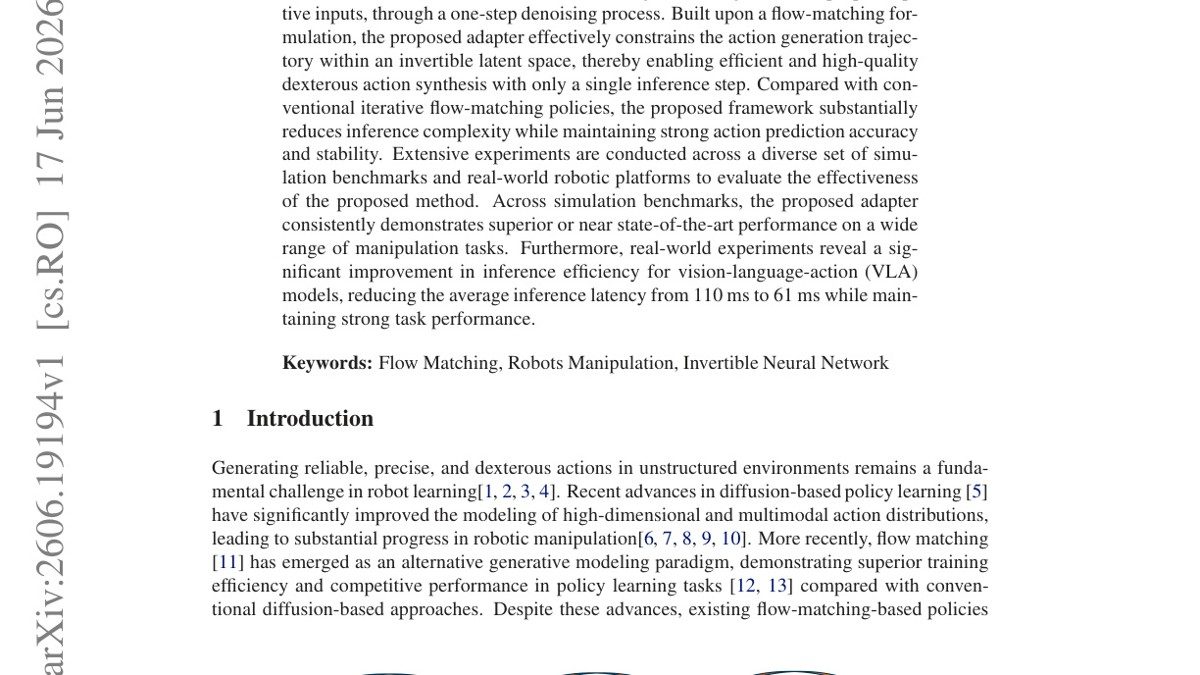
Invertible Neural Network Adapter for One-Step Flow Matching in Robot Manipulation
Yu Zhang, Kangyi Ji, Yongxiang Zou et al.
This paper presents an invertible neural network adapter for general robotic manipulation, designed to generate precise high-dimensional actions conditioned on multimodal observations, including visual, linguistic, and proprioceptive inputs, through a one-step denoising process.
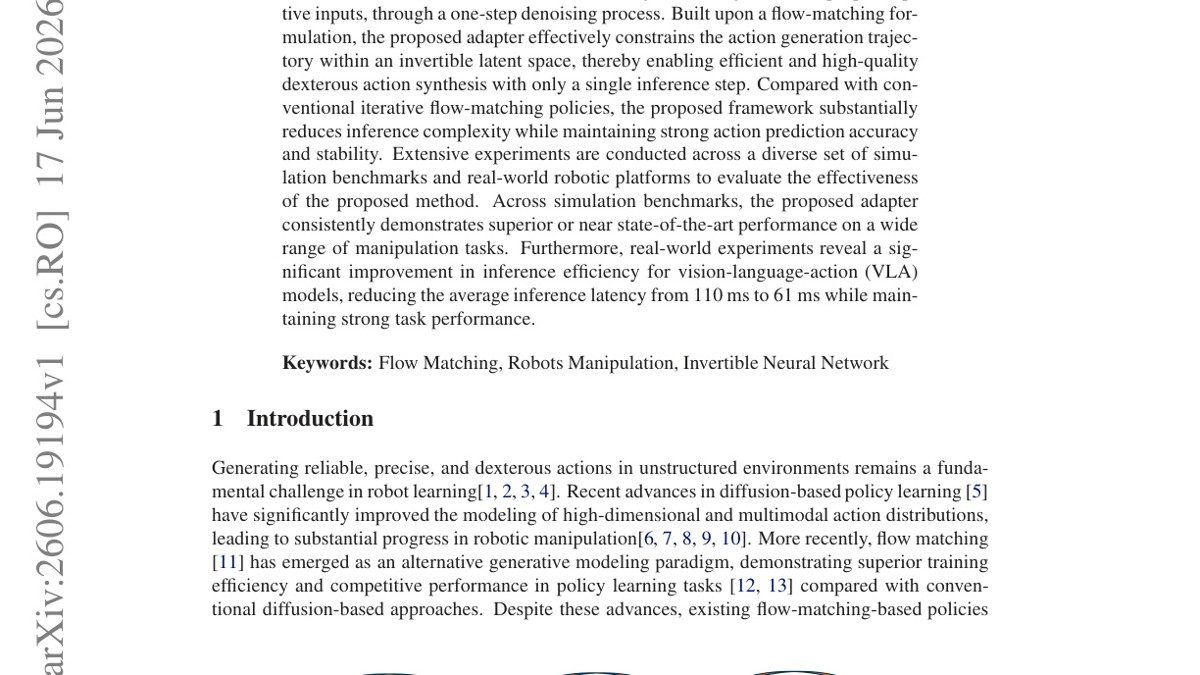
Invertible Neural Network Adapter for One-Step Flow Matching in Robot Manipulation
Yu Zhang, Kangyi Ji, Yongxiang Zou et al.
This paper presents an invertible neural network adapter for general robotic manipulation, designed to generate precise high-dimensional actions conditioned on multimodal observations, including visual, linguistic, and proprioceptive inputs, through a one-step denoising process.
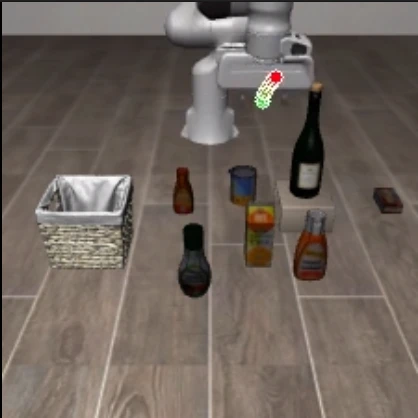
Neuro-Symbolic Safety Guidance for Vision-Language-Action Models via Constrained Flow Matching
William English, Hao Zheng, Rickard Ewetz
This method checks a predicted action sequence for future collisions while the VLA is still generating it, rather than correcting only the next action.