
At a glance
- Problem: reactive corrections can interfere with a multi-step policy. Source
- Idea: interleave trajectory prediction and constrained correction during flow matching. Source
- Evidence: improved collision avoidance and task completion on SafeLIBERO. Source
Evaluation scope Simulation evaluation with obstacle positions supplied by the simulator. These results are not physical-robot safety certification. Source

How it works
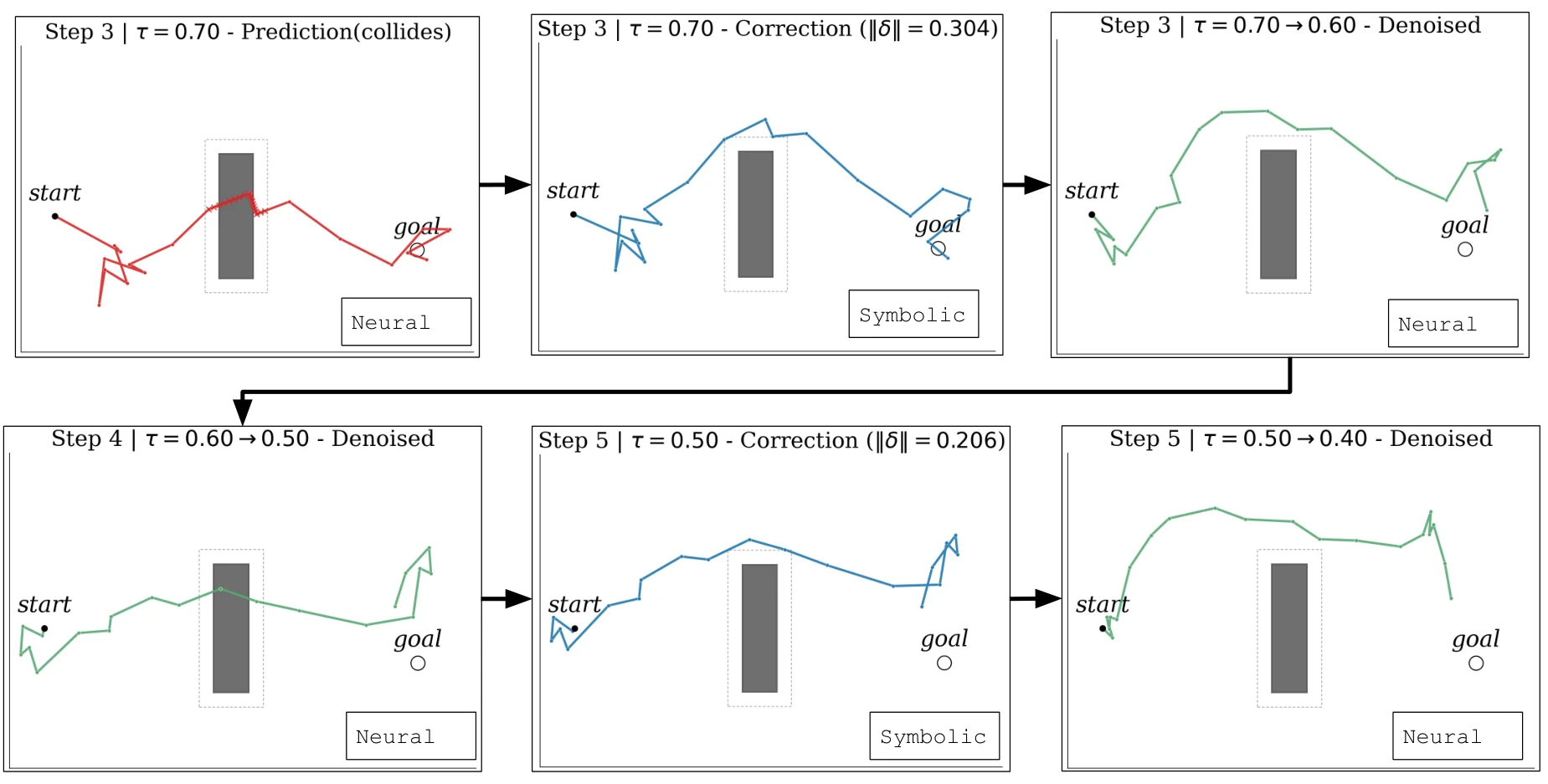
- Predict future end-effector positions from the current action chunk and check obstacle clearance. Source
- Apply minimum-norm corrections before the next denoising step, allowing the model to adapt its trajectory. Source
Evidence & results
Limitations & boundaries
Takeaway
Integrating constraints during generation is promising, but perception uncertainty and full-body safety remain unresolved. Source
Resources
Figures: the paper's authors. Editorial source and image review: 2026-10-21. Findings are author-reported, not independently reproduced by Robotics Research Hub.
Original abstract
Vision-Language-Action (VLA) models have demonstrated promising generalization capabilities across robotic manipulation tasks, yet their real-world deployment remains limited by the lack of effective safety measures. Specifically, existing safety measures only prevent collisions caused by the robot's next action. In this paper, we propose a neuro-symbolic safety guidance mechanism for flow matching based VLAs that enables predictive collision avoidance. Flow matching based VLAs determine the next actions by predicting a trajectory (a sequence of actions) through an iterative neural flow matching process. Our method formulates safety enforcement as a minimum-norm constrained optimization problem that corrects safety violations during the denoising process of noisy intermediate trajectory predictions. By analyzing predicted trajectories and applying corrections during iterative denoising, our approach anticipates collisions before they become unavoidable. This interleaving of symbolic constraint satisfaction with neural trajectory generation enables predictive collision avoidance rather than reactive intervention. On the SafeLIBERO benchmark, our method achieves 82.8% collision avoidance and 81.6% task success, a 6.3% and 19.8% improvement respectively over single-step methods, with the largest gains on long-horizon tasks where compounding distribution shift is most pronounced. Video demonstrations of our approach are included on our project page at https://willenglish.tech/SafetyGuidedFlowMatching/.