
Invertible Neural Network Adapter for One-Step Flow Matching in Robot Manipulation
FeaturedYu Zhang, Kangyi Ji, Yongxiang Zou, Rongtao Xu, Feng Zheng, Long Cheng · · 2026
Framework
N/A
License
N/A
Stars
N/A
Summary
This paper presents an invertible neural network adapter for general robotic manipulation, designed to generate precise high-dimensional actions conditioned on multimodal observations, including visual, linguistic, and proprioceptive inputs, through a one-step denoising process.
Abstract Summary
Key Points
- Proposes Invertible Neural Network Adapter for One-Step Flow Matching for robotics.
- Evaluated on real or simulated robotic tasks.
- Primary contribution in ar-vr.
Method
Following [ 13 ] , the forward process of the flow ODE is defined as a straight-line path between the data distribution and the noise distribution.
Specifically, given a data sample $\mathbf{x}_{1}\sim\mathcal{D}$, a noise sample $\mathbf{x}_{0}\sim\mathcal{N}(\mathbf{0},\mathbf{I})$, and a time step $t\sim\mathcal{U}[0,1]$, the interpolated state $\mathbf{x}_{t}$ is defined as The corresponding velocity is defined as the displacement from the noise sample to the data sample: The flow model parameterized by $\theta$ is trained to predict the ve...
Experimental Results
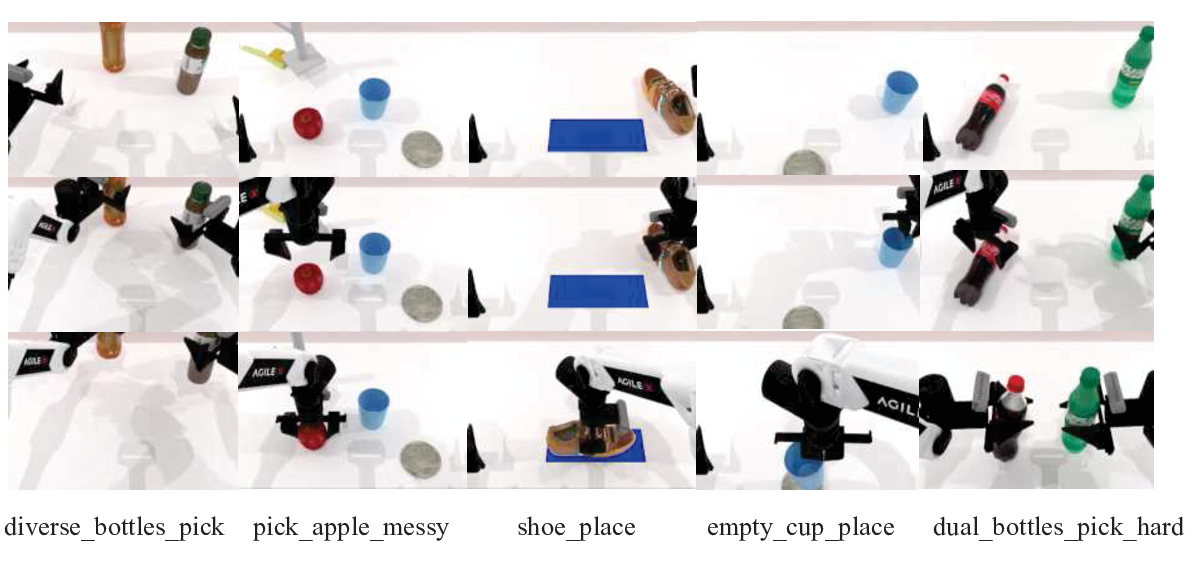
Five dexterous manipulation tasks from RoboTwin 1.0 [ 20 ] are selected to evaluate the manipulation capabilities of the proposed adapter. For 2D image observations, comparisons are conducted against ManiFlow, Diffusion Policy, and Flow Matching Policy, all built upon a shared ResNet-18 encoder to ensure a fair comparison.
For 3D point cloud observations, the proposed method is further compared with ManiFlow, 3D Diffusion Policy, and 3D Flow Matching.
Limitation
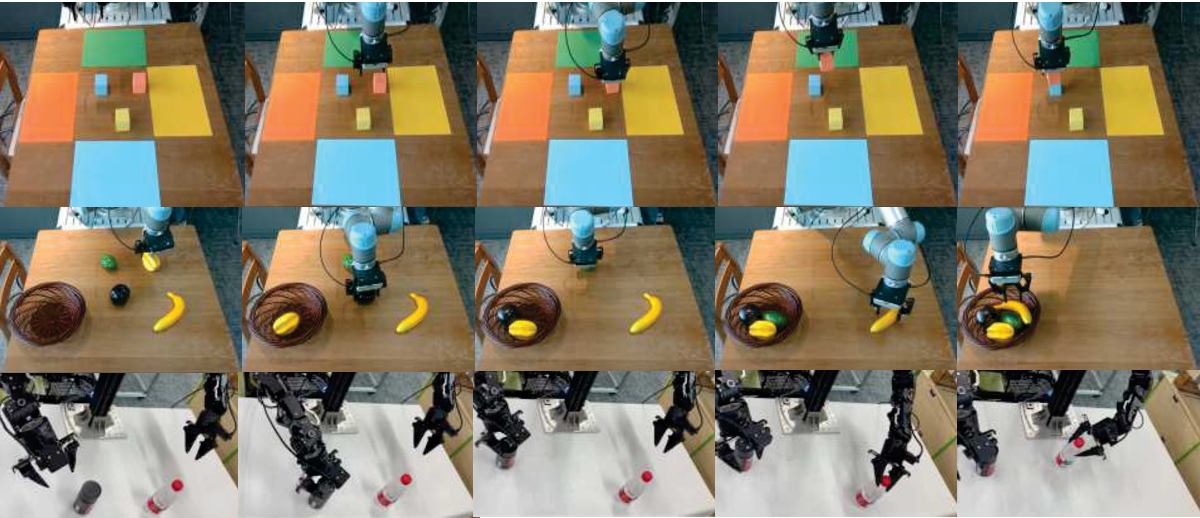
While the invertible neural network adapter improves performance across both simulated and real-world manipulation tasks, several limitations remain. First, the method assumes that the action distribution can be mapped to a well-structured latent space via an invertible transformation.
Although this holds for the manipulation tasks studied here, its validity for highly multimodal or discontinuous action distributions remains an open question.
Sources and Demonstrations
Figures are reproduced from Zhang et al. See the full paper for experimental details and the project page, when the paper links one, for demonstrations and videos.
Related Papers
Co-VLA: Coordination-Aware Structured Action Modeling for Dual-Arm Vision-Language-Action Systems
Yandong Wang, Jiaqian Yu, Xiongfeng Peng et al.
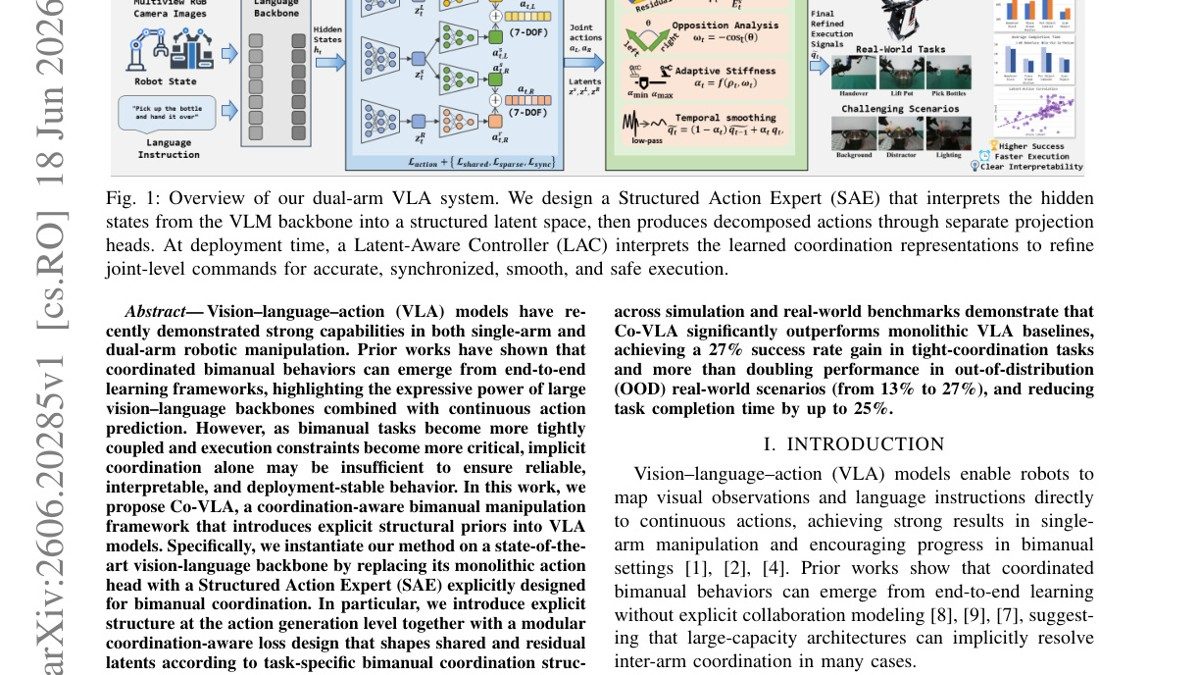
Vision-language-action (VLA) models show strong capabilities in single and dual-arm robotic manipulation. Prior works show coordinated bimanual behaviors can emerge from end-to-end learning, leveraging large vision-language backbones with continuous action prediction.
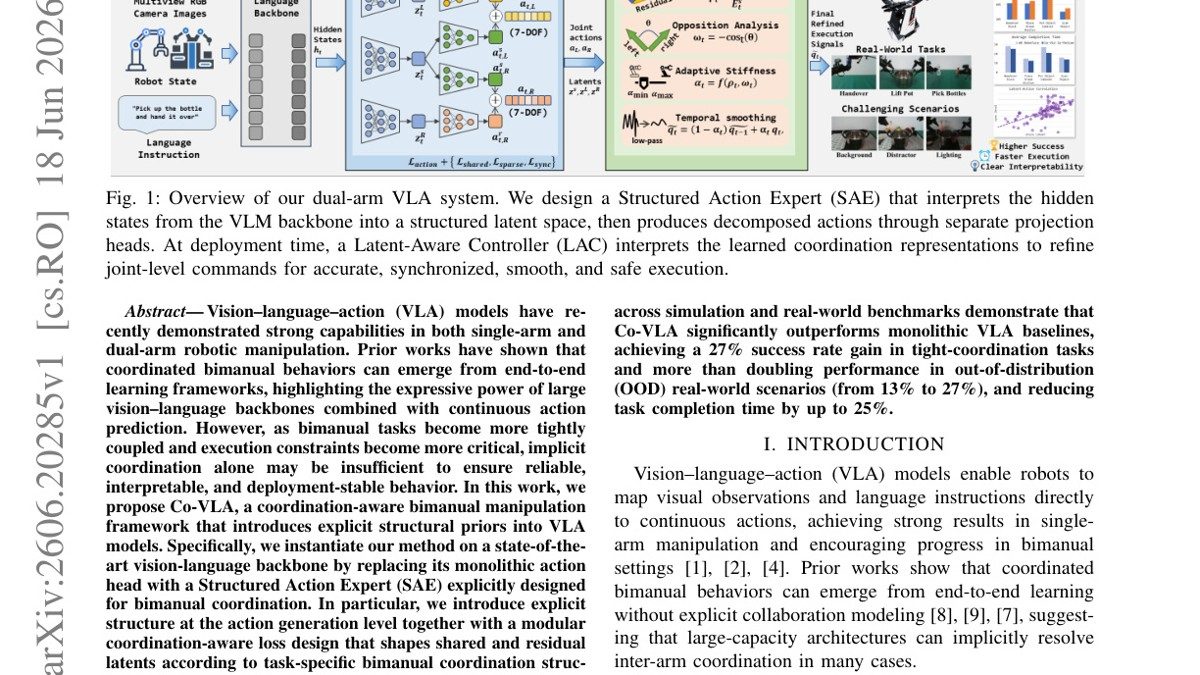
Co-VLA: Coordination-Aware Structured Action Modeling for Dual-Arm Vision-Language-Action Systems
Yandong Wang, Jiaqian Yu, Xiongfeng Peng et al.
Vision-language-action (VLA) models show strong capabilities in single and dual-arm robotic manipulation. Prior works show coordinated bimanual behaviors can emerge from end-to-end learning, leveraging large vision-language backbones with continuous action prediction.
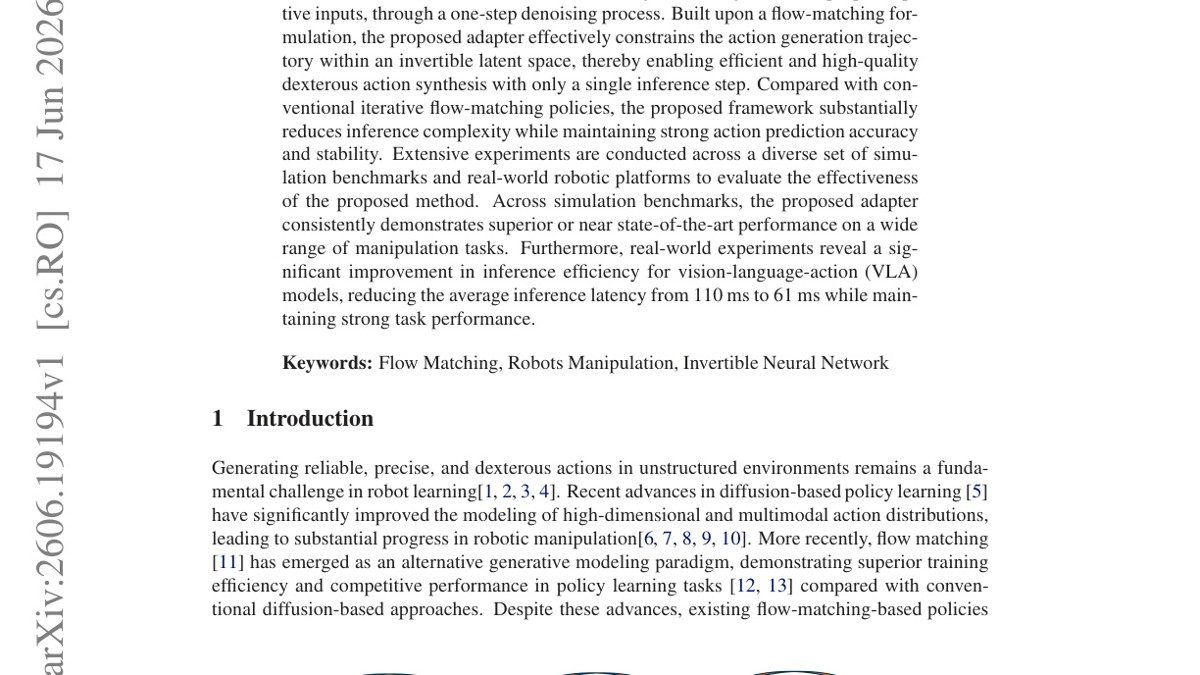
Invertible Neural Network Adapter for One-Step Flow Matching in Robot Manipulation
Yu Zhang, Kangyi Ji, Yongxiang Zou et al.
This paper presents an invertible neural network adapter for general robotic manipulation, designed to generate precise high-dimensional actions conditioned on multimodal observations, including visual, linguistic, and proprioceptive inputs, through a one-step denoising process.
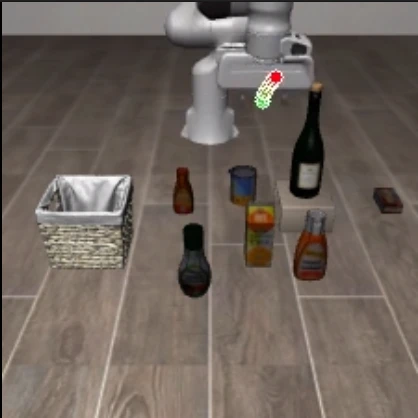
Neuro-Symbolic Safety Guidance for Vision-Language-Action Models via Constrained Flow Matching
William English, Hao Zheng, Rickard Ewetz
This method checks a predicted action sequence for future collisions while the VLA is still generating it, rather than correcting only the next action.